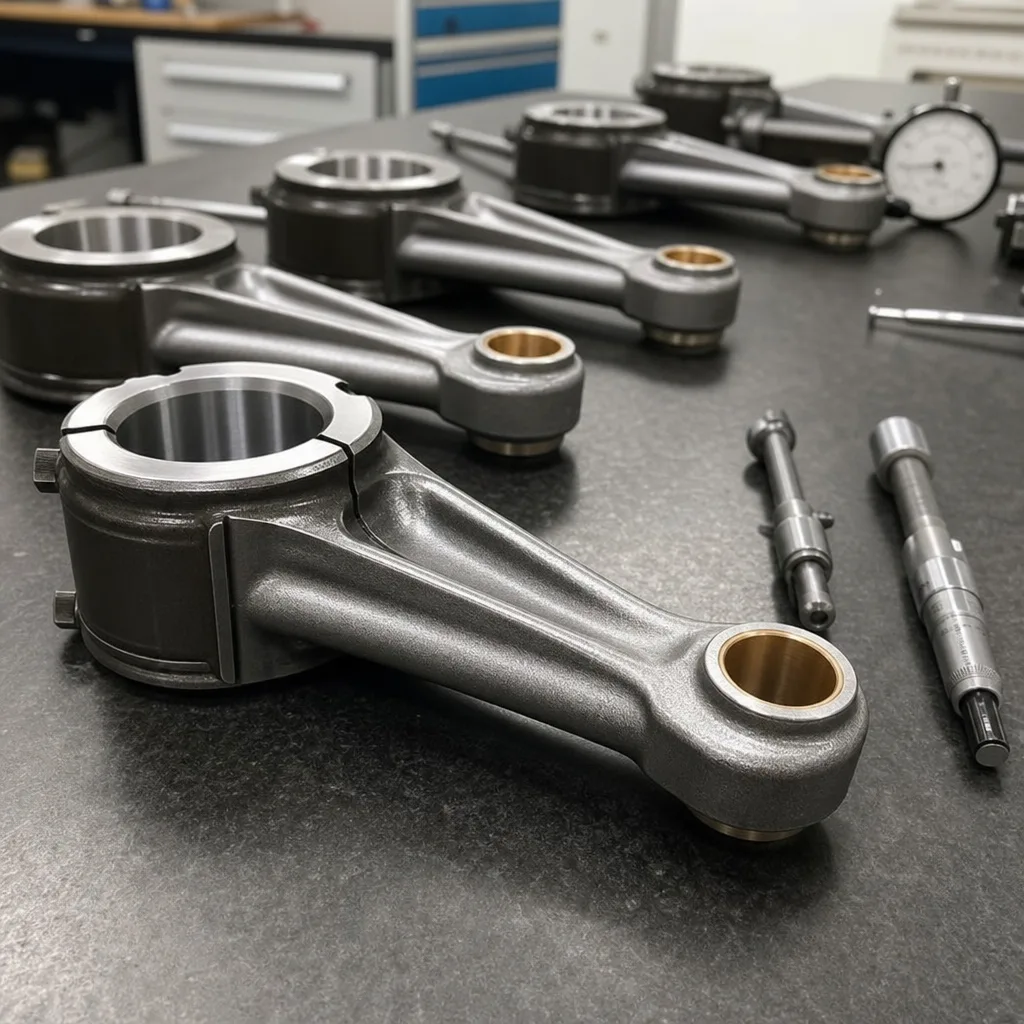
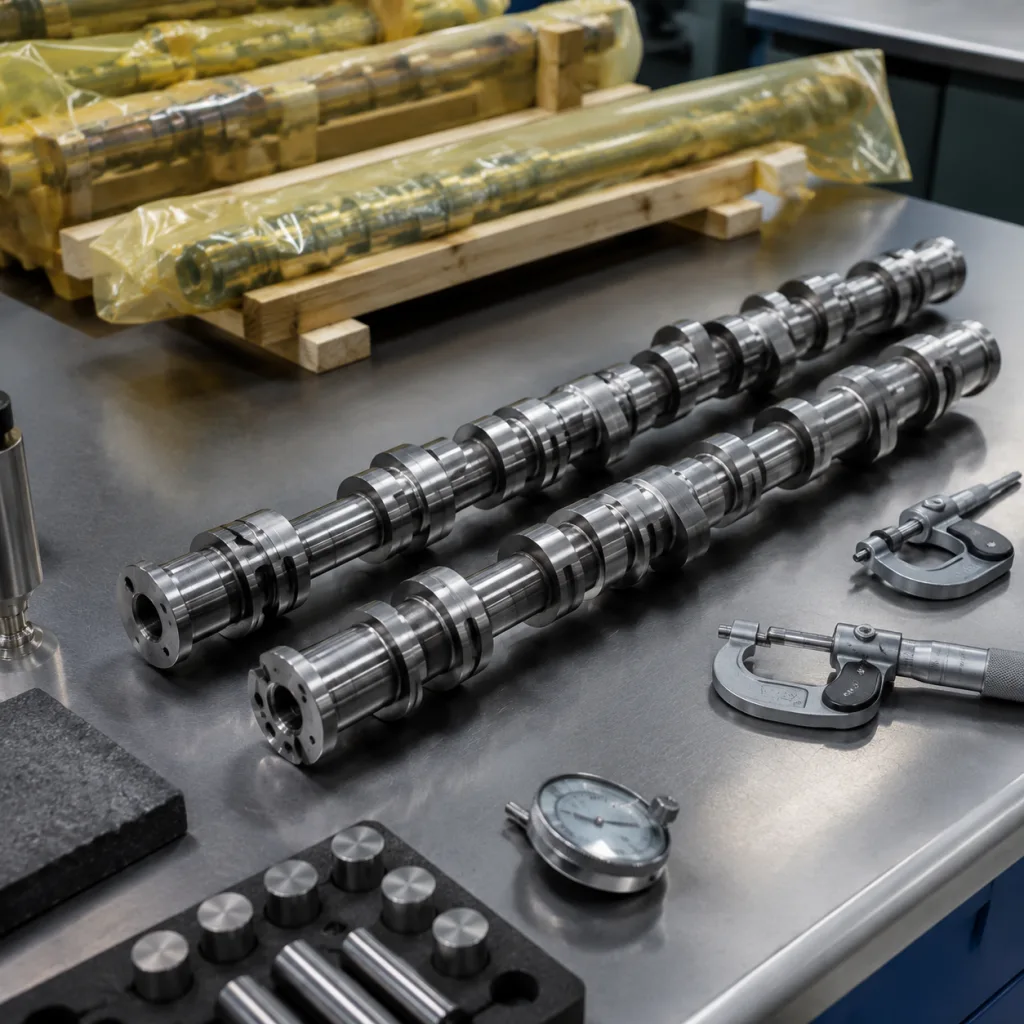
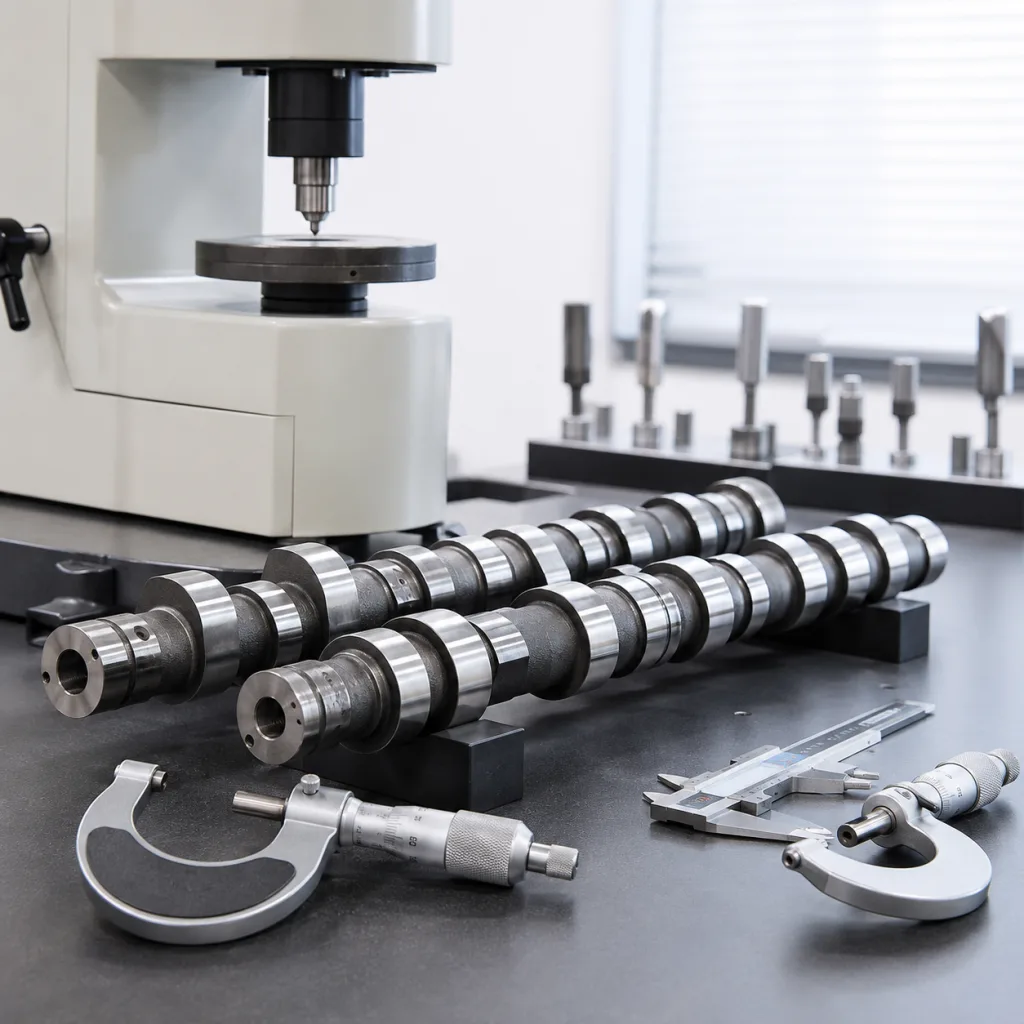
A camshaft aftermarket replacement programme is more than a catalogue-matching exercise. For distributors, repair-chain buyers and sourcing engineers, approval depends on whether the part reproduces OE-equivalent geometry, withstands follower contact stress and remains traceable across repeat orders. Camshafts control valve timing, lift and duration; small deviations in lobe profile, journal diameter, surface finish or phase position can affect emissions, drivability, lubrication demand and warranty exposure. This checklist explains how B2B buyers can assess replacement camshafts through dimensional equivalence, metallurgy, validation testing, documentation and supplier qualification. It focuses on passenger car and light commercial engine applications in the independent aftermarket. Driventus is an independent aftermarket manufacturer; brand names are referenced for fitment only.
What OE-equivalence means for replacement camshafts
For a replacement camshaft, OE-equivalence starts with function rather than appearance. The part must reproduce the required valve-event timing, lift curve, journal fit and drive-interface geometry for the target engine family. Buyers should request measurement evidence against a controlled drawing or qualified master sample, especially when several applications are being consolidated under one stocking reference.
Key characteristics normally reviewed during sourcing include:
Overall length and journal layout: measured against bearing positions, thrust-control features and installation constraints.
Journal diameter and roundness: controlled tightly enough to maintain bearing clearance and stable oil-film formation.
Lobe lift and base-circle diameter: verified by profile measurement, not by simple caliper checks alone.
Lobe angular position: checked relative to the drive datum, keyway, slot or timing feature.
Surface hardness and case depth: matched to the follower design, whether flat tappet, roller follower or finger follower.
Oil-feed holes and grooves: confirmed for position, burr condition and cleanliness.
OE part-number cross-references can support application mapping, but they should remain fitment references rather than claims of vehicle manufacturer approval. Buyers comparing coverage can review engine-component references in our catalog and the engine range at /products/engine-components.html.
Dimensional and material checks before approval
Camshaft failure can begin with a part that looks correct but has the wrong lobe taper, surface finish, runout or heat-treatment result. Procurement teams should therefore separate visual inspection from engineering release. A first-article inspection report is useful only when it covers the dimensions that influence valve timing, lubrication and contact loading.
Checkpoint
Typical buyer requirement
Why it matters
Lobe lift variation
Confirmed by cam profile or height measurement
Controls valve opening and engine breathing
Journal diameter
Drawing-specific tolerance, often within micrometre range
Maintains bearing clearance and oil pressure
Lobe phase angle
Measured from a defined datum
Prevents timing shift and emissions risk
Surface roughness
Controlled on journals, lobes and thrust faces
Reduces scuffing during break-in
Hardness profile
Verified at defined lobe and journal locations
Supports wear resistance under follower contact
Runout
Checked over bearing journals
Limits vibration, noise and uneven loading
Oil-hole condition
Deburred, cleaned and position-checked
Prevents bearing and follower oil starvation
</tr></thead><tbody> </tbody></table>Material route depends on the camshaft design. Common production methods include chilled cast iron, ductile iron, forged steel and assembled tube-and-lobe construction. Each route has different cost, weight, machinability and wear characteristics. Buyers should request material grade confirmation, heat-treatment records and hardness test locations rather than relying on a certificate of conformity alone.
For regulated markets, material declarations may also be needed for REACH (EC) No 1907/2006 and customer restricted-substance lists. These documents support compliance screening, but they do not replace mechanical validation.
Validation testing that reduces warranty risk
A camshaft aftermarket replacement supplier should be able to show how it validates wear resistance, geometry retention and batch consistency. The exact test plan depends on engine type, follower system, sales volume and customer warranty exposure, but several controls are common in serious aftermarket programmes.
A practical validation package can include:
3D or cam-profile measurement against master geometry.
Metallographic inspection for chilled layer, case depth or microstructure.
Rockwell or Vickers hardness checks at defined lobe and journal zones.
Magnetic particle inspection or another crack-detection method where applicable.
Dynamic runout and straightness inspection after heat treatment and machining.
Surface roughness measurement on journals, lobes and thrust faces.
Bench rotation or engine-dyno durability testing for selected high-volume applications.
Packaging drop, humidity or corrosion checks for export supply chains.
For emissions-related engine components, buyers should not assume that a replacement profile is acceptable without application validation. Engine calibration, valve overlap and cam timing can affect compliance outcomes under regulations such as ECE R-83 for emissions type approval. Aftermarket parts do not normally carry vehicle approval by themselves, so procurement teams should focus on dimensional match, test evidence and application control.
Driventus operates under IATF 16949:2016 and ISO 9001:2015. Buyers can review the structure of our quality system, including process control, incoming inspection, traceability and corrective-action handling.
Supplier documentation for importers and distributors
Importers need repeatable documentation because camshaft disputes often appear months after sale, after the part has been installed, lubricated and exposed to operating conditions outside the supplier’s direct control. Clear records help separate manufacturing issues from installation errors, lubrication problems, worn companion parts or incorrect application selection.
A procurement file for replacement camshafts should normally include:
Approved drawing or controlled inspection specification.
Part-number cross-reference list for fitment only.
First-article inspection report with critical dimensions.
Material certificate or material declaration.
Heat-treatment and hardness results by batch.
Surface roughness and profile measurement results for sampled parts.
Batch number, production date and inspection status.
Packaging specification, carton quantity and anti-corrosion method.
Non-conformance and 8D corrective-action procedure.
Buyers should also define the evidence required for a warranty claim before orders begin. Useful records include engine code, mileage, oil type, follower condition, photos of lobe wear, installation date and confirmation of whether related parts were replaced. A camshaft installed with worn followers, blocked oil galleries, contaminated oil or incorrect break-in lubrication may fail even when the new component was within specification.
For private-label projects or application consolidation, custom manufacturing may be appropriate when buyers need a controlled drawing, dedicated inspection plan or application-specific packaging.
Replacement sourcing: cost, coverage and risk trade-offs
A low unit price is not always the lowest landed cost. Camshafts are heavy enough to influence freight economics and precise enough to create warranty exposure if measurement control is weak. Buyers comparing suppliers should evaluate total cost through fill rate, packaging performance, claim handling and documentation quality.
Sourcing factor
Low-control supply risk
Preferred procurement control
Application mapping
Incorrect engine fitment
Verified cross-reference and sample trial
Heat treatment
Premature lobe wear
Batch hardness and microstructure records
Machining control
Noise, oil-pressure loss or seizure
Journal, runout and profile inspection
Packaging
Rust or impact damage in transit
VCI protection, separators and export cartons
Traceability
Slow claim resolution
Batch code linked to inspection records
Order planning
Stock-outs on slow-moving references
MOQ and forecast agreement by SKU group
</tr></thead><tbody> </tbody></table>For aftermarket distributors, a balanced camshaft range usually combines high-turnover references, selected timing-chain or valve-train companion parts, and slow-moving SKUs handled through scheduled production. For multi-location repair chains, consistency, fitment accuracy and claim response may matter more than maximum catalogue breadth.
Driventus manufactures engine and powertrain components in Taizhou, Zhejiang, and exports to more than 60 countries. For camshaft programmes, buyers can discuss MOQ, lead time, documentation level, packaging format and sample inspection before release.
Procurement checklist before placing an order
Before approving a camshaft aftermarket replacement source, use a checklist that links engineering requirements to commercial terms. This reduces ambiguity between sourcing, quality and aftersales teams and makes supplier comparison more consistent.
Buyer release checklist
Confirm engine application, production years and fitment notes.
Verify drawing, master sample or OE-equivalent geometry basis.
Agree material, heat treatment, hardness range and inspection frequency.
Review IATF 16949:2016 and ISO 9001:2015 certification scope where relevant.
Confirm restricted-substance documentation for REACH (EC) No 1907/2006 when importing into the EU.
Approve anti-corrosion packaging and carton strength for sea or air freight.
Define warranty evidence requirements and claim-response timing.
Record whether the part is for open aftermarket distribution, private label or repair-chain supply.
A disciplined release process is especially important when replacing legacy references or switching suppliers. Direct price comparison should come after dimensional evidence, validation records and packaging review. Buyers who need application coverage or a controlled replacement programme can request a quote with target SKUs, forecast volume and documentation requirements.
Driventus is an independent aftermarket manufacturer; brand names are referenced for fitment only.
Frequently asked questions
Verify lobe profile, phase angle, journal diameter, runout, surface finish, oil-hole position, material and heat-treatment results. Also confirm application mapping, packaging and batch traceability. Visual matching is not sufficient for camshaft approval.
Yes. Driventus can discuss private-label packaging, SKU consolidation, inspection reporting and drawing-based production where the commercial volume and technical data support the project. Requirements should be confirmed before sample release.
No approval should be assumed unless formally documented by the vehicle manufacturer. Driventus supplies independent aftermarket parts for fitment replacement, with brand names referenced only to identify application compatibility.
For camshaft sourcing, sample review or documentation requirements, share your target applications, forecast volumes and market requirements with Driventus at /contact.html