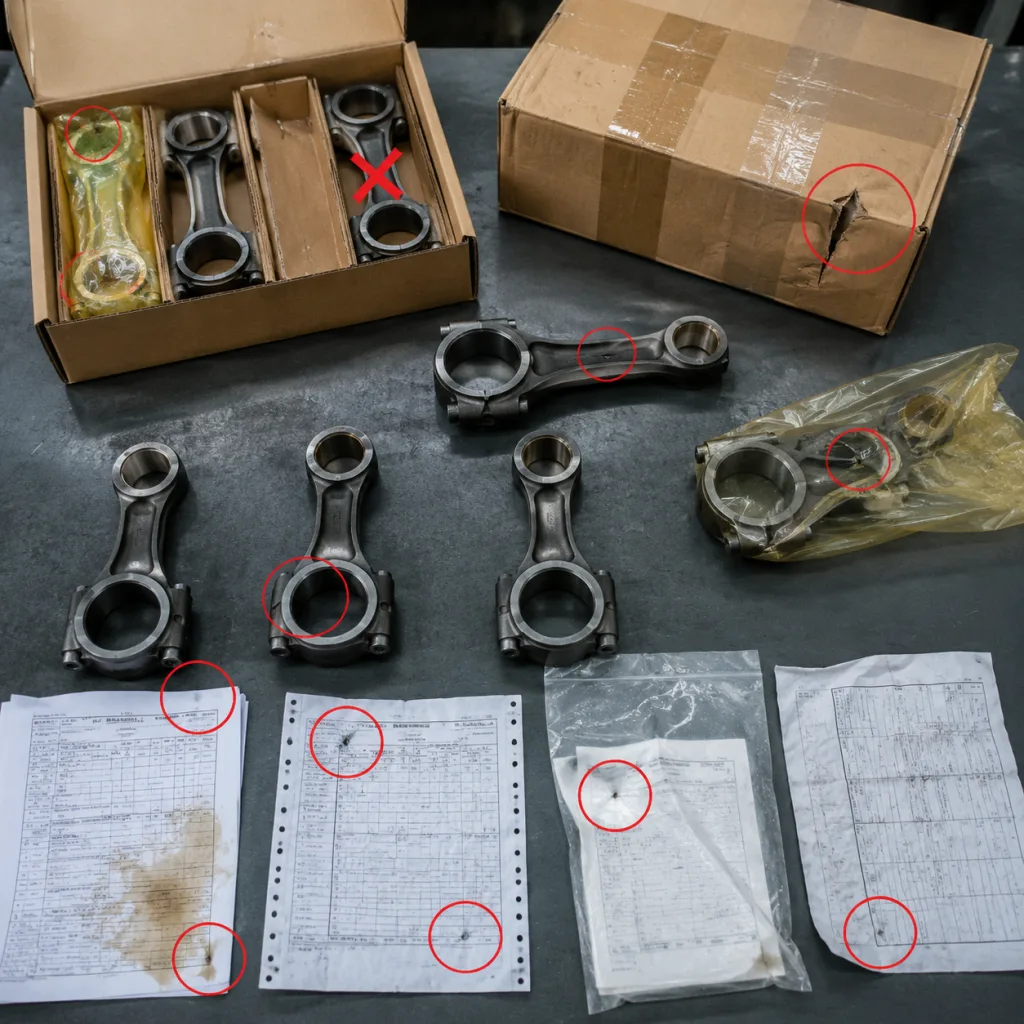
Export packaging for connecting rods has one job: keep the parts clean, dry, traceable, and dimensionally stable until they reach receiving inspection. For procurement teams, the packaging spec is not separate from the part spec. It affects corrosion risk, mixed-lot control, customs handling, and how quickly the warehouse can book goods in. This matters for aftermarket distributors, OEM suppliers, and repair-chain networks that need predictable inbound quality across sea, air, and road freight.
For connecting rod packaging requirements export programmes, the buyer should define rust prevention, cavity separation, carton strength, pallet configuration, label content, and inspection records before production starts. Driventus is an independent aftermarket manufacturer; brand names are referenced for fitment only. We manufacture in Taizhou, Zhejiang, and operate under IATF 16949:2016 and ISO 9001:2015 controls. If the programme includes OE cross-reference or private-label supply, packaging should be written into the purchase order and approved sample set so that every carton arriving at destination matches the agreed format.
How to decide the right export pack
The first decision is not carton size. It is failure tolerance. Ask what would break the shipment: rust, impact, mix-ups, or a receiving delay.
A connecting rod is a machined steel part with critical bores, parting faces, and identification marks. Export packaging has to protect four things at once:
Surface protection: stop metal-to-metal contact during vibration and stacking.
Lot control: keep each part number, size grade, engine application, and batch separate.
Traceability: preserve carton-level and pallet-level identity through transit and receiving.
For connecting rod packaging requirements export specs, the best starting point is a simple rule: one failure mode, one control. If the route is humid, spend on moisture barrier and desiccant. If the route is rough, spend on cavity separation and carton strength. If the buyer handles many SKUs, spend on labeling discipline and fixed pack counts. That is more useful than a generic “export grade” label.
Set numeric limits before the first shipment. Common controls include zero metal-to-metal contact, no carton collapse under normal hand stacking, and no visible rust on protected machined areas at receipt. If the rods are coated with preservative oil, define the film weight target and whether the coating must remain non-drip after 24 hours at ambient conditions. Where mixed references are involved, one part number per inner pack is the safest default unless a carton map is approved in writing.
Packaging specification that actually works
A workable export spec reads like a controlled packing instruction, not a marketing promise. Keep it short, measurable, and repeatable.
Item
Recommended requirement
Primary protection
Individual VCI bag or oiled paper wrap for each rod
Contact separation
Formed pulp, tray insert, or cavity divider
Inner carton
Double-wall carton for sea freight, where needed
Outer carton
Strong corrugated case with lot label on two sides
Pallet
Heat-treated wooden pallet or export-grade equivalent
Moisture control
Desiccant pack and sealed carton closure for long transit
Traceability
Part number, quantity, lot, date code, and carton serial
Stack security
Corner boards, stretch wrap, and strap bands
</tr></thead><tbody> </tbody></table>Treat carton fit as a control point. Leave enough clearance for inserts, but not so much that rods shift inside the pack. A practical target is 2 to 4 mm lateral movement per rod at most. For the outer case, keep at least 10 mm clearance around inserts to reduce corner crush during vibration and handling.
If the buyer wants branded packs, kit packing, or private-label cartons, align the design before first production and lock it to the purchase order. That avoids last-minute changes that create mix-ups at the warehouse. For palletised shipments, standardise the footprint at 1200 x 1000 mm or 1200 x 800 mm only if the destination site accepts it. A gross carton weight of 12 to 18 kg usually keeps manual handling practical, while a pallet height of 1.2 to 1.6 m helps stability in export lanes.
Label and paperwork failure points
Labels fail in export when they are readable in the factory but not at destination. Heat, abrasion, humidity, and repeated handoffs expose weak print and loose application.
Minimum carton data should include part description, quantity, gross and net weight, origin, lot number, carton number, and customer reference. Add HS code, purchase order number, and handling marks only when they help operations. Do not add warnings that do not change how the freight is handled.
Typical document set
Commercial invoice
Packing list by carton and pallet
Certificate of origin, if required by destination market
Material certificate or inspection record when agreed in the contract
Photo record of packed cartons and pallet layout
Label format matters as much as label content. A common, reliable choice is 80 x 50 mm or 100 x 70 mm carton labels with Code 128 or QR content for carton ID, plus a pallet label on two adjacent sides. If barcodes are used, set a minimum scan grade of C or better at 1 m distance under warehouse lighting.
The packing list must reconcile to the physical count before shipment release. If the document set says 480 pieces and the cartons contain 482, do not ship and sort it out later. That is how small admin mistakes become receiving delays. The packaging file should also match the part files shown in our catalog and the relevant product family page such as engine components. If the supplier provides a quality manual, confirm that incoming inspection aligns with our quality system.
What changes by shipping mode
The same part needs a different pack strategy depending on how it moves. Sea, air, and road each create different packaging failures.
Sea freight: higher humidity, longer dwell time, and more handoffs. Use a stronger carton, better moisture barrier, and more robust pallet wrap.
Air freight: shorter transit time, but more compression changes and handling. Focus on impact protection, carton rigidity, and label durability.
Road freight: vibration, braking, and load shift are the main risks. Use tighter carton fit, anti-slip pallet layers, and stable stacking height.
For long-haul export, ask for a packing sample or photo approval before mass shipment. That matters more when the destination warehouse uses automated receiving, because carton size consistency affects scan speed and pallet stability. If the shipment includes multiple lots, the pallet map should show the carton sequence so mixed inventory is not created at arrival.
A route-based protection matrix is more useful than a generic packing note. For ocean freight over 21 days, specify desiccant at roughly 50 to 100 g per cubic metre of enclosed pack volume and require a moisture indicator card inside the master case. For air freight, prioritize carton edge crush resistance and tighter internal dunnage because the risk is drop damage rather than condensation. For hot-climate road freight, require pallet wrap tension that keeps the load from shifting during 0.5 g braking events and cap pallet overhang at 0 mm. If transshipment is involved, add a seal number record for each pallet so the buyer can confirm the load was not opened in transit.
Step-by-step buyer checklist
Use the same sequence every time. That is how procurement stops packaging from becoming an afterthought.
1. Define the failure mode: rust, mix-up, impact, or handling delay. 2. Set the pack unit: individual bag, cavity pack, inner carton, or mixed case. 3. Choose the moisture control method: VCI, oil, desiccant, or a combination. 4. Fix carton and pallet dimensions before production. 5. Approve label content, barcode format, and document set. 6. Ask for a pre-shipment photo set or sample pack. 7. Check the physical count against the packing list. 8. Record carton numbers and pallet seal numbers for traceability.
This checklist is simple on purpose. It keeps the discussion on controls instead of vague quality language. If your programme needs special dimensions, a different grease specification, or branded carton artwork, approve it before tool release or first order. Driventus supports custom manufacturing for controlled pack formats, but the buyer should still lock the packaging standard into the PO so the factory and freight forwarder work from the same instruction set.
Add measurable acceptance criteria. Useful examples include carton compression set below 5 mm after 24 hours of stack storage, no punctures larger than 3 mm in outer cases, and pallet lean under 2 degrees when fully wrapped. For first-article approval, request three production cartons, one pallet photo set, and a sealed retention sample from the top, middle, and bottom of the load.
Acceptance rules for procurement teams
A good acceptance rule is short enough to use at receiving and strict enough to prevent arguments later.
Cartons are sealed, dry, and free of compression damage
Rods are separated so no metal contact occurs in transit
Labels are legible and match the packing list
Quantity per carton and pallet matches the order
Lot traceability is visible on the outer pack and shipping documents
No loose fasteners, oil contamination, or rust staining
Pallet stack is stable, strapped, and wrapped
If you need special dimensions, a different preservative, or branded carton artwork, approve it before first shipment. A controlled pack spec only works if it is frozen early and attached to the PO. For enquiries or sample approval, request a quote. If the same supplier ships to multiple distributors, this is where a written acceptance rule matters most: it prevents each destination from inventing its own standard after the goods leave the factory.
For tighter control, tie packaging nonconformance to a remedy. Use repack at supplier cost, replacement within the original lead time, or credit note if the issue is found after departure. That gives procurement a real control point instead of a vague complaint path. If you need a single sentence to guide internal review, use this: the pack is acceptable only when it preserves part identity, prevents damage, and arrives ready for receiving inspection.
Frequently asked questions
Yes, when corrosion control or mix prevention matters. Individual VCI bags or wrapped cavities reduce metal contact and keep each part number separate during transit and warehouse handling.
Part number, quantity, lot number, carton number, and customer reference are the minimum. Add gross weight, net weight, and handling marks only when they help receiving or transport control.
Yes. Sea, air, and road freight create different risks, so carton strength, moisture control, pallet height, and wrap specification should be adjusted to the route and warehouse method.
If you need a controlled pack spec for export programmes, review the options with our team and send your drawing, target market, and carton preference here: /contact.html