Choosing a timing belt supplier is a risk decision disguised as a purchasing task. A belt may pass a quick visual check and still fail early because the compound ages badly, the tensile cord stretches, the tooth fabric wears through, the pitch is unstable, or the curing process varies from batch to batch. For distributors, repair chains and timing kit assemblers, that means warranty disputes, immobilised vehicles, installer complaints and catalogue damage.
The right question is not simply “Who can quote this reference?” It is: can this supplier hold the specification, prove the batch, ship the right kit contents, and respond when a field issue appears six months later?
This article explains how to choose a timing belt supplier using a procurement framework built for aftermarket and OEM-adjacent programmes. It covers range data, belt construction, dimensional control, validation, traceability, factory audit points, commercial terms and launch checks. It is written for category managers, sourcing engineers and import teams evaluating Chinese manufacturing partners for timing belts, kits and related powertrain components. Driventus is an independent aftermarket manufacturer; any brand or OE-style references are used for fitment identification only.
Decision gate 1: prove the supplier understands the application, not just the part number
Start with the range file. If the supplier treats timing belts as interchangeable by length or tooth count alone, stop the discussion. A timing belt must match the engine family, pulley system and tensioning layout. Tooth pitch, tooth form, belt width, tensile cord, jacket fabric, back thickness and installation load all matter.
Typical automotive timing belts may use pitch families such as 8 mm or 9.525 mm, widths from about 17 mm to 32 mm, and tooth counts from fewer than 90 to more than 250 teeth. Those figures are not enough to approve a belt. They must be verified SKU by SKU against the application.
For aftermarket programmes, ask the supplier to map every SKU to vehicle application, engine code and OE-style reference where applicable, such as OE 06A… or OE 11251… when those references already exist in your data. The file should also show whether the item is sold as a belt only, a basic tensioner kit, a full kit with idlers, or a water-pump kit. If one engine family uses both manual and automatic tensioner variants, the split must be visible.
Request a range file that includes:
Application list by market: EU, UK, US, Canada, Australia or Brazil.
Engine code, displacement, fuel type and production-year coverage.
Belt dimensions: tooth count, pitch, nominal width, tooth profile and controlled back thickness.
Tooth form reference or drawing, including the profile-gauge method.
Kit bill of materials: tensioner, idler, water pump, gasket, seals or bolts where supplied.
Cross-reference table separating OE-style references from aftermarket references.
Supersession notes where a reference has been replaced or revised.
Packaging options for distributor brand, neutral brand or private label, including barcode format.
Annual forecast split by A/B/C movers so MOQ and stock policy can be calculated realistically.
A strong supplier will also tell you what does not fit. This is important. Two belts may share a similar tooth count but differ in tooth geometry, pulley engagement, belt width or tensioner design. A 1–2 mm width difference can cause tracking issues on narrow pulleys. The wrong tooth profile can create noise, fabric wear or jump risk even when the belt installs without resistance.
If these differences are missing from the cross-reference file, the risk moves to your catalogue team, warehouse and installer network. Good application data narrows the fitment decision before samples are even produced.
Spec deep-dive: what is inside the belt and how tightly is it controlled?
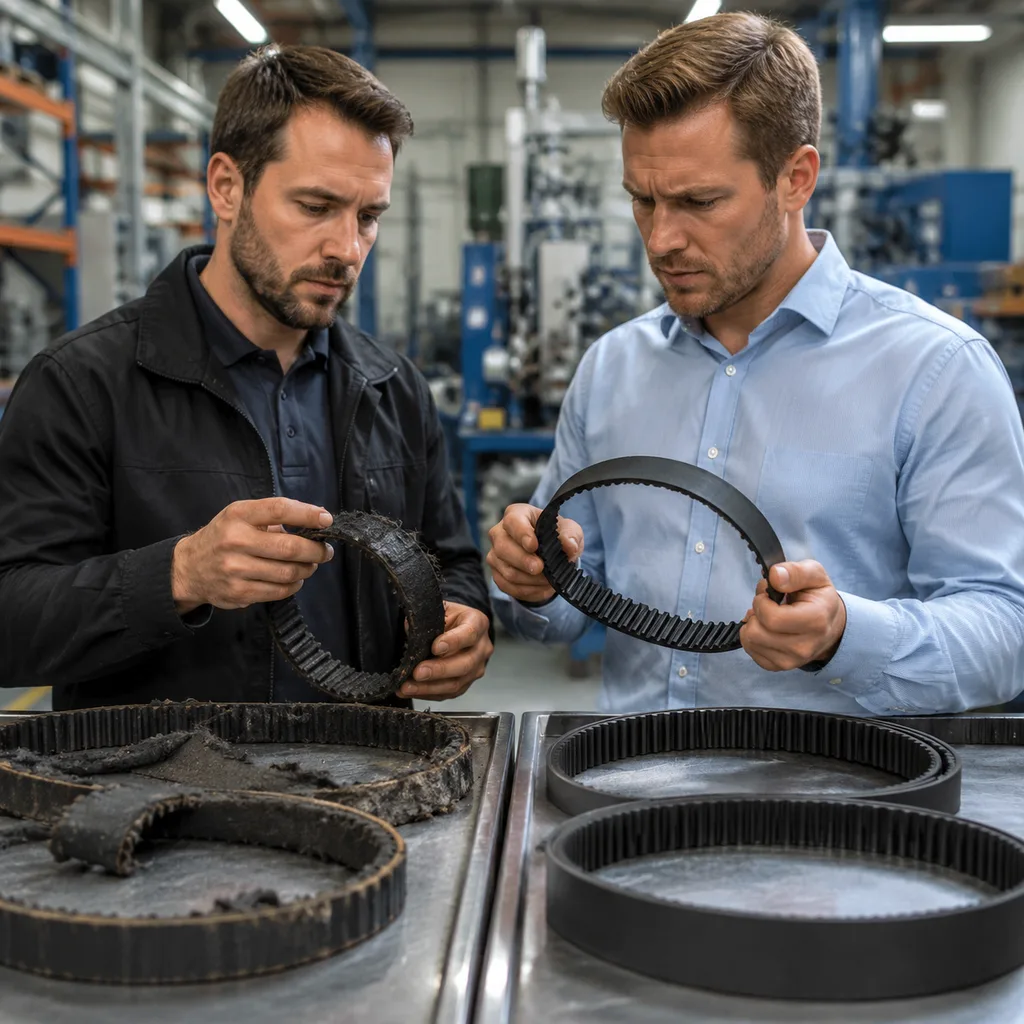
Do not accept “high-quality rubber” as a specification. It is a sales phrase, not an engineering control. Timing belt durability comes from the interaction between elastomer, tensile cord and tooth fabric, then from the factory’s ability to hold dimensions after building, curing, cutting and marking.
Common constructions use HNBR or CR compounds, glass fibre or aramid tensile cords, and nylon tooth fabric. The right combination depends on engine temperature, load, oil mist exposure, pulley design and service interval. For many modern high-temperature engine bays, HNBR is preferred because it normally gives better heat and ozone resistance than standard CR. For older, lower-temperature applications, CR may still be acceptable if validation supports the duty cycle.
Use the specification review to force precision:
Item to verify
What to ask for
Practical acceptance logic
Elastomer
HNBR, CR or other stated compound, with compound code
Link the compound to heat ageing, ozone and oil-resistance results
Tensile cord
Glass fibre or aramid construction, twist direction and cord count
Confirm length stability and load transmission under tension
Tooth fabric
Nylon facing type, coating and adhesion method
Control pulley-contact wear and reduce noise
Tooth profile
Profile drawing, gauge report and tolerance
Verify engagement accuracy and prevent pitch mismatch
Belt width
Nominal width and production tolerance
Common buyer target: nominal width within about ±0.3 mm unless the drawing states otherwise
Pitch length
Effective length or tooth count and pitch
Prevent cumulative pitch error and timing deviation
Back thickness
Nominal thickness and tolerance where specified
Affects tensioner contact, bending fatigue and cover clearance
Marking
Batch code, part number, direction arrows and timing marks
Supports traceability and installation support
</tr></thead><tbody> </tbody></table>Dimensional checks should apply to production batches, not just first articles. Ask for inspection records covering width, tooth pitch, pitch length, total length, visual defects, cord exposure, tooth surface condition, back cracks, edge fray and marking accuracy.
For first shipments or new tooling, tighten the inspection plan. A practical approach is full dimensional checks on at least 5–10 belts per SKU, plus visual inspection to an agreed AQL level. After capability is proven, batch sampling can be reduced, but the supplier should still keep measurement history by lot.
Also ask how gauges are calibrated and how rejected belts are segregated. Calipers alone are not sufficient for tooth geometry. A serious supplier should use profile gauges, pitch-length fixtures, width gauges, tensile or adhesion test equipment and calibrated reference samples. Calibration intervals are usually defined at 6 or 12 months depending on the tool and factory procedure.
Nonconforming belts should be physically separated, labelled and recorded. They should not be reworked into mixed stock. Where a supplier also manufactures or integrates related engine components, catalogue alignment becomes easier because the belt, tensioner, idler and water pump can be reviewed as a system. See our catalog for the broader Driventus powertrain range.
Failure-mode review: ask for evidence that explains what can go wrong
There is no single public standard that fully defines every aftermarket timing belt for every engine. That makes the supplier’s validation plan critical. Certification helps, but it does not replace product testing. You need evidence that the belt survives heat, flexing, load, tooth engagement and contamination risks expected in the target application.
Driventus operates under IATF 16949:2016 and ISO 9001:2015 requirements. These standards are relevant because timing belt supply depends on stable process control, supplier management, controlled inspection and disciplined nonconformity handling. For regulated markets, buyers may also need substance compliance declarations under REACH (EC) No 1907/2006, plus material safety, heavy-metal or packaging documentation where applicable.
Ask the supplier to show test and traceability evidence for the main failure modes:
Heat ageing: defined temperature and duration, such as 120–150°C exposure for a stated number of hours, followed by tensile, hardness or crack evaluation.
Flex fatigue: endurance testing under controlled load, speed, pulley diameter and ambient temperature.
Tooth loss or jump risk: tooth shear and tensile strength checks linked to the drawing or internal standard.
Delamination: adhesion checks between tooth fabric, rubber body and tensile cord.
Contamination sensitivity: oil, coolant or ozone exposure evaluation where relevant to the application.
Dimensional drift: batch reports with measured values, not only pass/fail stamps.
New-part launch risk: first article inspection report for new SKUs, new tooling, new material or a new production line.
Unknown batch origin: traceability from compound lot to cord lot, fabric lot and finished belt lot.
Delayed claims: retained sample procedure and retention period, commonly at least 12–24 months or aligned with warranty exposure.
Traceability must connect inspection records to shipment lots. A carton label alone is weak evidence. Lot number, production date, mould or line reference, curing batch, inspector ID, inspection status and retained sample practice should be documented within the quality system. This matters when an importer has to investigate a return months after sale.
Define the claim evidence package before launch. Useful information includes mileage, installation date, engine code, tensioner condition, pulley photos, water-pump condition, fracture surface, tooth-loss location, contamination signs and remaining kit components. Without those details, the discussion turns into blame: material failure, incorrect tension, seized bearing, oil contamination or installer error. A good supplier helps you separate those causes with data.
Factory audit scenario: follow one belt and one kit through the plant
A useful audit is not a document tour. Walk the process. Follow one belt from incoming material to final carton, then follow one kit through component picking and packing. This reveals whether the supplier can consistently build, inspect and package the range you intend to buy.
For timing belts, the audit should cover raw material storage, mixing or compound control, belt building, curing, cutting, marking, inspection and final packaging. If timing belt kits are supplied, include tensioners, idlers, bolts, gaskets, water pumps and outsourced components in the audit scope.
Factory audit points
Incoming material identification and shelf-life control for rubber compound, cords and fabric.
Storage temperature and humidity rules, especially for rubber and adhesive-coated fabrics.
Separation of approved, pending and rejected materials with clear status labels.
Process parameters for building, curing, cutting and marking, including who can change settings.
Curing record control: temperature, time, pressure and batch identification.
Cutting width control and edge-quality inspection after slitting.
Calibration status of measuring equipment, profile gauges and test machines.
Operator instructions at each production station, including visual defect examples.
In-process rejection criteria for tooth voids, fabric wrinkles, cord exposure, edge fray and marking errors.
Final inspection sampling plan, release authority and escalation rules for repeated defects.
Retained sample storage and claim review process.
Private-label packaging control, barcode verification and carton labelling.
Control of engineering changes, artwork revisions and reference updates.
For multi-part kits, clarify what the supplier makes and what it buys. Integration can work if sub-supplier control is documented and incoming inspection is real. It is a problem if the main supplier cannot identify bearing origin, grease specification, water pump seal material, impeller material, casting source, bolt grade or gasket material.
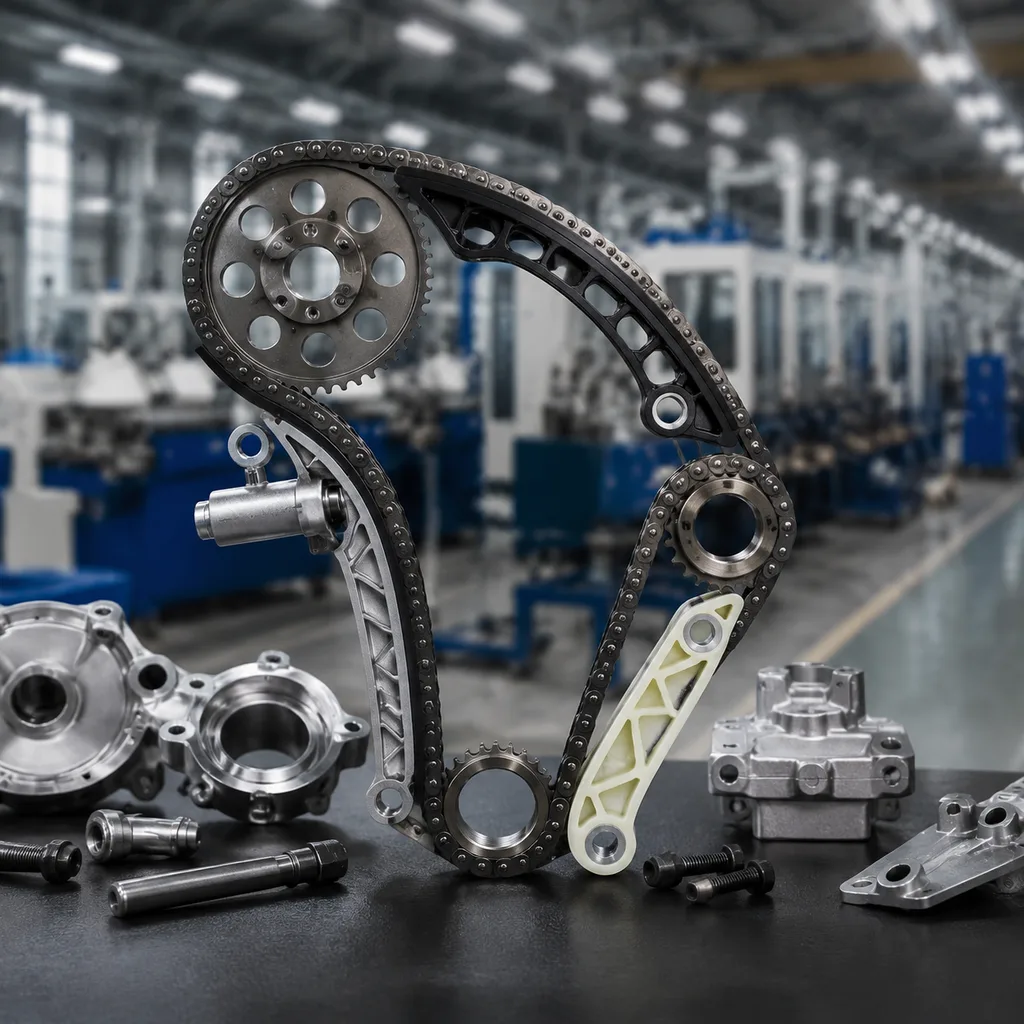
Kit assembly deserves separate control. A typical timing belt kit may include one belt, one automatic or manual tensioner, one or more idlers, bolts, a water pump, gasket and installation note. The packing line should use a controlled bill of materials, barcode scanning or checklist verification, and a final weight check where possible. A wrong idler or missing bolt can create the same customer dissatisfaction as a failed belt.
For buyers needing drawings, special packaging, kit consolidation or engineering changes, custom manufacturing can align belt, tensioner and water pump requirements under one programme. The objective is simple: avoid a kit that is commercially convenient but technically inconsistent.
Commercial comparison: identify the hidden cost behind a cheap quote
A low unit price is useful only if the supplier can hold the specification and deliver repeatably. Otherwise, the saving disappears into air freight, warranty credits, repacking labour, slow-moving stock and customer complaints.
Compare suppliers with a landed-cost and risk model. Include tooling, validation, packaging, inspection, freight, duties, buffer stock and defect administration. A belt that is 3–5% cheaper can be the more expensive choice if it creates stock-outs, claim disputes or mixed-quality batches.
Commercial factor
Procurement question
Buyer logic
MOQ
Is MOQ per SKU, per tooth profile, per kit or per shipment?
Typical factory MOQ may be 200–500 pcs per belt SKU; kit MOQ can be 100–300 sets depending on components and packaging
Lead time
What is production time after artwork approval and deposit?
Common planning range is 30–45 days for repeat orders and 45–75 days for new tooling or private-label launches
Tooling
Are new moulds, cutters, gauges or print plates needed?
Tooling cost should be quoted separately and amortised by forecast volume
Unit price
Is the quote based on annual volume, first order volume or spot production?
Ask for price breaks at 100, 300, 500, 1,000 and 3,000 pcs where relevant
Packaging
Who approves artwork, barcodes and carton drop-test requirements?
Mislabelled stock can create warehouse rework, customer claims and import delays
Warranty
What evidence is required for claims?
Define photo evidence, returned parts, analysis time and credit or replacement method
Incoterms
FOB, CIF, DAP or another term?
Compare suppliers on the same port, currency, palletisation and documentation basis
Safety stock
Can the supplier reserve stock for A-moving SKUs?
Agree reorder point or rolling forecast to reduce stock-outs during seasonal demand
Documentation
Are inspection reports and batch records shipped with each order?
Prevent delays in release, customer approval and claim investigation
</tr></thead><tbody> </tbody></table>For EU, UK, North American and Brazilian distributors, stable replenishment is often worth more than a small price reduction. Ask for a 12-month capacity view, not just the first-order quotation. Confirm whether the supplier can support mixed-SKU containers, phased call-offs and repeatable packaging.
A workable replenishment model is to place A-moving SKUs on forecasted monthly supply, B-moving SKUs on quarterly call-off and C-moving SKUs on consolidated production runs. That protects MOQ efficiency without starving the range.
Do not trade away technical controls during price negotiation. If the supplier reduces price by changing HNBR to CR, simplifying tooth fabric, lowering inspection frequency or using unverified tensioner bearings, the saving should be rejected unless the new specification is validated. For repair-chain programmes, agree service expectations before launch: emergency order rules, claim response time and replacement policy. A practical target is claim acknowledgement within 2 working days, containment plan within 5 working days and technical conclusion within 10–20 working days after evidence or returned parts are received.
Step-by-step buyer workflow for approving a timing belt supplier
Use a staged workflow so the decision is based on evidence, not confidence. The same process works for a new programme and for replacing an underperforming vendor.
1. Define the range. List SKUs, engine applications, target markets, OE-style cross-references, annual forecast and expected order frequency. 2. Set technical targets. Confirm tooth count, pitch, width tolerance, tooth profile, construction, marking, kit contents and packaging level. 3. Request technical files. Ask for drawings, belt construction, material declarations, inspection criteria, validation summaries and traceability format. 4. Check commercial assumptions. Request MOQ by SKU, price breaks, tooling cost, sample charge, lead time, payment term and Incoterm on the same basis. 5. Validate samples. Check dimensions, tooth profile, markings, packaging, fitment data and compatibility with tensioners or kit components. 6. Run pilot inspection. Use a defined sample size, such as 5–10 pcs per SKU for dimensional review plus packaging and barcode checks. 7. Review certification. Confirm IATF 16949:2016 and ISO 9001:2015 scope, certificate validity, issuing body and product relevance. 8. Assess compliance. Request REACH (EC) No 1907/2006 declarations where required by your import market. 9. Audit production. Review process control, calibration, traceability, retained samples, change control and nonconforming material handling. 10. Compare landed cost. Include MOQ, tooling, packaging, freight, duty, inspection, buffer stock and claim administration. 11. Agree quality terms. Define AQL, claim evidence, response time, containment actions, replacement policy and responsibility for analysis costs. 12. Pilot the first shipment. Inspect arrival condition, labels, barcode accuracy, carton strength, batch documentation and random belt dimensions. 13. Monitor field feedback. Track returns by SKU, installation mileage, engine family, installer comments and failure mode. 14. Review quarterly. Compare defect rate, on-time delivery, backorders, forecast accuracy and claim closure time before expanding the range.
This workflow keeps the supplier discussion factual. It also separates controlled manufacturers from traders that only assemble quotations. If your team is ready to review drawings, samples or a pilot order, you can request a quote.
Frequently asked questions
Request a specification sheet, application list, OE-style cross-reference file, drawing or profile data, material declaration, inspection criteria, test summary, packaging layout and valid quality certificates such as IATF 16949:2016 and ISO 9001:2015. For EU supply, ask for REACH (EC) No 1907/2006 compliance documentation where applicable.
No. IATF 16949:2016 supports process control and corrective action, but buyers should still review product validation, dimensional inspection, traceability, factory capability, kit assembly control and commercial terms. Certification should be one part of supplier approval, not the only basis for approval.
Compare landed cost and risk, not only unit price. Include MOQ, lead time, tooling, packaging, testing, freight, duties, inspection work, warranty terms, price breaks and the supplier’s ability to maintain consistent dimensions and batch traceability over repeat orders.
Driventus can support timing belt sourcing with application data, controlled specifications, validation documents, MOQ planning and export packaging options. Send your target range or drawings through /contact.html