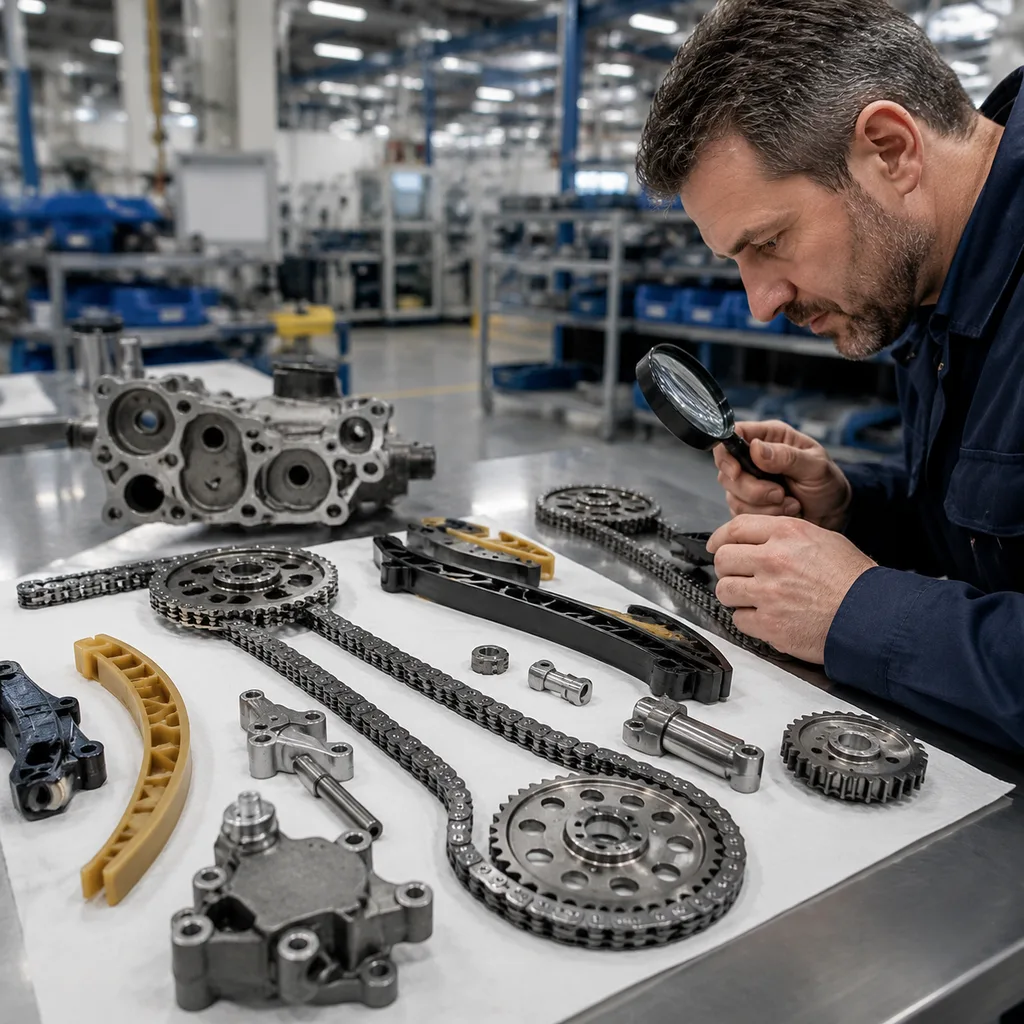
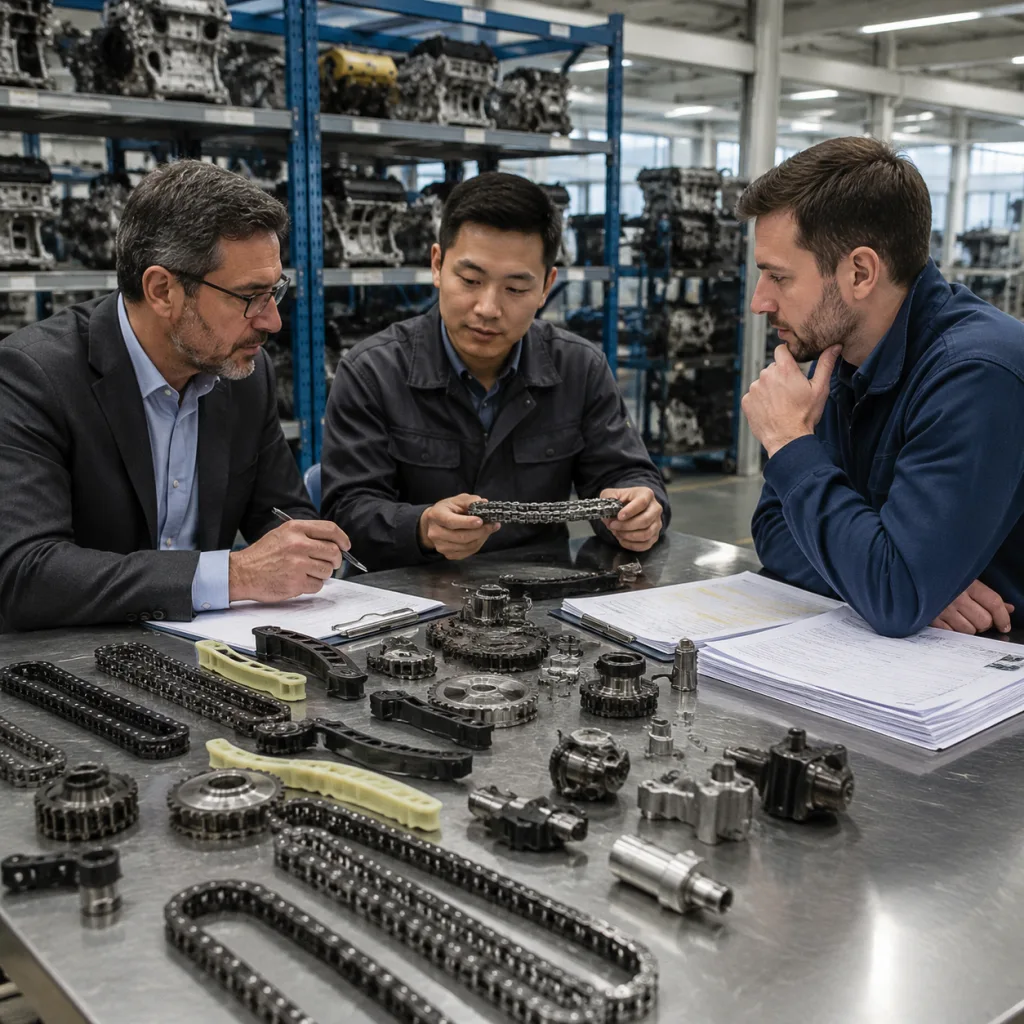
Choosing a timing chain kit supplier is closer to engineering risk management than routine purchasing. The kit may include a chain, tensioner, guides, rails, sprockets or VVT-related parts, torque-to-yield bolts, crank/cam seals and gaskets. One weak item can turn a good-looking quotation into start-up rattle, camshaft correlation faults, guide wear, oil leaks or engine damage.
That is why the decision should start with facts: kit scope, chain pitch, link count, guide geometry, tensioner behaviour, hardness, material traceability, packaging controls, MOQ, lead time and change-control rules. Price matters, but only after the buyer knows what is being priced.
This article explains how to choose a timing chain kit supplier for aftermarket, private-label, OEM and Tier-1 programmes. It uses a sourcing decision framework rather than a generic checklist: first define the repair job the kit must complete, then test the supplier’s engineering control, production repeatability, commercial assumptions and launch discipline.
Start with the repair outcome, not the supplier catalogue
A timing chain kit is often sold under one reference, but the real content can vary sharply between suppliers. One quote may include sprockets, bolts and seals. Another may include only the chain, guide and tensioner. If those offers are compared as “one kit versus one kit,” the cheaper option may simply be incomplete.
Before requesting pricing, define the repair outcome the kit must support. Is it a full workshop repair pack? A core timing drive set for resale? A private-label kit aligned to an existing catalogue? The answer changes the bill of materials, packaging, documents and warranty exposure.
A useful RFQ should state:
Vehicle application range, engine code, fuel type, displacement and production years, especially for 1.4/1.6/2.0 L variants where chain length or tensioner design may differ
Required kit content: chain, hydraulic or mechanical tensioner, guides, rails, cam/crank sprockets, VVT phasers if applicable, bolts, seals and gaskets
OE part-number cross-references where already known, including superseded numbers used in existing catalogues
Critical dimensions from drawings or samples: chain pitch, link count, guide mounting-hole centres, sprocket tooth count, bore diameter and keyway or locating-pin position
Annual volume, first order quantity and quarterly forecast by SKU, so slow-moving kits are not hidden inside total demand
Packaging format: neutral, Driventus box, private label, bulk workshop pack or e-commerce-ready carton with drop-test expectations
Target markets, including the EU, UK, US, Canada, Australia or Brazil, because labelling, compliance declarations and logistics assumptions may differ
Required documents: material reports, inspection records, PPAP-level files where applicable, REACH declarations and compliance statements
Catalogue mapping deserves special attention. A supplier may list one kit across several engine variants, while another separates those applications because the tensioner oil feed, guide profile, chain pitch, link count or sprocket design differs. Ask how fitment data is created and updated when OE supersessions, warranty returns or market feedback appear. For high-risk applications, require the supplier to record the OE sample source, VIN or engine code used for validation and the catalogue release date.
Also define what is not included. Are bolts reusable or single-use torque-to-yield? Is thread-lock pre-applied? Are installation notes required? Does the buyer expect crank and cam seals in the carton? These details are not minor. They decide whether a field complaint is a supplier issue, a catalogue issue or a buyer-scope issue.
Driventus maintains application mapping across engine components in our catalog and can review kit composition against buyer-provided references.
Supplier qualification: separate evidence from sales language
When evaluating how to choose a timing chain kit supplier, treat “OE quality,” “premium grade” and “100% tested” as claims that need proof. Strong suppliers are comfortable with documents, measurements and traceability. Weak suppliers steer the conversation back to price and catalogue coverage.
Use the following qualification matrix during initial screening, document review and on-site audits. Add numeric acceptance criteria before samples are made; otherwise the buyer and supplier may approve different interpretations of the same part.
Evaluation area
What to verify
Evidence to request
Quality certification
Active system certification relevant to automotive production
IATF 16949:2016 and ISO 9001:2015 certificates, audit scope, certificate body and expiry date
Process control
Stable production of chains, guides, tensioners and sprockets
Control plans, work instructions, PFMEA, in-process inspection records and reaction plans
Material control
Correct steel grade, heat treatment, plastic guide material and rubber sealing parts
Material certificates, hardness reports, resin grade confirmation and batch traceability records
Dimensional accuracy
Chain pitch, guide profile, sprocket tooth form and mounting-hole position
First article inspection, CMM or fixture reports, gauge R&R records and drawing balloon reports
Functional validation
Tensioner response, chain wear and noise control
Bench test summaries, endurance test records, leak-down data and sample test plans
Traceability
Ability to isolate affected batches within hours, not days
Lot codes, production date records, heat-treatment batch, carton labels and barcode data
Export readiness
Stable supply to regulated markets
REACH (EC) No 1907/2006 declarations where applicable, HS code support, packing lists and country-of-origin process
Claim handling
Root-cause analysis and corrective action discipline
8D reports, warranty return process, containment timing and response lead time
</tr></thead><tbody> </tbody></table>For aftermarket sourcing, a practical baseline is 3 to 10 sample kits per reference, a first article report for at least 5 critical dimensions per component, and lot traceability down to chain assembly, guide moulding, tensioner machining and packing date. For OEM-style projects, request PPAP Level 3 unless your programme specifies another submission level.
The certificate scope must match the actual work. A trading company may present a strong catalogue and valid certificates, but the audit needs to show who manufactures the chain, guides, sprockets and tensioners. If subcontractors are involved, confirm how incoming quality, batch identity and engineering changes are controlled.
Put change-control rules in writing. Require buyer approval before any change in material grade, heat-treatment supplier, mould cavity, chain assembly line, tensioner seal supplier or packing specification. A timing kit is too failure-sensitive for silent substitutions.
Failure modes by component: what the supplier must control
A timing chain kit combines stamped metal, heat-treated parts, moulded polymer, hydraulic control and sealing components. The supplier may present it as one SKU. Engineers should not evaluate it that way.
Chain and sprockets
For roller and silent chains, confirm pitch accuracy, pin hardness, plate thickness, elongation control and burr control. A useful chain report shows measured values, sample quantity and the gauge or fixture used. A report that only says “OK” is not enough.
Typical checks include chain pitch tolerance, total chain length under a defined measuring load, side-plate thickness, pin diameter, pin/plate hardness and surface finish after stamping. Small deviations can create noise, accelerated wear or timing deviation over service life.
Sprockets need controlled tooth profile, tooth count, concentricity, runout and heat treatment. Define bore diameter, mounting-hole position, face width, runout limit and surface hardness or case depth according to the drawing or approved sample. A chain and sprocket can each look acceptable in isolation and still mesh poorly together. Ask whether the supplier checks chain-sprocket engagement under fixture load and whether wear pattern or noise is reviewed after endurance cycling.
Guides, rails and tensioners
Guide rails usually combine a backing structure with a wear surface designed for oil, heat and sliding contact. Request material identification and ageing data, especially for hot-running engines or applications known for guide wear. Control points include resin grade, glass-fibre content where applicable, warpage after moulding, mounting-hole position, wear-surface profile and dimensional stability after heat ageing in oil.
Tensioners deserve extra scrutiny. Hydraulic units rely on plunger travel, preload, ratchet engagement where used, oil retention, leak-down behaviour, cleanliness and seal quality. A small machining or spring-rate difference can cause start-up rattle or unstable chain load.
Require measurable acceptance criteria, such as plunger stroke range, spring preload range, leak-down time or displacement under a specified oil temperature and load, and cleanliness limits for internal parts. A capable supplier can explain the test method, not just confirm that testing exists.
Key control points include:
Chain pitch, link count and total length against drawing limits under a defined measurement load
Pin, plate and sprocket hardness values, including case depth where heat treatment is specified
Sprocket tooth form, tooth count, concentricity, axial/radial runout and bore or locating feature position
Guide rail profile, wear-surface material, warpage and mounting-hole position
Tensioner plunger stroke, preload, ratchet engagement, oil retention and leak-down result
Bolt grade, coating, thread-lock specification and torque-angle requirement where supplied
Gasket and seal material compatibility with engine oil, coolant and operating temperature
Cleanliness of hydraulic tensioners and oil passages after machining and assembly
For buyers needing special geometry, material changes or private-label kit development, Driventus offers custom manufacturing based on drawings, samples or buyer-controlled specifications.
From sample approval to repeatable production: prove the second batch will match the first
A clean sample kit is only the start. It proves that the supplier can make a small quantity once. It does not prove that serial production will use the same materials, tooling, subcontractors, inspection plan or packaging standard.
Ask how the factory moves from prototype or sample lots to bulk production. The answer should identify the process route, tooling, inspection records, lot controls and release authority. If the supplier cannot explain that transition, bulk risk remains high.
Relevant validation activities may include dimensional inspection, hardness testing, metallographic checks, salt spray testing for specified metal parts, tensioner leak-down checks, endurance bench testing, thermal ageing, oil compatibility checks and installation verification on representative engines. The plan should match the kit type and target market. A low-volume aftermarket kit may not need the file depth of an OEM programme, but critical features still need defined limits and recorded results.
Use sample sizes that match the risk:
3 to 5 complete kits for first fitment and installation review
10 to 30 pieces for key component measurement when tooling is new
50 to 300 kits for a pilot lot before container-level release
AQL inspection for packaging and appearance
Zero-defect treatment for critical characteristics that can cause engine damage
Cp/Cpk data on selected dimensions once the process has enough production history
Published standards help frame the discussion. IATF 16949:2016 sets automotive quality management requirements, including defect prevention, variation reduction and control of externally provided processes. ISO 9001:2015 confirms a broader quality management framework. REACH (EC) No 1907/2006 is relevant when exporting to the European market and when substances in articles or packaging require assessment.
For noise, durability or drivability claims, ask for the method. What equipment was used? What was the sample size? Which oil temperature, speed/load cycle and acceptance criteria applied? Were chains measured for elongation before and after cycling? Were guides weighed or visually rated for wear? Was tensioner performance checked again after the test?
If a kit was redesigned because of a field issue, request the engineering change record, validation data and evidence that old stock was segregated. Do not accept “improved version” without a traceable change history.
Driventus operates under a documented quality system covering incoming inspection, in-process control, final inspection and traceability. Buyers can request document samples during RFQ review.
Commercial comparison: price the kit, the risk and the paperwork
Low unit price can hide missing parts, weaker packaging, material substitution or absent documentation. For timing chain kits, compare landed cost and risk cost together. A small saving disappears quickly if the shipment creates fitment disputes, warranty returns, relabelling work or slow claim resolution.
Compare commercial terms line by line:
MOQ by kit reference and by mixed-container order, with rules for slow-moving SKUs and high-volume SKUs
Tooling, mould or fixture cost for new kit development, including ownership, maintenance and replacement-cavity terms
Sample lead time and mass production lead time, separated into engineering review, tooling, trial, production and export booking
Price validity period and raw material adjustment rules for steel, resin, rubber, packaging and exchange-rate movement
Incoterms, carton dimensions, gross weight, pallet loading plan and container utilisation assumptions
Spare parts support for slow-moving applications and minimum annual replenishment requirement
Private-label packaging artwork responsibility, barcode format, print proof approval and revision workflow
Claim allowance, return policy, replacement procedure and debit-note rules
Documentation included as standard versus charged separately, such as PPAP files, special test reports or third-party inspection
MOQ should be reviewed by product family, not only by supplier average. Existing kits may carry lower MOQs. New moulded guides, low-volume hydraulic tensioners or new sprocket tooling may require higher quantities because set-up, validation and mould-change costs are different.
Ask for price breaks at realistic quantities: sample order, pilot order, carton-level replenishment, 500 kits, 1,000 kits and annual contract volume. If a lower price appears at a higher MOQ, ask why. Is the saving from batch efficiency, packaging simplification, reduced inspection or material substitution? The answer matters.
Lead time deserves the same discipline. Factory-wide capacity is not the same as capacity for a specific chain type, guide mould or hydraulic tensioner line. Define a standard lead time after deposit or purchase order. Add separate timing for packaging artwork, new tooling, pre-shipment inspection and ocean or air freight. Require early notice if heat treatment, coating, seal or spring suppliers become bottlenecks.
Vertical integration can reduce risk, but only when verified. If the supplier manufactures related engine components internally, audit machine capability, gauge calibration, heat-treatment control, cleaning process, test-bench capacity and final inspection discipline.
Finally, confirm that the quoted price includes the agreed control plan, traceability label, inspection report and packaging standard. Any cost-down proposal should be submitted for buyer approval before implementation, with a record of changed parts, affected lots and validation evidence.
Launch scenario: the audit, pilot order and first container release
A good sourcing decision should end in a controlled launch, not a handshake and a deposit. For new suppliers, use a phased sequence that connects commercial approval with technical evidence. Assign an owner and target date to each phase so sourcing, engineering, quality and logistics do not approve different versions of the same kit.
1. Document screening: certificates, company profile, product range, export markets, traceability format and sample 8D report. 2. Technical RFQ: kit content, drawings or samples, target applications, critical dimensions, packaging and annual volume. 3. Feasibility review: supplier confirms manufacturability, tooling needs, inspection method, MOQ, lead time and open technical risks. 4. Sample build: marked samples with inspection reports, material confirmation, date code and component-level lot identification. 5. Fitment and function check: installation review, timing alignment, tensioner operation, oil-pressure behaviour and noise assessment where applicable. 6. Pilot order: smaller controlled batch with full lot traceability, packaging verification and pre-shipment inspection. 7. Mass production release: agreed control plan, approved packaging, approved label file, claim handling process and change-control procedure.
During the factory audit, focus on operations that affect timing drive reliability: heat treatment, chain assembly, guide moulding, tensioner machining, clean assembly, test benches and final kit packing. Review calibration records, nonconforming-part segregation, operator training, preventive maintenance and changeover controls between similar references.
Ask operators practical questions. How do they distinguish left and right guides? How are similar chain lengths separated? How are sprocket variants identified? What prevents mixing tensioners with different oil-feed designs?
Packing is not a side issue. Missing bolts, mixed guide variants, wrong gasket inclusion or incorrect labels can create high field cost even when the manufactured parts are acceptable. For private-label supply, check carton strength, barcode accuracy, country-of-origin marking, artwork revision control and the method used to prevent mixed kits at the packing station.
A practical packing control uses a kit BOM checklist, component photo board, weight check range, scanner verification and sealed inner bag for small hardware.
The launch should close with three aligned documents: the commercial agreement, the technical specification or approved sample record, and the packaging and labelling standard. Keep a golden sample or retained production sample for each approved reference, with the lot number, approval date and packaging revision recorded. When a future claim appears, that sample becomes evidence, not memory.
Frequently asked questions
Request IATF 16949:2016 and ISO 9001:2015 certificates, control plans, material certificates, dimensional reports, hardness results, tensioner leak-down data, traceability samples and packaging specifications. For EU supply, request REACH (EC) No 1907/2006 declarations where applicable.
No. Samples confirm initial capability but not repeatability. Use a pilot order with lot traceability, inspection records and packaging checks before full release. Confirm that bulk production uses the same materials, tooling, subcontractors and process route as the approved samples.
Yes. Driventus can support neutral packaging, buyer branding and custom kit composition subject to MOQ, artwork approval and application review. Driventus is an independent aftermarket manufacturer; brand names are referenced for fitment only.
If you are qualifying a timing drive supplier, share your kit list, target market, expected MOQ and annual forecast. Our team can review fitment, documentation and commercial terms when you [request a quote](/contact.html).