Head Gasket Leak: Head Gasket Diagnosis for Buyers
A head gasket leak is rarely just a failed repair. For distributors, repair chains, fleet maintenance networks, and sourcing engineers, it can become a repeat-claim pattern: warranty labour, vehicle downtime, installer distrust, stock write-offs, and supplier escalation. The response should start with evidence, not assumptions. Confirm the leakage path. Identify the failure mode. Inspect the mating parts. Then verify that the replacement head gasket matches the engine’s sealing requirements.
The joint has a difficult job. It must hold combustion pressure while keeping coolant, oil, and the outside environment separate through thousands of heat cycles. Peak cylinder pressure may exceed 100 bar on gasoline turbo engines and reach 180–220 bar on many diesel applications. A small dimensional error, the wrong coating, an unsuitable surface finish, or lost clamp load can trigger another leak even when the catalogue listing appears correct. This article sets out a practical diagnostic route and the procurement checks that reduce avoidable returns. Driventus supplies head gaskets for aftermarket and B2B programmes, with production controlled under IATF 16949:2016 and ISO 9001:2015. Driventus is an independent aftermarket manufacturer; brand names are referenced for fitment only.
First Decision: Which Sealing Zone Has Failed?
Do not begin by asking whether the gasket is “bad.” Start with the path. A head gasket separates four zones: the combustion chamber, coolant jacket, oil gallery, and outside environment. Symptoms change depending on which zones have become connected and how fast pressure, heat, or fluid crosses the failed area.
Use the field symptom to narrow the path:
- Combustion to coolant: continuous bubbles in the expansion tank during cranking, a positive CO₂ block-test fluid colour change, rapid hose hardening, or cooling pressure rising before the thermostat opens
- Coolant to combustion: coolant loss without an external leak, white exhaust vapour after warm-up, sweet odour at the tailpipe, cold-start misfire, plug staining, or a steam-cleaned piston crown
- Coolant to oil or oil to coolant: mayonnaise deposits under the cap, oil-film traces in the expansion tank, rising oil level, or contaminated lubricant
- Oil or coolant to outside: seepage along the block-to-head joint, commonly near oil-feed drillings, coolant transfer holes, dowel areas, or timing-cover interfaces
- Combustion to combustion: low compression between adjacent cylinders; a difference above 10–15% against the best cylinder normally needs investigation
Small coolant loss matters. Losses of 0.2–0.5 L per 1,000 km are already significant on many passenger-car systems when there is no visible external leak. So does timing. A hose that becomes hard within 30–90 seconds after a cold start points toward combustion pressure entering the cooling circuit, not simple boiling.
A visible external trace is often late evidence. Many warranty returns begin with overheating, coolant pressurisation, or intermittent misfire before any stain appears. By the time the removed gasket reaches a distributor, it may show secondary heat damage rather than the initiating defect.
The real diagnostic question is why the sealing system lost control. Common causes include low clamp load, a warped cylinder head, unsuitable surface finish, detonation, restricted cooling flow, incorrect gasket construction, damaged bolts, liner-height error, or installation process failure. A proper review looks at the gasket, the engine, and the repair together. That is the difference between a useful head gasket leak head gasket investigation and a parts argument.
Failure-Mode Matrix for Claim Triage
When claims arrive from multiple installers, a matrix keeps the discussion grounded. It connects the symptom to a likely leakage path, then to inspection actions. This format works for warranty review, supplier escalation, service-network training, and early detection of application or batch patterns.
| Symptom observed | Likely leakage path | Possible root cause | Inspection action |
|---|---|---|---|
| Bubbles in coolant during cranking | Combustion to coolant | Fire ring damage, low clamp load, head lift, local overheating | Perform CO₂ block test, cylinder leak-down at 5–7 bar shop air, and bolt torque or bolt replacement review |
| Coolant in one cylinder | Coolant to combustion chamber | Local gasket breach, head crack, liner protrusion error, corrosion at coolant passage | Borescope cylinder, pressure test head at typical cap pressure plus margin, and check liner height where applicable |
| Oil and coolant mixing | Oil gallery to coolant jacket | Gasket crush loss, casting corrosion, wrong gasket aperture, oil cooler fault | Inspect gasket land, pressure test oil cooler, compare gasket layout with OE-style reference and oil-feed hole diameter |
| External oil seepage | Oil gallery to outside | Coating damage, surface scratch, poor flatness, local clamp loss | Check head and block surface roughness, straightedge flatness, and bolt-hole condition for bottoming or trapped oil |
| Repeat overheating after repair | Not always the gasket | Air lock, thermostat fault, water pump issue, radiator restriction, fan control fault | Test cooling system function before condemning the new gasket; verify fan cut-in, cap pressure, flow, and bleed procedure |
| Failure between cylinders | Combustion to combustion | Detonation, inadequate clamp, wrong thickness, head or block distortion | Compression test, inspect fire ring, verify gasket specification and engine calibration; compare adjacent cylinder readings |
| Rapid pressure rise in cooling system | Combustion to coolant | Combustion leakage, cracked head, block crack, sleeve movement | Use combustion gas test, cooling pressure test, and cylinder leak-down comparison while watching coolant neck movement |
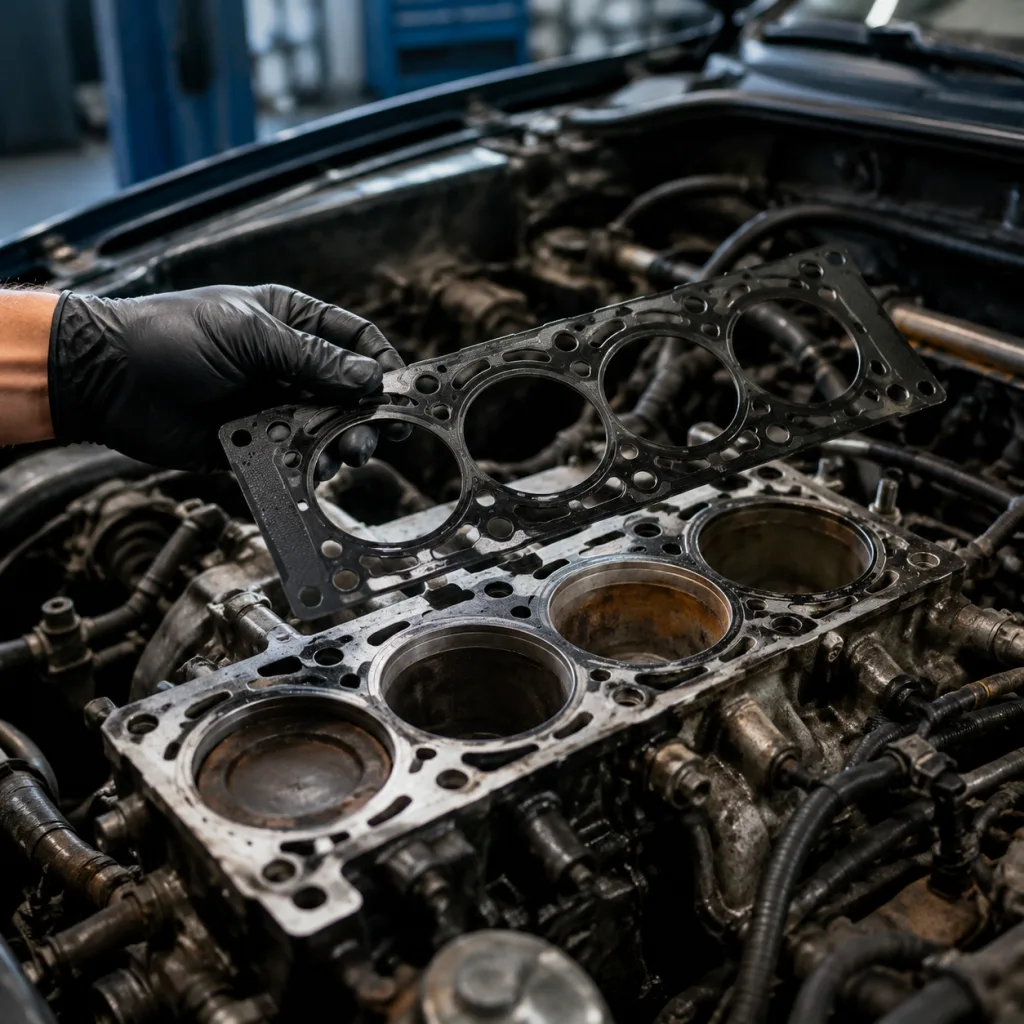
| Gasket type | Typical use | Strengths | Procurement checks |
|---|---|---|---|
| MLS, multi-layer steel | Modern aluminium head engines and many high-compression applications | Strong combustion sealing, elastic recovery, coating control, stable layer geometry | Layer count, steel grade, total thickness tolerance, stopper design, coating adhesion, embossment consistency, rivet or tab integrity |
| Composite | Older engine families and selected service applications | Conformability on less perfect surfaces, good accommodation of minor irregularities | Core material, facing quality, fire ring retention, crush thickness, fluid resistance, storage stability |
| Steel-elastomer | Selected coolant and oil sealing layouts | Defined bead sealing around fluid passages and controlled compression around ports | Rubber compound, bead height, compression set, ageing resistance, bond quality |