Head Bolt Set Packaging Requirements for Export Buyers
Head bolt sets are small, heavy, and failure-sensitive. When export packaging is weak, buyers do not just see damaged cartons; they see mixed kits, worn thread starts, missing washers, rust, and label disputes before the shipment even reaches a warehouse. That is why head bolt set packaging requirements export buyers should treat packaging as part of the technical specification, not a cosmetic extra. A complete requirement should define kit structure, corrosion control, traceability labels, carton strength, palletisation, container loading, and shipment documents before the purchase order is released. This guide gives procurement teams, aftermarket distributors, and sourcing engineers a practical framework for buying from China or other manufacturing bases. Driventus is an independent aftermarket manufacturer; brand names are referenced for fitment only.
Start with the Kit Map, Not the Carton
The first packaging decision is the kit definition. If the bill of materials is wrong, no carton specification can save the shipment. A head bolt set may contain 8, 10, 12, 14, 16, or 20 bolts depending on engine layout. Some applications mix two or four lengths in one kit. Others add different shank diameters, washer types, head forms, or coating colours.
Before artwork or box selection, confirm:
Bolt count per set, length groups, and count per length group.
Thread size and pitch, such as M10 x 1.5, M11 x 1.25, or M12 x 1.75.
Under-head length and the tolerance used for pack verification.
Head style and drive form, such as hex, bi-hex, Torx, or internal spline.
Washer status: captive, loose, pre-assembled, or excluded.
Coating and visible finish, including whether light oil or colour variation is acceptable.
Fitment cross-reference format, only where it is already approved in the application data.
Reuse warning for torque-to-yield applications, if the buyer wants it on the pack.
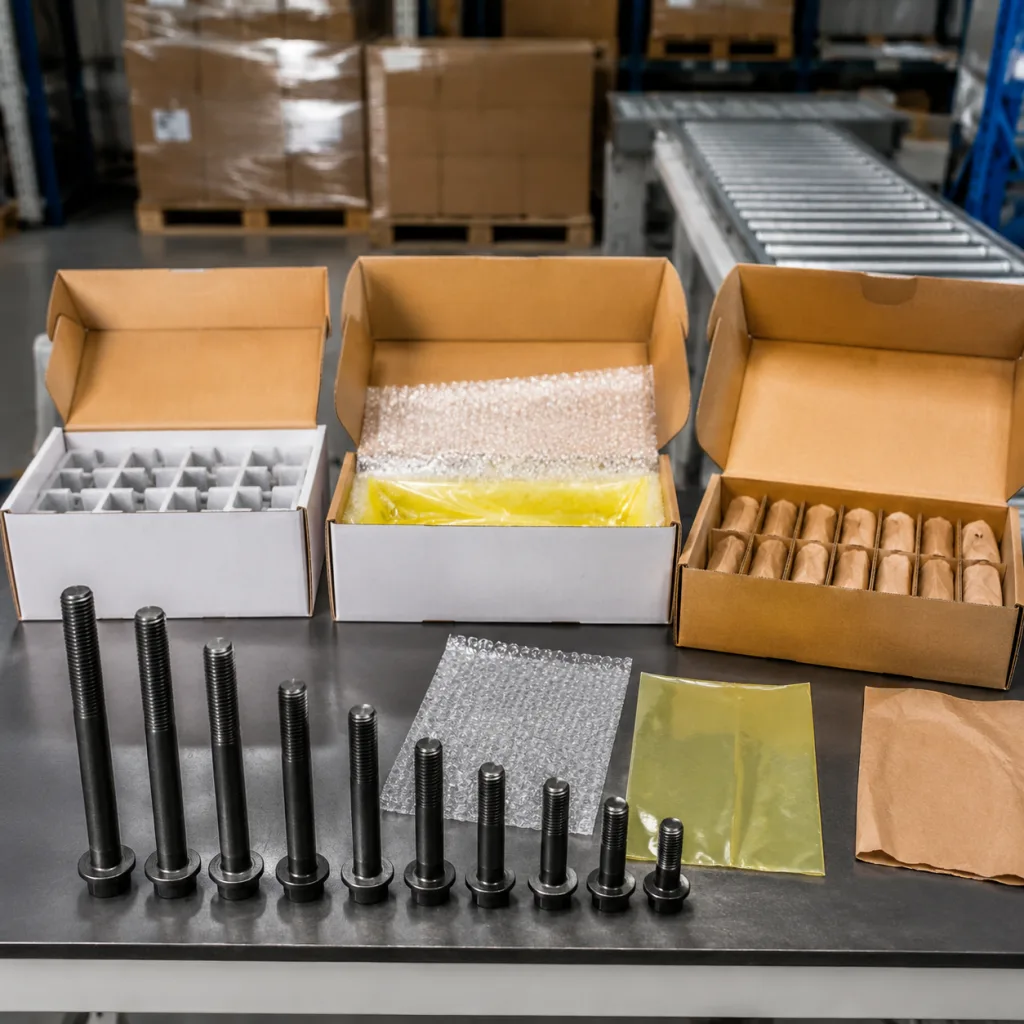
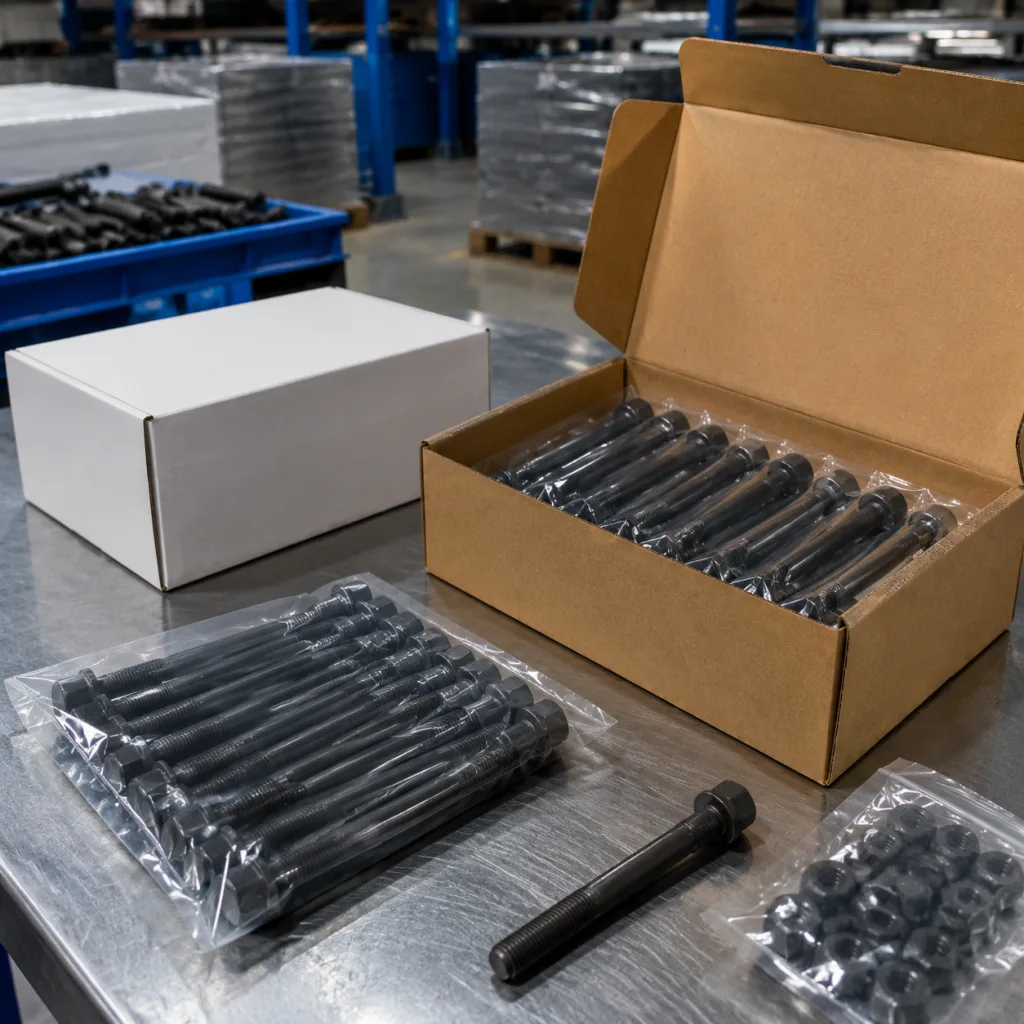
Use a poka-yoke packing method. One sealed inner bag, tray cavity, or compartment should correspond to one engine set. If a kit has multiple bolt lengths, separate them with labelled sub-bags, dividers, or a formed tray so the wrong length cannot be dropped into the set by mistake. Do not depend on operator memory. Similar-looking fasteners are the easiest way to create a claim.
A good first-article pack approval should include photos of each length group, the caliper point or gauge point used for inspection, and the exact order of placement for washers or instruction sheets. For a new SKU, request 3 to 5 pre-production packed samples and one fully packed master carton. Any change to the kit count, washer style, coating, or artwork should trigger re-approval because weight, corrosion risk, and carton compression behaviour can all change.
Where Export Packs Usually Fail
Most packaging failures are not dramatic. They are quiet, repetitive, and expensive.
The common failure modes are easy to spot once you know where to look:
Mixed lengths in one set because the packing line relied on visual similarity.
Thread damage from loose stacking, poor dividers, or metal-to-metal contact.
Rust spots caused by weak sealing, high humidity, or a delayed container move.
Carton collapse after stacking because the board grade was chosen for light parts.
Labels that scan in the factory but fail after stretch wrap, abrasion, or condensation.
Packing lists that do not match the carton count, lot number, or actual quantity.
Corrosion control should match the route, not a generic standard. Head bolts are usually high-strength steel, so the pack must protect the surface finish and the threads during sea freight, customs storage, inland transport, and distributor handling. Depending on the application, the bolts may be phosphate and oil, zinc flake, black oxide, electro-zinc, or another specified coating. Packaging has to preserve that condition through the full dwell time.
A realistic export exposure window is often 45 to 120 days from packing to installation. For slow-moving aftermarket SKUs, buyers may ask for 12 to 24 months of shelf protection after receipt if cartons remain unopened in a dry warehouse. That is why the specification should state the exposure period. A plain carton is not a corrosion plan.
Packaging element
Common requirement
Procurement check
Inner bag
60–100 micron sealed PE bag or VCI bag
No punctures, agreed seal width, correct kit count
Desiccant
2–5 g per inner set or carton-level units by volume
Confirm quantity and use of humidity indicator card
Thread protection
Dividers, sleeves, caps, or tight bundling
First 2–3 thread turns undamaged
Coating protection
Oil-free, light oil, VCI, or specified anti-rust method
Compatible with workshop use and gasket handling
Carton liner
PE liner for humid or mixed-container routes
Liner closed before top flap sealing
Shelf-life marking
12, 18, or 24 months if agreed
Date code traceable to batch and pack date
</tr></thead><tbody> </tbody></table>Salt spray targets, when specified, should be tied to the coating standard and the sample condition, not treated as a packaging promise. Packaging cannot fix a weak coating. Coating approval cannot replace a sealed inner pack. For EU-bound material and surface declarations, buyers may request REACH (EC) No 1907/2006 compliance information. For humid lanes, add a container desiccant plan, keep wet pallets out of the load, and record packing-area humidity at closure.
Pick the Right Carton and Barrier System
A head bolt set is compact, but it is not light. That is where generic packing specs break down. A carton that works for gaskets or filters may fail under bolt density, point loads, and pallet stacking pressure.
Use a written carton spec, not a phrase like “strong export carton.” Define the actual build:
Inner box dimensions and master carton dimensions, with tolerance.
Board grade, such as 5-ply double-wall corrugated for heavy cartons.
Sets per master carton, chosen to keep gross weight in a workable range.
Maximum gross weight and the allowed weight tolerance.
Tape width, tape pattern, and strapping rule.
Drop-test expectation for the packed carton.
Stacking or compression requirement under planned pallet load.
Moisture protection for mixed-container or humid routes.
For dense fastener kits, the practical limit is usually handling, not volume. Many buyers target 15 to 20 kg per carton for manual movement. That is a better commercial check than trying to maximise the count in every box.
Carton strength should be judged against claim cost. A slightly better double-wall carton can cost very little on a per-set basis when volume is high. One collapsed pallet can create repacking, missing-set disputes, and customer penalties. The carton is cheap. The failure is not.
If the destination uses automated receiving, confirm label size, barcode type, print contrast, and placement before production starts. Common requirements include Code 128 or EAN-13, 80 x 40 mm or 100 x 60 mm labels, and at least one long-side and one short-side label. Keep the quiet zone clear of tape. A label that works in the office may fail after wrap, stacking, or moisture exposure.
For repeat orders, store the approved carton drawing, packed-carton photo, label artwork, and approved gross weight in the SKU file. That prevents reorders from drifting back to verbal instructions.
How to Palletize and Load a Dense Fastener SKU
Palletisation is not a warehouse detail. It is part of the shipment spec.
For heavy fastener programs, define the loading sequence in writing:
1. Choose the pallet type: fumigated wood, plywood, plastic, or floor-load by agreement. 2. Define the footprint: Euro, UK, North American, or buyer-specific size. 3. Set the maximum pallet weight and height for warehouse handling. 4. State the carton orientation, layer pattern, and maximum layers. 5. Define the slip sheet, corner board, stretch film, top sheet, and strap method. 6. Decide whether one SKU per pallet is required or whether mixed pallets are allowed. 7. Require loading photos before container seal.
If wood packaging is used, check the destination rule for ISPM 15 treatment and marking. The requirement can differ by country and route. Brazil, Australia, Canada, the UK, the EU, and the US may all apply different inspection expectations.
Do not plan a container by cubic metres alone. A 20-foot container filled with engine fasteners may hit weight limits before volume limits. Ask for a load plan that shows carton count, pallet count, gross weight, blocking method, and container seal number. If the cargo is floor-loaded, agree the unloading method before shipment release. If the buyer’s warehouse requires palletised receiving, floor loading may save freight space but add labour, injury risk, and delay at the dock.
For palletised loads, specify no carton overhang, no crushed bottom cartons, stretch wrap anchored to the pallet, and labels on two adjacent sides. For mixed purchase orders, the packing list should map each pallet number to SKU, carton range, lot number, and quantity.
Traceability Rules That Keep Claims Investigable
Traceability starts at the pack bench. If a claim is raised later, the buyer needs to connect the set, the carton, the pallet, and the shipment back to production records.
At minimum, require these markings on the inner box or label:
Customer SKU and supplier item code.
Product description: head bolt set and engine or application family.
Quantity per set and quantity per carton.
Batch or lot number, with one production lot per inner set.
Production date or packing date in an agreed format.
Country of origin.
Handling symbol if moisture control, stacking, or orientation matters.
Revision level for artwork, kit structure, or drawing where the buyer controls revisions.
The paperwork must match the labels exactly. The commercial invoice, packing list, carton marks, and pallet marks should use the same SKU, description, quantity logic, gross weight, net weight, carton count, and country-of-origin statement. Small wording differences can delay customs clearance or make a later claim hard to prove.
A clean process flow is: pack inner set, record or scan the label, seal the inner bag, place the set into the master carton, apply the carton label, weigh the carton, assign the carton number, palletise by carton range, and release against the packing list. If barcode data is required, the buyer should give the syntax before artwork is printed.
For private-label orders, packaging approval should cover both appearance and data accuracy. Buyers can review related engine parts in our catalog and discuss custom manufacturing if the head bolt set needs buyer-specific labels, barcode rules, carton structure, or kitting logic. Neutral export cartons are often the fastest starting point; printed boxes can follow once the program is stable. Driventus is an independent aftermarket manufacturer; brand names are referenced for fitment only.
First-Run Packaging Audit Before Release
Use a packaging audit before shipment release, especially on first orders, new artwork, revised kit structures, changed coating, or a new carton supplier. The check should be simple enough for factory QC, the buyer’s inspector, and the packing team to use on the floor.
Pre-shipment checklist
Confirm the set contains the correct bolt count, length groups, and washer configuration.
Check 5 to 10 sets from at least 3 cartons for thread damage, coating damage, corrosion signs, and mixed parts.
Measure representative bolt lengths and thread sizes against the BOM or drawing using the agreed tolerance.
Verify inner bag sealing, VCI or desiccant placement, and humidity card if specified.
Compare inner label, carton label, pallet label, and packing list for SKU, quantity, lot number, date code, and country of origin.
Weigh packed cartons and compare against approved master data.
Photograph one open carton, one sealed carton, each pallet side, and the loaded container.
Record container number, seal number, pallet count, carton count, gross weight, and loading date.
The purpose is not paperwork for its own sake. It is to catch the kinds of mistakes that cost time later: the wrong washer style, a loose label, a carton that opens in transit, or a pallet count that does not reconcile. For aftermarket distributors, that means fewer receiving disputes and less repacking. For OEM and Tier-1 supply chains, it supports the discipline expected under IATF 16949:2016.
Commercial terms should also be realistic. Neutral-label orders usually move faster because carton and label materials are standard. Printed boxes, custom trays, and buyer-specific barcodes need artwork approval, material lead time, and sample validation. When comparing quotations, check MOQ, unit price, packaging surcharge, sample lead time, production lead time, and whether carton testing or third-party inspection is included.
Frequently asked questions
Correct kitting and traceability come first. Each set must contain the exact bolt count, length mix, washer configuration, and approved label data for the application. Labels should connect the set, carton, and pallet to a production batch.
VCI bags are commonly used when transit and storage expose steel fasteners to humidity. The choice depends on coating type, shipping route, storage period, and buyer requirement. Desiccant, sealed PE bags, carton liners, and container desiccants may also be specified.
Yes, private-label packaging can be discussed for B2B orders, subject to artwork approval, MOQ, label data, carton validation, and packaging material lead time. Driventus does not claim vehicle manufacturer endorsement; brand names are referenced for fitment only.
If you are defining packaging rules for a head bolt set import programme, share your SKU list, route, carton limits, MOQ target, label requirements, and delivery schedule to [request a quote](/contact.html).