Flywheel vs SKF Alternative: B2B Sourcing Comparison
For B2B buyers, a flywheel is not a simple catalog item. It affects clutch feel, crankshaft load transfer, starter ring gear engagement, and drivetrain noise, so a flywheel vs SKF alternative decision should be made with evidence, not habit. The right choice depends on dimensional interchange, material consistency, machining control, balance data, packaging robustness, and the supplier’s ability to repeat results across batches. This article takes a decision-first view of aftermarket flywheel sourcing, with practical checks for distributors, repair chains, and Tier-1 procurement teams. Driventus manufactures engine and powertrain components in Taizhou, Zhejiang, and exports to more than 60 countries. Driventus is an independent aftermarket manufacturer; brand names are referenced for fitment only.
Start With the Sourcing Decision, Not the Brand Name
A flywheel vs SKF alternative comparison is useful only if the buyer begins with the job the part must do. If the priority is immediate availability and low order complexity, a branded catalog route may be easier. If the priority is repeat volume, private-label packaging, or controlled landed cost, a factory-direct alternative can be more effective.
Decision factor
Branded sourcing route
Independent manufacturer route
What the buyer must verify
Fitment confidence
Usually strong for mainstream references
Strong if application data is complete
Compare sample, drawing, and vehicle map
Commercial flexibility
Often limited by distributor policy
Usually negotiable by volume
Confirm MOQ, step pricing, and lead time
Documentation depth
Established catalog references
Depends on factory discipline
Request inspection, traceability, and control plan records
Packaging options
Standardized aftermarket packaging
Neutral, private label, or bulk export
Check carton strength and corrosion protection
Change control
Usually rigid
Can be defined in the agreement
Freeze drawings and notification rules
</tr></thead><tbody> </tbody></table>The practical rule is simple: brand familiarity is not a substitute for validation. Buyers should ask whether the supplier can prove stable production, not only one acceptable sample. If the answer is yes, the comparison can move forward on commercial terms. If not, the risk belongs to the buyer.
Where Flywheel Programs Fail in the Field
Most flywheel problems do not start at the point of sale. They show up later as clutch chatter, starter noise, vibration complaints, or premature wear. That is why the failure-mode review matters more than a generic product description.
Common failure points include:
Incorrect bolt-circle geometry or pilot register fit.
Friction-face runout that is acceptable on paper but unstable after installation.
Ring gear issues such as poor press fit, tooth damage, or inadequate heat treatment.
Imbalance that passes a quick check but still creates NVH complaints at speed.
Packaging damage from heavy-part movement during ocean freight or pallet handling.
Warranty confusion when clutch mismatch or torque errors are blamed on the flywheel.
A buyer can reduce these failures by separating manufacturing defects from installation errors before approval. Ask the supplier for measurement records, not just a pass/fail statement. If a claim appears later, the file should already show runout, flatness, balance correction, and heat-lot traceability. That is the difference between a manageable warranty case and a repeated field issue.
What a Flywheel Must Prove Before Approval
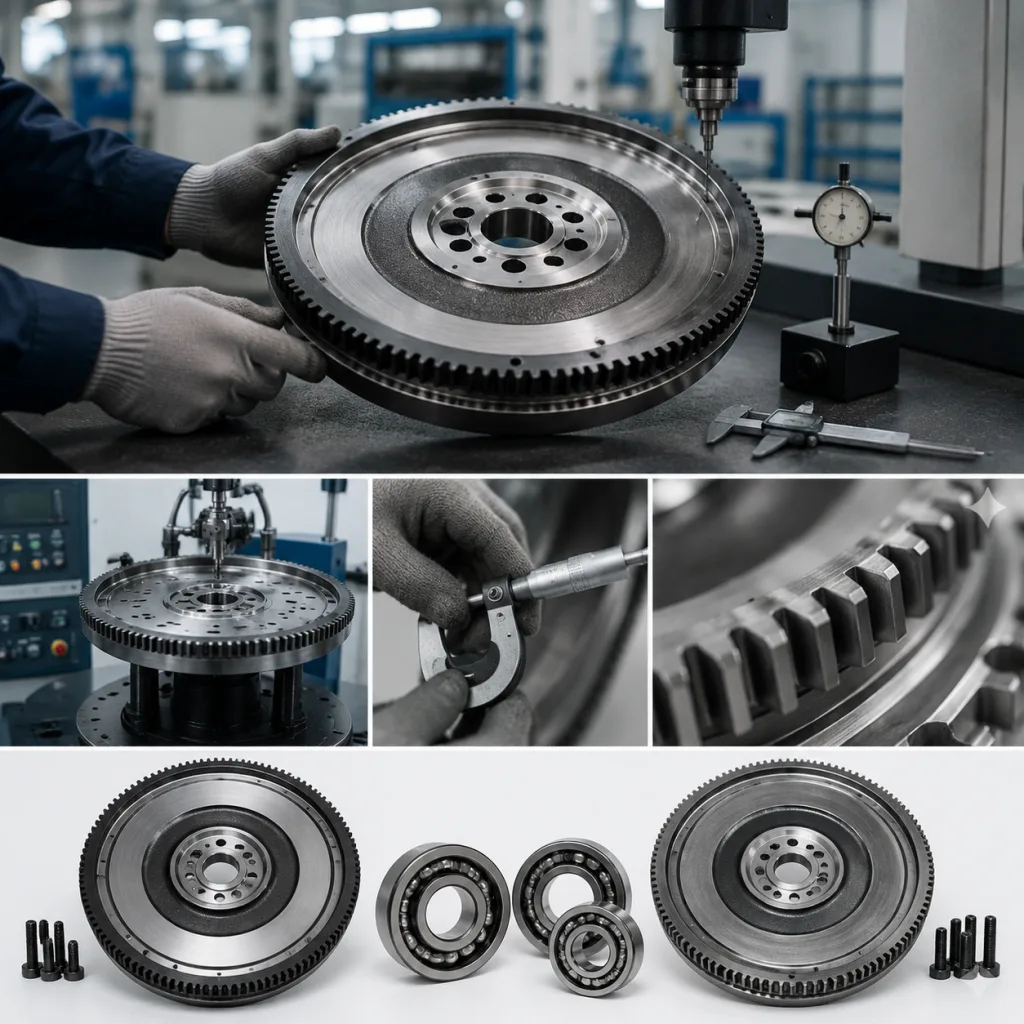
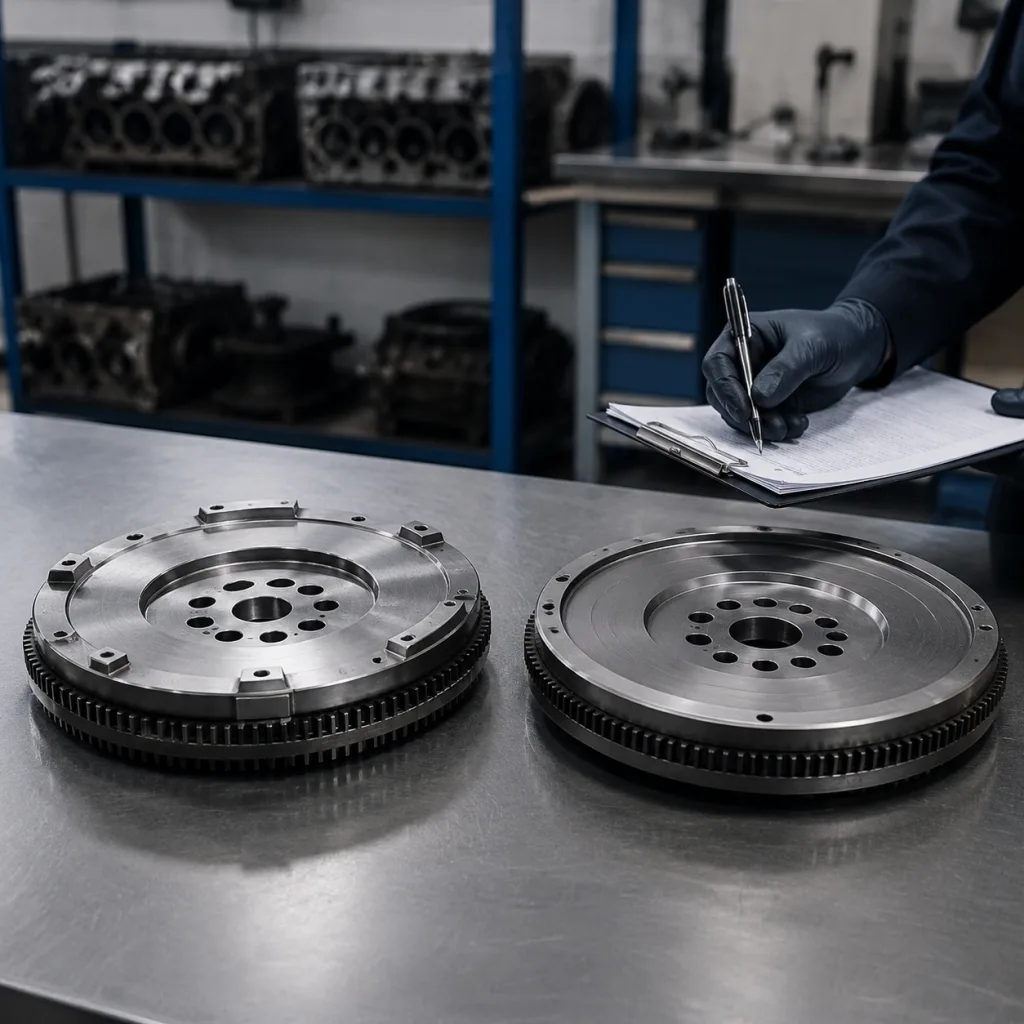
A safe approval process follows the part, not the brochure. Compare the physical sample, the drawing, and the application list at the same time.
Key checks include:
Crankshaft bolt pattern: pitch circle diameter, thread clearance, and counterbore depth.
Clutch face: flatness, roughness, mounting height, and post-machining runout.
Starter ring gear: tooth count, concentricity, press-fit security, and hardness.
Mass and inertia: must stay within the application’s drivability and NVH limits.
Sensor features: trigger teeth, timing windows, or machined references where used.
Overall finish: corrosion protection, edge quality, and packaging condition.
For procurement, the most useful numbers are the ones tied to the actual drawing. A common buyer target is mounting-face runout within 0.10 mm TIR, pilot register diameter within the agreed fit class, and clutch-face flatness within the stated engineering limit. If the flywheel is paired with a clutch kit, confirm stack height and release geometry before releasing the order. A small mismatch here can create a large field return later.
Driventus can review fitment and application data through our catalog, including engine and drivetrain component families where the customer supplies samples, drawings, or vehicle references.
Material and Balance Controls That Separate Good Parts From Cheap Ones
The price gap between a flywheel and an alternative supplier often comes from material choice and process control. That gap is meaningful only if the buyer knows what is being controlled.
Typical technical controls include:
Material verification: chemistry and mechanical properties checked by heat or batch.
Casting integrity: porosity, hard spots, and dimensional stability monitored during production.
Machining accuracy: clutch face, crank register, bolt holes, and ring-gear seat cut on controlled equipment.
Surface finish: roughness held in a range that supports clutch bedding without glazing.
Dynamic balancing: residual imbalance corrected after final machining.
Corrosion protection: oil, VCI paper, or sealed packaging matched to shipping route and storage time.
Common materials include grey cast iron, ductile iron, and forged steel. The right choice depends on torque, clutch load, and the engine platform. Buyers should put the material grade, hardness range, and test method into the purchase drawing or technical agreement. For management-system review, ask for IATF 16949:2016 and ISO 9001:2015 evidence. For EU chemical compliance, material declarations should support REACH (EC) No 1907/2006 where applicable.
As a sourcing rule, do not accept a vague “balanced OK” note. Require the machine report to state the correction method and the final residual unbalance per unit. If the supplier cannot state the acceptable band before RFQ, the commercial quote is not yet comparable.
Step-by-Step: How to Qualify an Alternative Supplier
A structured qualification process keeps the project from turning into a price-only comparison. Use a simple sequence and do not skip gates.
1. Send the application list, sample photos, annual forecast, and any OE-style reference numbers. 2. Request a drawing match, material proposal, MOQ, lead time, and packaging option. 3. Review the initial sample inspection report against the agreed master sample or drawing. 4. Check material certificate, balance report, runout data, and ring-gear inspection. 5. Approve a pilot lot of 20–50 pieces before mass release. 6. Lock change-control rules for drawing revisions, material changes, and notifications.
This process works because it forces the supplier to prove repeatability early. It also helps the buyer detect whether the part is genuinely ready for production or only acceptable as a one-off sample. If the supplier cannot return traceable records within 48 hours of request, that is a sourcing risk, not a clerical issue.
Driventus supports review of control plans, inspection records, and batch traceability through its documented quality system.
Commercial Scenarios: When the Alternative Wins
The independent route is strongest when the buyer has stable demand and clear technical data. It is weaker when the requirement is urgent, the vehicle map is incomplete, or the annual volume is too small to justify setup and packaging work.
Use these scenarios as a guide:
Choose catalog sourcing when speed and low quantity matter most.
Choose factory-direct sourcing when recurring volume, packaging control, and margin management matter more.
Use dual sourcing for fast-moving references where continuity matters.
Keep safety stock for heavy flywheels because sea freight does not solve emergency demand.
For a distributor or repair-chain buyer, the strongest case for a flywheel vs SKF alternative is predictable demand plus validation discipline. In that situation, total landed cost matters more than unit price alone. Damage rate, warranty exposure, catalog accuracy, and payment terms all affect the real margin. A lower quote that creates returns is not a better buy.
For private-label or customer-owned drawings, Driventus offers custom manufacturing under agreed specifications and confidentiality controls. Typical program structures include sample quantity of 2–5 pieces, pilot MOQ of 20–30 pieces, and production MOQ of 50–200 pieces depending on ring-gear sourcing, machining setup, and carton count. If custom marking or packaging is required, expect extra setup time and a longer first-parts lead time than for repeat orders.
FAQ: Quick Answers Buyers Usually Need
A cross-reference is useful, but it is not proof. The buyer still has to verify the part against the actual engineering requirement and the receiving market’s quality expectations. Driventus is an independent aftermarket manufacturer; brand names are referenced for fitment only.
Frequently asked questions
Start with dimensional interchange: crankshaft register, bolt pattern, clutch mounting face, starter ring gear, overall height, runout, and balance. Commercial comparison should come only after these technical checks are confirmed by sample inspection. Buyers should also confirm the tolerance band in writing, including runout, flatness, and pilot register fit, before approving MOQ.
Yes, for suitable volume and approved specifications. Packaging, labels, inspection reports, and pallet configuration can be discussed during RFQ. Any private-label programme should include agreed drawings, samples, change-control rules, and warranty handling terms. Buyers should also ask for sample lead time, production lead time, and step pricing at the target order quantities.
No. OE-format references are used only to identify fitment and interchange. They do not mean approval or endorsement by a vehicle manufacturer. Driventus is an independent aftermarket manufacturer; brand names are referenced for fitment only.
If you are comparing flywheel supply options for distribution, repair-chain, or OE-service programmes, send your application list, sample photos, and annual forecast. Our team can review feasibility and help you [request a quote](/contact.html)