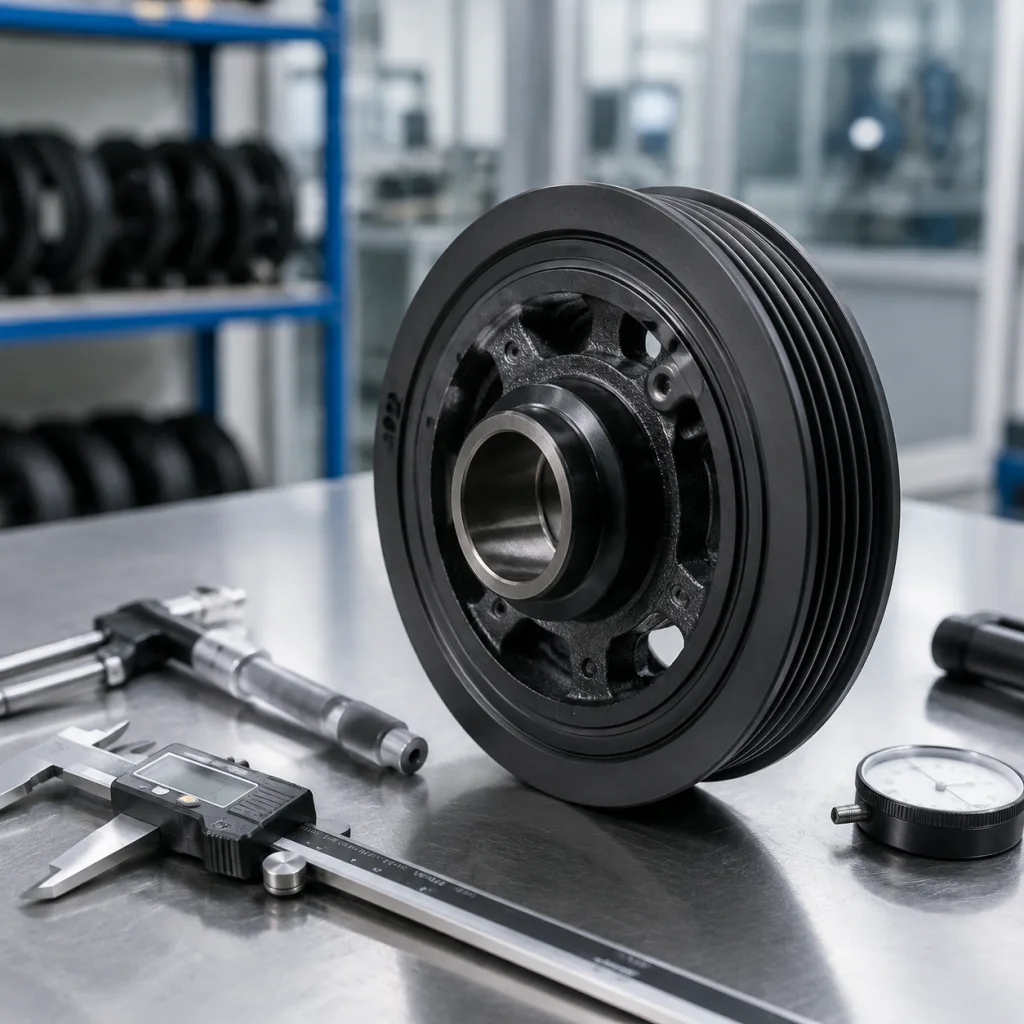
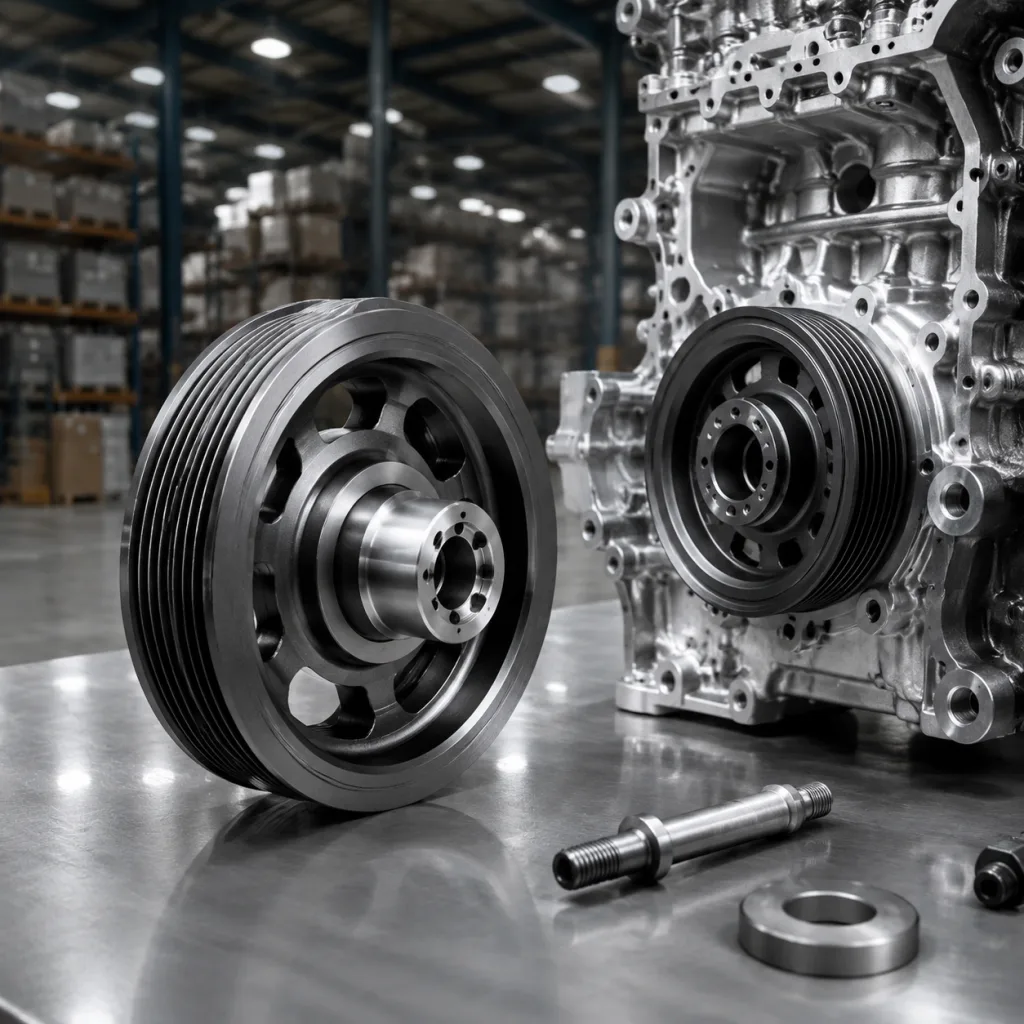
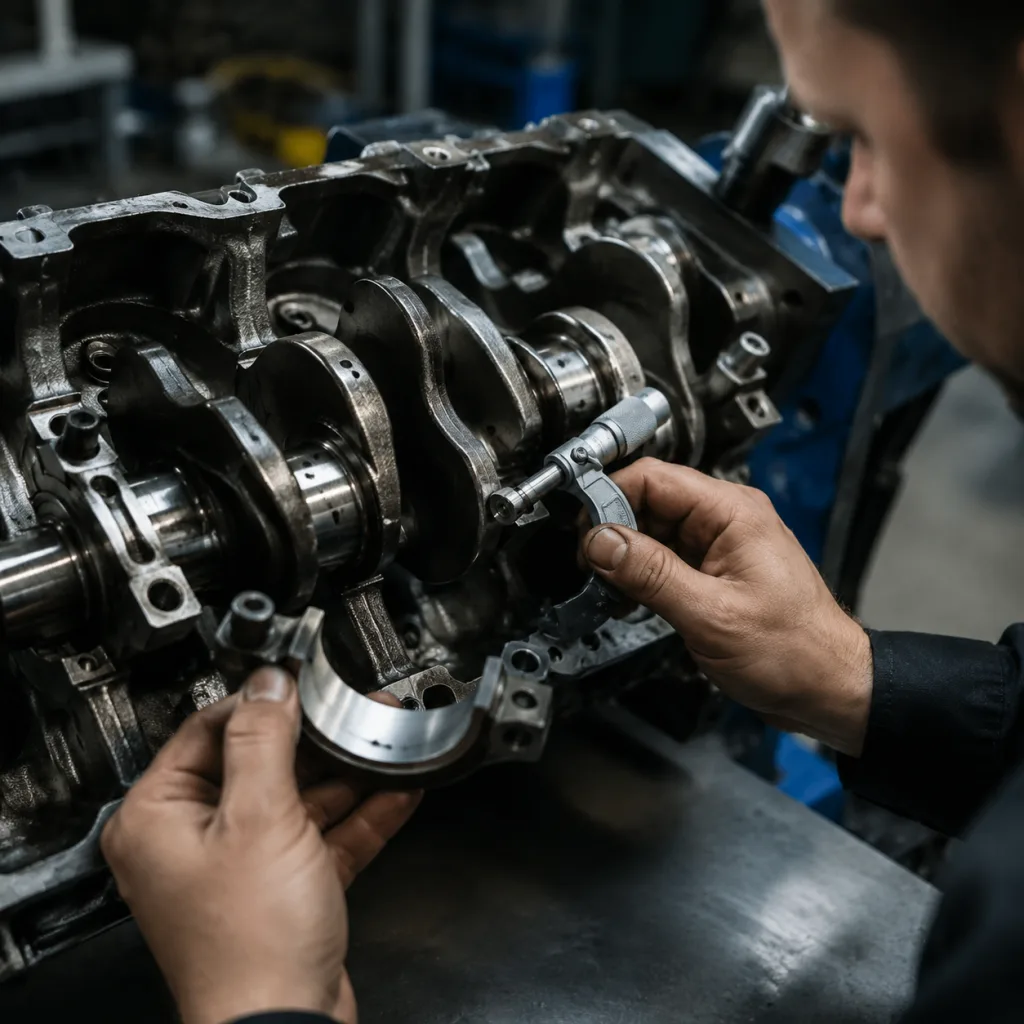
Crankshaft Pulley Peugeot Supplier Sourcing Guide
Choosing a crankshaft pulley Peugeot supplier is rarely a price-only decision. Procurement teams need confidence in fitment coverage, elastomer bonding, torsional damping performance, export packaging, and repeatable documentation across replenishment orders. For distributors, OEM/Tier-1 buyers, and repair-chain category managers, the main failure modes are dimensional drift, rubber-to-metal separation, belt squeal after installation, excessive radial runout, and late supply during seasonal demand peaks. Driventus manufactures engine and powertrain components in Taizhou, Zhejiang, including crankshaft pulleys, pistons, crankshafts, gaskets, water pumps, and turbochargers. We export to more than 60 countries and operate under IATF 16949:2016 and ISO 9001:2015. This guide shows how to qualify a Peugeot crankshaft pulley source, which specifications to request before purchasing, and how to plan MOQ, price, lead time, factory audit preparation, and export documentation. Driventus is an independent aftermarket manufacturer; brand names are used for fitment reference only.
How to Separate a Real Fitment Match from a Catalog Guess
Peugeot crankshaft pulley sourcing often looks simple until the details collide. Two pulleys can share a part number-style reference and still differ in belt line, offset, bore, or damping design. That is why the first step is not price comparison; it is fitment proof.
Buyers should confirm the application by engine code, model year range, fuel type, turbo/non-turbo status, belt rib count, and OE cross-reference format. A supplier that can only quote from a vehicle name is not giving enough technical control. Driventus does not claim approval or endorsement by any vehicle manufacturer.
Build the RFQ around a shared measurement base:
- Vehicle make and model range, referenced for fitment only
- Engine code, displacement, fuel type, turbo/non-turbo status, and production years
- Pulley outside diameter, belt rib count, groove angle, and groove pitch
- Hub bore, bolt-hole PCD, bolt diameter, keyway or locating feature, and offset
- Mounting-face flatness, axial runout, radial runout, and concentricity targets
- Damper design: solid pulley, bonded rubber damper, or dual-mass construction
- Packaging format: neutral carton, private label, service kit, or bulk pack
- Destination market and any country-specific labeling or documentation needs
For quoted comparisons, insist that every supplier work from the same sample revision, drawing revision, inspection datum, and packaging assumption. If the pulley uses a bonded elastomer, the RFQ should also state whether the buyer expects a Shore A range, a defined compound, or a supplier-proposed rubber matched to the approved sample. Driventus maintains cross-reference and application data for aftermarket crankshaft pulley programmes. Buyers can review related engine parts in our catalog and the broader engine components range at /products/engine-components.html.
What Actually Fails in Service, and Why It Matters at Source
A crankshaft pulley is not just a turned metal wheel. On many Peugeot applications it is also a torsional vibration damper. That means the supplier is controlling geometry, rubber chemistry, bonding, balance, and surface protection at the same time. If any one of those slips, the failure may appear only after installation.
Common failure modes include:
- Rubber-to-metal separation after heat cycling
- Belt squeal from groove mismatch or misalignment
- Excessive radial runout that shortens belt and bearing life
- Poor balance that adds vibration and accessory-drive noise
- Corrosion that weakens the pulley during storage or humid-market use
- Dimensional drift that creates installation difficulty or bracket interference
The supplier’s process plan should make those risks visible before purchase. Typical controls include raw material traceability, machining checks, rubber preparation, adhesive application, curing control, balance testing, coating, and final inspection. A procurement team should ask how each step is verified, not simply whether the supplier has a certificate.
A practical control plan should show:
- Receipt of blank, casting, or forging material
- Turning, drilling, broaching, and groove machining
- Degreasing, shot blasting, or surface activation
- Adhesive application, rubber moulding or assembly, and curing
- Final machining where applicable
- Balancing, coating, marking, packing, and outgoing inspection
For audit readiness, buyers should review gauge calibration, traceability examples, corrective-action history, and in-process inspection records. Driventus supports supplier qualification reviews through its quality system, aligned with IATF 16949:2016 and ISO 9001:2015. If PPAP-style evidence is needed, the scope should be agreed early so the right dimensional, material, process, capability, and packaging records are prepared before shipment.
Spec Deep-Dive: The Numbers Procurement Should Lock Down
This is the section that usually prevents rework. The wrong tolerance or unclear surface requirement can turn a reasonable quote into a returned shipment. For Peugeot pulley programmes, the spec conversation should be precise and short.
Lock down these items before release:
- Outside diameter, bore, offset, and mounting-face geometry
- Groove profile, belt rib count, and effective belt-line position
- Radial runout, axial runout, concentricity, and flatness limits
- Rubber hardness window for damper designs, not just a nominal value
- Dynamic balance limit by part family and test method
- Coating type, corrosion resistance target, and storage expectation
- Marking format, batch coding, and packaging standard
Typical production controls used by Driventus include the following:
| Control point | Procurement relevance | Typical verification |
|---|---|---|
| Raw material traceability | Enables batch containment if a defect occurs | Heat number, supplier lot, and incoming inspection record |
| Machining accuracy | Helps prevent belt misalignment and installation difficulty | CMM, bore gauge, groove gauge, runout measurement |
| Critical tolerances | Keeps belt tracking and mounting repeatable | Bore often controlled within ±0.02–0.05 mm; runout target agreed by drawing |
| Elastomer bonding | Reduces the risk of rubber ring separation | Surface preparation record, bonding temperature/time, peel or shear check |
| Rubber hardness | Keeps damping response consistent | Shore A measurement, commonly controlled within an agreed ±5 range |
| Dynamic balance | Controls vibration, noise, and accessory-drive stability | Balance test by part family; residual unbalance limit agreed by size and speed |
| Surface protection | Supports long export storage and humid-market distribution | Zinc phosphate, e-coat, paint, or oil protection; salt-spray hours by specification |
| Final inspection | Confirms shipment conformity before release | AQL sampling, dimensional report, appearance and packaging check |