Timing Chain Kit Material: Specs Buyers Should Verify
Timing chain kit material determines wear life, noise, corrosion resistance, and build consistency. For procurement teams, the real question is not just fitment, but what each loaded component is made from, how it is heat treated, and which test methods verified it. A kit usually includes chains, guides, tensioners, sprockets, seals, and sometimes bolts or gaskets, and each item carries different material and process requirements. Driventus is an independent aftermarket manufacturer; brand names are referenced for fitment only. For buyers comparing suppliers across the EU, UK, US, Canada, Australia, and Brazil, the most useful review is a specification check against OE dimensions, surface hardness, fatigue data, and corrosion exposure. The notes below focus on the material choices that matter most when qualifying a timing chain kit for aftermarket distribution, OEM programs, or multi-location repair networks.
Timing chain kit material: what actually changes between suppliers
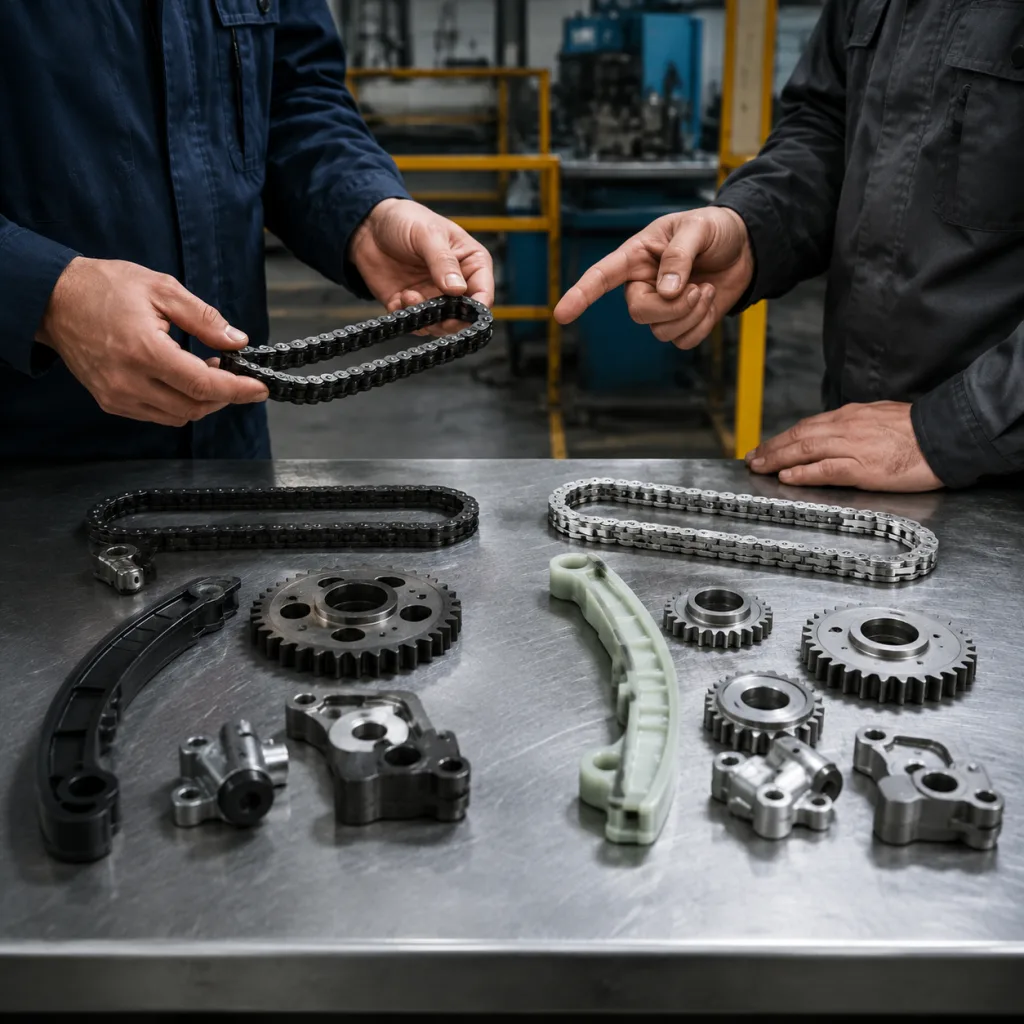
A timing chain kit is a mixed-material assembly, so the sourcing risk sits in the full bill of materials, not a single line item.
Typical component material groups:
Component
Common material
Why it matters
Chain plates and pins
Alloy steel, carburised or through-hardened
Fatigue resistance and elongation control
Guide rails
PA66, PPA, or steel-backed polymer
Wear rate, oil compatibility, and noise
Tensioner body
Aluminium alloy or steel
Stiffness and dimensional stability
Tensioner shoe
Polymer friction layer
Start-up wear and low-friction operation
Sprockets
Case-hardened steel
Tooth wear and pitch accuracy
Seals and gaskets
FKM, NBR, or ACM
Oil resistance and temperature range
</tr></thead><tbody> </tbody></table>The practical procurement question is simple: can the supplier identify the grade, heat treatment, coating, and inspection method for each loaded component? If not, the buyer inherits the risk when warranty claims or field failures appear.
A useful RFQ should name the engine family, OE or cross-reference target, annual volume, target market, required packaging format, and whether the kit is for retail, workshop, or assembly-line use. That context changes the BOM, the validation package, and sometimes the tooling requirement.
Where the failures start: chains, guides, sprockets, seals
Chain set elements
The chain usually drives the longest service expectation and the highest scrutiny. Alloy steel is preferred because it supports controlled carburising, high surface hardness, and stable pin-to-bushing wear behaviour. Buyers should ask for the steel grade, the heat-treatment route, the target surface hardness, the core hardness range where applicable, and proof of fatigue testing.
Common buyer checkpoints for a chain element specification:
Plate thickness tolerance: typically ±0.01 to ±0.03 mm depending on chain type
Pin diameter tolerance: typically ±0.005 to ±0.015 mm
Link pitch consistency: measured across a sample length with a documented Cp/Cpk target where available
Surface hardness: often specified around 58 to 64 HRC for hardened wear surfaces, subject to design
Fatigue evidence: test cycles, load level, lubrication condition, and failure mode documentation
Guides and tensioners
Guide rails are commonly moulded from engineering thermoplastics such as PA66 or PPA, often with glass fibre reinforcement. Those grades help retain shape under oil temperature and cyclic load. The friction surface may be a separate wear layer or a filled polymer blend. Tensioner shoes need low friction and predictable cold-start behaviour, while the body needs dimensional stability under pressure.
For guide components, buyers should verify:
Polymer grade and fibre content, such as PA66-GF30 or a supplier-defined equivalent
Heat deflection or continuous-use temperature rating suitable for engine bay conditions
Wear-layer thickness and bond strength if a two-layer construction is used
Dimensional tolerance on critical mounting bosses and wear surfaces, commonly within ±0.10 to ±0.25 mm depending on geometry
Low-temperature impact performance if cold-start noise is a concern
Sprockets and fasteners
Sprockets are generally case-hardened steel. Case depth, tooth profile accuracy, and concentricity matter more than nominal steel type alone. If the kit includes bolts, confirm whether they are torque-to-yield or reusable, and verify coating compatibility.
Typical sprocket validation asks:
Case depth target and method of measurement
Tooth profile runout and radial runout limits
Bore-to-tooth concentricity
Surface hardness after heat treatment, usually reported in HRC
Coating type for corrosion resistance and storage stability
Sealing items
If a kit includes seals or gaskets, elastomer selection must match oil chemistry and temperature. FKM is often used where heat exposure is higher; NBR remains common where cost and standard oil resistance are the main targets.
For seals, ask for:
Material designation, such as FKM, NBR, or ACM
Temperature range, including peak exposure and continuous use
Compression set data and fluid compatibility summary
Shelf-life and packaging controls to prevent deformation before installation
Driventus specifies material and process controls under our quality system.
Use this checklist before you approve a quote
A timing chain kit material declaration is only useful if sourcing teams compare the same data from every supplier.
Chain plate and pin steel grade
Heat treatment method and target hardness
Chain pitch and pin diameter tolerance
Guide rail polymer grade and fibre content
Tensioner shoe friction material and backing structure
Sprocket case depth, hardness, and runout
Seal elastomer grade and temperature range
Surface coating type for corrosion resistance
Salt spray or cyclic corrosion test method
Packaging control to prevent rust and contamination
Lot coding and traceability format
Sample quantity and PPAP/approval document set
For technical validation, request conformance to published standards where relevant, including IATF 16949:2016, ISO 9001:2015, REACH (EC) No 1907/2006, and test methods such as SAE J2527 for corrosion exposure when used by the supplier. If the application is emission-sensitive, ask whether the kit configuration has been assessed for compatibility with ECE R-83 related engine systems where applicable.
A good supplier should provide dimensional reports, material certificates, and lot traceability. For sourcing decisions, also ask for the minimum order quantity by SKU, the price break points at 100, 500, and 1,000 units, the standard lead time in working days, and any surcharge for special coating, boxed retail packaging, or mixed-kit content. If the supplier cannot state whether tooling is already available, treat the lead-time promise as provisional until the first article is approved.
A practical RFQ should request annual forecast, first order quantity, target ship date, incoterm, destination country, required carton quantity, barcode or label standard, and whether partial shipments are acceptable. Those items directly affect price, production slotting, and finished-goods inventory planning.
What material quality does to noise, wear, and timing stability
Material quality shows up in service outcomes, not just in lab reports.
Higher chain hardness can reduce pin wear, but excessive brittleness raises fracture risk.
Lower-grade polymer guides can deform, increasing chain noise and altering timing stability.
Poor sprocket heat treatment can cause tooth wear or surface pitting.
Inadequate corrosion protection can lead to early rust staining, especially after storage or humid shipping routes.
Loose dimensional control can create stack-up error across the chain, guide, and tensioner system.
The most common failure pattern in low-spec kits is not a single broken part. It is a combination of chain stretch, guide wear, and tensioner loss of control. That is why buyers should compare the complete material stack, not just the chain steel.
From a procurement standpoint, ask the supplier to define the acceptance limits it uses for critical characteristics. For example, if chain elongation after durability testing exceeds the target by even a small margin, the kit may still fit but create timing noise or tensioner overtravel in service. The same logic applies to guide wear thickness, sprocket tooth profile deviation, and seal leakage under heat soak.
If your programme requires non-standard packaging, special coatings, or a revised material stack, use custom manufacturing to define the required specification before sampling.
Standard vs premium materials: a buyer comparison
Area
Standard choice
Higher-spec choice
Trade-off
Chain
Through-hardened alloy steel
Carburised alloy steel
Better wear life, higher process cost
Guide
Filled PA66
PPA with reinforcement
Better heat stability, tighter mould control
Tensioner body
Aluminium alloy
Machined or higher-grade cast alloy
Better stiffness, higher unit cost
Sprocket
Hardened steel
Case-hardened, controlled finish
Better tooth durability, stricter process control
Seal
NBR
FKM
Better heat and oil resistance, higher cost
</tr></thead><tbody> </tbody></table>This comparison is useful when suppliers quote the same part number with different internal constructions. A lower price can be acceptable only if the material stack, hardness, inspection data, and coating performance remain equivalent. If the supplier cannot produce those records, the quote is incomplete.
Buyers should also compare commercial terms against process burden. A kit with custom corrosion coating, laser-marked traceability, and retail packaging will usually carry a higher unit price than a bulk-packed program. The right comparison is landed cost per approved unit, not the ex-works sticker price alone. MOQ often drops when a supplier already has existing tooling and prior validation data, while first-time builds usually require a higher MOQ, a sample approval fee, or both.
For procurement, the review should end with fitment, material, validation data, MOQ, and lead-time assumptions in one file, not separate emails.
What Driventus can supply
Driventus produces timing chain kits with controlled material selection, in-process inspection, and lot traceability for aftermarket and B2B channels. We support OE part-number cross-references where the application data is already established, and we do not claim OEM approval or endorsement.
Typical buyer requirements we can support:
Material declarations by component
Dimensional inspection reports
Salt spray or cyclic corrosion testing on request
Packaging and labelling for distribution programmes
Private-label and custom BOM configurations
MOQ and lead-time confirmation by application
Sample set provision for fit and function validation
Typical commercial flow:
1. Buyer shares engine code, OE reference, annual forecast, target market, and packaging need. 2. Driventus confirms material stack, available tooling, and whether the build is standard or custom. 3. We issue a quote with MOQ, sample quantity, price breaks, and an estimated lead time. 4. Buyer approves samples and receives dimensional, material, and traceability records. 5. Production starts after approval, with packaging and shipping terms aligned to the destination market.
If you need a supplier review, factory documentation, or a quotation for a specific application, start with request a quote.
Frequently asked questions
The chain steel is usually the most critical, but the full kit matters. Guides, tensioners, sprockets, and seals can determine real-life durability and noise.
Yes. Ask for component-level material declarations, hardness data, and traceability. For B2B sourcing, this is basic evidence for validation and warranty control.
Yes. We support custom manufacturing for material, coating, packaging, and kit content changes when the technical requirements are clearly defined.
If you are qualifying a kit for distribution or OE-equivalent replacement, send the application details and target specification through /contact.html.