Exhaust Manifold Salt Spray Test Standard Guide
Salt spray testing is often requested for exhaust manifolds, especially in export markets that use de-icing salts or in coastal fleets exposed to high-chloride conditions. Procurement teams often ask for a single pass/fail number, but the correct requirement depends on manifold material, coating system, welds, machined faces, tolerance-sensitive sealing surfaces, and the intended duty cycle. A cast iron manifold, a stainless tubular manifold, and a coated fabricated assembly should not be judged by the same corrosion acceptance criteria.
This guide explains how to define an exhaust manifold salt spray test standard in a purchase specification, what laboratories normally report, and how to verify that a supplier’s result is relevant to production parts. It is written for sourcing engineers, import managers, and category buyers comparing aftermarket and OE-equivalent exhaust manifold suppliers. Driventus is an independent aftermarket manufacturer; brand names are referenced for fitment only.
Which published salt spray standards apply
The most common neutral salt spray references are ASTM B117 and ISO 9227. Both describe a controlled corrosive atmosphere using sodium chloride solution, defined temperature, pH range, collection rate, and exposure duration. They are widely used for comparative quality control, coating verification, and incoming inspection.
For exhaust manifolds, these standards do not define the functional life of the part on a vehicle. They define the test environment. The buyer must still specify the sample type, exposed surfaces, masking, acceptance criteria, and reporting format.
A practical sourcing specification normally references:
- ASTM B117 or ISO 9227 for the neutral salt spray method.
- ISO 9001:2015 for documented inspection control and traceability.
- IATF 16949:2016 where automotive process control, PPAP-style evidence, corrective action, and change management are required.
- REACH (EC) No 1907/2006 when coatings, surface treatments, or supplied articles are shipped into the EU market.
- Applicable emissions and durability requirements such as ECE R-83 when the manifold is part of an emissions-relevant engine system, although ECE R-83 is not a salt spray procedure.
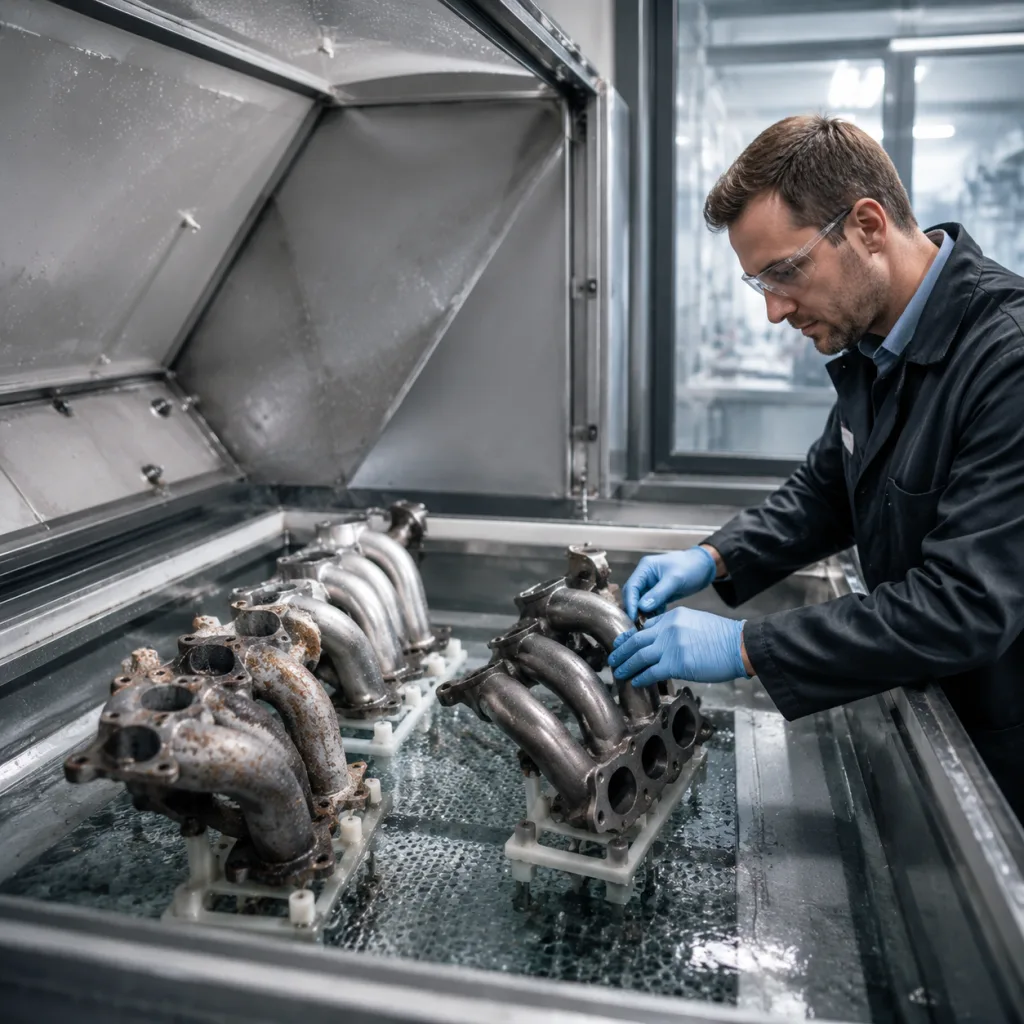
For lab setup, buyers should expect the report to state at minimum: chamber temperature at 35 ± 2 °C, salt solution concentration at 5 ± 1% NaCl, pH in the target range specified by the method, and collection rate in the chamber around 1.0 to 2.0 mL/h per 80 cm² of horizontal collection area. If the laboratory cannot provide those readings, the result is weak for supplier comparison.
Driventus controls exhaust manifold manufacturing under a documented quality system, including material traceability, dimensional inspection, process records, and corrosion test coordination where required by the customer specification.
How to write the test requirement in a sourcing drawing
Avoid a vague note such as “salt spray 240 hours OK”. It is incomplete and creates disagreement during inspection. A useful requirement identifies the test method, surface condition, sample origin, exposure time, inspection points, and allowed corrosion.
A concise specification may read:
- Test method: ISO 9227 neutral salt spray, or ASTM B117 neutral salt spray.
- Sample type: production-representative exhaust manifold from normal casting, machining, welding, cleaning, and coating process.
- Sample quantity: minimum 3 pieces per part number for routine qualification; 5 pieces if the part is a new design, a new coating system, or a high-risk export programme.
- Exposure duration: defined by buyer, for example 96, 240, 480, or 720 hours depending on material and coating.
- Masking: gasket faces, threaded holes, oxygen sensor bosses, and machined sealing areas masked or unmasked as specified.
- Evaluation interval: record at start, intermediate interval, and final inspection; many buyers choose 0 / 96 / 240 / final for qualification programs.
- Acceptance criteria: red rust, coating blistering, flaking, pitting, thread seizure, sealing-face corrosion, and dimensional impact.
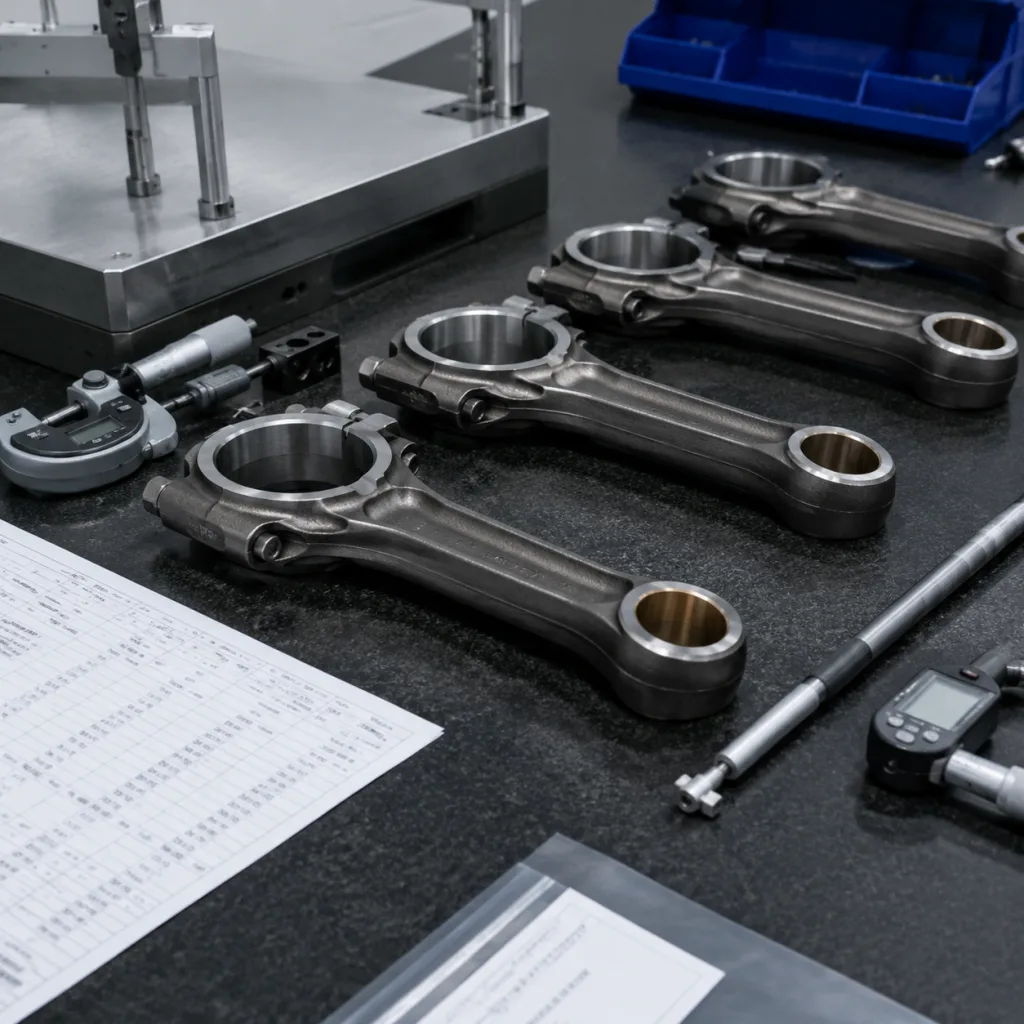
- Dimensional tolerance check: verify critical faces and hole locations before and after exposure; a typical buyer may require no sealing-face distortion greater than 0.10 mm flatness change and no thread gauge failure after test, unless the drawing states tighter limits.
- Report: include photos, chamber calibration status, solution concentration, pH, temperature, collection rate, sample identification, and any post-test dimensional readings.
A buyer sourcing multiple engine variants through our catalog should keep one common corrosion test template, then adjust exposure hours and acceptance levels by material family. This makes quotation comparison more reliable and reduces exceptions after sample submission.
For commercial control, it also helps to define when testing is paid by the buyer and when it is included in the unit price. A common approach is: no separate test charge for standard repeat orders when the test is part of the quality plan, but a one-time laboratory fee for new tooling, new coating, or first article validation. For small lots, many suppliers will quote the test as a non-recurring engineering charge unless the annual volume exceeds an agreed MOQ threshold.
Recommended acceptance criteria by manifold type
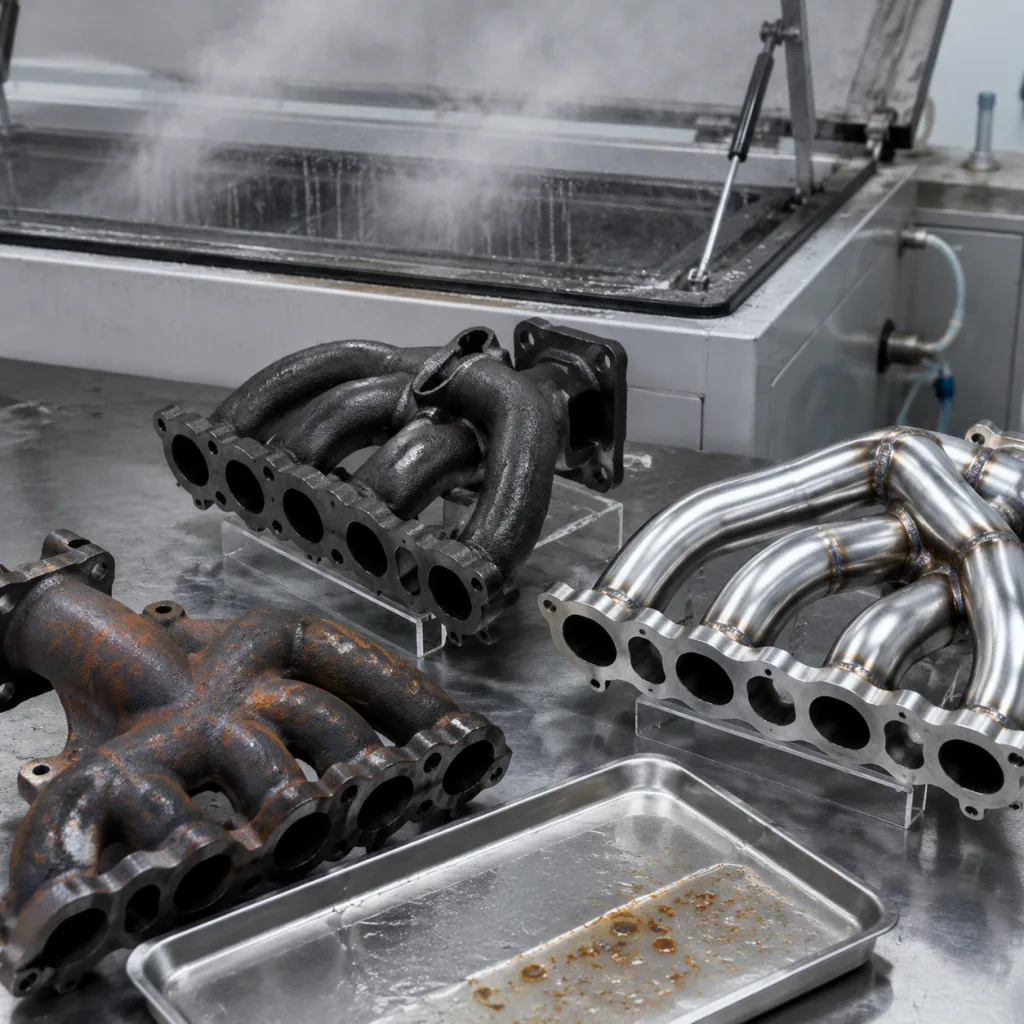
Corrosion assessment must reflect how the exhaust manifold is made. High-silicon molybdenum cast iron can show superficial oxidation while still meeting functional requirements. Stainless tubular assemblies may require stricter visual limits at welds. Coated manifolds need evaluation of coating adhesion and underfilm corrosion, not only surface rust.
| Manifold type | Typical material or process | Salt spray focus | Example acceptance points |
|---|---|---|---|
| Cast iron manifold | High-temperature grey iron or ductile iron grades | Uniform oxidation, sealing face condition, thread function | No corrosion that affects gasket sealing, bolt seating, or sensor installation; sealing face remains within 0.10 mm flatness drift unless drawing states otherwise |
| Stainless tubular manifold | Stainless tube, formed and welded | Weld bead corrosion, heat-affected zone, crevice areas | No perforation, cracking, severe pitting, or weld-adjacent flaking; no crack indication at weld toes under visual or dye-penetrant follow-up where required |
| Coated cast manifold | Cast substrate with paint, aluminised, or other coating | Coating adhesion, blistering, edge creep | No coating delamination beyond agreed limit; blistering limited to ISO 4628 rating or buyer-defined area; machined faces remain functional |
| Turbo manifold | Cast or fabricated, high thermal load | Flange flatness, turbine mounting face, fastener bosses | No corrosion that affects turbo mounting, sealing, or fastener torque; flange bolt-hole position and flatness remain within drawing tolerance after test |