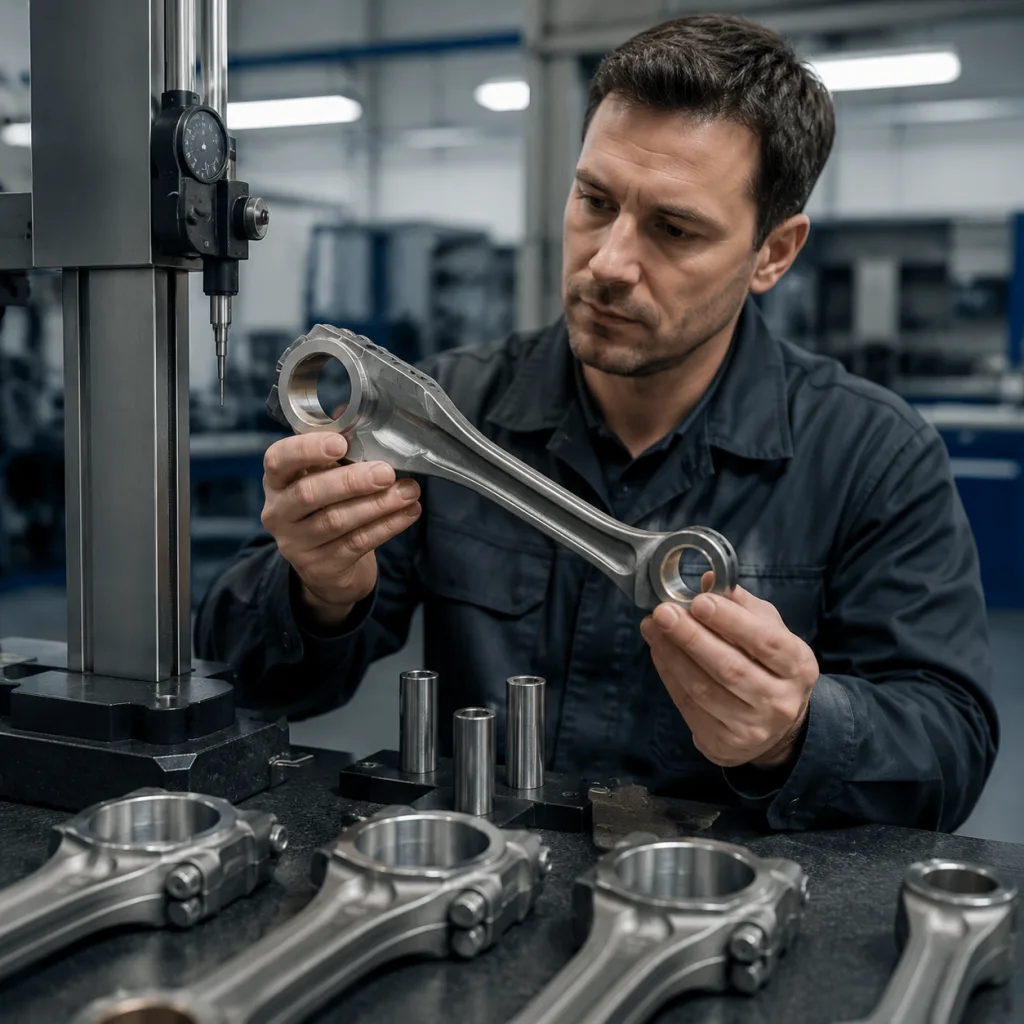
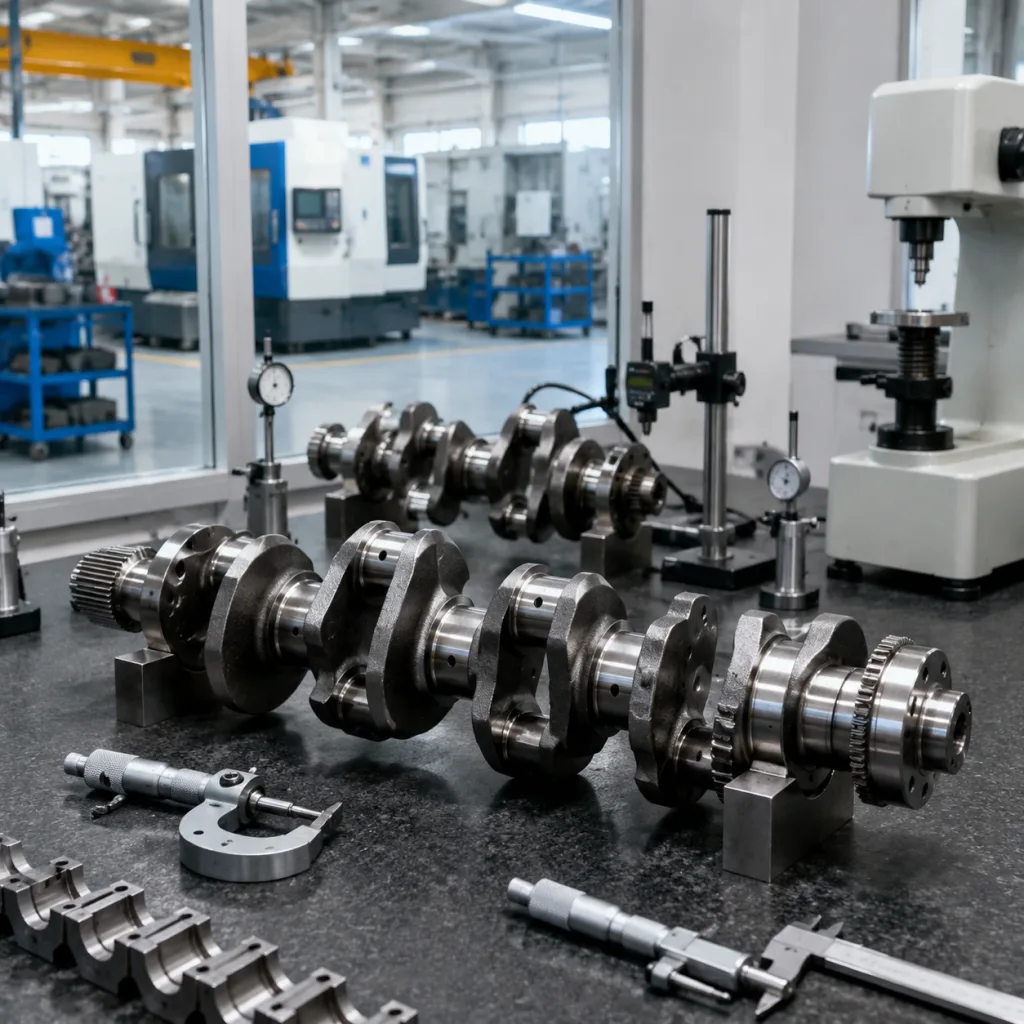
A connecting rod for Fiat Doblo replacement should be qualified by engine family and measured specification before it enters a sourcing programme. The critical checks are crankpin journal size, piston-pin diameter, centre-to-centre length, big-end housing bore, big-end width, bearing interface, cap design, bolt specification, and rod weight. For distributors and repair-chain buyers, the main risk is not simple catalogue fitment; it is whether every production batch repeats the approved sample through controlled steel grade, heat treatment, machining, bore honing, bolt clamping, inspection, and traceable packaging. This guide gives B2B buyers concrete controls for comparing OE-equivalent aftermarket connecting rods for Fiat Doblo applications, including dimensional confirmation, tolerance targets, material review, validation tests, MOQ and price logic, lead-time planning, workshop-channel risk reduction, and order documentation. It is intended for procurement and quality teams, not for retail installation guidance. Driventus supplies engine components for aftermarket and programme customers through catalogue supply and custom manufacturing. Driventus is an independent aftermarket manufacturer; brand names are referenced for fitment only.
Fitment Scope and OE-Equivalent Matching
Fiat Doblo applications differ by market, model year, displacement, fuel type, emission generation, and engine code. A replacement rod should therefore be specified by confirmed engine code and measured dimensions, not by vehicle name alone. Before a production order is placed, buyers should request a technical drawing, sample inspection report, or approved-sample reference that defines the physical part.
Key fitment checks include:
Engine identification: displacement, fuel type, engine code, emission generation, and production year range; one Doblo range can contain different crankshaft, piston, and rod combinations.
Big-end bore: finished housing bore measured after cap assembly and bolt torque; buyers should define the bore diameter, roundness, cylindricity, and bearing-shell reference, with critical bore variation commonly controlled in the 0.005–0.015 mm range depending on drawing class.
Crankpin and width interface: crankpin diameter, big-end width, side-clearance requirement, chamfer position, oil-hole design, and bearing locating tang position must match the crankshaft and shell set.
Small-end design: press-fit pin, floating pin, bronze bushing, or unbushed steel bore; the order file should state pin diameter, bore finish, bushing material, and oil-hole orientation where applicable.
Centre distance: centre-to-centre length between crankpin and wrist-pin bores; many buyer drawings control this within about ±0.02–0.05 mm because deviation affects compression height and piston crown position.
Rod weight balance: total weight and end-to-end weight split; for matched sets, practical aftermarket targets are often within 2–5 g total weight and within 1–3 g per end unless the OE drawing requires tighter control.
Cap separation method: machined cap or fracture-split design, which affects cap matching, orientation control, claim review, and service handling.
OE part-number cross-references can help narrow the search, but they should not replace dimensional confirmation. A practical RFQ should include the target engine code list, required annual volume, sample quantity, drawing or used OE sample, bearing-shell reference, bolt requirement, and packaging preference. Driventus can review generic references such as OE 06A… or OE 11251… after the buyer provides full application data, a drawing, or a physical sample. No vehicle manufacturer approval is implied.
Material, Heat Treatment and Machining Controls
Connecting rods for light commercial diesel and petrol engines are commonly produced from forged steel, powder-forged steel, or high-strength cast steel, depending on the original design and expected load. The material route should match the engine duty cycle. A Doblo used for parcel delivery, trades work, or urban fleet service may experience frequent cold starts, repeated low-speed torque demand, stop-start operation, and high idle hours. Those conditions make fatigue strength, bore stability, and cap clamping consistency important sourcing criteria.
Control point
Buyer requirement
Practical target or record
Why it matters
Raw material certificate
Heat number and grade traceability
Steel grade, heat number, supplier lot
Confirms steel source and batch identity
Heat treatment record
Hardness range and process lot
Typical forged-steel rod hardness may sit around HRC 28–36, subject to drawing
Supports fatigue performance and dimensional stability
Big-end bore tolerance
Measured after cap torque
Diameter, roundness, cylindricity, bore gauge master ID
Protects oil clearance and bearing life
Small-end bore tolerance
Matched to pin or bushing design
Pin-fit class, bushing ID, oil-hole position
Controls pin noise, seizure risk, and wear
Surface finish
Bore and thrust-face Ra values
Bore finish commonly specified around Ra 0.4–0.8 µm where honed
Reduces bearing distress and fretting
Bolt control
Grade, torque method, and thread inspection
Bolt grade, torque/angle value, thread gauge result
Maintains cap clamping under cyclic load
Weight control
Total and end-weight data
Set matching target agreed before production
Reduces vibration and cylinder imbalance
</tr></thead><tbody> </tbody></table>The production route should normally include forging or casting review, normalising or quench-and-temper control where specified, shot blasting, rough machining, cap cutting or fracture splitting, bolt-hole machining, cap assembly, torque-controlled big-end finish honing, small-end boring or bushing, surface cleaning, rust protection, and final inspection. Buyers should ask which dimensions are checked at line inspection and which are checked at final audit, because a rod measured before cap torque does not prove bearing housing geometry in service condition.
Driventus production controls are managed under IATF 16949:2016 and ISO 9001:2015. These management-system standards do not replace part-level validation, but they define the operating discipline for process control, corrective action, traceability, supplier management, gauge calibration, and continuous improvement. Buyers can review the quality system as part of supplier approval.
Validation Tests Buyers Should Request
For connecting rod for Fiat Doblo replacement programmes, buyers should separate initial sample approval from routine batch inspection. A supplier may pass dimensional checks on a small sample yet still lack production controls for fatigue strength, cap alignment, bore roundness, or thread consistency. The validation package should prove that the proposed rod meets the drawing and that the process can repeat it.
A practical validation pack should include:
First article inspection report covering all drawing dimensions, with at least 3–5 pieces measured for sample approval and critical dimensions clearly marked.
Material certificate linked to the production lot, including heat number, grade, chemical composition, and supplier batch.
Hardness results and heat-treatment batch record, with readings taken from agreed locations rather than only from a furnace coupon.
Magnetic particle inspection or another crack-detection method for forged rods where specified, especially after forging, heat treatment, or cap separation.
Big-end roundness and cylindricity data measured after bolt tightening to the specified torque or torque-angle value.
Small-end bore geometry, bushing-retention checks, pin-fit confirmation, and oil-hole alignment where applicable.
Weight data for total rod weight and reciprocating/rotating end split, preferably reported per cavity, fixture, or production batch.
Bolt thread gauge results, proof-load or certificate data, and torque-angle or torque-yield evidence if the design depends on controlled bolt stretch.
Fatigue test summary for new programmes, modified designs, changed material route, or higher-risk commercial-vehicle applications.
Packaging drop, corrosion, or sea-freight protection check where the order will move by consolidated container or long storage.
For routine batch release, buyers can define an incoming-control plan such as 100% visual and traceability check, 5-piece dimensional audit per lot, 1–3 pieces for hardness where destructive checks are not required, and 100% protection of machined bores and threads. Higher-risk launches may use a tightened AQL such as 0 critical defects, AQL 1.0 for major defects, and AQL 2.5 for minor packaging or cosmetic issues, subject to the buyer’s quality system.
For aftermarket distribution, Driventus normally recommends retaining golden samples and inspection masters for each engine family. These references help resolve claims quickly when a field complaint involves oil starvation, incorrect bearing selection, improper bolt reuse, mixed caps, or assembly contamination rather than a manufacturing defect.
Replacement Risk Points in the Workshop Channel
Although this guide is written for procurement teams, workshop failure patterns should influence the sourcing specification. A connecting rod is rarely replaced in isolation unless the engine has suffered bearing damage, hydrolock, piston seizure, lubrication failure, or overhaul-related wear. Buyers supplying repair chains should make sure packaging, labels, and technical support documents help prevent avoidable installation errors.
Common risk points include:
Incorrect engine code selection: similar Doblo model names can use different crankshaft, piston, and rod combinations; carton labels should show engine-code coverage and exclusion notes where fitment is narrow.
Mixed rod caps: fracture-split caps must stay with the original rod body and orientation; buyer instructions should warn against swapping caps between rods even when the cast or forged shape appears identical.
Bearing mismatch: the rod housing bore must correspond with the bearing shell set and crankpin size; oversized or undersized crankshaft repair bearings should be called out separately.
Bolt reuse: some designs require new bolts if the fastening method depends on controlled stretch; if bolts are included, the package should state quantity per rod and the fastening method.
Poor cleaning after failure: debris from a failed bearing can damage the replacement rod and crankshaft journal; repair-chain notes should require oil-gallery cleaning, crankshaft inspection, and oil-pump review after severe failure.
Unbalanced sets: replacing one rod without checking weight can introduce vibration in sensitive engines; buyers can offer rods as matched sets when the market expects overhaul kits.
Wrong orientation: oil holes, chamfers, bearing tangs, and piston-pin offset must be aligned with the engine build specification, not assumed from appearance.
Procurement teams can reduce returns by specifying clear carton labels, engine-code fitment tables, batch traceability marks, QR-code batch lookup, corrosion paper or VCI bag protection, and instructions on cap orientation or bolt replacement where relevant. For private-label supply, useful carton fields include part number, engine code, batch number, production date, quantity, country of origin, barcode, and handling note such as “keep rod and cap matched”. Driventus engine components can be reviewed through /products/engine-components.html, with broader product availability listed through the catalogue.
Sourcing Criteria for Distributors and Repair Chains
A replacement programme should be judged on more than unit price. The cost of a connecting rod claim can include labour reimbursement requests, damaged crankshafts, engine downtime, emergency freight, inventory quarantine, and customer loss. Buyers should qualify suppliers using both technical evidence and operational performance.
Recommended commercial and technical checkpoints:
Confirm that IATF 16949:2016 or ISO 9001:2015 certification scope covers engine component manufacturing, machining, or relevant quality operations.
Request production part approval documentation for new or revised items where applicable to your organisation, including control plan, process flow, PFMEA, MSA, and capability data for critical bores when required.
Define acceptable AQL level, critical dimensions, inspection frequency, non-conformance process, quarantine responsibility, and claim-response timing in the purchase agreement.
Require barcode or lot coding on cartons for warehouse traceability, with each inner pack linked to production date, material lot, heat-treatment lot, and final inspection record.
Agree packaging protection for machined bores, mating faces, threads, and bolts during sea freight, including VCI bag, bore sleeve, oiled paper, divider carton, or foam insert as needed.
Check whether the supplier can support low-volume applications through custom manufacturing instead of requiring large speculative stock.
Review compliance expectations for materials and packaging, including REACH (EC) No 1907/2006 where products enter the EU market.
MOQ and price logic should be discussed before samples are approved. For catalogue rods with existing tooling, sample quantities may be 1–5 pieces and trial orders may start from a few dozen to several hundred pieces depending on stock position and packaging. For custom manufacturing, MOQ is driven by forging die or casting tooling, machining fixture setup, heat-treatment batch size, and inspection cost; buyers should expect higher minimums when a new blank, new bushing, or dedicated gauge is required. Unit price normally moves with material grade, forging weight, machining cycle time, bolt inclusion, 100% inspection requirements, packaging standard, documentation depth, and Incoterms.
Lead time should be separated into sample, tooling, mass production, and freight. Existing-stock samples can often be prepared faster than newly machined samples, while custom tooling and first-article approval may add several weeks before mass production starts. For planning purposes, buyers should ask for a written timeline covering drawing review, sample production, sample inspection report, buyer approval window, production slot, final inspection, export documents, and sea or air freight.
Driventus exports from Taizhou, Zhejiang, to more than 60 countries. For buyers building a Fiat Doblo aftermarket range, the practical path is to validate samples, confirm dimensional and material reports, approve packaging, and then scale into scheduled releases or blanket orders tied to forecasted demand.
Documentation to Include With Each Order
Clear documentation reduces disputes and speeds incoming inspection. For a connecting rod for Fiat Doblo replacement order, the purchase file should identify both the application and the physical specification so the supplier, warehouse, and quality team work from the same reference.
A complete order pack should normally include:
Vehicle application range and engine code list, including market, model-year range, fuel type, and any exclusions.
Drawing number, revision level, approved sample reference, or signed golden-sample record.
Any OE cross-reference supplied by the buyer, written generically where public use is restricted.
Material grade, heat-treatment requirement, hardness range, surface-treatment or shot-peening requirement where applicable.
Critical-to-quality dimensions, including big-end bore, small-end bore, centre distance, big-end width, bolt-hole geometry, cap alignment, and weight target.
Inspection frequency, report format, gauge method, and whether results are required per piece, per batch, or per shipment.
Bolt inclusion status, bolt grade, washer requirement if any, torque or torque-angle specification, and whether replacement bolts must be packed separately.
Packaging standard, inner quantity, master carton quantity, pallet labelling, VCI or oil protection, barcode format, and corrosion-protection duration.
Required certificates, inspection reports, packing list, commercial invoice, country-of-origin documents, and any customer-specific compliance declaration.
Commercial terms covering MOQ, target price range, Incoterms, payment terms, sample charge, tooling charge if applicable, lead time, and forecast or blanket-order schedule.
For repeat orders, buyers should add an engineering-change rule: no change to material source, heat-treatment process, forging/casting supplier, machining fixture, bolt supplier, or packaging method without written approval. This protects the approved sample condition and prevents silent process changes that are difficult to detect at warehouse receiving.
For OEM, Tier-1, or private-label programmes, Driventus can develop drawings, tooling, inspection gauges, and production control plans through custom manufacturing. For standard aftermarket supply, buyers can request application lists, sample availability, documentation scope, MOQ, price basis, and lead-time details before committing to a container or scheduled blanket order.
Frequently asked questions
Confirm the engine code, model year range, fuel type, crankpin diameter, piston pin size, big-end bore, big-end width, centre distance, cap design, bolt specification, oil-hole layout, and rod weight specification. Vehicle name alone is not enough because Doblo applications vary by market and generation.
Yes. Sample supply is usually available after application data, drawings, or physical samples are reviewed. Buyers can request dimensional reports, material documentation, hardness data, weight records, and other agreed validation records as part of the sample approval process.
No. Driventus is an independent aftermarket manufacturer; brand names are referenced for fitment only. Products are supplied for OE-equivalent replacement or customer-specified manufacturing programmes without implying endorsement by any vehicle manufacturer.
If you are building a Doblo engine parts range, share the engine codes, target volumes, sample quantity, MOQ expectations, target price basis, packaging standard, and documentation requirements so Driventus can check availability, fitment evidence, validation scope, and lead time. To start a sourcing review, request a quote at /contact.html