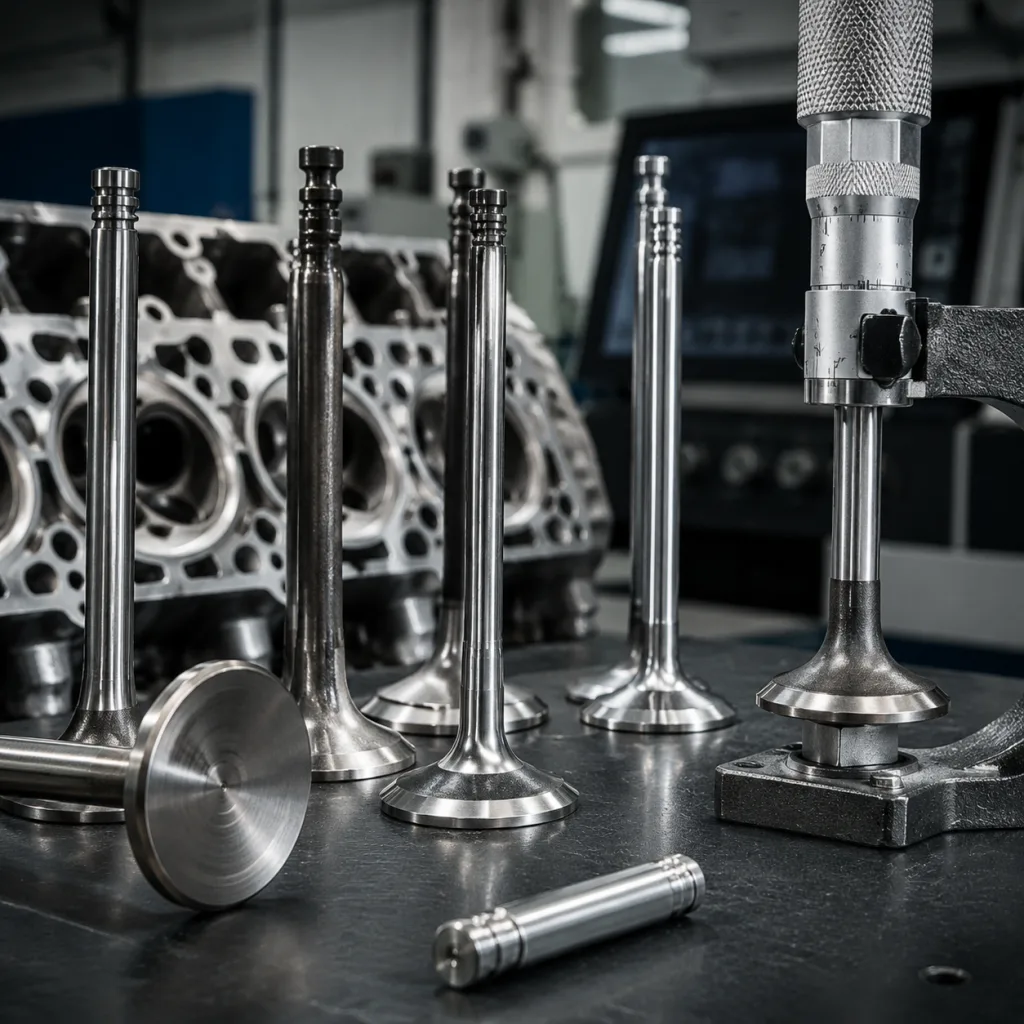
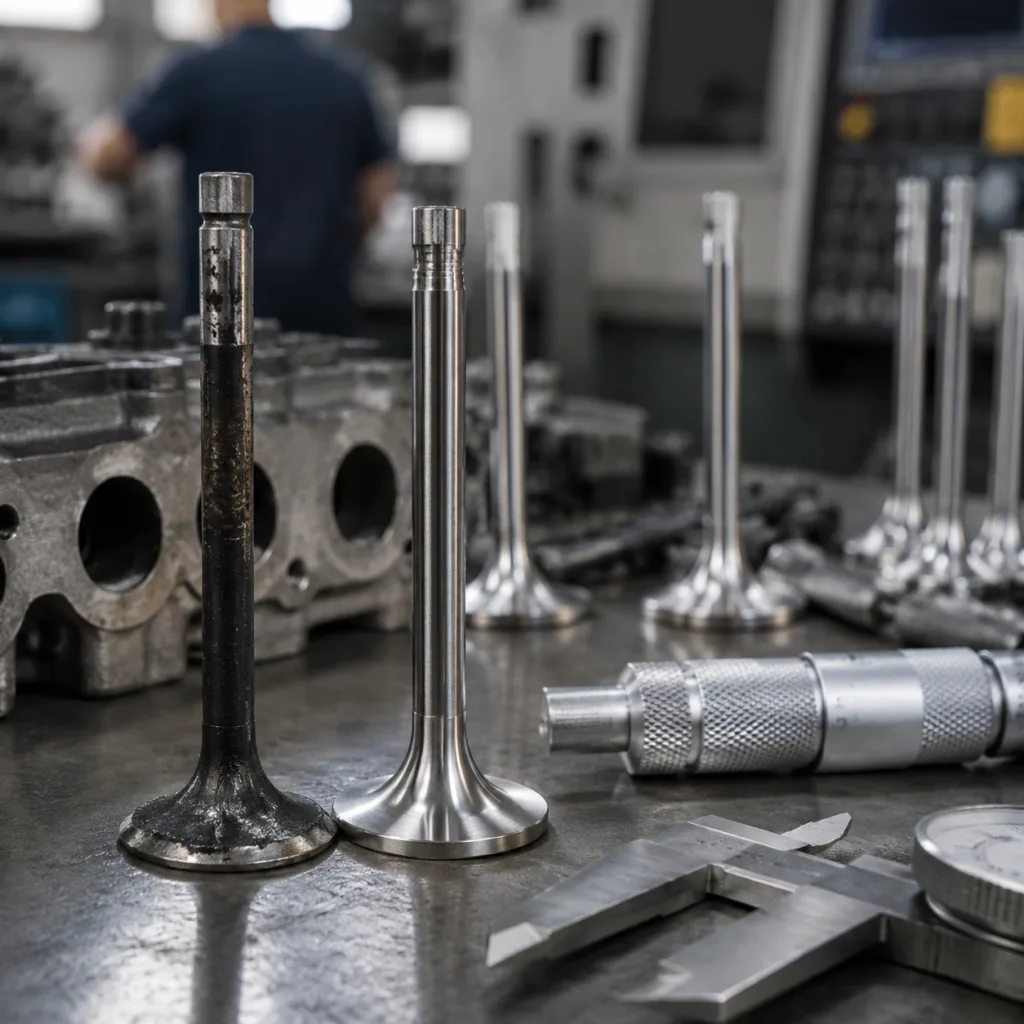
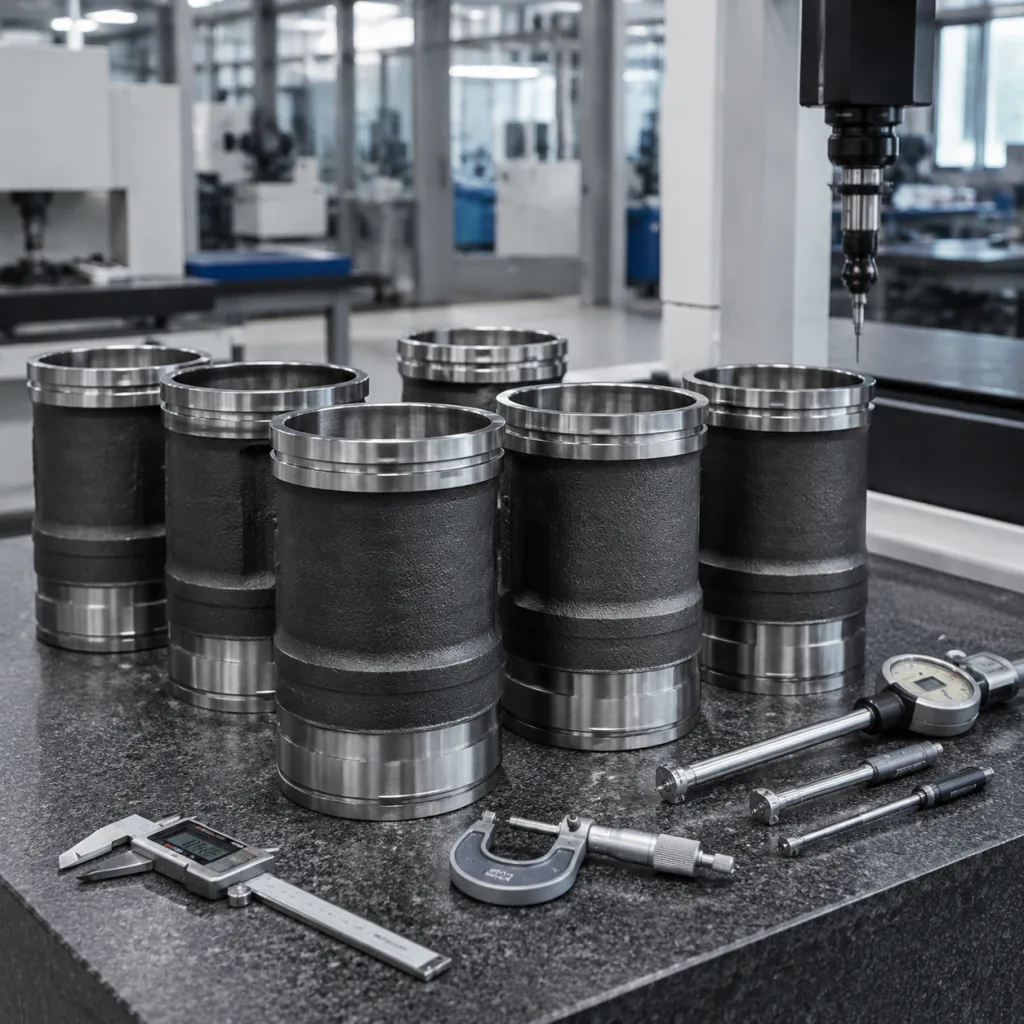
Price only matters after the geometry is trusted. A valve may fit a catalogue line and still create warranty exposure if the stem, margin, keeper groove, seat face, or overall length misses the required limit by 0.05 mm. For B2B sourcing, the practical question is not “Can the supplier make this valve?” but “Which engine valve dimensions are controlled, how are they measured, and what evidence proves they stay controlled in production?”
This guide reframes valve sourcing around decisions procurement teams actually make: what to put in the RFQ, which tolerances deserve capability data, how materials change final size, what to inspect on arrival, and how dimensional errors show up in the field. It is written for sourcing engineers, import managers, distributors, repair-chain buyers, and programme managers working with intake and exhaust valves for passenger car, light commercial, and selected heavy-duty applications. Driventus is an independent aftermarket manufacturer; brand names and OE references are used for fitment identification only.
Start the RFQ with the dimensional stack, not the catalogue match
A usable RFQ must describe the full functional stack. Head diameter and stem diameter are only the beginning. The relationship between the head, stem, seat face, tip, keeper grooves, margin, and overall length controls sealing, guide clearance, spring retention, installed height, oil control, and heat transfer.
If two quotations look similar but one supplier has not confirmed the datum scheme or measurement method, the prices are not comparable.
Dimension
Why procurement should care
Common measurement method
Head diameter
Controls flow area and seat contact position; passenger-car valves are often 24–40 mm, while heavy-duty valves may exceed 45 mm
Digital caliper, CMM, or optical comparator
Overall length
Affects installed height and valvetrain geometry; many light-vehicle valves fall around 85–140 mm
Height gauge or dedicated fixture from tip datum to head datum
Stem diameter
Controls guide clearance and oil control; common nominal sizes include 5.0, 5.5, 6.0, 7.0, 8.0, and 9.0 mm
Micrometer, air gauge for high volume
Seat face angle
Must match valve seat insert geometry; 45° is common, with 30° used in selected designs
Optical comparator, angle gauge
Margin thickness
Supports heat transfer and resistance to burning; commonly checked near 0.7–2.0 mm depending on head size
Caliper or sectioned sample audit
Keeper groove position
Determines spring retainer location and lock engagement; small position errors change installed height
Profile projector or coordinate measuring machine
Tip length and tip hardness zone
Protects rocker, tappet, or follower contact durability
Height gauge plus hardness test
Fillet radius under head
Reduces stress concentration and fatigue risk
Optical profile inspection
</tr></thead><tbody> </tbody></table>The first decision is the drawing source. Are the engine valve dimensions taken from an OE drawing, customer drawing, reverse-engineered drawing, or approved reference sample? Each option carries different risk. A controlled drawing is the cleanest source. A new OE reference sample can be useful. A worn field sample is risky and should not define nominal stem diameter, seat face width, tip height, or margin without engineering review, because wear and regrinding can remove 0.02–0.20 mm from functional surfaces.
For sample-based projects, measure at least 3–5 unworn samples or new OE references where possible. Then convert the data into a controlled drawing with tolerances, datums, inspection points, and revision status. OE references such as 06A107065 or 11251… may help when they already exist in the customer’s fitment data, but they cannot replace dimensional confirmation.
Driventus can map samples, drawings, and application lists through custom manufacturing when private-label programmes or SKU consolidation require a controlled specification.
Tolerance triage: which valve dimensions deserve the tightest control?
Not every dimension deserves the same inspection cost. The sourcing task is to separate critical-to-function features from general features, then assign measurement frequency and capability targets accordingly. Stem diameter, seat face runout, keeper groove geometry, stem straightness, and overall length usually sit at the top of the risk list.
The ranges below are typical sourcing discussion points. They are not a substitute for an approved engineering drawing.
Feature
Typical tolerance range
Buyer decision point
Stem diameter
±0.005 to ±0.015 mm
Confirm measuring height along the stem; affects guide clearance, oil consumption, and seizure risk
Head diameter
±0.05 to ±0.10 mm
Check against seat insert diameter and combustion chamber clearance
Overall length
±0.05 to ±0.15 mm
Critical for hydraulic lash adjuster range and installed height consistency
Seat face runout
≤0.03 to 0.05 mm
Affects sealing, compression stability, and seat wear
Stem straightness
≤0.02 to 0.04 mm
Higher risk in long-stem diesel and heavy-duty valves
Seat face width
±0.05 to ±0.15 mm
Must align with heat transfer and sealing targets
Surface roughness on stem
Ra 0.2–0.8 µm typical
Impacts guide wear, oil film, and scuffing risk
Keeper groove width
±0.02 to ±0.05 mm
Must match valve locks and retainers
Tip hardness depth
Drawing-defined, often verified by section audit
Important for cam follower, rocker, or tappet contact wear
</tr></thead><tbody> </tbody></table>A practical tolerance strategy looks like this:
1. Classify the dimension. Is it safety, sealing, wear, installation, or cosmetic? 2. Define the datum. A measurement is only meaningful if both parties use the same reference surfaces. 3. Choose the gauge. Micrometer, air gauge, height fixture, optical comparator, CMM, or dedicated runout fixture. 4. Set the control method. 100% inspection, first-off/last-off inspection, SPC, or AQL sampling. 5. Request capability evidence. For stable mass production, Cpk ≥1.33 is a practical expectation for key characteristics; Cpk ≥1.67 may be agreed for warranty-sensitive dimensions.
Measurement conditions can distort results if they are ignored. Confirm whether inspection is performed at 20 °C, whether fixtures are in the calibration system, and whether operators follow the drawing datum scheme. For higher-risk programmes, buyers often require 100% gauging for stem diameter, straightness, and seat runout; first-off and last-off checks per grinding machine; and statistical sampling for lower-risk external features. This supports ISO 9001:2015 measurement traceability and the process discipline expected in IATF 16949:2016 supply chains.
Spec deep-dive: how material and process choices move finished dimensions
Engine valve dimensions are not just machined into the part at the end. They are shaped by metallurgy and every upstream process step. Change the steel grade, heat treatment, friction-weld setup, coating, nitriding depth, or final grinding sequence and the final geometry can shift.
That is why the material specification belongs in the same sourcing discussion as the dimensional drawing.
Typical specification points include:
Intake valve materials: martensitic or alloy steel grades selected for wear resistance, machinability, and stem durability, commonly in the X45CrSi or 40Cr family depending on drawing requirements.
Exhaust valve materials: austenitic heat-resistant steels selected for high-temperature strength and oxidation resistance, such as 21-4N or equivalent grades where specified.
Bi-metal construction: friction-welded or similar designs that combine a heat-resistant head with a wear-resistant stem; the weld zone should be defined and validated by bend, tensile, hardness, or metallographic checks.
Surface treatment: nitriding, chrome plating, or drawing-defined stem treatment to reduce wear, scuffing, and guide friction; stem build-up or diffusion depth must be included in final dimensional control.
Seat face treatment: induction hardening, stellite-facing, or other alloy facing where load, temperature, LPG/CNG use, or turbocharged operation requires it.
Tip treatment: hardening or cap welding where rocker, tappet, or follower contact stress is high; tip hardness is commonly specified in HRC or HV with a defined test location.
The failure mode is often hidden in the sequence. Forging establishes the head form and grain flow. Heat treatment can distort the stem. Friction welding can introduce runout if the fixture is not controlled. Nitriding or plating can change the effective stem diameter. Final centreless grinding determines the actual guide fit.
Ask these questions before approval:
Is stem diameter measured before or after coating?
Is final grinding performed after treatment?
How is post-treatment straightness controlled?
Where is hardness measured: tip, stem, seat face, or sectioned sample?
Does the material certificate show chemical composition, grade reference, heat number, and heat-treatment status?
Are friction-welded or bi-metal valves validated by metallographic, bend, tensile, or hardness checks?
For products entering the EU supply chain, buyers should also consider REACH (EC) No 1907/2006 obligations for restricted substances in articles and related supplier declarations. An engine valve is not normally certified on its own under vehicle emissions frameworks such as ECE R-83, but dimensional or material deviation can affect combustion stability, compression, oil consumption, catalyst loading, and downstream emissions performance. Valve specification control is therefore part of broader engine compliance risk management.
Incoming inspection: a lean receiving plan that still catches expensive mistakes
Warehouse inspection should not attempt to recreate the supplier’s whole quality system. It should catch the problems most likely to create field risk: wrong part, mixed lot, stem damage, corrosion, dimensional drift on key features, or missing documentation.
The supplier should already operate a documented control plan with calibrated gauges, batch traceability, and reaction rules when a critical feature trends toward its limit.
Recommended B2B documentation package:
Approved drawing or dimensional specification with revision level.
Initial sample inspection report covering all drawing dimensions, usually based on 3–10 pieces from pilot production or tooling approval.
Material certificate for each production batch, including heat number and grade reference.
Heat-treatment and surface-treatment records where applicable.
Process flow, control plan, and failure mode review for IATF 16949:2016 programmes.
Final inspection report with sample size, measured values, gauge ID, and acceptance status.
Capability study for critical engine valve dimensions such as stem diameter, runout, straightness, and overall length.
Packaging specification to prevent stem damage, mixed parts, corrosion, and handling marks.
Traceability code linking carton, production date, production line, and inspection lot.
For a new supplier, a practical first-lot plan is to check 5–13 pieces per SKU for the first three lots. Include stem diameter at two or three heights, overall length, head diameter, seat runout, keeper groove width, and visual condition. Once performance is stable, reduce inspection or move to skip-lot sampling. Do not reduce checks for mixed labels, damaged packaging, corrosion, or obvious stem impact; those defects should be segregated immediately.
Nonconforming valves should be quarantined by lot. Do not blend suspect parts into saleable inventory while waiting for supplier feedback.
Driventus operates under IATF 16949:2016 and ISO 9001:2015, with dimensional inspection integrated into the production flow rather than treated as a final sorting activity. Buyers can review our quality system and compare standard engine component coverage through our catalog, including the engine component range at /products/engine-components.html.
For recurring programmes, maintain a golden sample and boundary sample set. The golden sample confirms nominal geometry. Boundary samples clarify acceptable surface marks, grinding transitions, tip appearance, coating colour variation, and packaging condition. This prevents avoidable disputes across distributors, regional warehouses, and multi-location repair chains.
When valves fail in the field, trace symptoms back to dimensions first
Warranty claims often arrive with a symptom, not a root cause. “Low compression.” “Oil consumption.” “Noise after installation.” The fastest way to avoid false conclusions is to compare the failed part and unused stock against the controlled engine valve dimensions before blaming design, installation, or supplier process control.
Field symptom
Possible dimensional contributor
Inspection focus
Low compression after installation
Seat face runout, incorrect seat angle, bent stem
Runout, seat contact pattern, stem straightness
High oil consumption
Stem diameter undersize, surface finish issue
Stem size, roughness, guide clearance
Valve burning
Low margin, poor seat contact, material mismatch
Margin thickness, seat width, material certificate
</tr></thead><tbody> </tbody></table>A disciplined warranty review follows a short path:
1. Clean the returned sample carefully without removing evidence. 2. Photograph the valve, seat contact band, stem, tip, and keeper groove. 3. Measure it against the drawing. 4. Compare it with unused stock from the same lot. 5. If the valve is within specification, review the guide bore, seat machining, spring pressure, valve timing, lubrication, overheating history, and installation procedure.
The useful evidence is specific: engine code, mileage after installation, cylinder number, compression readings, guide bore measurement, spring free length or load if available, and photos of the seat contact band. A stem that is 0.01 mm undersize may not fail by itself if the guide is correct. Combine it with an oversized guide and it can create excessive clearance, oil pull-down, and deposits. A small seat angle mismatch can move the contact band, reduce heat transfer, and accelerate burning in exhaust service.
For importers and wholesalers, this approach reduces unnecessary debit claims. It also protects saleable inventory when one complaint is linked to installation conditions or existing engine damage rather than the full production batch.
Purchase-order decision checklist: compare the quote behind the unit price
Before placing a purchase order, confirm that the supplier can control the complete dimensional and material specification. A valve that only “matches the application” is not enough for a professional sourcing programme.
RFQ checklist for engine valve dimensions:
Application list and engine code coverage.
Drawing, sample, or approved dimensional data.
Intake or exhaust position clearly identified.
Head diameter, stem diameter, overall length, seat angle, margin, tip, and keeper groove requirements.
Material grade, heat treatment, and surface treatment.
Critical dimensions requiring 100% inspection or capability monitoring.
Required inspection report format and sampling plan.
Packaging quantity, corrosion protection, and labelling format.
Minimum order quantity, lead time, and annual forecast.
Compliance declarations relevant to the destination market.
PPAP or customer-specific documentation requirements where applicable.
Then compare the commercial offer by sourcing scenario:
Scenario
What usually drives MOQ
What usually drives lead time
Buyer risk
Existing production item
Packing, warehouse economics, available stock
Stock position or repeat production schedule
Fitment and documentation mismatch
Low-volume aftermarket item
Set-up time, batch heat treatment, grinding capacity
Batch planning and material availability
Higher unit cost and slower replenishment
New custom valve
Tooling, fixture preparation, sample approval, process validation
Uncontrolled assumptions if the drawing is incomplete
</tr></thead><tbody> </tbody></table>A lower unit price can be misleading. One quote may include nitriding, batch-level material certificates, controlled packaging, and full dimensional reports. Another may cover only general aftermarket packing and catalogue matching. Confirm Incoterms, currency, packaging count, inspection documents, sample charges, tooling charges, surface treatment, and whether mixed-SKU consolidation is allowed. A 2–5% saving can disappear if the offer excludes material certificates, requires a much higher MOQ, or forces extra incoming inspection.
For distributors managing many SKUs, standardised RFQ fields reduce fitment errors, speed up first-article approval, and make supplier comparisons more objective. Driventus supports distributors, OEM/Tier-1 suppliers, and repair-chain buyers with OE-equivalent valve manufacturing, drawing-based programmes, and consolidated sourcing across engine components. To discuss a drawing, sample, or fitment list, you can request a quote.
Frequently asked questions
Stem diameter is usually the most sensitive because it controls guide clearance, lubrication film, oil consumption, and seizure risk. Seat face runout, keeper groove geometry, stem straightness, and overall length are also critical and should be included in the inspection plan.
Yes, but sample-based sourcing should include reverse measurement, material verification, and customer approval of a new drawing. A worn sample is not a reliable source for stem diameter, margin thickness, seat angle, or keeper groove geometry without engineering review.
They can share some geometry in selected engines, but they often differ in head diameter, material, seat treatment, stem treatment, and thermal design. Buyers should treat intake and exhaust valves as separate specifications unless the approved drawing states otherwise.
If your team is reviewing a valve drawing, sample set, or application list, Driventus can provide dimensional review and quotation support. Send your requirements through /contact.html