full engine gasket kit · 2026-06-09

Engine Smoke at Startup: Full Engine Gasket Kit Sourcing Guide

Engine smoke at startup is a frequent warranty and comeback trigger for repair chains, distributors, fleet workshops, and remanufacturing programmes. The root cause is not automatically a failed head gasket. Blue smoke usually suggests oil entering the combustion chamber through valve stem seals, turbocharger oil leakage, piston-ring wear, or a crankcase ventilation fault. White vapour may be harmless condensation, while persistent white smoke with coolant loss can indicate coolant entry through a head gasket, intake gasket, EGR cooler, or another coolant-side seal. Grey or black smoke often points first to fuel, air, injection, EGR, or sensor-control issues rather than a gasket alone.

For procurement teams, the practical risk is different: ordering an incomplete sealing set, accepting inconsistent elastomer quality, or missing application-specific gaskets once the engine is already open. A full engine gasket kit should support the complete reseal event, not just a cylinder head repair. This guide connects the symptom, inspection path, kit specification, installation controls, and B2B sourcing checks needed to reduce repeat failures. It also explains how Driventus supports aftermarket gasket kit manufacturing for distributors, repair networks, and private-label supply programmes. Driventus is an independent aftermarket manufacturer; brand names and OE references are used for fitment identification only.

Smoke Colour and Likely Sealing-Related Causes

Startup smoke is useful because it appears after oil, fuel, or coolant has accumulated while the engine is off. The first 5–30 seconds after a cold start can show whether leakage occurs during overnight static soak, hot shutdown, high-vacuum overrun, or a short idle period. Smoke colour is not a final diagnosis, but it helps buyers and technical teams decide which sealing systems must be considered before specifying a full engine gasket kit.

</tr></thead><tbody> </tbody></table>For distributors, the kit must cover the parts a workshop will need once the engine is opened. Missing small seals can stop a bay, force emergency purchasing, and create inconsistent repair outcomes across branches. Driventus full engine gasket kit programmes are mapped by application, engine code, bore family, production split, gasket thickness where applicable, and buyer-supplied OE part-number cross-reference, such as OE 06A… or OE 11251… formats.

Diagnostic Path Before Replacing the Kit

A gasket kit should be specified after evidence has been collected. Replacing seals without diagnosis increases repeat-failure risk and can hide a machining defect, turbocharger fault, cooling-system problem, crankcase ventilation restriction, or fuel-control issue.

Recommended inspection sequence:

  • Record smoke colour, duration, odour, ambient temperature, mileage, service history, and whether smoke appears only after overnight parking, hot restart, long idle, or deceleration.
  • Check engine oil level, coolant level, coolant pressure behaviour, and visible contamination at the oil filler, dipstick, coolant tank, spark plugs, glow plugs, and exhaust outlet.
  • Perform compression and leak-down testing before disassembly. Compare cylinder-to-cylinder variation and leakage path, not only absolute pressure.
  • Pressure-test the cooling system when cold and, where appropriate, check for combustion gases in the coolant.
  • Inspect the PCV system, breather hoses, turbocharger oil feed and return lines, intercooler, and intake tract for oil pooling or restriction.
  • Review fuel trims, injector balance, misfire records, EGR operation, DPF condition where relevant, and air-metering data before treating grey or black smoke as a sealing problem.
  • During teardown, check cylinder head flatness, block deck condition, liner protrusion where applicable, fastener stretch, surface finish, and evidence of overheating before fitting a new head gasket.

When a Full Engine Gasket Kit Is Justified

A complete kit is justified when the repair scope includes cylinder head removal, timing cover removal, oil pan reseal, intake and exhaust manifold removal, turbocharger gasket replacement, crankshaft seal replacement, or engine overhaul. It is also appropriate for remanufacturing operations where the engine is stripped and reassembled under a controlled workflow.

For partial repairs, buyers should compare the labour value and bay downtime against the cost of missing components. A low-cost top set can become expensive if the workshop later needs a rear main seal, oil cooler gasket, water pump gasket, thermostat seal, valve cover grommet, injector washer, or O-ring that was not included in the package. The engine smoke at startup full engine gasket kit decision should therefore be based on repair scope, not on the smoke symptom alone.

What a Full Engine Gasket Kit Should Include

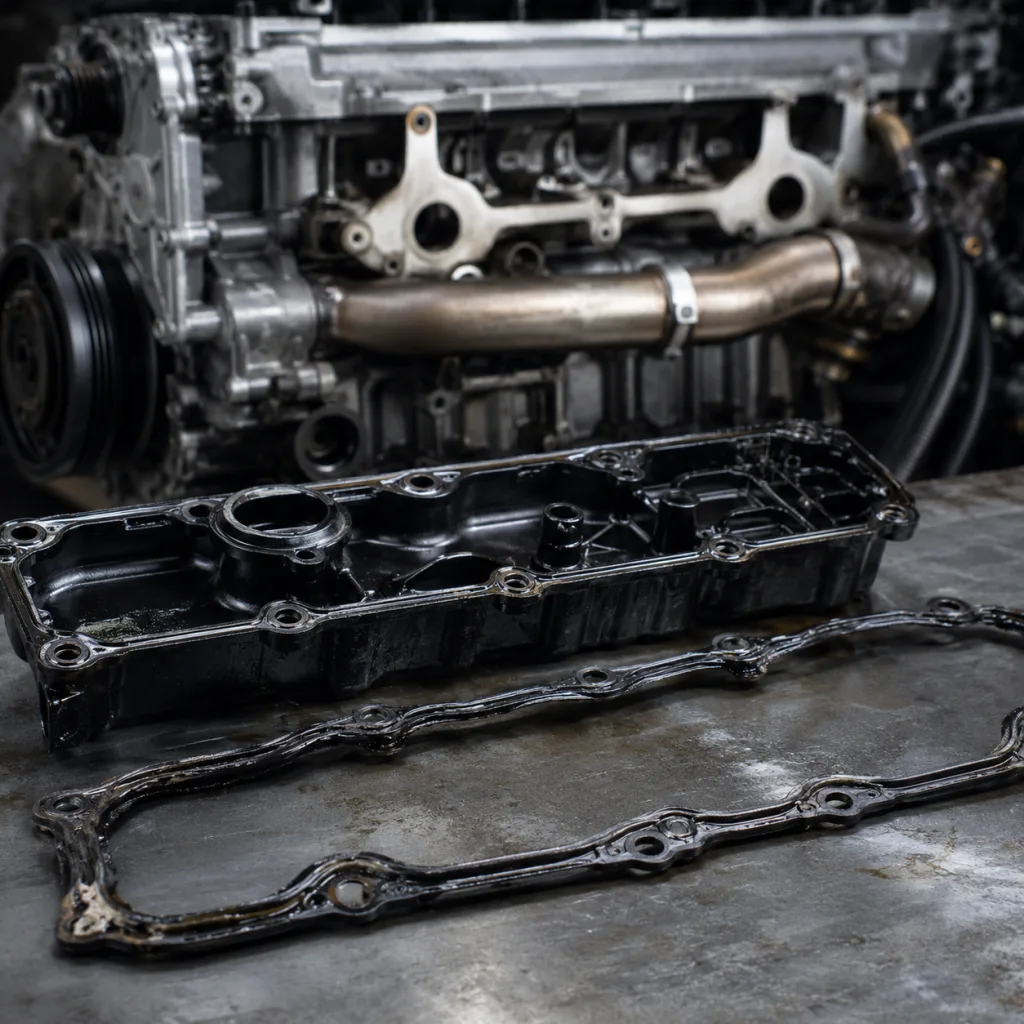
Kit content varies by engine architecture, fuel type, emission system, production date, regional specification, and market variant. Procurement teams should request a bill of materials, exploded-view mapping, sample images, packing layout, and fitment notes before placing volume orders.

Typical kit content may include:

  • Multi-layer steel or composite cylinder head gasket, selected by engine design, bore diameter, coating system, fire-ring design, and required thickness.
  • Valve cover gasket, spark plug tube seals where applicable, bolt grommets, half-moon seals, and related cover seals.
  • Intake manifold, exhaust manifold, throttle body, EGR, turbocharger, oil cooler, and charge-air sealing parts where fitted.
  • Valve stem seals manufactured from FKM, ACM, HNBR, or other specified elastomers depending on temperature, oil exposure, and application design.
  • Timing cover, oil pan, oil pump, water pump, thermostat housing, coolant flange, coolant pipe, and auxiliary housing seals.
  • Rear main seal, front crankshaft seal, camshaft seals, balance-shaft seals, O-rings, copper washers, injector washers where applicable, and ancillary sealing rings.
  • Application-specific items such as sealant instructions, installation sleeves, dowel-related notes, or thickness-selection guidance where required by the engine family.

Driventus supports catalogue programmes through our catalog and engine sealing components under engine components. For private-label or engine-family-specific requirements, our custom manufacturing team can align kit content, packaging, barcode format, carton structure, inspection documents, and receiving labels to the buyer’s internal process.

Driventus is an independent aftermarket manufacturer; brand names are referenced for fitment only.

Material and Process Checks for Smoke-Related Repairs

Startup-smoke repairs often expose sealing components to thermal cycling, oil additives, coolant chemistry, combustion pressure, exhaust heat, and imperfect mating surfaces. Material selection should therefore be verified through specification and inspection rather than assumed from a generic product description.

Key specification checks for full engine gasket kit sourcing:

Smoke at startup Common indication Sealing parts to inspect Notes for buyers
Blue smokeOil entering the combustion chamber or exhaust streamValve stem seals, cam cover gasket, turbo oil feed and return gaskets, intake gaskets, crankshaft seals where oil migration is suspectedOften worse after overnight parking, long idle, deceleration, or turbo heat soak
White smoke with sweet odourCoolant entering the cylinder, intake, EGR system, or exhaust pathCylinder head gasket, intake manifold gasket, thermostat housing gasket, coolant pipe seals, EGR cooler seals where fittedConfirm with pressure test, coolant loss records, combustion-gas test, and plug or bore inspection
White vapour, no odourCondensation in exhaustUsually no gasket replacementNormal in cold or humid conditions if it clears quickly and coolant level is stable
Grey/black smokeRich mixture, poor combustion, air restriction, injector issue, or EGR/fuel-control faultIntake gasket leak, EGR gasket, injector seals where applicableDiagnose air, fuel, sensor, and emission-control systems before authorising resealing

</tr></thead><tbody> </tbody></table>Published standards help define the supply system, although they do not replace application validation. Driventus operates under IATF 16949:2016 and ISO 9001:2015 principles for automotive quality management. For exported kits, material declarations may be requested to support REACH (EC) No 1907/2006 obligations in the EU. Emission regulations such as ECE R-83 can be relevant to the vehicle environment because intake, exhaust, EGR, and crankcase sealing faults may affect emissions performance after repair.

Buyers should avoid broad claims such as “fits all variants” unless the supplier provides the engine-code range, production date split, gasket thickness options, and clear exceptions. For engines with multiple head gasket thicknesses, valve-cover layouts, thermostat housings, or EGR configurations, variant control is as important as material selection.

Failure Prevention During Installation

A well-made kit can fail if the mating surfaces, tightening sequence, fasteners, sealant use, or supporting systems are not controlled. Procurement specifications should include technical notes for workshops or remanufacturing stations, especially where parts are supplied under a private label and used across many locations.

Installation controls to document:

  • Clean mating faces without aggressive abrasive discs that can alter surface finish, round edges, or leave embedded particles.
  • Verify cylinder head and block flatness against the engine manufacturer’s service data, and check surface roughness requirements for MLS head gaskets.
  • Use new torque-to-yield fasteners when the application requires them, and confirm washer orientation and thread condition.
  • Follow the tightening sequence, torque stages, and angle stages specified for the engine family.
  • Lubricate seals only where specified; dry-fit PTFE crankshaft seals when required by design and observe any waiting time before rotation.
  • Apply RTV or anaerobic sealant only at the specified joints and bead dimensions, especially near timing covers, ladder frames, oil pans, and half-moon areas.
  • Replace contaminated oil and coolant, flush affected systems where needed, and clear crankcase ventilation restrictions.
  • Confirm there is no blocked turbo oil return path, since excessive return pressure can force oil past seals and recreate blue smoke.
  • Recheck cooling-system pressure, idle quality, fault codes, fluid levels, and visible leaks after the first heat cycle.

Procurement teams should ask for incoming inspection samples before the first bulk order. Practical checks include gasket hole alignment, bore measurement, rubber hardness, visual coating coverage, seal-lip finish, label accuracy, barcode readability, instruction-sheet clarity, and carton drop resistance. For chains with multiple repair locations, consistent kit layout reduces technician error and shortens receiving inspection.

Sourcing Requirements for B2B Buyers

For an engine smoke at startup full engine gasket kit programme, the supplier must support repeatable fitment, traceability, and stable replenishment. A distributor may need broad coverage, reliable cross-reference data, and low carton damage rates. A repair chain may need consistent kit contents across branches and packaging that makes technician selection easy. An OEM, Tier-1 buyer, or remanufacturer may require PPAP-style documentation, material test reports, process audits, and change-control discipline.

Recommended RFQ data:

  • Engine code, displacement, fuel type, aspiration type, model years, market region, emission system, and any OE part-number cross-reference supplied by the buyer.
  • Required kit level: head set, conversion set, bottom set, or complete full engine gasket kit.
  • Critical variants: gasket thickness, bore size, valve cover type, thermostat housing layout, turbocharger configuration, EGR version, and production-date split.
  • Annual volume, forecast release schedule, MOQ target, delivery port, Incoterms preference, and replenishment rhythm.
  • Packaging requirements: neutral, private label, barcode, QR traceability, multilingual label, inner bag coding, installation note, or bulk service pack.
  • Required documents: dimensional report, material declaration, incoming inspection report, certificate of conformity, batch traceability, and sample-approval record.
  • Warranty return process, failure-analysis format, photo requirements, and response-time expectation.

Driventus manufactures and exports engine and powertrain components from Taizhou, Zhejiang to 60+ countries. Our quality system is structured around IATF 16949:2016 and ISO 9001:2015, with process controls for material inspection, die cutting, moulding, coating, assembly, kitting, labelling, and final packing. Buyers can request a quote with application data, target quantity, packaging preference, and required documentation.

Frequently asked questions

Yes, but it is not the only cause. Coolant entry through a head gasket can create white smoke after startup, especially when there is coolant loss, pressure-test failure, overheating history, or combustion gas in the cooling system. Blue smoke is more often linked to oil entry through valve stem seals, turbo oil leakage, PCV faults, worn guides, or ring wear.

A head set may be enough for limited cylinder head work. A full engine gasket kit is better for engine overhaul, remanufacturing, oil pan removal, timing cover reseal, crankshaft seal replacement, turbocharger gasket replacement, or mixed smoke repairs where multiple sealing systems are disturbed during diagnosis.

Provide engine code, displacement, fuel type, aspiration type, model years, market region, kit level, annual volume, packaging requirement, required documents, and any buyer-supplied OE cross-reference such as OE 06A… or OE 11251…. Photos, teardown notes, or sample kits help confirm content and variant differences.

If you are building a gasket kit programme for distributors, repair chains, or remanufacturing lines, share the engine application list, target kit level, annual volume, packaging requirements, and inspection documents with Driventus. Start a technical sourcing discussion at /contact.html

Request a Quote
Component Common material requirement Procurement check
Head gasketMLS stainless steel or composite construction depending on applicationThickness, bore diameter, coating continuity, embossment condition, oil/coolant hole alignment, batch traceability
Valve stem sealsFKM, ACM, HNBR, or application-specific elastomerLip geometry, spring retention, oil compatibility, heat-ageing result, installation fit on guide and stem
Manifold gasketsGraphite, steel, fibre, mica, or coated metalPort alignment, crush height, edge quality, temperature rating, bolt-hole accuracy
O-ringsNBR, HNBR, EPDM, FKM as specified by fluid and temperature exposureHardness, compression set, coolant or oil compatibility, moulding flash, dimensional stability
Shaft sealsFKM, ACM, or PTFE depending on designShaft diameter match, dust lip, sealing-lip quality, installation sleeve requirement, rotation direction if applicable