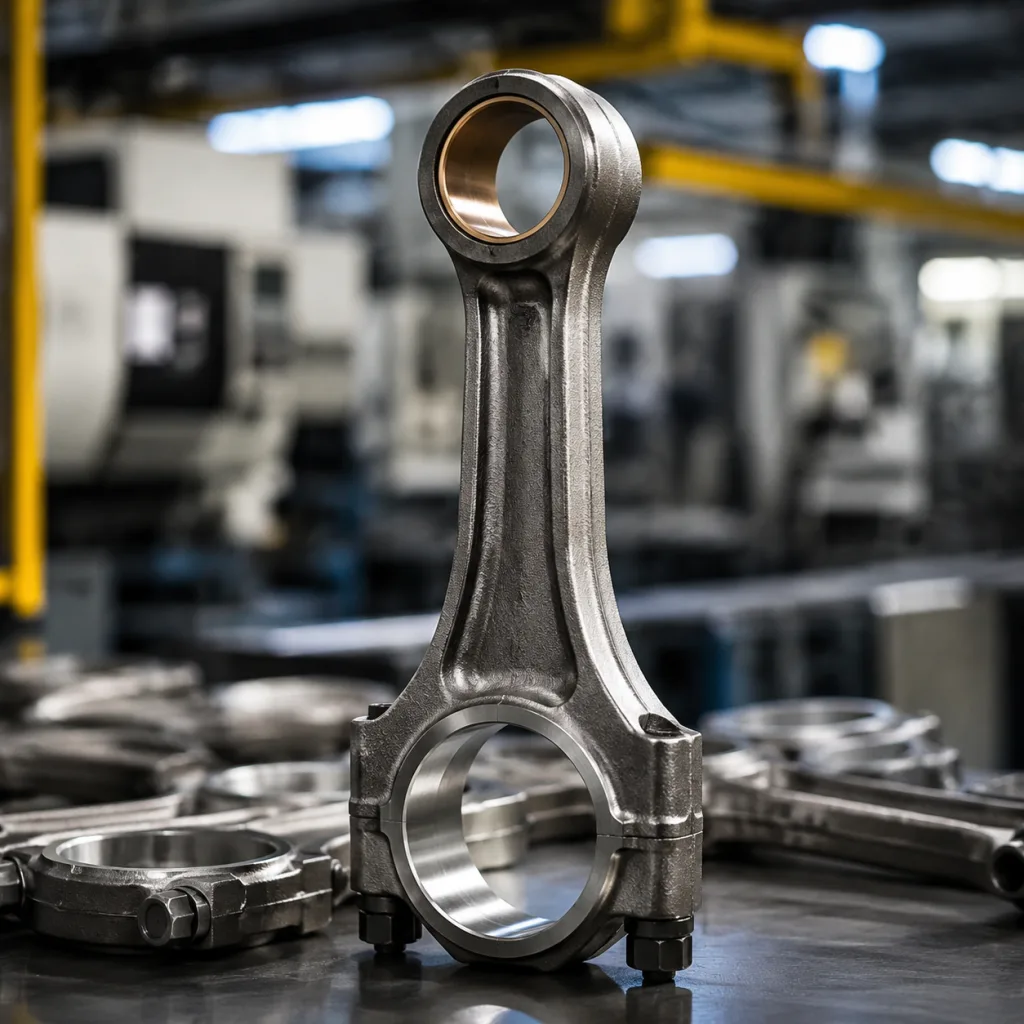
Connecting Rod Fiat Manufacturer China Sourcing Guide
Sourcing Fiat-fit connecting rods from China requires more than comparing unit prices. Procurement teams need confidence in dimensional stability, traceable steel, controlled heat treatment, repeatable machining and responsive engineering support during validation. A sound supplier decision also considers MOQ, sample timing, PPAP readiness, export documentation and the supplier’s ability to resolve technical issues before production release.
Driventus manufactures engine and powertrain components in Taizhou, Zhejiang, serving aftermarket distributors, wholesalers, OEM and Tier-1 programmes, and multi-location repair groups. Our connecting rod supply covers standard replacement references, private-label packaging and drawing-based programmes where buyers define metallurgy, tolerance windows and inspection records.
This guide gives B2B buyers a practical framework for evaluating a connecting rod Fiat manufacturer China option, from RFQ preparation and factory audit points to commercial terms, validation evidence and cross-reference handling. Driventus is an independent aftermarket manufacturer; brand names are referenced for fitment only.
What Buyers Should Confirm Before RFQ
A connecting rod programme should start with fitment scope and engineering evidence, not only a target price. Fiat applications can vary by petrol or diesel engine, production year and regional market, so the buyer should define engine code, bore and stroke family, pin diameter, bearing width, centre-to-centre length, bolt specification, and expected annual volume before requesting a quotation.
Useful RFQ inputs include:
Application list by engine family and market
Sample part, 2D drawing or 3D model where available
Required steel grade and heat-treatment condition
Surface treatment, shot peening or crack-detection requirements
Annual forecast and first order quantity
Packaging format, label rules and carton strength requirement
Inspection report format and critical-to-quality dimensions
Destination port, Incoterms and required export documents
Clear inputs reduce rework during quotation and help separate catalogue replacement parts from engineered programmes. For standard engine components, buyers can review our catalog and the engine range at /products/engine-components.html. For drawing-controlled programmes, custom manufacturing is more appropriate because the technical file, gauges and validation plan can be agreed before tooling or fixture work starts.
Factory Capability and Process Control
A capable supplier should be able to explain each process step from raw material receiving to final packing. For connecting rods, variation often enters through forging control, heat treatment, bore machining, bolt seating, surface finishing and final sizing. Buyers should ask how the factory controls each point, not simply whether CNC equipment is available.
Typical process controls for Fiat-fit connecting rods include:
Process area
Procurement check
Evidence to request
Raw material
Steel grade, mill certificate and batch traceability
Material certificate and incoming inspection record
Forging or blank preparation
Grain flow, flash removal and dimensional allowance
Process route and first-piece report
Heat treatment
Hardness range and distortion control
Furnace record and hardness test data
Machining
Big-end bore, small-end bore and centre distance
CMM or dedicated gauge report
Surface finishing
Shot peening, deburring and cleanliness
Visual criteria and process record
Final inspection
Critical dimensions and weight grouping
Batch inspection sheet
</tr></thead><tbody> </tbody></table>A sourcing team should also confirm whether repeat orders remain on the same line, fixtures and inspection method, or whether any operation is transferred to subcontractors after approval. Stable fixtures, controlled tooling changes and defined gauge calibration reduce the risk of dimensional drift once the initial sample has passed validation.
MOQ, Lead-Time and Commercial Terms
Commercial fit is a major part of supplier selection. A low quotation may not be usable if the MOQ exceeds demand, sample timing is unclear, or the supplier cannot maintain approved tolerances after the pilot batch.
For a connecting rod Fiat manufacturer China RFQ, buyers normally evaluate these commercial variables:
MOQ: linked to forging batch size, material purchase, machining setup and packaging run.
Sample lead-time: usually longer for drawing-based parts than stocked references because fixtures, gauges, programming or test planning may be required.
Mass production lead-time: should separate machining time, outside process time, inspection and packing.
Price validity: should identify steel cost assumptions, exchange-rate terms and the period covered by the offer.
Payment terms: should match audit status, order history and credit control policy.
Packaging: should cover corrosion protection, part separation, label rules and export carton durability.
Warranty handling: should define claim data, return samples, containment action and root-cause report timing.
For distributors, the first practical step is often a controlled trial order covering the highest-moving references. For OEM or Tier-1 projects, the buying process usually requires engineering review, sample approval, capability data and production part documentation before release. In both cases, the purchase agreement should make clear which inspection documents ship with the goods and which are retained by batch for traceability.
Quality System, Testing and Compliance
Certification does not replace part validation, but it is a useful filter when shortlisting suppliers. Driventus operates under IATF 16949:2016 and ISO 9001:2015 certified systems, with documented control of purchasing, production, inspection and corrective action. Buyers can review our quality system when preparing a supplier audit.
For connecting rods, validation should focus on mechanical integrity, dimensional repeatability and traceability from steel batch to finished shipment. Depending on application and buyer requirements, the evidence package may include:
Material certificate and heat number traceability
Hardness test records after heat treatment
Magnetic particle inspection or other crack-detection records where specified
Big-end bore, small-end bore and centre-distance inspection
Parallelism, twist and bend checks
Bolt torque or stretch control data where applicable
Weight grouping report if required by the engine build specification
Salt spray or corrosion-protection evidence for coated parts, where specified
Environmental and market compliance should be handled early, not after packing is complete. For shipments into the European Union, buyers may request material declarations relevant to REACH (EC) No 1907/2006. Packaging requirements, wood treatment rules, country-of-origin marking and labelling regulations should be confirmed before the purchase order is released.
Audit Questions for a Chinese Connecting Rod Supplier
A factory audit should test whether the supplier can run the part repeatedly under controlled conditions. Desk certificates are useful, but the audit should include a process walk-through, gauge review, traceability check and nonconformance handling review.
Recommended audit questions include:
1. Which process steps are in-house and which are subcontracted? 2. How are steel heat numbers linked to finished batches? 3. What gauges are used for big-end bore, small-end bore and centre distance? 4. How often are gauges calibrated, and to which internal procedure? 5. What is the reaction plan when hardness, bore size or roundness is out of specification? 6. Are inspection records retained by batch and shipment? 7. Can the supplier provide first-article inspection reports for new references? 8. How are engineering changes approved and documented? 9. What packaging test or drop-test method is used for export cartons? 10. Who signs off corrective action reports after customer claims?
Procurement teams should also check communication discipline. A supplier that gives clear answers on tolerances, drawings, deviations and process records before the order is more likely to support stable replenishment after the first shipment. If responses are vague during RFQ, the risk usually increases once deadlines and claim pressure appear.
How Driventus Supports Fiat-Fit Programmes
Driventus supplies engine and powertrain components to B2B customers in more than 60 countries. For connecting rod programmes, we support aftermarket range development, private-label supply and drawing-based production for customers that require controlled specifications. We do not claim approval or endorsement by any vehicle manufacturer.
Our support model includes fitment review, sample comparison, quotation by forecast volume, inspection planning and export packaging. For catalogue parts, we can help buyers consolidate related engine components to reduce supplier count and shipping complexity. For custom parts, engineering review can cover material, machining tolerances, surface finish, marking, packing and documentation before pilot production.
When OE references are provided by the buyer, they are handled only as fitment cross-references. If a buyer lists a generic reference such as OE 06A107065 or OE 11251…, we use it to confirm application scope and avoid catalogue ambiguity. Brand names and OE references are not used to imply endorsement, supply status or vehicle manufacturer approval.
Buyers qualifying Driventus as a connecting rod Fiat manufacturer China partner can start with an application list, expected volume and any available drawings or samples. From there, our team can advise whether the programme is best handled through catalogue supply, private-label packaging or a drawing-controlled production route.
Frequently asked questions
Send the engine application, annual forecast, target order quantity, drawing or sample availability, material requirement, packaging rules and destination port. If you have OE-style cross-references, include them for fitment confirmation only.
Yes. Catalogue supply is suitable for common aftermarket references. Custom manufacturing is available for drawing-controlled programmes where the buyer defines material, tolerances, inspection records, packaging and validation requirements.
No. Driventus is an independent aftermarket manufacturer; brand names are referenced for fitment only. Any OE-style number is used only to clarify application and dimensional matching requirements.
If you are qualifying a connecting rod supplier in China, share your application list, drawings or samples for technical review. You can [request a quote](/contact.html) or contact our export team at /contact.html.