Engine smoke at startup is not one problem. It can be harmless condensation, oil draining into the intake or combustion chamber, coolant leakage past a sealing interface, rich cold-start fuelling, or a repair error from the last workshop visit. That distinction matters for B2B buyers because a full engine gasket kit can solve only the faults connected to disturbed or failed sealing joints. It cannot correct injector leakage, a blocked PCV system, or poor turbo oil drainage. For distributors, rebuilders, and repair-chain procurement teams, the job is to connect the field symptom to a defensible repair scope, then source a kit that fits the engine family, survives handling, and repeats batch after batch. This article uses the primary symptom—engine smoke at startup—to build a practical sourcing framework for a full engine gasket kit program, covering diagnosis, kit justification, failure modes, material specifications, quality controls, MOQ logic, pricing, lead-time planning, and RFQ inputs.
Decision framework: what the first 60 seconds of smoke really tells you
Do not start with the parts catalogue. Start with a controlled observation. Startup smoke should be recorded after the vehicle has been parked long enough for oil or coolant to settle, usually 8–12 hours. Cold weather adds noise to the diagnosis, so note ambient temperature, humidity where relevant, coolant level, oil level, odour, idle stability, diagnostic trouble codes, and smoke duration. A 30–60 second cold-start video gives warranty reviewers and sourcing teams far better evidence than “smokes on start.”
Relevant if covers, manifolds, head, or stem seals are serviced
Dense white smoke beyond 10–20 seconds with sweet odour
Coolant entering combustion
Pressure loss, combustion gas in coolant, plug condition, misfire
Strong relevance to head gasket and coolant-passage sealing
Thin white vapour that clears quickly in cold weather
Condensation
No coolant loss, no misfire, normal pressure
Usually no gasket kit required
Black smoke on cold start
Rich mixture
Injector leakage, fuel trim, sensors, air metering
Only relevant if intake sealing is disturbed
Smoke after recent gasket work
Installation or component mismatch
Torque sequence, surface preparation, sealant use, part alignment
High relevance to kit quality and repair controls
</tr></thead><tbody> </tbody></table>Use threshold notes. “Blue smoke clears in 5 seconds after overnight parking; oil use 0.5 L/1,000 km; coolant stable” points toward oil-control investigation rather than a head gasket. “White smoke for 30 seconds; coolant loss 0.3 L/week; cold-start misfire on cylinder 3; cooling pressure falls from 1.2 bar to 0.7 bar in 10 minutes” is a different case. That one justifies combustion-to-coolant sealing checks.
This decision split prevents a common procurement mistake: treating a gasket set as a universal remedy. A full engine gasket kit is justified when tests show a failed sealing interface or when the repair will disturb multiple sealing surfaces. It is not justified by smoke colour alone.
Repair-scope comparison: head set, conversion set, or full engine gasket kit
A full kit makes sense when the job is wider than one leaking cover or manifold. Typical triggers include cylinder head removal, overheating repair, complete overhaul, timing cover reseal with oil pan removal, or a rebuild where multiple oil, coolant, intake, exhaust, and combustion joints are opened. It also helps repair chains standardise the bill of materials instead of mixing loose gaskets from several sources.
The commercial language is not always consistent, so define the kit type before comparing prices:
Head set: usually supports cylinder head removal. It may include the cylinder head gasket, valve cover gasket, intake and exhaust manifold gaskets, valve stem seals, and coolant seals around the upper engine.
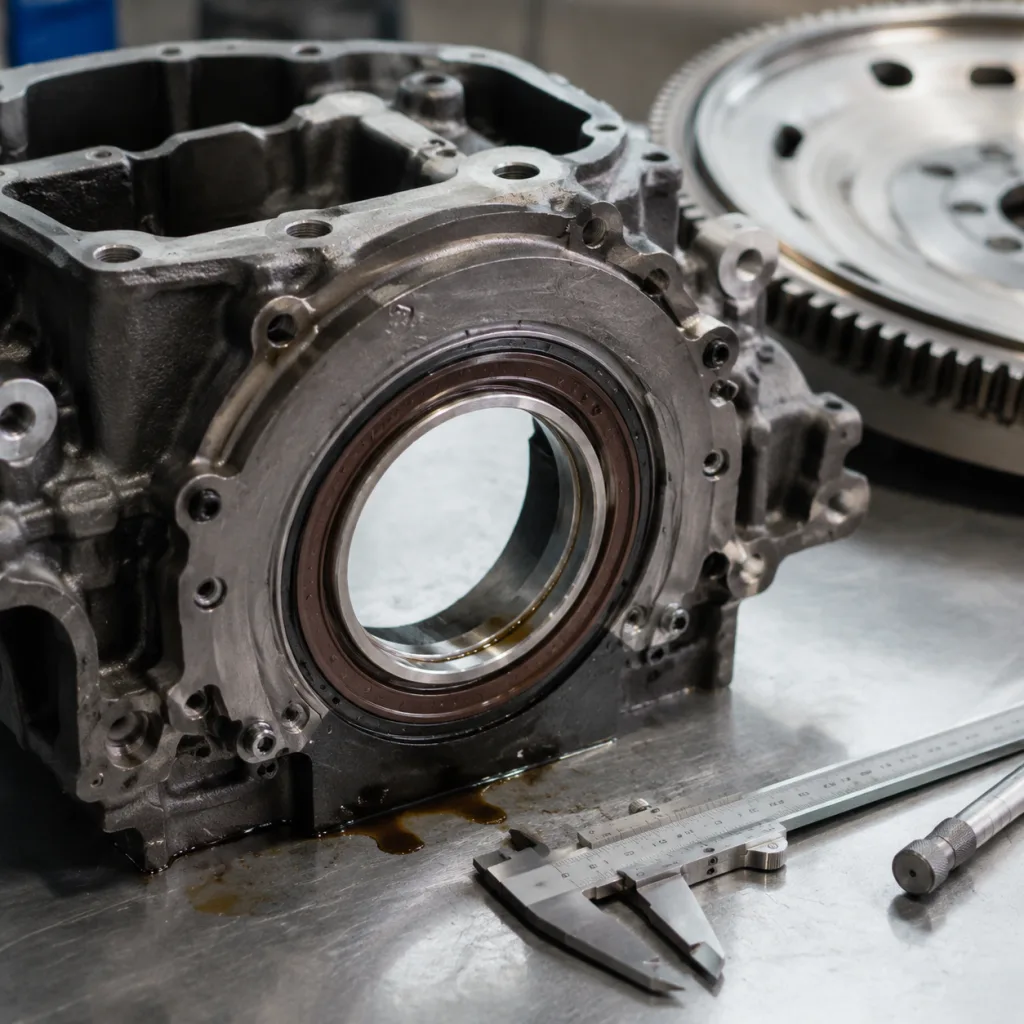
Conversion set: usually covers lower-engine sealing, such as oil pan, rear main, front cover, crankshaft seals, and related O-rings.
Overhaul or full engine gasket kit: combines upper and lower sealing parts and may add small washers, grommets, plugs, and auxiliary seals.
Custom repair-chain kit: built around a defined workshop procedure, sometimes excluding parts the chain buys separately, such as head bolts or RTV.
Typical content can include cylinder head gasket by bore and thickness, valve cover gasket, spark plug tube seals, intake and exhaust manifold gaskets, throttle body and EGR seals, timing cover and oil pan sealing parts, camshaft and crankshaft oil seals, water outlet and thermostat seals, oil cooler seals, O-rings, washers, and grommets.
Confirm the grey areas early: valve stem seals, head bolts, dowels, washers, RTV sealant, and instruction sheets. Torque-to-yield head bolts are often not reused, but many gasket kits exclude them as a separate line item. RTV may be excluded for shelf-life, storage, or transport reasons. If supplied, specify 12–18 months minimum remaining shelf life from manufacture and a storage range such as 5–25°C.
MOQ and lead time follow the scope. A stocked standard kit may start around 100–300 sets per SKU. A customised kit with private-label packaging, compound changes, or non-stock components may require 300–1,000 sets. New MLS stamping tools or moulded rubber tooling should be quoted separately from unit price. Planning assumptions are usually 2–4 weeks for stocked repeat orders, 35–60 days for standard production after BOM and artwork approval, and 60–90 days when tooling, special compounds, or PPAP-style documentation is required.
Driventus can map kit structures against engine code, bore size, buyer reference lists, and repair scope through custom manufacturing, without claiming vehicle manufacturer approval.
Driventus is an independent aftermarket manufacturer; brand names are referenced for fitment only.
Failure modes: when startup smoke is actually a sealing problem
The cleanest gasket-related pattern is white smoke with coolant loss. A compromised head gasket can let coolant enter a cylinder after shutdown. On the next start, the engine burns that coolant, creating dense white smoke, often with a sweet smell, rough idle, misfire, or abnormal cooling-system pressure. Confirmation should include cooling system pressure testing, combustion-gas detection in coolant, spark plug inspection, oil and coolant condition checks, and compression or leak-down testing.
Look for numbers, not impressions. Many cooling systems are tested near the cap-rated pressure, often 0.9–1.5 bar depending on application. If pressure decays quickly without an external leak, investigate further. Leak-down below about 10% is generally healthy; 10–20% needs interpretation by design and mileage; more than 20–25% with bubbles in the expansion tank strongly supports combustion-to-coolant leakage. Adjacent low compression cylinders, oil/coolant emulsion, a steam-cleaned spark plug, or coolant odour from the exhaust all strengthen the case for a head gasket or related surface issue.
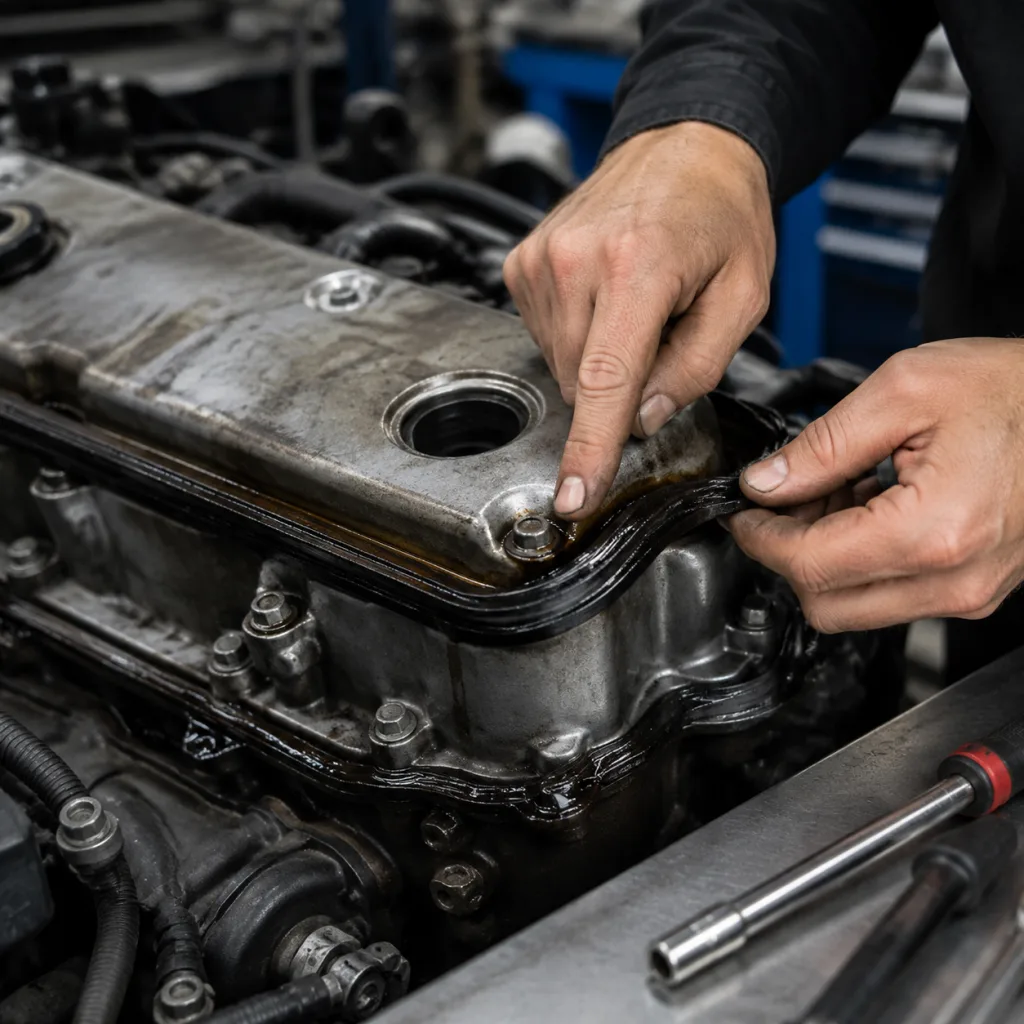
Blue smoke is more complicated. Oil may pass worn valve stem seals after overnight parking. It may enter through a failed PCV diaphragm, collect in the turbocharger compressor housing, or back up because of a restricted turbo oil return. A valve cover gasket can leak oil into spark plug wells or onto hot external surfaces without causing exhaust smoke. Intake manifold leakage can also disturb crankcase ventilation or mixture control on some engines.
A practical failure-mode sequence is:
1. Measure oil and coolant consumption in L/1,000 km, L/week, or another repeatable unit. 2. Inspect external leakage at the valve cover, timing cover, oil pan, coolant outlet, oil cooler, and head-to-block joint. 3. Test the cooling system and cap at the specified pressure. 4. Run compression and leak-down tests when combustion sealing is suspected. 5. Check PCV function, turbocharger oil feed and return, and intake tract oil pooling. 6. Review fuel trims, injector leakage, misfire data, and temperature-sensor readings for black smoke or rich running. 7. Verify cylinder head and block flatness, surface finish, bolt-hole cleanliness, and thread condition before installation.
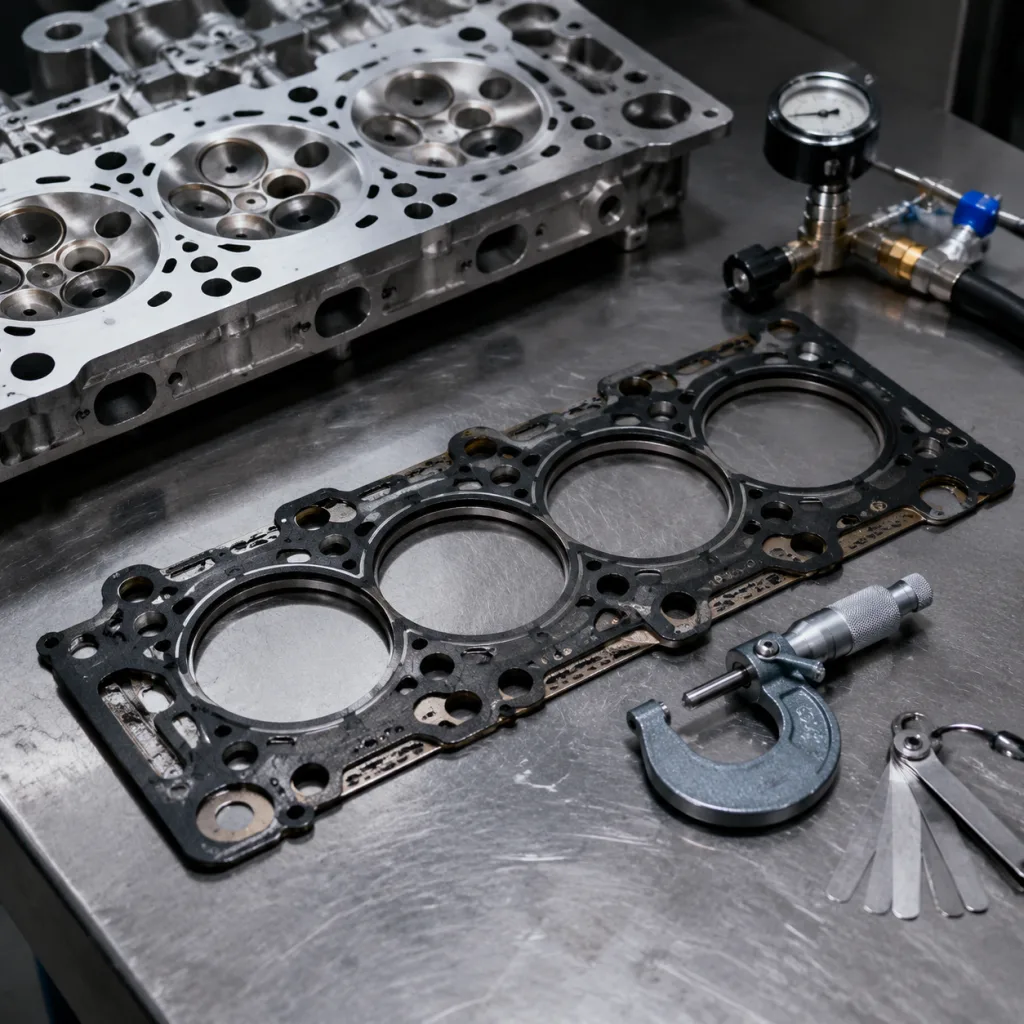
Before fitting the replacement kit, workshops should clean blind bolt holes, remove old sealant without gouging aluminium, and check head/block flatness with a precision straightedge and feeler gauges. Common service limits may fall around 0.03–0.10 mm across critical spans, but the engine manual or buyer-approved procedure must govern. This protects distributors from unnecessary returns and helps procurement teams decide whether an engine smoke at startup full engine gasket kit repair is technically supported.
Spec deep-dive: materials, tolerances, and the hidden cost of a cheap kit
A gasket kit is not a bag of similar-looking seals. Each interface has a different load, temperature, chemical exposure, surface finish, and movement pattern. Procurement teams should therefore specify the sealing package, not just the part count. Multi-layer steel head gaskets, graphite composite gaskets, fibre-rubber materials, FKM or ACM oil seals, EPDM coolant seals, and silicone moulded gaskets respond differently to compression, heat cycling, oil, coolant, and fuel vapour.
Core specification points include:
Head gasket construction: MLS layer count, stopper or embossing design, coating type, bore size, and oil/coolant hole alignment.
Thickness control: free thickness, compressed design target where specified, and selectable thickness grades where the engine requires them.
Rubber compound: FKM, ACM, NBR, silicone, or EPDM selected by oil, coolant, fuel vapour, temperature, and exhaust-gas exposure.
Surface compatibility: aluminium, cast iron, plastic covers, and mixed-material flanges.
Oil seal geometry: lip profile, garter spring retention, mould flash, case design, and shaft contact compatibility.
RTV or formed-in-place sealing: oil/coolant compatibility, cure conditions, shelf life, and application guidance if supplied.
Packaging: flat protection for MLS gaskets, anti-deformation support for moulded parts, moisture control, and separation of small seals.
Traceability: batch number, production date, material lot, inspection record, and link to the approved BOM.
Useful drawing-level targets should be agreed before sampling. For many passenger-car programs, buyers request critical bore and fluid-passage position tolerance around ±0.10–0.20 mm, non-critical outer profile around ±0.30–0.50 mm, MLS free-thickness control around ±0.03–0.05 mm where design-sensitive, and moulded rubber hardness tolerance of ±5 Shore A. Oil seals should state shaft diameter, housing diameter, width, lip material, spring specification, and flash limits. O-rings should define ID, cross-section, compound, hardness, and compression set target. EPDM is typical for coolant; FKM or ACM is better suited to hot oil exposure.
Price gaps usually come from material and process choices, not only piece count. MLS head gaskets require steel grade selection, embossing, coating, possible heat treatment or stress-relief control, and flat packing. Rubber-moulded gaskets add compound cost, mould cavities, curing time, and deflashing. Oil seals add metal cases, elastomer bonding, springs, and lip inspection. A low quote may exclude valve stem seals, head bolts, FKM material, export cartons, or inspection documents.
For fair comparison, require the same BOM, material callouts, packaging level, documentation, MOQ, Incoterms, currency, and annual volume assumptions. Management standards such as IATF 16949:2016 and ISO 9001:2015 matter because gasket performance depends on repeatable compound control, stamping accuracy, mould maintenance, coating control, and final inspection. For regulated markets, include REACH (EC) No 1907/2006 and applicable customer restricted-substance lists where needed.
Quality-control failure traps that create repeat comebacks
Many gasket failures are not visible during a quick carton check. A kit can look complete and still cause a comeback if hole position is off, coating adhesion is weak, rubber hardness drifts, an oil seal lip is damaged, or an MLS gasket bends in transit. Driventus applies incoming material control, in-process inspection, and final kit verification within its quality system. For B2B programs, agree the evidence before the first shipment.
Failure trap
Evidence to request
Why it matters
Misaligned bore, oil, coolant, or bolt holes
CMM, optical, or fixture inspection records
Prevents blocked passages and poor clamp distribution
Rubber hardness drift
Shore A data by compound and batch
Controls compression, recovery, and sealing load
Weak MLS coating adhesion
Peel test, coating validation, or process record
Reduces fretting, coating loss, and coolant leakage
Damaged oil seal lip or spring
Visual criteria and sampling record
Prevents immediate oil leakage after installation
Missing O-rings or washers
Barcode, weighing, photo record, or checklist
Avoids workshop downtime and emergency sourcing
Distorted head gasket in shipping
Packaging validation, flatness check, carton spec
Protects critical parts during export handling
Poor lot traceability
Lot code, production date, inspection report
Enables containment when a field issue appears
</tr></thead><tbody> </tbody></table>A practical inspection plan uses 100% visual and kit-completeness checks, with dimensional sampling by lot under an agreed AQL or buyer-specific control plan. Critical-to-function features—head gasket bore openings, oil feed holes, coolant holes, bolt holes, seal lips, and moulded sealing beads—need tighter control than carton artwork or non-sealing outside profiles. Incoming rubber batches should be checked for certificate consistency, hardness, and shelf-life status. MLS sheets should be reviewed for thickness, coating condition, burrs, and distortion before packing.
For first-article approval, buyers often request five to ten complete kits, dimensional reports on critical parts, material declarations, hardness data, fitment trial feedback, packaging drop-test results, and installation photos. For repeat production, a certificate of conformity, batch inspection summary, and retained sample policy may be sufficient unless the program is safety-critical or customer-specific PPAP is required.
Warranty containment should define which lots are isolated, which trace codes are affected, and what evidence is required before credit or replacement. For importers and multi-location repair chains, consistency is the commercial value. A correct kit with missing small parts, distorted MLS gaskets, mixed batches, or unclear labels creates the same workshop delay as a wrong kit. Buyers can review related engine sealing and rotating components in our catalog and engine-specific ranges under engine components.
RFQ scenario: building a kit around repeated startup-smoke claims
Assume a repair chain is seeing repeated white startup smoke on one engine family after overheating events. The wrong RFQ says: “Quote full gasket kit for model year X.” The better RFQ connects the symptom, engine data, repair scope, and commercial plan. Vehicle model year alone is not enough because one model can use different engine codes, emissions packages, head gasket grades, intake layouts, and coolant routing by market.
Collect engine code, displacement, fuel type, aspiration, emissions variant, production date range, head gasket thickness where applicable, and any OE reference format already used in the market. Where a buyer provides a cross-reference such as OE 06A… or OE 11251…, Driventus can align drawings, samples, and kit bills of materials against the supplied reference.
For an engine smoke at startup full engine gasket kit project, the RFQ should include:
Annual demand by engine family and destination market.
Kit content standard: overhaul set, head set, conversion set, or customised repair-chain set.
Required materials, compound preferences, and restricted-substance declarations.
Inspection documents required with shipment, including dimensional or material reports.
Target lead time, safety stock policy, forecast frequency, and phased launch quantities.
Warranty return data, known failure modes, and installation notes from the repair network.
Labelling requirements, barcode format, language requirements, and carton identification.
Incoterms, currency, destination port or warehouse, carton weight limits, pallet rules, and mixed-SKU consolidation needs.
Commercial planning should link MOQ, price, and lead time. A distributor launching 20 engine codes may start with 100–200 sets for fast-moving SKUs and 50–100 sets for trial SKUs, accepting a higher unit cost because production, labels, and cartons are split across many low-volume items. A repair chain with predictable monthly consumption can usually improve pricing through quarterly forecasts, for example 500–2,000 sets per engine family per quarter, plus 4–8 weeks of safety stock.
Private-label cartons, multilingual instruction sheets, and barcode serialisation add setup time. Allow 7–14 days for label proofing before production release. A typical launch path is: RFQ and BOM confirmation in 3–7 working days if references are complete; sample preparation in 10–30 days depending on stock and tooling; buyer test or fitment feedback in 1–3 weeks; mass production in 35–60 days after deposit, artwork approval, and sample approval.
Driventus manufactures engine gaskets and related powertrain components in Taizhou, Zhejiang, supplying aftermarket distributors, OEM/Tier-1 programs, and repair-chain customers in more than 60 countries. Certification to IATF 16949:2016 and ISO 9001:2015 supports structured production control, but buyers should still define fitment, testing, labelling, packaging, and documentation in writing before approval. Clear RFQ inputs turn a generic assortment into a kit matched to the startup-smoke repair scenario.
Frequently asked questions
Sometimes, but not always. Blue smoke after overnight parking often points to valve stem seals, PCV faults, turbocharger oil leakage, or oil entering the intake. A gasket kit is relevant when the repair requires removing covers, manifolds, the cylinder head, or other sealed interfaces.
Confirm engine code coverage, head gasket construction, bore and hole alignment, rubber compound, seal hardness, kit contents, packaging protection, and batch traceability. Request tolerances such as critical hole position, free thickness, Shore A hardness, and inspection evidence linked to IATF 16949:2016 and ISO 9001:2015 controls where applicable.
No vehicle manufacturer approval is claimed. Driventus is an independent aftermarket manufacturer; brand names are referenced for fitment only. Kits are developed to buyer specifications, supplied references, samples, drawings, and agreed validation requirements.
If your team is diagnosing repeated startup smoke claims or preparing a gasket kit sourcing program, share engine codes, kit contents, annual volume, target MOQ, required documents, failure notes, and target markets with Driventus. You can [request a quote](/contact.html).