Engine Mount Isuzu Manufacturer China: Sourcing Guide
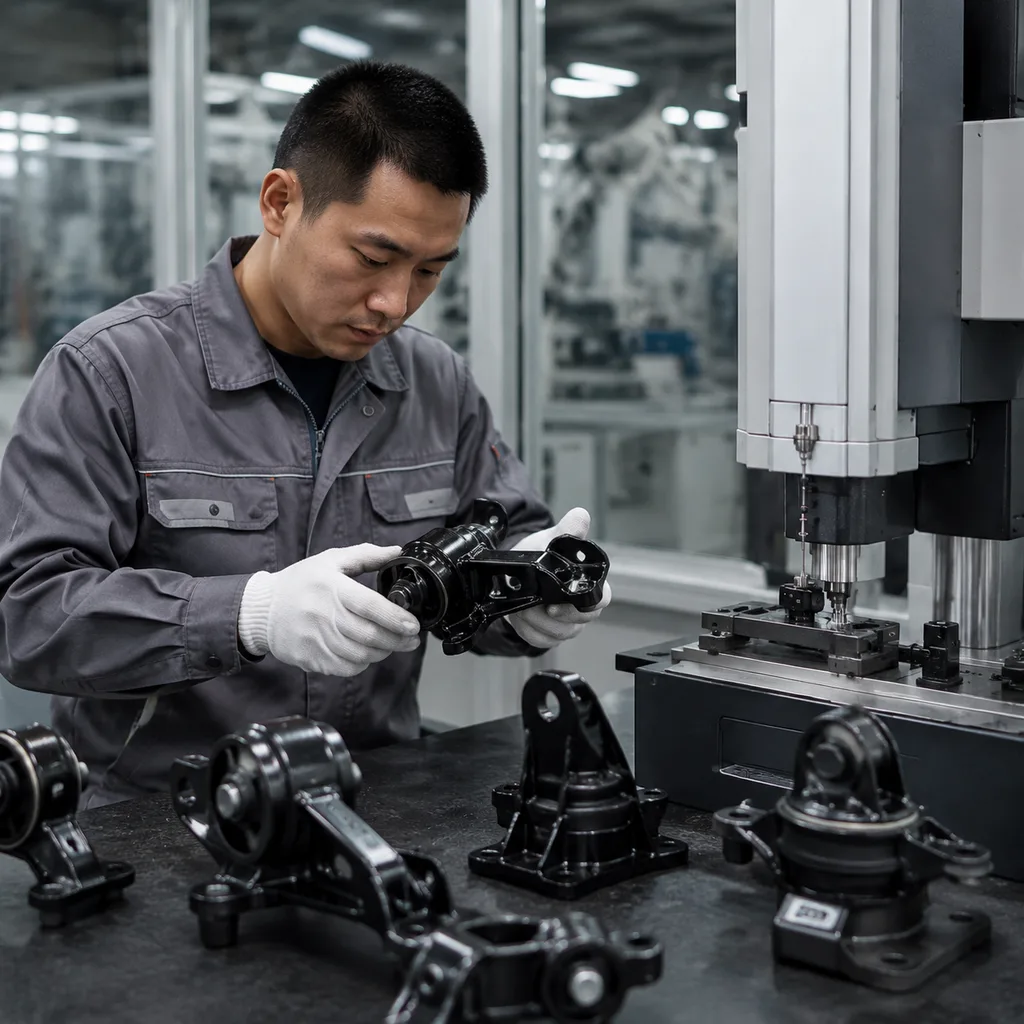
Buyers searching for an engine mount Isuzu manufacturer China usually need three things at once: fitment that actually matches the vehicle, vibration control that holds up in use, and supply that stays predictable after launch. An engine mount is not a simple rubber block. It carries engine load, manages torque roll, reduces noise, and protects alignment under acceleration, braking, gear changes, and road shock.
That is why the supplier question matters. Unit price is only part of the decision. The real test is whether the factory can hold geometry, compound, bonding quality, corrosion protection, packing, and traceability across repeated production runs. Buyers should ask for Shore A targets, tolerances, coating or salt-spray requirements, sample approval timing, MOQ rules, and the inspection records that travel with each shipment.
Driventus manufactures engine and powertrain components in Taizhou, Zhejiang, and exports to more than 60 countries. We operate under IATF 16949:2016 and ISO 9001:2015 quality systems, and we support part-number cross-references, production traceability, and export packing requirements. Driventus is an independent aftermarket manufacturer; vehicle and brand names are referenced for fitment identification only.
If you are comparing Isuzu engine mount suppliers, focus on material specification, dimensional control, test evidence, MOQ, lead time, replenishment stability, and whether the factory can support custom manufacturing for mixed platforms. A workable RFQ should include the reference number, vehicle model, engine code, year range, sample photos from three angles, packing requirement, target annual demand, and any market-specific compliance or labeling rule.
First question: is the mount actually the right one?
Before you request pricing, lock down the application. Engine mounts can look nearly identical in photos and still fail to fit because of a small change in bracket angle, stud position, bushing height, or locating feature. On Isuzu light truck, pickup, SUV, and commercial applications, the same visual style may be used with different offsets, stud lengths, or rubber rates across engine variants and market versions.
What to verify
OE or aftermarket cross-reference, where applicable and checked against catalogue data
Vehicle details: model, engine code, displacement, year range, drive side, transmission type, and market version
Mount position: left, right, front, rear, transmission mount, torque rod, or complete set
Mount type: rubber-to-metal, hydraulic, or active-style replacement
Rubber hardness, usually given in Shore A, with a typical working tolerance of ±5 Shore A unless the drawing is tighter
Metal finish: phosphate, e-coat, zinc plating, powder coating, or painted steel, with a salt-spray target such as 48, 96, 240, or 480 hours depending on the programme
Dimensional tolerance on bracket holes, studs, locating pins, welded features, and assembly height; critical-to-fit dimensions often need ±0.2 mm to ±0.5 mm control
The first audit question is simple: can the supplier repeat the same geometry and compound across production lots? Ask for controlled drawings, inspection points, sample approval records, and traceability. If the answer is vague, the quote is difficult to trust because the real cost risk shows up later as returns, fitting complaints, and uneven NVH performance.
A strong RFQ should also define how approval will work. Sample fitment only is faster, but measured data is safer. A practical sequence is: supplier confirms cross-reference, buyer approves drawing or critical dimensions, factory makes 3 to 10 samples, buyer checks installation and NVH feedback, then a pilot lot is released before mass production. It takes longer than a photo-based quote. It also avoids wrong-part risk for distributors carrying multiple Isuzu applications.
What actually controls service life
Engine mounts usually combine a steel bracket, elastomer element, bonded interface, and fasteners. Some applications add a hydraulic chamber to improve damping at idle and low speed. The material stack has to match vehicle mass, torque reaction, underhood temperature, oil mist, road salt, and the duty cycle. A capable supplier should explain the material route, not just quote a reference number.
Component
Common material
Procurement relevance
Bracket
Low-carbon steel, stamped steel, cast aluminium on some designs, or alloy steel
Affects stiffness, dimensional stability, corrosion resistance, weld quality, and clamp face flatness
Elastomer
NR, SBR, CR, EPDM, NBR, or blended rubber compounds
</tr></thead><tbody> </tbody></table>For export programmes, request a rubber compound declaration, coating specification, and salt-spray data where available. Hardness should be reviewed in context. Too soft, and the engine moves too much. Too hard, and vibration reaches the cabin. In many conventional rubber-to-metal mounts, common hardness ranges sit around 45 to 70 Shore A, but the right value depends on load, geometry, and vehicle calibration. Bonding quality matters just as much. A mount can meet dimensions and still fail early if the rubber delaminates.
Process control starts before molding. Brackets are stamped, welded, or formed, then cleaned by shot blasting, degreasing, phosphating, or another surface preparation step before adhesive is applied. Rubber is batch-mixed, checked for compound identity, and molded under controlled temperature, pressure, and cure time. After demolding, flash is trimmed, assemblies cool in controlled conditions, and critical dimensions are checked before coating touch-up or final packing. For hydraulic mounts, fluid fill, sealing, and leak checks become additional critical steps.
If the application faces road salt, oil mist, high temperature, or heavy-duty service, the supplier should explain how the mount resists swelling, cracking, compression set, bond failure, and bracket corrosion. Useful test references may include heat ageing at 70°C to 100°C, oil or fuel resistance checks where applicable, ozone exposure for cracking risk, compression set measurement, and salt spray to ASTM B117 or an equivalent internal method. For Isuzu-related programmes used in commercial, pickup, SUV, or light-truck applications, durability under load variation matters because vehicles may alternate between empty running, towing, off-road use, and fleet duty.
What a serious quality file should contain
A factory serving EU, UK, US, Canada, Australia, Brazil, the Middle East, and other export markets should work with documented incoming inspection, in-process control, and final release checks. The minimum evidence set is straightforward, but it must be current, traceable, and tied to the batch being supplied. For engine mounts, inspection has to cover both fitment geometry and rubber performance. A part can measure correctly and still create vibration complaints if hardness, bonding, or damping is inconsistent.
Evidence to request
IATF 16949:2016 certificate and ISO 9001:2015 certificate, with scope and expiry checked
Control plan or inspection flow for critical characteristics
Incoming material inspection records for steel, rubber, fasteners, adhesives, and coatings
Dimensional report for brackets, studs, holes, locating features, thread length, centre distance, and assembly height
Rubber hardness and compound verification records, normally by batch and cavity where relevant
Bond integrity, peel, pull, or destructive adhesion-test summary where relevant
Load-deflection or compression test data for programmes that require NVH consistency
Hydraulic leakage or damping checks for hydraulic-style mounts, where applicable
Salt-spray or corrosion-resistance data for coated metal parts, where required
PPAP-style documentation for OEM or Tier-1 programmes, if required
Traceability by lot number, production date, machine, operator, or shipment batch
Final packing inspection and carton-marking confirmation
A practical inspection plan separates critical, major, and minor characteristics. Critical-to-fit points include bolt-hole centre distance, stud position, bracket angle, mounting face flatness, locating pin position, and total installed height. Depending on the design, buyers often specify hole-position control within ±0.2 mm to ±0.5 mm, stud perpendicularity control, and thread go/no-go checks. Rubber hardness is usually checked with a calibrated Shore A durometer after defined conditioning time, while metal thickness, weld penetration, and coating appearance are controlled during bracket production.
If your route to market includes environmental compliance, request material declarations aligned with REACH (EC) No 1907/2006 where applicable. Depending on the destination market and customer requirement, buyers may also ask about RoHS-related restrictions, conflict-mineral policies, PAHs, SVHC declarations, or other substance documentation. These should be confirmed before artwork and carton labels are frozen, especially for retail channels.
This is where a real manufacturer differs from a trading-only source. A serious supplier can show how each batch is controlled from raw material to packing. The documentation should match the part number, production date, and shipment under review. For repeat orders, ask the supplier to retain samples or inspection history so any field complaint can be compared against the approved baseline instead of handled as a one-off dispute.
Lead time and MOQ: read them as a system, not a line item
For a standard replacement programme, MOQ depends on tooling status, application spread, order mix, and packaging format. If the part is already in routine production, the supplier may support a lower MOQ for mixed-SKU orders. For a new or modified programme, the order usually needs enough volume to cover tooling review, setup, sample testing, labeling, and carton configuration. Buyers should separate sample lead time, pilot-lot lead time, and mass-production lead time because each stage has different cost and scheduling logic.
Questions that expose the real operating model
What is the standard lead time after sample approval, and does it change in peak season?
Is the item in active production, dormant tooling, or new-development status?
Can the factory support consolidated export shipments across multiple references?
Is private label artwork allowed for cartons, inner boxes, and barcode labels?
Can the supplier provide mixed-reference order planning for distributors?
What is the policy for repeat batches, call-off schedules, and forecast-based production?
How are engineering changes, supersessions, and cross-reference updates controlled?
What inspection documents are provided with shipment or on request?
What are the carton quantity, gross weight, pallet height, and loading plan for LCL or FCL shipments?
As a planning benchmark, in-stock or active-production items may move faster once packaging is confirmed, while made-to-order replacement mounts often need about 30 to 60 days after deposit and sample or artwork approval. New tooling or a structural modification can add several weeks for drawing review, mold preparation, trial molding, sample testing, and correction. MOQ may be set per SKU, per mixed order, or per private-label packing run. A factory may accept a lower per-reference MOQ when the buyer consolidates 20 to 80 references in one shipment, but require higher quantities for a new mount with dedicated tooling, color carton printing, or non-standard coating.
Price logic should be reviewed in layers. Ex-works unit price is affected by rubber compound, steel weight, bracket complexity, adhesive system, coating requirement, test scope, packing, and annual volume. A hydraulic mount normally prices differently from a conventional solid rubber-to-metal mount because of the diaphragm, fluid, sealing, and leak-test requirements. Private-label packaging, barcodes, extra nuts, rust inhibitor bags, thicker cartons, and palletization should be quoted separately or clearly included.
For most buyers, the useful answer is not just the quoted factory lead time. It is the repeatability of the replenishment cycle. A supplier with stable planning, clear MOQ rules, and predictable dispatch dates is easier to manage than a lower-priced source with inconsistent availability. When comparing an engine mount Isuzu manufacturer China with a trading company or spot-market source, consider the full landed cost: sampling delays, packaging errors, fitting complaints, return handling, emergency air freight, and customer-service burden can erase a small unit-price saving.
How Driventus handles the sourcing workflow
Driventus supplies engine and powertrain components from a vertically integrated base in Taizhou, Zhejiang. For buyers, that means material control, machining, rubber-to-metal assembly, inspection, and export packing can be coordinated through one manufacturing organization. For engine mount procurement, this reduces handoff risk and shortens the path from drawing review to shipment. It also gives sourcing teams a clearer route for resolving technical questions, because fitment review, process control, and shipment preparation are not split across unrelated suppliers.
Our normal workflow starts with reference review and application confirmation, followed by drawing or sample comparison, costed quotation, sample or pilot-lot approval, mass production, final inspection, and export packing. For custom items, the discussion should include bracket material, rubber hardness, surface treatment, load target, tolerance points, marking, packaging, and expected annual volume. Where the application is sensitive to vibration complaints, we recommend comparing the proposed sample against the buyer’s existing approved sample or vehicle fitment result before releasing a large order.
We support sourcing teams that need replacement engine mounts, powertrain components, and related assemblies for aftermarket distribution, repair networks, and programme-based supply. You can review our catalog, including related engine and powertrain parts at /products/engine-components.html. If your programme needs a non-standard bracket, application-specific change, label update, carton artwork, barcode format, pallet pattern, or special packing method, custom manufacturing is available for agreed specifications.
Driventus is an independent aftermarket manufacturer. Brand names and vehicle names are referenced only to identify compatibility and fitment. We do not claim OEM endorsement, and fitment references should not be treated as approval claims. Buyers should validate application data, dimensions, material requirements, and performance expectations against their own catalogues, samples, and market requirements.
For sourcing teams evaluating an engine mount Isuzu manufacturer China, Driventus offers a practical combination of certified systems, export experience, part-number review, and production traceability. The goal is not only to ship a compatible part, but to support repeatable supply that distributors and programme buyers can manage over time with controlled documentation, realistic lead times, and a clear approval path before bulk orders are released.
Frequently asked questions
Yes. We can quote against OE or aftermarket references when the application is clear. Final fitment should always be verified against the buyer’s own catalogue data, drawings, dimensions, and sample checks before bulk ordering.
Typical documents include IATF 16949:2016, ISO 9001:2015, dimensional reports, material declarations, inspection records, and traceability information. Additional records such as control plans, salt-spray summaries, or PPAP-style files can be prepared for programme-specific approval requests where agreed.
Yes. We can support carton artwork, barcode labels, mixed-SKU packing, export cartons, palletization, and other agreed requirements through our OEM workflow. Share your target market, packaging specification, carton quantity, label format, and order mix with the enquiry.
If you are qualifying a new supplier or comparing replacement options, send your drawing, OE or aftermarket reference, sample photos, critical dimensions, target market, packing requirement, MOQ expectation, and annual demand for review. Use our request form at /contact.html.