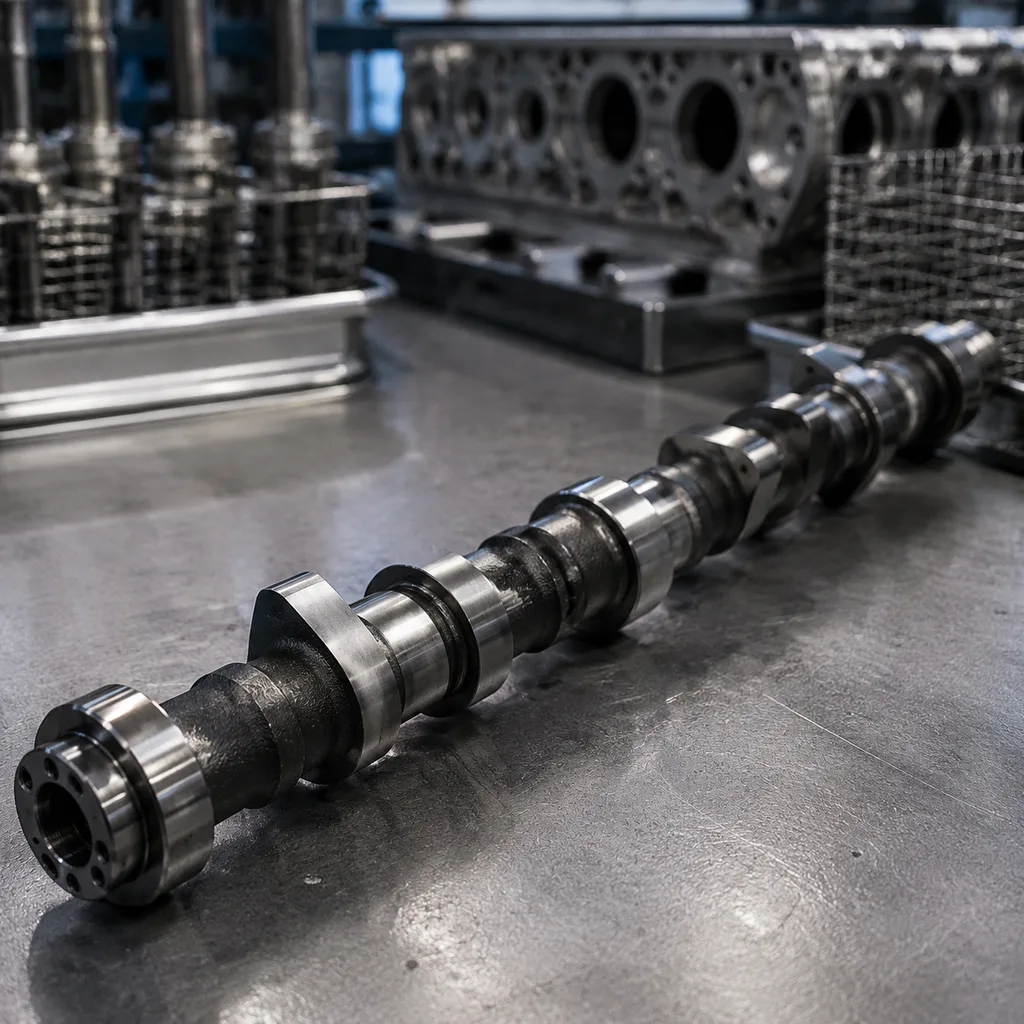
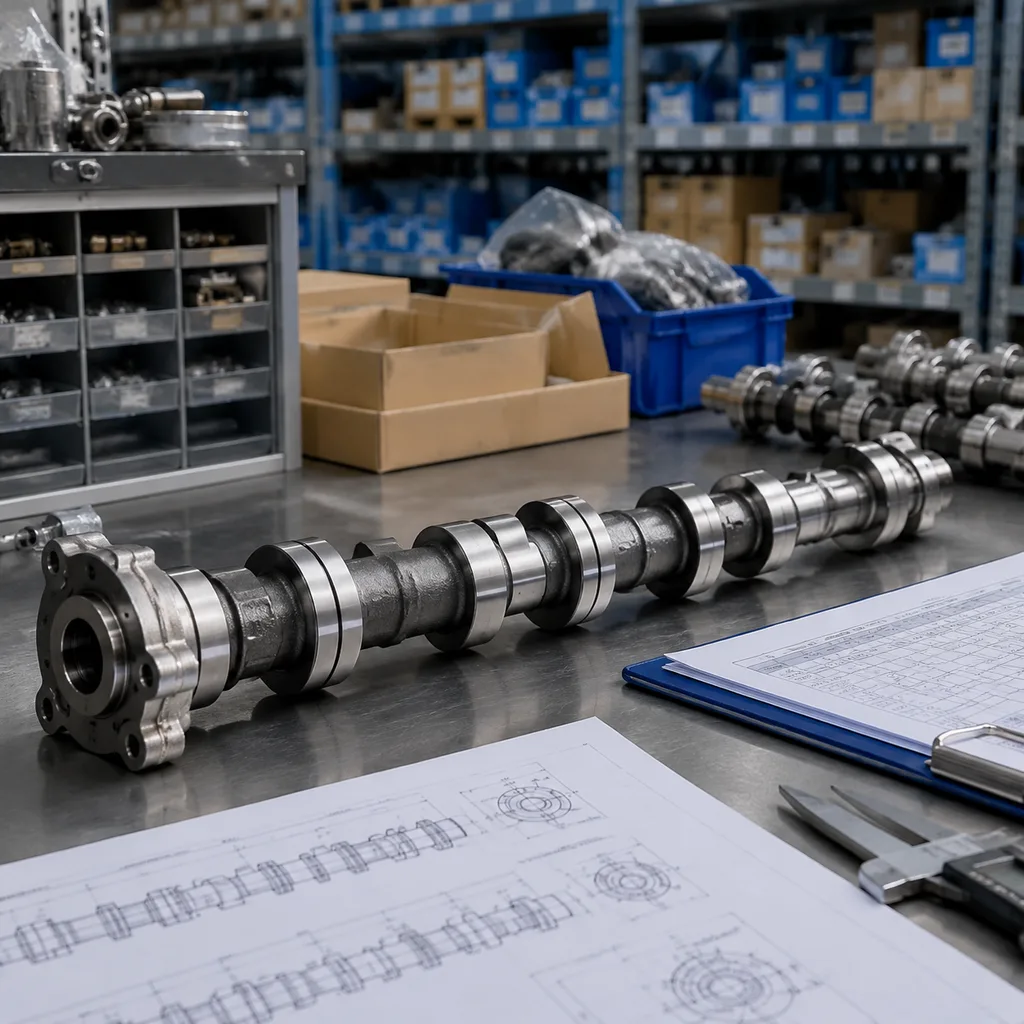
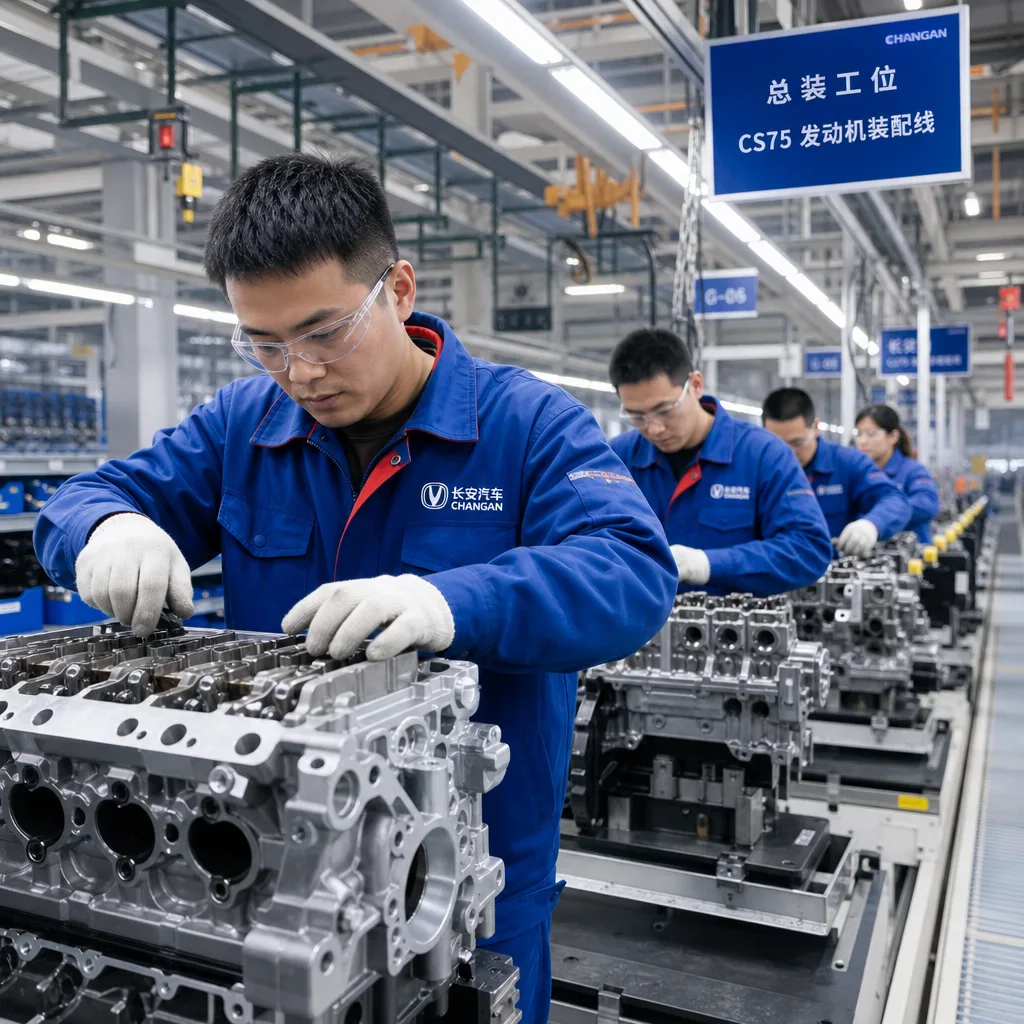
A camshaft for Toyota Yaris aftermarket replacement must match the original valve timing geometry, journal dimensions, surface hardness and drive-interface design for the target engine code. For procurement teams, the risk is not only fitment: a visually similar camshaft with 0.10 mm excess lobe lift, 1–2° phase error, poor oil-hole deburring or journal runout above drawing limits can create valve-train noise, low compression, cam/crank correlation faults, accelerated follower wear or labour-heavy warranty claims. Driventus manufactures engine and powertrain components in Taizhou, Zhejiang, and supplies distributors, importers, OEM/Tier-1 programmes and repair-chain networks in more than 60 countries. This article explains how to specify, validate and source Toyota Yaris replacement camshafts for aftermarket distribution, including OE-equivalence checks, inspection criteria, documentation, MOQ/lead-time logic and purchasing considerations. Driventus is an independent aftermarket manufacturer; brand names are referenced for fitment only.
Replacement scope and fitment confirmation
Toyota Yaris applications vary by market, model year, engine family, valve-train layout and emissions calibration. Before sourcing a replacement camshaft, buyers should confirm the exact engine code and camshaft position. Depending on the Yaris generation and market, common engine families may include 1.0L, 1.3L and 1.5L petrol applications, with chain-driven DOHC layouts and intake/exhaust camshafts that are not interchangeable. Some engines use separate intake and exhaust camshafts, while others integrate variable valve timing features on one side only.
A procurement specification should not rely on vehicle model name alone. The purchase file should include:
Vehicle model, production year range and destination market, because the same model year can have different emissions calibration by region
Engine code and displacement, verified from the VIN/engine plate where possible
Intake or exhaust camshaft requirement, including left/right or front/rear orientation if the buyer uses local terminology
Valve count, camshaft drive type and sprocket/gear interface, such as chain sprocket bolt pattern, locating dowel diameter and keyway position
Overall length, journal count, journal diameter range, thrust face arrangement and end-float control method
Sensor trigger wheel, reluctor, slot or reference feature, including tooth count and angular position if applicable
Variable valve timing interface, oil-control groove and oil-feed drilling layout, if applicable
Packaging and labelling requirements for the destination market, including EAN/UPC, QR code, batch code and local language warning labels
Any known OE reference format, where provided by the buyer, such as OE 06A… or OE 11251… style cross-reference conventions
For distributors managing a broad Asian or global passenger-car range, camshaft fitment should be linked to a structured interchange database with engine code, build date and cam position as mandatory fields. Buyers can review related engine items in our catalog and the engine component range at /products/engine-components.html.
OE-equivalence checks for Yaris camshafts
A camshaft replacement must reproduce the functional geometry of the original part. The critical areas are the cam lobes, journals, thrust surfaces, oil passages and drive-end features. Differences that appear minor during visual inspection may affect valve opening duration, lift, timing accuracy or oil-film stability. For example, a 0.05–0.08 mm journal error can change oil clearance enough to increase hot-idle noise or seizure risk, while a 1° lobe phase deviation can affect idle quality, OBD monitoring and emissions behaviour on sensitive applications.
For B2B purchasing, Driventus recommends using a controlled sample approval process before bulk release. The inspection plan should compare a production sample against the approved reference drawing or master sample. Where no drawing exists, the buyer should approve a reverse-engineered drawing from at least 3–5 measured OE or serviceable samples to separate true design dimensions from used-part wear.
Inspection item
Typical control method
Practical target for RFQ discussion
Procurement relevance
Overall length
Vernier, height gauge, CMM
Drawing value, often controlled within ±0.10–0.20 mm
Confirms assembly fit and end-clearance range
Journal diameter
Outside micrometer, air gauge, roundness tester
Commonly ±0.008–0.015 mm where oil clearance is critical
Controls oil clearance and seizure risk
Journal roundness/cylindricity
Roundness tester or CMM
Usually ≤0.005–0.010 mm, subject to drawing
Reduces local bearing load and oil-film breakdown
Cam lobe lift
CMM or cam profile measuring system
Often ±0.02–0.05 mm against master profile
Confirms valve lift and engine breathing
Lobe phase angle
Camshaft measuring system
Commonly within ±0.5–1.0° cam angle
Protects valve timing and emissions performance
Base circle diameter
Micrometer/CMM
Drawing value, typically ±0.02–0.05 mm
Supports correct lash/hydraulic adjuster range
Runout
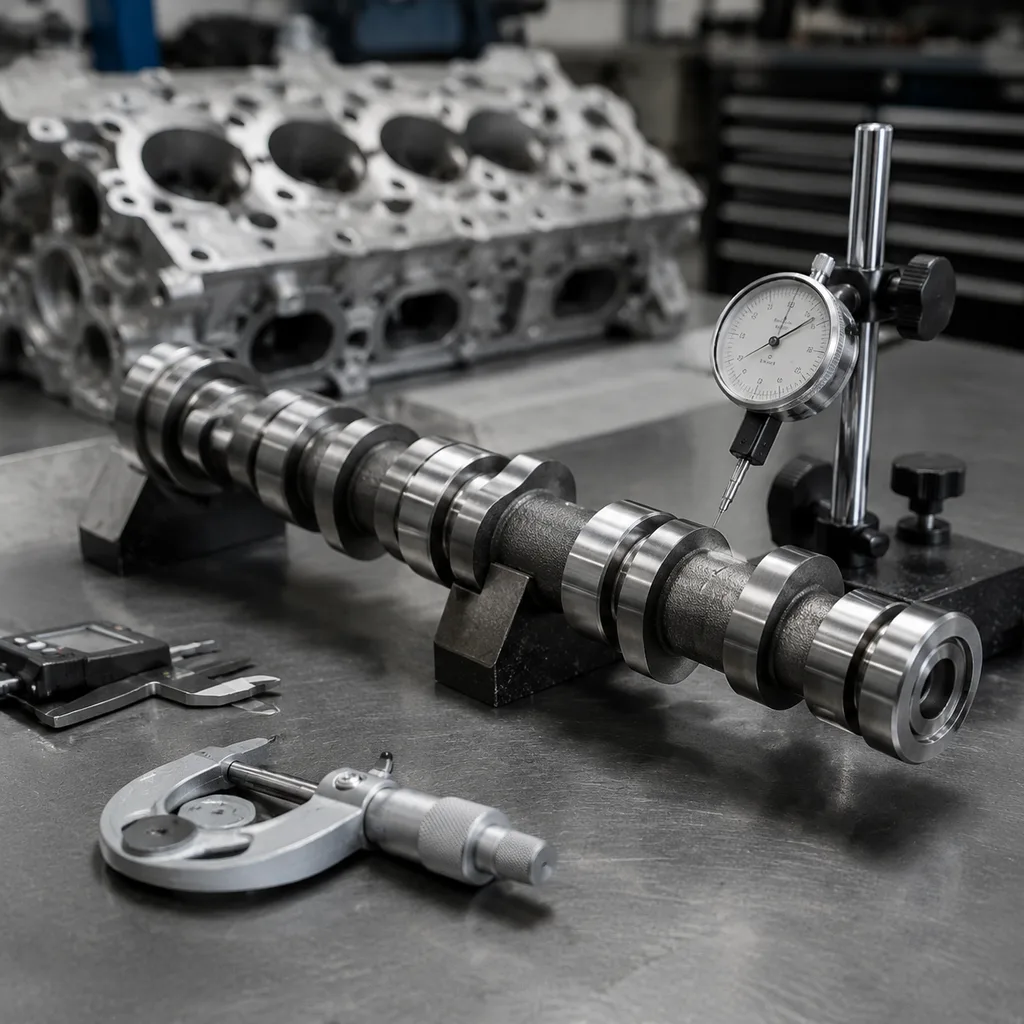
V-block and dial indicator or CMM
Typically ≤0.03–0.05 mm TIR unless drawing differs
Reduces valve-train vibration and bearing load
Surface hardness
Rockwell or Vickers test
Example: chilled/induction lobe surface often in 50–60 HRC range, per material route
Supports wear resistance at lobe and journal surfaces
Surface roughness
Profilometer
Lobe/journal Ra often controlled around 0.2–0.8 µm depending on mating system
Helps prevent follower scuffing at cold start
Oil hole position
Pin gauge, borescope, dimensional inspection
Hole diameter/position per drawing; 100% deburring check recommended
Confirms lubrication alignment
Sensor or trigger feature
Gauge and functional fit check
Tooth/slot count and angular position verified to master
Prevents crank/cam correlation faults
</tr></thead><tbody> </tbody></table>Dimensional tolerances depend on the specific camshaft design and drawing. As a general sourcing rule, journal and lobe features should be controlled with process capability evidence, not only final inspection sorting. For repeat orders, buyers should ask for Cp/Cpk data on journal diameter, lobe lift and phase angle after the pilot batch, with agreed escalation rules if capability drops below the approved level.
Materials, heat treatment and surface integrity
Passenger-car camshafts are commonly produced from chilled cast iron, alloy cast iron, ductile iron or forged steel, depending on the OE design and operating load. For a camshaft for Toyota Yaris aftermarket replacement, the material selection should match the original functional requirement rather than a generic catalogue description. Substituting a lower-grade iron or changing a hardened steel design to a non-equivalent casting may reduce cost on paper but can increase lobe pitting, journal scoring or follower wear in the field.
A sourcing specification should request a material certificate and heat-treatment record for each production lot. Relevant quality controls include:
Chemical composition verification by spectrometer, with lot traceability to the casting or bar-stock batch
Microstructure inspection after casting or heat treatment, including chilled layer, graphite form or carbide distribution where applicable
Surface hardness testing at lobes and journals, with a defined test location and frequency such as first-off, last-off and periodic in-process checks
Case depth verification where induction hardening is used, for example by cut sample or approved non-destructive method on validation lots
Magnetic particle inspection or equivalent crack detection where specified, especially after heat treatment and straightening
Cam lobe polishing and surface roughness control, normally verified by profilometer rather than visual judgement only
Deburring of oil holes and machined edges, followed by washing and compressed-air/oil-passage cleanliness checks
Anti-rust oil or VCI protection suitable for 30–90 days domestic storage or 60–120 days sea freight exposure, depending on packing specification
A typical process route is raw casting or forged blank receipt, incoming material check, rough turning, rough grinding, drilling of oil passages, heat treatment or induction hardening where required, straightening, finish grinding of journals and lobes, polishing, washing, rust prevention, final inspection and packing. Critical control points are usually after heat treatment, after finish grinding and before final packing.
Surface finish is important because the cam lobe and follower interface operates under high contact stress during boundary lubrication conditions, especially at cold start. Rough lobes can accelerate follower wear. Over-polished or incorrectly hardened surfaces can also fail if the underlying metallurgy is not controlled.
Driventus applies incoming material checks, in-process machining controls and final inspection under a documented quality system aligned with IATF 16949:2016 and ISO 9001:2015. These standards support traceability, corrective action and change control, but they do not replace part-specific validation.
Validation testing before aftermarket release
Replacement intent requires evidence that the part can operate reliably in the target application. Validation should cover both fitment and durability. For new camshaft programmes, especially where the buyer plans private-label distribution, Driventus can support sample production, measurement reports and controlled pilot orders.
Recommended validation steps include:
1. Dimensional first-article inspection against the approved drawing or master sample, normally covering all journals, lobes, thrust faces, drive-end features, oil holes and sensor features. 2. Assembly fit check in a representative cylinder head or fixture to confirm bearing cap fit, thrust clearance, sprocket alignment and cover clearance. 3. Rotation and end-float verification to confirm bearing alignment and thrust control; the cam should rotate smoothly after lubrication and cap torqueing without binding. 4. Valve lift and phase confirmation using a cam profile measuring system, with lift curve, base circle and lobe centreline recorded for intake/exhaust positions. 5. Hardness and microstructure review on production samples, including surface and, if specified, case-depth verification. 6. Oil passage verification to confirm drilling position, cross-hole connection, deburring and cleanliness; buyers should specify whether 100% air-flow or borescope inspection is required. 7. Bench or engine durability testing where programme volume or warranty exposure justifies it. A practical aftermarket plan may include 20–50 hours of bench running or an engine/vehicle mileage trial before mass release, while high-volume programmes may justify longer endurance validation. 8. Packaging drop and corrosion checks for export routes with long sea transit, such as carton drop testing from 0.8–1.2 m and humidity/corrosion exposure checks based on the buyer’s warehouse route.
For sample approval, a common sequence is 5–10 pcs prototype or first-article samples, 30–100 pcs pilot batch after buyer sign-off, and then mass production once fitment, inspection and packaging are approved. A retained master sample should be sealed after approval; production parts are then checked against the master sample and the controlled drawing.
For emissions-regulated markets, the camshaft must not alter the intended valve timing profile of the application. Vehicle-level compliance is controlled by the vehicle system, but component geometry can affect catalyst light-off, misfire behaviour and OBD monitoring. Buyers operating in Europe should consider the broader regulatory environment, including REACH (EC) No 1907/2006 for restricted substances in materials and coatings. For markets where emissions requirements reference vehicle type-approval frameworks, ECE R-83 may be relevant to the vehicle platform, although it is not a camshaft manufacturing standard.
Purchasing data for distributors and repair-chain suppliers
For aftermarket buyers, the commercial file should be as controlled as the engineering file. A camshaft is a high-consequence engine component: one incorrect interchange can generate labour claims that exceed the part value. A low unit price is not useful if the supplier cannot lock the lobe profile, maintain batch traceability or separate similar intake/exhaust references during packing.
A practical RFQ package should include:
Target engine code and model-year coverage, with exclusions clearly listed
Required monthly or annual volume, split by intake/exhaust references if both are requested
Market destination and packaging language, including importer address and compliance marks where required
Required cross-reference structure and barcode format, such as EAN-13, UPC, Code 128 or buyer SKU format
Private-label artwork and carton strength requirements, including inner foam, anti-rust bag, VCI paper and master-carton quantity
Inspection report format required by the buyer, including whether every shipment needs dimensional, hardness and batch traceability records
Target warranty process and claim evidence requirements, such as installation photos, oil condition, mileage and diagnostic code records
Incoterms, preferred port and shipment frequency, such as EXW, FOB Ningbo/Shanghai, CIF or DAP by project agreement
Driventus supplies bulk, neutral-pack and buyer-branded packaging for qualified programmes. MOQ and pricing depend on whether the item uses existing tooling, shared blanks or a new casting/forging and grinding setup. As a practical buying guide, existing catalogue references may start from lower MOQs, while a new or private-label programme commonly requires a pilot quantity first and then production batches sized to tooling, heat-treatment and grinding capacity. Unit price is mainly driven by raw material route, machining cycle time, heat treatment, inspection frequency, packaging complexity, annual volume and Incoterms. Lead time is typically shortest for validated catalogue items, longer for private-label packing, and longest for new-sample development because reverse engineering, tooling confirmation, first-article inspection and pilot approval must be completed before release.
For distributors requiring a new interchange or a controlled drawing based on a supplied sample, the custom manufacturing process can define tooling, sample approval, pilot batch and mass-production control stages.
Replacement sourcing comparison
Sourcing route
Typical advantage
Main risk to control
Practical buying logic
Spot purchase from trader
Short lead time for common references
Limited traceability and inconsistent batches
Use only for urgent low-volume demand where fitment risk is already known
Catalogue aftermarket manufacturer
Stable fitment range and repeat supply
Must verify validation depth and documentation
Best for recurring distributor demand with forecastable volume
Custom production from sample/drawing
Better control over geometry, branding and packaging
Requires sample approval time and clear specifications
Suitable when annual volume justifies tooling and inspection setup
OE channel
Original service fitment
Higher cost and limited availability for some markets
Useful as benchmark sample or for low-volume premium repair demand
</tr></thead><tbody> </tbody></table>For most B2B replacement programmes, the best balance is a controlled aftermarket manufacturer with repeatable tooling, documented inspection and transparent change management.
Documentation, compliance and change control
Importers and repair-chain suppliers should request documentation before shipment, not after a warranty issue occurs. The minimum document package for a Toyota Yaris replacement camshaft programme should include material certificate, dimensional inspection report, hardness result, batch number, packing list and production traceability record. For higher-risk or private-label programmes, buyers should add first-article inspection, control plan, process flow chart, packaging specification, anti-rust method, retained-sample record and nonconformance response procedure.
Each carton and part label should support traceability back to production lot. A practical format includes buyer part number, supplier part number, engine/application note, intake or exhaust position, quantity, production batch/date code, country of origin and barcode. For mixed camshaft orders, intake and exhaust items should use visibly different labels and inner packaging to reduce warehouse picking errors.
Where buyers supply drawings, part data or fitment lists, revision control is essential. A change to a sensor trigger feature, oil hole, casting supplier, heat-treatment setting, grinding wheel/process parameter or packaging label may require buyer approval before implementation. Under IATF 16949:2016 and ISO 9001:2015, change control, nonconforming output management and corrective action are part of the management system, but the buyer and supplier still need a written part-level agreement.
Driventus also recommends retaining reference samples from approved lots for at least the warranty period or the period agreed in the supply contract. This supports future claim analysis, dimensional comparison and revalidation when the vehicle application list is expanded. If a field claim occurs, useful evidence includes installed mileage, engine oil grade and change history, photos of lobes and followers, fault codes, batch code, installation date and whether the mating followers/buckets were replaced.
Driventus is an independent aftermarket manufacturer; brand names are referenced for fitment only. No approval or endorsement by any vehicle manufacturer is claimed or implied.
Frequently asked questions
Provide engine code, model-year range, intake or exhaust position, camshaft drive type, VVT interface if used, and any buyer-approved interchange data. A sample or drawing is recommended for first-article inspection, and the RFQ should state target volume, packaging, Incoterms and inspection-report requirements.
Yes. Driventus can support neutral, bulk or buyer-branded packaging for qualified B2B programmes, subject to artwork approval, carton specification, barcode format, anti-rust method and destination-market labelling requirements.
No. IATF 16949:2016 and ISO 9001:2015 support process control and traceability. Fitment still depends on correct engine-code matching, intake/exhaust position, dimensional validation, lobe profile control and approved interchange data.
If you are building a camshaft for Toyota Yaris aftermarket replacement programme, share your fitment list, engine codes, intake/exhaust split, target annual volume, packaging requirements and inspection criteria. Driventus can review the specification and prepare a controlled quotation at [request a quote](/contact.html).