Engine Compression Test Failure: Engine Block Checks
An engine compression test failure does not automatically make the engine block unusable. Low or uneven compression may be caused by piston rings, valve sealing, head gasket leakage, liner wear, deck distortion, cracked water jackets, porous castings, or a flawed test procedure. For procurement teams, the question is both technical and commercial: can the unit be repaired within service limits, should the block be machined, or is replacement the lower-risk option for uptime and warranty control? This guide sets out a practical diagnostic path from symptom to root cause, with specific checks for cylinder blocks used in aftermarket, remanufacturing, and fleet repair programmes. It adds working numbers for test repeatability, bore geometry, deck checks, pressure testing, sampling, MOQ, price and lead-time logic so buyers can brief repair partners and suppliers with fewer assumptions. Driventus is an independent aftermarket manufacturer; brand names are referenced for fitment only.
How compression failure points toward the block
A compression test measures how well each cylinder holds pressure during cranking. A healthy engine usually shows reasonably consistent readings from cylinder to cylinder, although the exact pressure depends on engine design, altitude, cam timing, cranking speed, and test method. In many workshops, a spread of more than 10–15% between cylinders is more useful as a warning sign than one isolated pressure number. As a practical control, repeat the test if battery voltage drops below about 12.2 V before cranking, if cranking speed varies by more than roughly 10%, or if the engine was not tested with the throttle fully open where the procedure requires it.
For engine block diagnosis, the pattern matters:
Compression pattern
Likely area
Block-related risk
One low cylinder
Valve, ring, liner, local gasket failure
Scored bore, cracked liner, local deck damage
Two adjacent low cylinders
Head gasket or deck sealing
Warped deck, fretting between bores, fire-ring brinelling
</tr></thead><tbody> </tbody></table>A dry compression test should normally be followed by a wet test and, where possible, a cylinder leak-down test. Add a controlled oil quantity, typically 5–10 ml for light-duty passenger engines or as specified by the OEM procedure; too much oil can falsely raise pressure. If compression rises by more than about 15–20% after oil is added, ring-to-bore sealing becomes suspect. If leakage is heard at the intake, exhaust, crankcase, or coolant reservoir during leak-down, the fault path becomes clearer. Many service programmes use less than 10% leakage as strong, 10–20% as serviceable depending on engine type, 20–30% as marginal, and more than 30% as requiring investigation. Procurement teams should request this sequence from repair partners before approving block replacement. Replacing an assembly on the basis of one cranking pressure reading can increase warranty cost and may leave the real failure mode unresolved.
Diagnostic workflow before condemning an engine block
A structured inspection reduces unnecessary replacement and supports stronger supplier claims when a part is genuinely defective. The following sequence is suitable for repair chains, distributors handling warranty returns, and remanufacturing plants.
1. Confirm test conditions: Record engine temperature, battery state, starter speed, throttle opening, fuel cut-off, injector disablement, and whether all spark plugs or injectors were removed. Note gauge make, calibration status, hose length, non-return valve location, and adapter used, because adapters can change effective chamber volume. 2. Compare all cylinders: Capture actual pressure values in bar or psi, not only pass/fail comments. A pattern across cylinders is often more valuable than a single result. Run at least 4–6 compression pulses per cylinder and stop at the same pulse count for comparability. 3. Run a wet compression test: Add a controlled small amount of oil to the cylinder. A significant increase points toward ring or bore sealing rather than valve leakage. No change usually pushes diagnosis toward valves, gasket sealing, timing, or a crack path. 4. Perform leak-down testing: Use shop air at a controlled pressure, commonly 80–100 psi, with the piston at true TDC on compression stroke. Listen for leakage through the intake, exhaust, crankcase, and cooling system. Bubbles in the coolant neck or expansion tank require deck, liner, gasket, head, and block crack checks. 5. Inspect the bore visually: Use a borescope to identify vertical scoring, glazing, rust pitting, broken ring-land damage, detonation marks, liner step wear, or foreign-object marks. Record cylinder number and clock position, for example “No. 3 thrust side, 2 o’clock.” 6. Check coolant and oil evidence: Combustion gas in coolant, emulsified oil, unexplained coolant loss, coolant pressurisation within 30–60 seconds of cold start, or oil film in the coolant may indicate deck, gasket, liner, head, or casting issues. 7. Measure, do not assume: Bore diameter, taper, out-of-round, deck flatness, deck roughness, main tunnel alignment, and liner protrusion should be measured with calibrated tools and compared with the engine specification. Bore gauges should normally be set with a micrometer or master ring close to nominal size, not zeroed by feel.
For B2B warranty control, the inspection report should include photographs, cylinder numbers, measured values, mileage or operating hours, oil and coolant service history where available, DTCs, overheating evidence, and the exact sequence of tests performed. Use a simple hold/release gate: if bore taper or out-of-round is above the service limit, if coolant-jacket pressure decays, if the deck exceeds flatness limits, or if a crack is confirmed, the block moves to machining/replacement review. This is particularly important when a distributor must decide whether to replace pistons and rings, machine the block, approve a sleeved repair, or source a complete block from our catalog.
Block defects that cause low compression
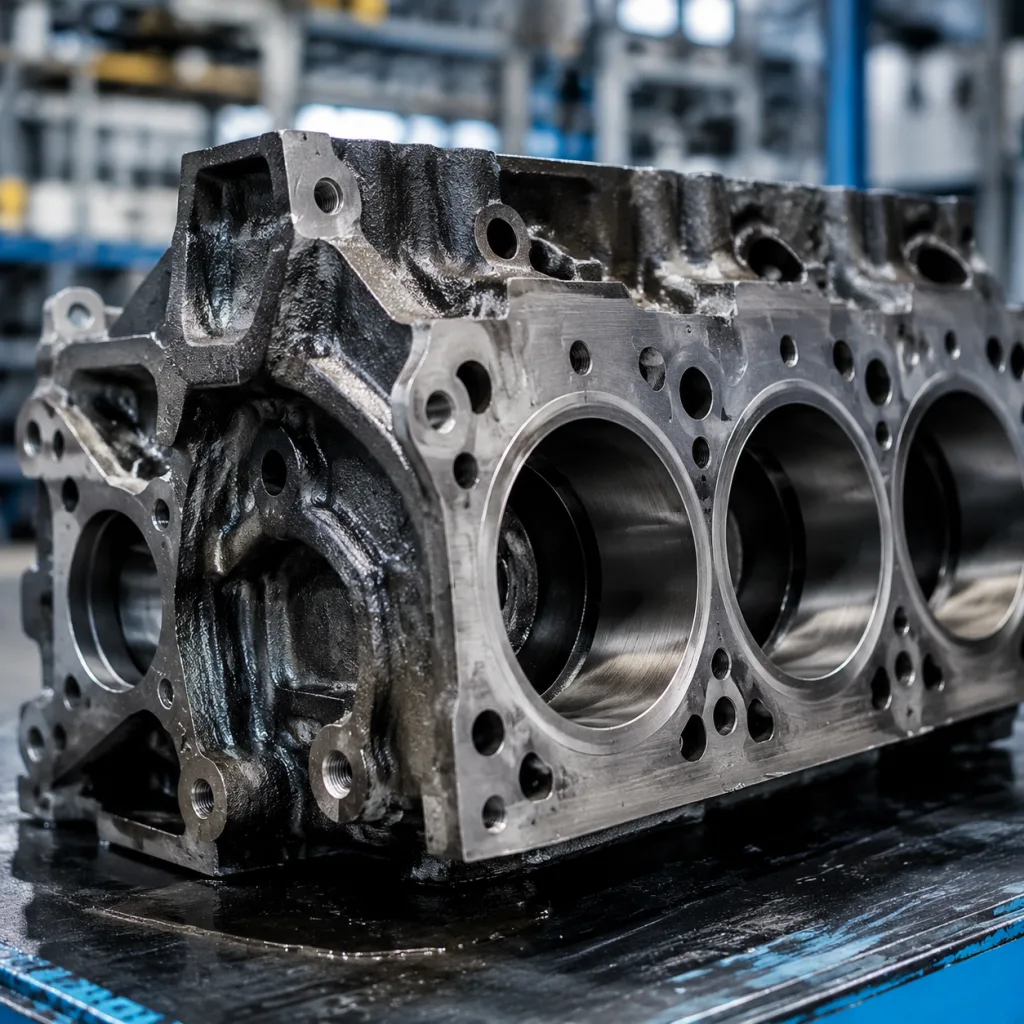
The engine block controls cylinder geometry, head gasket sealing, crankshaft alignment, and coolant/oil separation. Several block conditions can create compression loss directly or contribute to repeat failure after repair.
Cylinder bore wear and geometry errors
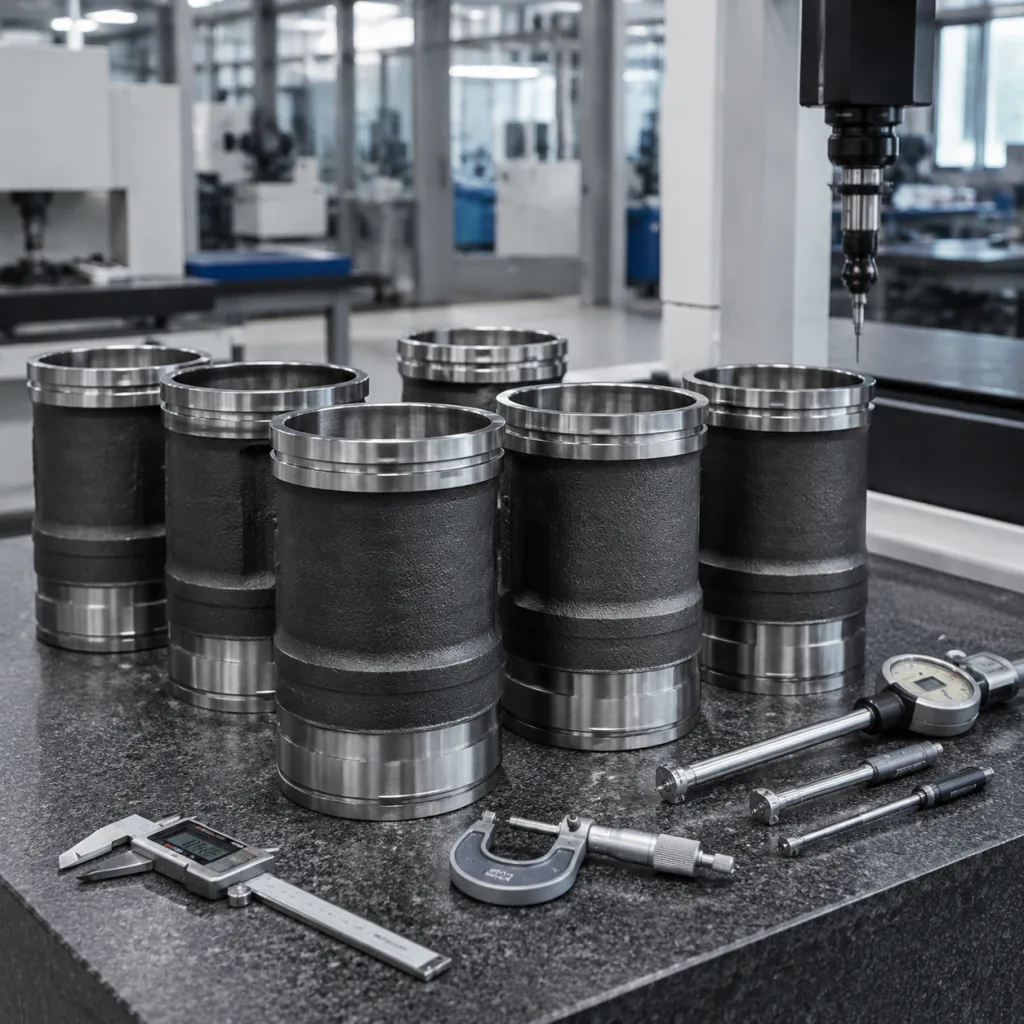
Bore wear reduces ring sealing. The main measurable conditions are excessive diameter, taper from top to bottom, and out-of-round. Even small geometry errors can prevent the compression ring from maintaining uniform contact, especially under thermal load. As practical reference points, many light-duty blocks require bore taper and out-of-round to be held within roughly 0.02–0.05 mm for service reuse, but the engine-specific manual always governs. Piston-to-wall clearance commonly sits in the 0.02–0.08 mm range on passenger engines and can be higher on some diesel or forged-piston applications. In high-mileage units, polished glazing may also prevent correct oil retention after re-ringing, leading to poor break-in and continued blow-by.
Typical inspection points include:
Bore diameter at upper, middle, and lower positions, measured about 10–15 mm below the deck, mid-stroke, and near the lower ring travel area
Measurements in thrust and non-thrust directions, with results recorded to 0.001 mm or 0.0001 in where the tool supports it
Taper and out-of-round compared with the engine specification and oversize piston programme
Surface finish after honing, including crosshatch consistency, plateau finish, and angle normally around 35–45° unless a ring supplier specifies otherwise
Evidence of liner movement, flange fretting, cavitation damage, liner seat erosion, or sleeve counterbore damage
Piston-to-wall clearance, ring end gap, and ring side clearance against the specified service limit
Deck distortion, cracks, and porosity
Adjacent-cylinder compression failure often leads technicians to suspect the head gasket. The block deck should be checked at the same time. Local overheating, incorrect bolt torque, previous machining, corrosion, and combustion leakage can damage the sealing surface. A crack between a cylinder bore and coolant passage can produce low compression together with coolant pressurisation, misfire, or unexplained coolant loss. Typical deck flatness targets are often 0.03–0.05 mm across a short span and 0.05–0.10 mm overall for many light-duty engines, but multi-layer steel gaskets and aluminium blocks can require tighter limits. Surface roughness must also match the gasket type; MLS gaskets frequently need a smoother controlled finish, often around Ra 0.4–1.2 µm, while some composite gaskets tolerate a rougher surface.
Inspection methods may include precision straightedge and feeler-gauge checks, CMM or surface plate checks for production validation, dye penetrant testing where appropriate, coolant-jacket pressure testing, and magnetic particle inspection for suitable ferrous castings. A common pressure-test window is 1.5–3.0 bar for 10–30 minutes, or according to the customer standard, with no visible bubbles and no measurable pressure decay beyond the agreed gauge tolerance. Aluminium blocks may require different non-destructive testing methods, such as dye penetrant, pressure decay, helium leak testing for special programmes, or other methods specified by the customer or engineering standard. For production control, Driventus uses dimensional inspection and process checks within an IATF 16949:2016 and ISO 9001:2015 aligned quality system.
Repair, machining, or replacement decision criteria
After an engine compression test failure engine block assessment, the next decision is whether the block can be reused with acceptable risk. The answer depends on the technical limit, vehicle downtime, machine-shop capability, parts availability, and warranty exposure.
Condition found
Possible action
Procurement consideration
Light glazing, bores within limit
Plateau hone and re-ring
Lowest part cost, depends on labour quality, clean washing, ring specification, and correct break-in
Moderate wear within oversize range
Bore/hone oversize, fit matched pistons
Requires machine-shop capacity, torque-plate process where required, and controlled piston supply
Deep scoring beyond machining limit
Replace block or complete a sleeved repair
Compare downtime, sleeve interference, flange support, and warranty exposure against component cost
Deck distortion within machining allowance
Resurface deck
Verify final deck height, surface roughness, gasket compatibility, valve/piston clearance, and compression ratio impact
Crack into water jacket or main web
Replace block
High warranty risk if repaired incorrectly; welding often needs heat treatment and re-machining
Porous casting or repeated coolant leakage
Replace block
Supplier traceability, leak-test records, and casting batch containment matter
</tr></thead><tbody> </tbody></table>For multi-location repair chains, replacement is often preferred when vehicle uptime and repeat failure risk outweigh machining savings. A useful commercial rule is to compare total installed cost, not part price only: machine labour, pistons, rings, bearings, gaskets, freight, vehicle downtime, comeback probability, and claim handling. If machining saves 15–25% on parts but adds 3–7 days of lead time and a higher repeat-failure risk, a new machined block may be the lower-cost choice for fleets. For remanufacturers, machining may be economical if the incoming core supply is consistent, specifications are well controlled, fixture repeatability is proven, and inspection capacity is available.
Where a new replacement block is selected, buyers should verify fitment by engine code, casting configuration, oil and coolant passage layout, sensor locations, mounting bosses, crankcase ventilation provisions, main cap style, liner type, deck height, and OE part-number cross-references if provided in the programme. Use generic references such as OE 06A… only where a confirmed cross-reference exists in the customer’s data. No part listing should imply vehicle manufacturer approval unless that approval is documented.
Sourcing controls for replacement engine blocks
A replacement block must match the original design functionally and dimensionally. Visual similarity is not sufficient, and small deviations in bore finish, deck roughness, coolant passages, or threaded-hole position can create repeat failures after installation. Buyers should request technical evidence before placing repeat orders, especially for private-label or regional distribution programmes.
Recommended sourcing checklist:
Casting material specification, such as grey cast iron grade, compacted graphite iron where required, or aluminium alloy grade, with chemical composition limits
Hardness range and metallurgical control, for example HB values, graphite structure for cast iron, porosity acceptance level, and microstructure report where specified
Heat treatment, ageing, or stress-relief process where applicable, including temperature/time records for controlled batches
CNC machining control plan for bores, decks, main bearing tunnels, threaded holes, dowel holes, plug bores, and seal surfaces
Bore diameter, roundness, cylindricity, taper, perpendicularity to crank centreline, and surface-finish inspection data
Deck flatness and surface roughness records for head gasket sealing, including Ra/Rz if the gasket supplier requires both
Main bearing housing alignment, housing bore size, cap fit verification, bolt torque procedure, and line-bore/line-hone record
Coolant jacket pressure-test parameters and results, including pressure, hold time, medium, acceptance criteria, and operator/batch ID
Thread gauge checks for head bolts, mounts, and accessories, including go/no-go records for critical threads
Verification of oil galleries, coolant passages, plugs, dowels, sensor ports, and cleaning process to remove chips and abrasive residue
Batch traceability, serial or lot identification, inspection report format, label content, and packaging method
Compliance review for substances under REACH (EC) No 1907/2006 where relevant to the sales region
Commercial controls should be tied to the technical risk. For a catalogue item using existing tooling, MOQ may be driven mainly by machining batch size and packaging, often lower than a new casting programme. For a new or modified block, MOQ must cover pattern/tooling, fixture design, first-article inspection, destructive validation if required, and casting trial losses. Price normally changes with material grade, machining completeness, inspection level, pressure-test requirement, packaging density, annual forecast, and payment terms. Lead time normally separates into tooling or fixture build, sample production, PPAP/FAI approval, mass production, and ocean/air freight. Driventus manufactures engine and powertrain components for aftermarket distributors, OEM/Tier-1 programmes, and repair networks. Standard items can be reviewed through our catalog, while engine block variants, machining changes, packaging, and private-label requirements can be discussed through custom manufacturing. For regulated markets, documentation should be aligned with the customer’s import, warranty, and technical file requirements.
What to include in a supplier RFQ after failure analysis
When the root cause indicates block replacement, the RFQ should be based on measured requirements rather than a broad description such as “engine block for replacement.” Clear technical inputs reduce sampling delays, prevent incorrect machining assumptions, and help avoid fitment disputes after shipment.
A practical RFQ should include:
Engine family, displacement, fuel type, aspiration, emission generation, and production year range
Required casting type, bare block, semi-finished block, or fully machined block configuration
Bore size: standard, semi-finished machining stock, or oversize requirement, with tolerance and piston matching method
Deck height, deck flatness, Ra/Rz surface finish, and head gasket interface requirements
Main bearing tunnel diameter, alignment tolerance, cap configuration, bolt grade, and torque/angle process if supplied assembled
Oil gallery, coolant passage, sensor, crankcase ventilation, and mounting-boss requirements with marked drawings or sample photos
Target order volume, annual forecast, call-off size, acceptable MOQ, and delivery schedule by month or quarter
Target price basis, such as EXW, FOB, CIF, DAP, or delivered warehouse, plus currency and payment terms
Required inspection report format, first-article inspection scope, sampling plan, and critical-to-quality dimensions
Packaging specification for sea, air, or courier shipment, including corrosion protection, pallet height, drop-test expectations, and label format
Market destination, including EU, UK, US, Canada, Australia, or Brazil, and any customer-specific compliance declarations
A realistic sourcing timeline is usually 2–4 weeks for drawing/sample review and quotation on a known family, 4–8 weeks for first samples when existing tooling and fixtures are available, and 12–24+ weeks for new casting tooling or major machining fixtures, before transport time. Approval can take longer if the customer needs dyno testing, endurance testing, or PPAP-style documentation. Published management standards such as IATF 16949:2016 and ISO 9001:2015 do not replace part validation, but they help define process discipline, document control, corrective action, and traceability. For compression-related warranty cases, suppliers should be able to review measurement evidence and respond with containment actions, dimensional reports, material records, pressure-test data, or production records. To start a technical review, buyers can request a quote with drawings, samples, inspection data, target MOQ, forecast, required Incoterm, and confirmed cross-reference information.
Frequently asked questions
No. Low compression can result from valves, rings, pistons, head gasket leakage, timing issues, or test errors. The block should be condemned only after repeatable dry/wet compression results, leak-down testing, bore measurement, deck inspection, and crack or pressure testing where relevant.
Key checks include bore diameter and roundness, taper, deck flatness, deck roughness, main bearing tunnel alignment, gasket surface finish, threaded hole positions, coolant/oil passage layout, and mounting points. These should be matched against the engine specification and confirmed with inspection records before volume purchasing.
Yes. Driventus can discuss standard and customised engine block supply, including machining requirements, MOQ, packaging, traceability, inspection documentation, and lead-time planning. Driventus is an independent aftermarket manufacturer; brand names are referenced for fitment only.
If your team is reviewing compression-related block failures or planning a replacement sourcing programme, send the inspection data, drawings, samples, target MOQ, forecast, required Incoterm, and packaging requirements. We will respond with technical and commercial options at /contact.html