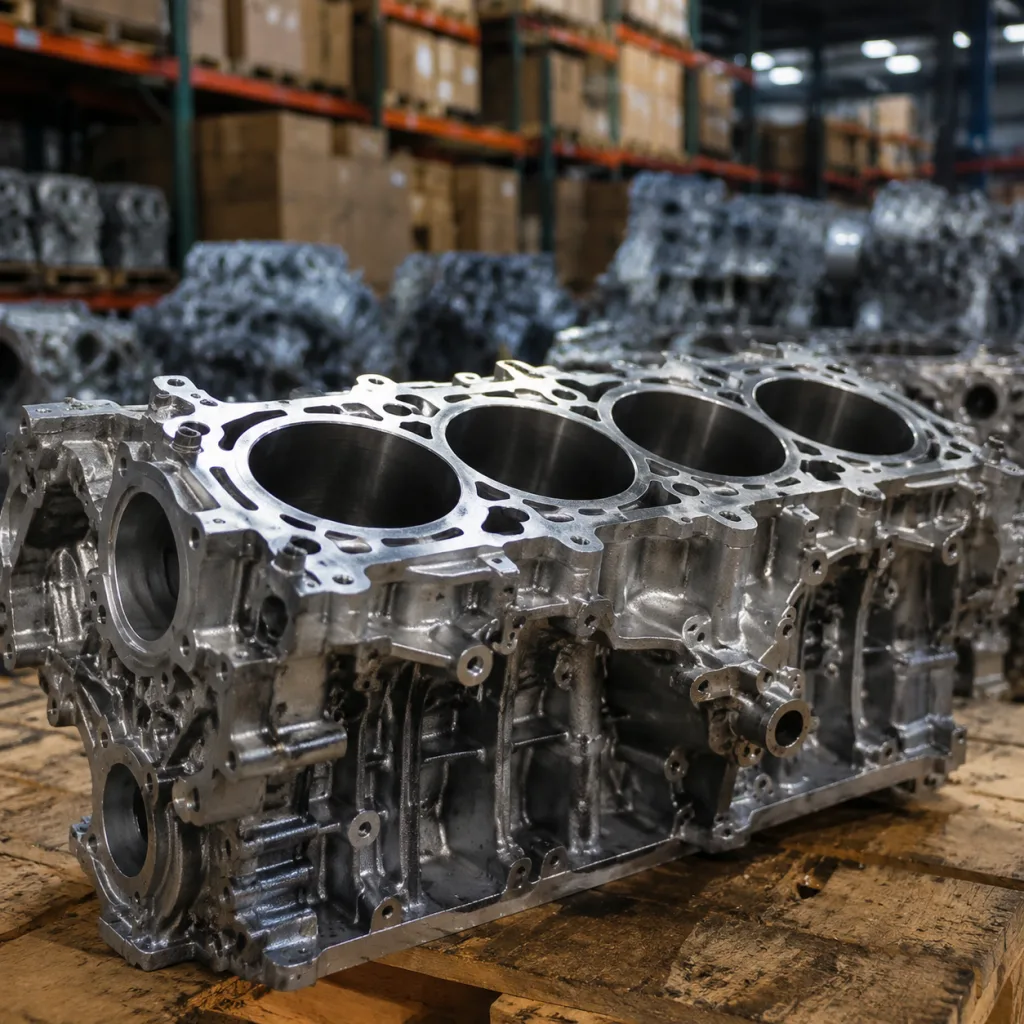
When sourcing an engine block Honda wholesale supply, the real decision is not price first; it is whether the block will fit, seal, and hold dimension after machining. An engine block is a structural casting with tight relationships between bore geometry, deck height, main tunnel location, coolant passages, and fastener interfaces. Driventus supplies engine and powertrain components from Taizhou, Zhejiang, to distributors, OEM and Tier-1 buyers, and repair networks in more than 60 countries. Driventus is an independent aftermarket manufacturer; brand names are referenced for fitment only. We work to IATF 16949:2016 and ISO 9001:2015 requirements, with documentation support for procurement reviews and supplier audits. This article frames the purchase as a sourcing decision: how to judge fitment risk, compare offers, and separate a workable supplier from a merely cheap quote.
Start With Fitment Risk, Not Price
A wholesale engine block order fails fastest when the buyer skips fitment control. For Honda applications, confirm whether the requirement is a bare casting, a semi-finished block, or a fully machined block ready for assembly. Each version changes cost, lead time, and rejection risk.
Minimum purchase checks
Application family and engine code, including displacement, cylinder count, and valvetrain family
Bore diameter, bore spacing, deck height, and main bore alignment
Casting material, alloy callout, and heat-treatment state
Machined surfaces covered by inspection reports, with stated tolerances
Packaging method for sea freight, mixed pallets, or consolidated cartons
If the part is cross-referenced to an OE number, keep the reference format in your purchase file, for example `OE 06A107065`, but verify the physical dimensions against the drawing or sample. Brand names should be used only for fitment, not as evidence of approval. For a buyer-ready RFQ, ask the supplier to state whether the block is bare, rough-machined, or finish-machined, because that choice changes bore tolerance, deck flatness, lead time, and rejection risk. Typical targets for a machined block are bore diameter tolerance within ±0.01 to ±0.03 mm on critical bores, deck flatness within 0.03 to 0.08 mm across the sealing face, and main bore alignment within 0.01 to 0.03 mm depending on the engine family and inspection method. Ask for the exact gauge method, not only the nominal result.
Where Wholesale Quotes Usually Break Down
Buyers often compare unit price before they compare supply terms. That is usually where engine block programs go wrong. MOQ, stable monthly capacity, tooling ownership, and repeatable machining route matter more than a headline number that cannot be repeated.
Commercial item
What to confirm
Buyer action
MOQ
Carton, pallet, or container level
Confirm the smallest order that still supports acceptable landed cost
Lead time
Prototype, first batch, repeat order
Separate sample timing from production timing
Capacity
Monthly output by reference
Match to your forecast and safety stock
Packing
VCI, crate, pallet, edge protection
Require export-grade packing photos or spec
Documents
COA, inspection report, packing list
Tie paperwork to exact part number and revision
Warranty terms
Claim window and defect handling
Define response time and disposition rules
</tr></thead><tbody> </tbody></table>For buyers in the EU, UK, US, Canada, Australia, and Brazil, the decision should also include importer documentation, HS classification support, and clear Incoterms on the purchase order. A practical wholesale quote should show three price breaks: sample or pilot, MOQ, and repeat order at forecast volume. Buyers commonly request a 10 to 20 unit pilot for fitment validation, a 50 to 100 unit production MOQ for mixed programs, and a 200+ unit annualized price tier when the route is stable. Lead time should be split into tooling or process setup, first-article approval, and repeat replenishment; a 30-day repeat order is not the same as a 30-day first build. When comparing offers, ask whether the quoted price includes palletization, corrosion protection, export cartons, and internal preservative oil, because those items can materially change landed cost.
Read the Quality Signals in the Process Flow
A reliable supplier should explain both foundry control and machining control. For an engine block, dimensional drift in the main tunnel or cylinder bank can create bearing issues, oil consumption, or sealing failures. The inspection sequence matters more than the final pass/fail result.
Typical control points
Chemical composition and melt traceability by heat or batch number
Casting defect inspection for porosity, shrinkage, and inclusions
Bore size and roundness checks after machining, with gauge calibration status
Deck flatness and surface finish records
Main tunnel alignment and torque-plate verification where applicable
Pressure testing for coolant jackets when specified
A supplier working to IATF 16949:2016 and ISO 9001:2015 should be able to provide controlled inspection records and batch identification. For buyer review, our quality system outlines the documents we use for incoming, process, and final inspection. Buyers should ask for concrete acceptance criteria: a bore diameter target with upper and lower limits, a cylinder roundness limit, surface roughness values for gasket interfaces, and an allowable porosity or leak threshold if pressure testing is used. If the block is machined in stages, request in-process checkpoints after rough boring, finish boring, deck milling, and final wash so that a defect does not move downstream. For wholesale control, a useful sample rule is first-article approval on the initial lot, then random lot verification at 5 to 10 percent for repeat shipments, with 100 percent visual and critical-dimension checks on every unit before packing. If the application includes torque-plate machining, the supplier should state the plate specification, clamping torque, and whether the inspection was performed at ambient temperature or a controlled shop condition.
How Driventus Fits into Procurement Workflows
Driventus supplies engine components through vertically integrated manufacturing in Taizhou, which helps shorten the gap between casting, machining, inspection, and packing. That structure is useful when buyers need stable repeatability across multiple SKUs or seasonal demand spikes.
We support sourcing teams with:
Drawing review and fitment confirmation against the buyer's reference set
Sample submission before volume release, including dimensional report and packaging photos
Batch traceability and inspection records tied to the production lot
Export packing suitable for containerised freight and mixed-pallet consolidation
Change control for process updates, tooling revisions, or material substitutions
For related product coverage, see our catalog and the engine component range at /products/engine-components.html. If your program requires non-standard machining, porting changes, or private-label packing, custom manufacturing is available for approved projects. A practical operating model is to request a quote with the target annual volume, forecast monthly pull, acceptable tolerance band, and required incoterm in one submission. That lets the supplier return a price tied to real capacity, not a generic list figure. If the program is time-sensitive, ask for a documented sample schedule, a first-batch completion date, and a repeat-run lead time so that engineering approval and replenishment planning stay separate.
Audit the Factory Like a Failure Prevention Exercise
A supplier audit should confirm whether the factory can hold dimensional control over time, not only pass a one-off sample. Buyers usually get better results when they ask the same questions for every quotation.
Audit checklist 1. What is the foundry source, alloy specification, and melt traceability method? 2. Which CNC operations are in-house, and which are subcontracted? 3. How are gauge sets calibrated, labeled, and rechecked after use? 4. What is the rejection rate by defect type over the last 3 to 12 months? 5. How are packaging, corrosion-prevention, and humidity-control steps defined? 6. What is the containment time for a nonconformance, and who signs disposition? 7. What is the sample-to-production conversion rule, including first-article approval?
Published regulations and standards may also matter depending on destination market and product scope. REACH (EC) No 1907/2006 can be relevant for material declarations, and durability validation may reference SAE J2527 or other customer-specified test methods where applicable. Do not rely on verbal assurance alone; request written evidence tied to the exact part number and revision. Buyers should also request the factory's process-flow chart, control plan, and gage list for the exact engine block reference, plus a recent corrective-action example showing how an out-of-tolerance batch was contained and reworked. If the supplier cannot state the tolerance used for bore size, deck height, and main tunnel alignment in writing, the program is not ready for wholesale release.
Frequently asked questions
Yes. We support wholesale programs with repeatable batch supply, inspection records, and export packing. Fitment is confirmed against drawings, samples, or OE cross-reference data provided by the buyer. For active programs, we can quote pilot quantity, MOQ, and repeat-order pricing separately so buyers can compare landed cost and inventory risk.
Typical documents include inspection reports, packing lists, commercial invoice data, and batch traceability. Additional paperwork can be prepared for customer audits or tender files. On request, we can also provide dimensional data, sample approval records, and packing specification sheets tied to the exact part number and revision.
Yes, for approved projects. Custom machining, packaging, and branding requests can be handled through our OEM workflow after technical review and sample confirmation. Buyers should submit the drawing, target tolerance bands, forecast volume, and required lead time so we can confirm whether the process is suitable for production.
If you are building a sourcing list for Honda-fit engine blocks, send the reference, annual volume, target market, and required tolerance band, and we will review the fitment and commercial options at /contact.html