Choosing an engine block Genesis supplier is not a catalogue exercise. One weak control point—core shift, bore geometry, dirty oil galleries, mixed revisions, poor export packing—can turn a low unit price into warranty cost and dead inventory. Buyers need to know who controls casting, machining, inspection, preservation and shipment paperwork before they release a purchase order.
Driventus Auto Parts manufactures engine and powertrain components in Taizhou, Zhejiang, for aftermarket distributors, OEM and Tier-1 programmes, and multi-location repair chains. Our supply model covers cast iron and aluminium engine block production, CNC machining, pressure or leak testing, anti-rust treatment, inspection records and private-label packaging.
The key sourcing decisions are practical: bare, semi-machined or fully machined; sample route; annual volume; Incoterms; packaging; and whether the programme needs PPAP-style records or a standard aftermarket inspection file. This article shows how to evaluate Genesis-family engine block suppliers, where projects usually fail, and what to fix in the RFQ before pricing comparisons begin. Driventus is an independent aftermarket manufacturer; brand names are referenced for fitment only.
Start with the process owner, not the part listing
The first filter is simple: does the supplier control the process, or are they only reselling available stock? Engine blocks are unforgiving parts. Stable casting, accurate bore geometry, correct deck height, clean oil galleries and packaging that protects machined surfaces all have to work together. A supplier that controls casting procurement, machining fixtures and final inspection can respond faster when buyers ask for dimensional reports, batch isolation or corrective action.
Driventus supplies engine components for petrol and diesel applications, including bare blocks and semi-finished blocks where the buyer completes local machining. Depending on the engine family and drawing status, castings may be grey iron, compacted graphite iron where specified, or aluminium alloy.
Common sourcing configurations include:
Bare castings for customers with in-house machining capacity, with datum pads and casting batch identification retained
Semi-machined blocks with controlled reference surfaces, rough bores and unfinished critical features for local final sizing
Fully machined blocks with cylinder bores, deck face, main bearing tunnel, oil passages and threaded holes completed to agreed drawing
First-article sample batches, normally 1–5 pieces per part number, for dimensional approval and installation validation
Pilot batches, commonly 10–30 pieces, used before a stocking order or repair-chain release
Neutral packaging or buyer-specified private label cartons with carton marks, SKU labels and batch codes
Consolidation with related engine components from our catalog, including pistons, gaskets, water pumps and crankshafts
Process control starts before machining. Casting batches are checked for visual defects, core shift risk, machining allowance, hardness range and key datum locations. Machining then follows a defined fixture sequence so the deck, bore centreline and main bearing tunnel are controlled as a system, not as isolated features. Typical in-process checks include first-off inspection at machine start-up, tool-wear checks during production and final sampling by batch.
Buyers should state whether they need 100% checks on critical features or sampling under an AQL or control-plan method. Where a programme requires engineering changes, fixture development or a buyer-controlled drawing, Driventus can review the project through custom manufacturing. This route is used for long-term distributor programmes, remanufacturing groups and Tier-1 supply where dimensional control plans, capability targets and PPAP-style documentation are required.
Compare quotes by landed risk, not unit price
Engine blocks are heavy, high-value parts. A cheap quote is not cheap if the shipment has mixed revision levels, weak packaging, missing accessories or no dimensional evidence. For any engine block Genesis supplier comparison, ask each bidder to quote the same machining status, accessory inclusion, inspection level, packaging method and Incoterm.
Typical sourcing variables are shown below. Exact values depend on engine family, casting material, machining content, fixture availability and forecast volume.
Sourcing item
Typical B2B consideration
Buyer action
MOQ
Sample 1–5 pcs; pilot 10–30 pcs; repeat MOQ often 20–100 pcs per part number depending on casting and machining setup
Confirm MOQ by part family and machining status, not only by purchase order value
Sample lead time
30–60 days for existing tooling; 60–120 days where new casting tooling or machining fixtures are required
Require first-article inspection report, photos and packing method with samples
Repeat lead time
30–45 days if castings are in pipeline; 45–75 days when casting, machining, testing and export packing are all scheduled
Lock rolling forecasts for 3–6 months and identify urgent SKUs separately
Price drivers
Material, casting yield, CNC cycle time, tool wear, 100% inspection, accessories and packaging
Compare like-for-like scope: bare, semi-machined or fully machined
Tooling and fixture cost
Tooling may be amortised into unit price or quoted separately; custom fixtures usually depend on annual volume
Separate tooling ownership, maintenance and revision responsibility from part price
Payment terms
Common structures include deposit plus balance before shipment for new accounts; better terms may follow repeat history
Define payment trigger: sample approval, production start, inspection pass or bill of lading date
Packaging
Must protect deck face, bore surfaces, corners, threaded areas and machined oil passages
Approve packaging drawings or photos before shipment and specify pallet stack limits
Incoterms
FOB, CIF and DDP models change freight, insurance, duty and customs responsibility
Compare landed cost per usable block, not ex-works price only
</tr></thead><tbody> </tbody></table>Finished block pricing moves with machining time and inspection burden as much as raw casting cost. A fully machined block with 100% pressure testing, rust prevention, private-label carton and dimensional report costs more than a semi-machined block shipped for local finishing. If two quotations differ sharply, request a line-by-line scope: included plugs, dowels, liners, thread inserts, cleaning method, final wash, inspection sample size, pallet type and export documentation.
For stocking distributors, a mixed-container plan can reduce inventory pressure. Engine blocks may be consolidated with other engine components, but heavy blocks should be floor-loaded or palletised so they do not compress lighter cartons. For repair-chain programmes, buyers often prefer scheduled releases with fixed batch codes so warranty claims can be traced to production lots.
A safer launch path is sample approval, then pilot order, then monthly or quarterly releases based on sell-through. Buying a full year of inventory before field feedback may improve unit price, but it also increases exposure if one machining assumption is wrong.
Audit evidence that proves control exists
A credible engine block Genesis supplier should be ready for a remote or on-site audit. Certification is useful, but it is only the entry point. Driventus operates under IATF 16949:2016 and ISO 9001:2015 management systems, with controls covering incoming inspection, machining, in-process checks, final inspection, nonconforming product control and corrective action.
Buyers can review Driventus’ quality system before supplier approval. For engine block programmes, the audit checklist should include:
Valid IATF 16949:2016 and ISO 9001:2015 certificates, including certification body, site address and scope
Process flow from casting receipt, heat or batch identification, machining, washing, testing, preservation and final packing
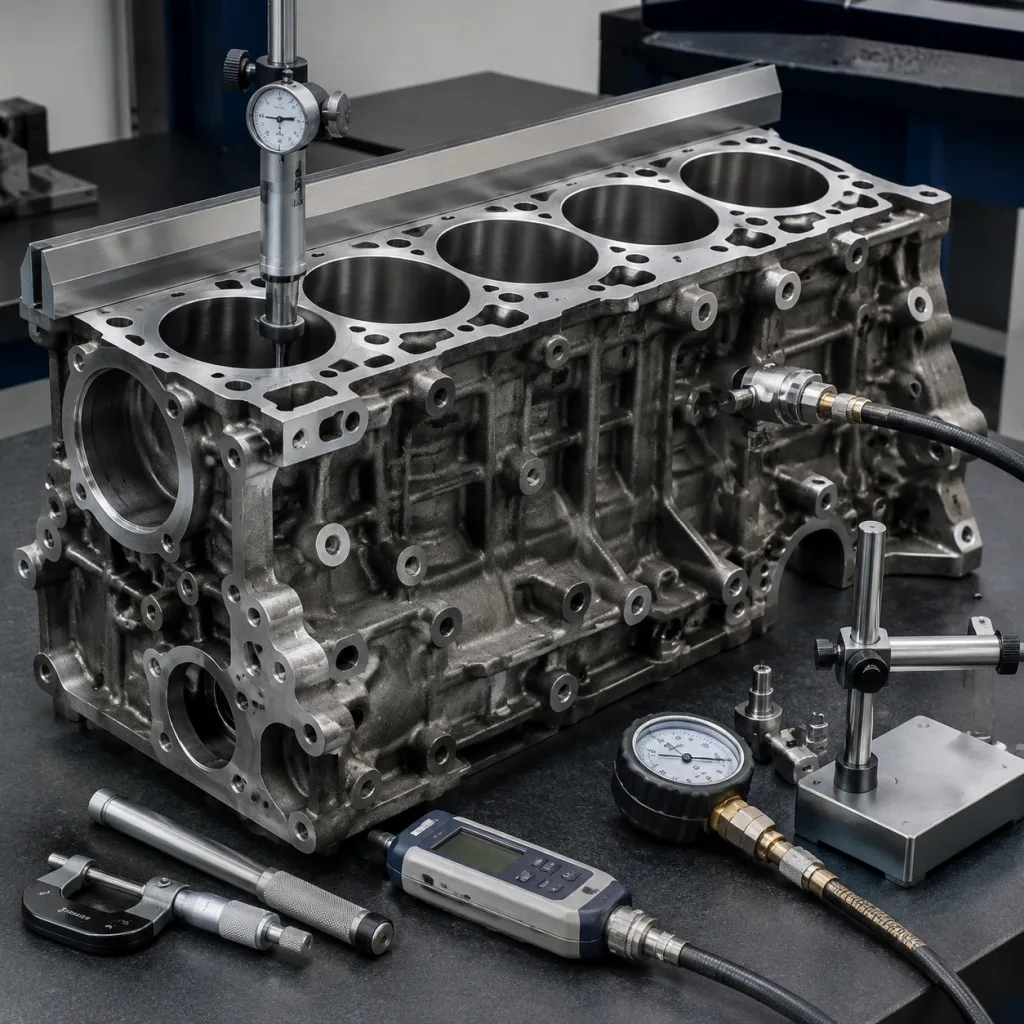
Control plan for critical dimensions such as cylinder bore, deck flatness, main bearing alignment and thread position
Calibration records for CMMs, bore gauges, air gauges, height gauges, surface roughness testers, pressure-test equipment and torque tools
Material traceability to heat, melt or casting batch records, with retention period defined in the supply agreement
Cleanliness control for oil galleries, coolant passages and blind threaded holes after machining
Pressure-test method, test pressure, hold time and rejection criteria where applicable
Nonconformance log, quarantine process and 8D or corrective action records for repeat defects
Packaging validation for sea freight, forklift handling and warehouse stacking
Do not stop at a certificate PDF. Ask for one recent anonymised dimensional report, one calibration certificate for a critical gauge, a sample control plan page and a photo of the actual packing method. If the project is high volume, request measurement-system analysis for bore and main tunnel checks, plus process capability data on agreed critical-to-quality characteristics.
Practical launch targets are often Cpk 1.33 or higher for stable production dimensions, but the exact requirement should be set by drawing and risk level. Environmental and chemical compliance may also matter for EU and UK importers. REACH (EC) No 1907/2006 should be considered where supplied parts, coatings, corrosion inhibitors or packaging materials include substances subject to restriction or communication duties. Buyers should request declarations appropriate to their import responsibility and market, including packaging material statements where wood pallets, anti-rust oil, VCI bags or printed cartons are used.
Failure modes to eliminate before sample approval
Engine blocks are not interchangeable just because a listing matches an engine family. Procurement and engineering teams should confirm fitment, machining status, revision level and required accessories before ordering. Driventus does not claim approval or endorsement by any vehicle manufacturer. OE-style references, engine codes and model names should be used only for fitment verification, supported by drawings, buyer samples or measured comparison.
Critical technical checks
Before issuing a production purchase order, ask the supplier to provide or confirm:
Cylinder bore nominal diameter, oversize policy, roundness and cylindricity targets; common finished-bore controls are in the 0.01–0.03 mm range where the drawing requires it
Bore surface finish and cross-hatch requirement if the block is supplied ready for piston and ring installation
Deck height, deck flatness and deck surface finish; gasket-facing surfaces often require controlled Ra and no handling marks
Main bearing tunnel diameter, alignment, straightness and cap matching method
Crankshaft centreline relationship to deck, bore centreline and transmission face
Head bolt thread size, depth, pitch, perpendicularity and position, plus any required thread repair inserts
Oil-gallery plug locations, thread details, sealing method and whether plugs are installed or supplied loose
Coolant passage layout, casting cleanliness and absence of loose core sand or chips
Crankshaft clearance and piston oil squirter provision where applicable
Sensor, bracket, alternator, engine mount and accessory bosses required for the target application
Pressure-test results for water jacket and oil circuits, including test pressure and hold time where specified
Compatibility with required gasket, fastener, liner, dowel, bearing and core-plug set
The tolerance plan must be written down. A remanufacturer may want semi-finished bores with 0.20–0.50 mm stock for final boring and honing. A distributor selling ready-to-install assemblies may need fully finished bores, final wash and corrosion protection. Those are different products; treating them as the same SKU invites claims.
A practical approval route is to measure 3–5 sample blocks against the buyer’s critical dimensions, install one sample where feasible and record assembly issues before releasing the pilot order. Pay close attention to dowel locations, starter and transmission mounting faces, head-gasket sealing area, water-pump interface and oil-filter housing area. Small errors in these zones can create large warranty exposure even when the casting looks correct.
Where an OE part-number cross-reference is used, it should be limited to a verified reference format such as OE 11251… and supported by buyer confirmation. Driventus is an independent aftermarket manufacturer; brand names are referenced for fitment only.
Paperwork that prevents receiving disputes
A clean documentation package reduces receiving delays, customs questions and warranty arguments. For repeat programmes, Driventus can align shipment documentation with the buyer’s enterprise resource planning requirements, including consistent item descriptions, batch references, carton marks and pallet labels.
Recommended documents for each engine block order include:
Commercial invoice and packing list with part number, item description, quantity, gross weight, net weight and carton or pallet count
Country-of-origin statement or certificate where required by the importer or destination market
Bill of lading or air waybill, depending on transport mode, with consignee and notify-party details checked before release
Inspection report listing critical dimensions, measurement tools, sample size and pass or reject status
Material certificate or casting batch traceability record where agreed
Pressure-test or leak-test report where required by specification, including test pressure, hold time and serial or batch reference
Photos of finished goods, labels, internal protection and export packing before shipment
Compliance declarations relevant to the destination market, including REACH (EC) No 1907/2006 where applicable
For higher-volume programmes, buyers may request launch documents such as process flow, control plan, failure mode and effects analysis, capability data and initial sample inspection results. Driventus can support these requests when they are defined during quotation, not after mass production is complete. If a buyer needs PPAP-style submission, the level, forms, sample quantity and dimensional layout requirements should be listed in the RFQ.
Documentation should also specify what is not included. A bare block may not include gallery plugs, dowels, liners, bearings, oil squirters, core plugs, bedplate, main caps, fasteners or sensors unless stated in the bill of materials. Missing accessory assumptions are a common source of receiving disputes.
The safest purchase order uses a revision-controlled item description such as “semi-machined bare block, no plugs, no dowels” or “fully machined block with installed gallery plugs and export VCI packing.” For traceability, carton labels, pallet labels and inspection reports should share the same batch or lot reference. This allows a distributor to isolate inventory quickly if a field issue appears months after receipt. For private-label programmes, label artwork, barcode format, carton strength and country-of-origin marking should be approved before production packing starts.
A practical qualification path for Driventus
Supplier qualification works best as a staged release, not a one-step price negotiation. For engine block sourcing, use this sequence:
1. Send target application, annual volume, destination market and required machining status. 2. Provide any available drawing, sample, inspection standard or OE-style cross-reference. 3. Confirm whether the product is for aftermarket distribution, remanufacturing, service repair, or an OEM/Tier-1 programme. 4. Review quotation, MOQ, tooling requirement, lead time, packaging plan, inspection scope and Incoterms. 5. Approve samples with dimensional report, packing photos and installation feedback where possible. 6. Place a pilot order before committing to a full stocking programme. 7. Track field performance by batch code and feed any warranty data back to the supplier.
A strong RFQ includes more than a part number. Buyers should state annual demand, first-order quantity, target monthly release, destination port, preferred Incoterm, packaging limits, accessory inclusion, inspection report requirement and whether the block will be sold as bare, semi-machined or ready to install. If a price target exists, share the required cost structure rather than asking suppliers to remove controls that protect the programme.
Compare suppliers on total risk. A useful scorecard includes certificate validity, audit response time, machining capability, dimensional reporting, packaging performance, claim handling, lead-time stability and communication quality. For engine blocks, add measurable criteria such as sample approval days, on-time delivery percentage, number of dimensional rejects per batch, packaging damage rate and average claim response time. A small reduction in claim rate can outweigh a lower unit price when blocks are shipped internationally.
Driventus can support distributors that need repeatable supply, repair chains that need low complaint rates and engineering buyers that require documentation for supplier approval. To start a technical review, buyers can request a quote with application details, target volume, machining requirement, inspection expectations and destination market.
Frequently asked questions
Send the target engine family, machining status required, annual volume, first-order quantity, destination country, Incoterm preference, packaging requirement and any drawing or sample data. If using an OE-style reference such as OE 11251…, confirm it is only for fitment cross-reference and provide technical details where possible.
Yes. Availability depends on the engine family, tooling, fixture requirements and buyer tolerance plan. Some buyers prefer semi-machined blocks with stock left for local finishing, while distributors usually request fully machined parts with inspection reports, pressure-test evidence where specified and protective export packaging.
No. Driventus does not claim approval or endorsement by any vehicle manufacturer. Driventus is an independent aftermarket manufacturer; brand names are referenced for fitment only.
For engine block sourcing, share the target application, volume, machining requirement, inspection scope and destination market. Our team can review MOQ, lead time, packaging and documentation needs through /contact.html