Procurement teams buying Acura-compatible engine blocks at wholesale level usually have different priorities from retail buyers. The focus is not appearance or packaging. It is dimensional stability, casting consistency, machining capability, documentation, and the supplier’s ability to ship repeatable batches on schedule. For importers, rebuilders, and multi-location repair groups, the real cost sits in return rates, line stoppage, and fitment disputes, not only unit price.
When assessing an engine block supplier, buyers should review casting material, bore and deck machining tolerances, pressure-test controls, traceability, corrosion protection, and export readiness. Commercial terms also matter: MOQ, sample approval procedure, production lead time, and support for OE cross-reference management. This article outlines practical criteria for sourcing Acura-compatible engine blocks from a B2B manufacturer and shows what documentation serious buyers should request before placing a programme order.
What B2B buyers should verify first
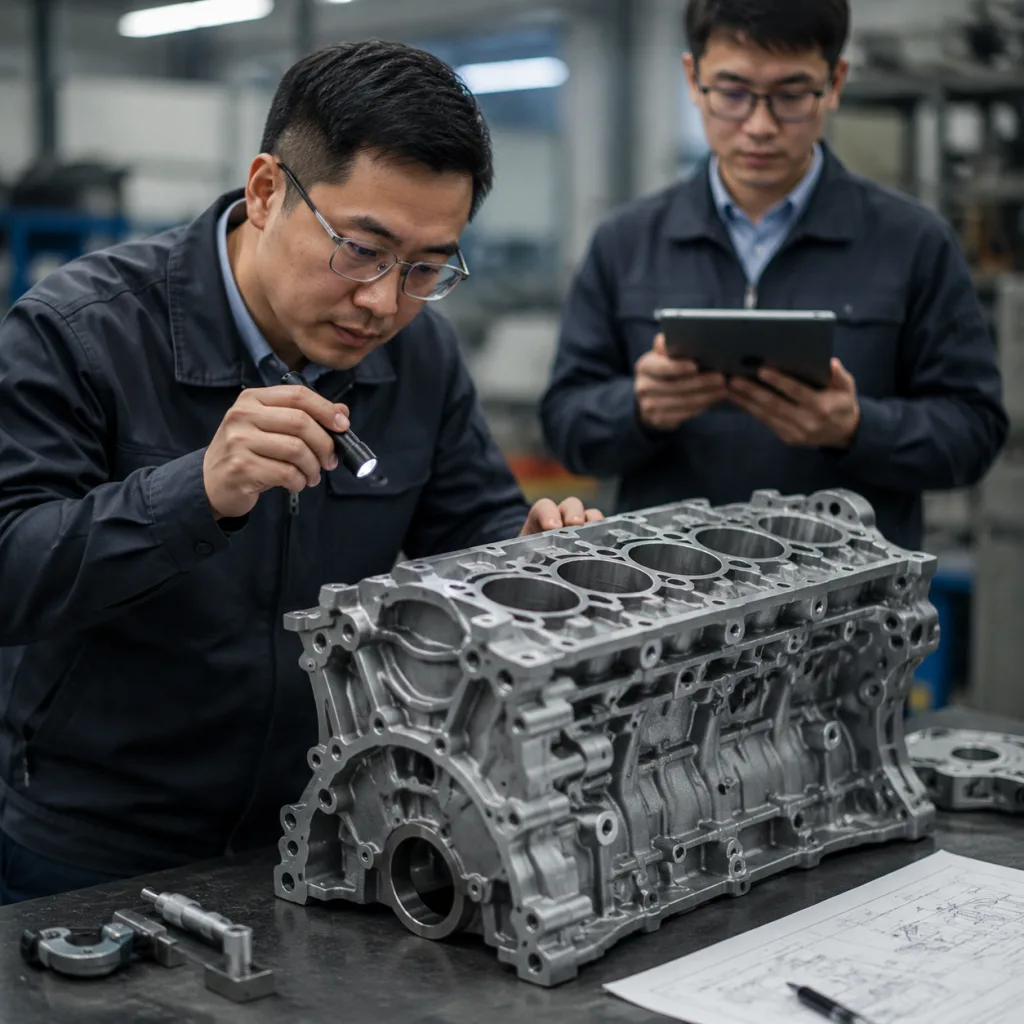
For this product category, supplier selection should start with manufacturing control rather than catalogue breadth. Engine blocks are high-risk structural components. Minor variation in deck flatness, main bearing bore alignment, or coolant passage cleanliness can create field failures that are expensive to recover.
Key points to verify during RFQ review:
Material specification: confirm the base cast iron or aluminium alloy grade used for the block family.
Machining scope: clarify whether the part is supplied as raw casting, semi-finished, or fully machined.
Critical tolerances: request control values for cylinder bore diameter, deck flatness, main tunnel geometry, and threaded hole positioning.
Leak integrity: ask whether each block is pressure tested for coolant and oil gallery sealing.
Batch traceability: confirm heat number, casting lot, machining batch, and inspection record retention.
A capable supplier should also explain how fitment references are managed. If the enquiry includes OE-style references, use formats such as OE 11251… only where relevant to the buyer’s own mapping. Driventus is an independent aftermarket manufacturer; brand names are referenced for fitment only.
Buyers comparing multiple sources can review our catalog and the dedicated /products/engine-components.html section to narrow the engine component range before requesting technical details.
MOQ, lead time and supply planning
Wholesale engine block programmes should be priced against the actual supply model, not only the quoted ex-works unit cost. A supplier with a lower price but unstable melting, outsourced machining, or inconsistent packing can create higher total landed cost.
Typical commercial checkpoints
Item
What to confirm
Why it matters
MOQ
Trial order MOQ and mass-order MOQ
Affects inventory exposure and launch timing
Sample lead time
Time for first article or pilot batch
Determines validation schedule
Production lead time
Standard days from deposit or PO release
Critical for replenishment planning
Capacity
Monthly casting and machining output
Reduces allocation risk during peak demand
Incoterms
EXW, FOB, CIF or DDP basis
Impacts landed-cost comparison
Packaging
Units per pallet, corrosion protection, gross weight
Affects freight efficiency and damage rate
Documentation
Packing list, inspection report, origin data
Supports customs and customer QA
</tr></thead><tbody> </tbody></table>For many B2B programmes, buyers should separate three stages:
1. Initial sample review 2. Pilot batch validation 3. Regular production release
This structure makes it easier to control engineering changes and packaging revisions before volume shipments begin. If your business needs private labelling, dedicated machining steps, or project-specific packaging, those requirements should be scoped early under custom manufacturing.
Quality controls that matter for engine blocks
A wholesale supplier should be able to show process discipline consistent with IATF 16949:2016 and ISO 9001:2015 principles, even when the buyer’s programme is aftermarket rather than OE service supply. The important question is not whether a certificate exists on paper, but how the system controls actual process risk.
Process areas to examine
Incoming material control for alloy chemistry and charge consistency
Casting inspection for porosity, cold shuts, shrinkage, and core shift
Machining inspection for bore geometry, deck height, tunnel alignment, and thread accuracy
Cleaning control for swarf, sand residue, and internal passage contamination
Final verification including pressure or leak test where specified
Nonconformance handling with segregation, rework criteria, and corrective action closure
A factory audit should also examine measuring equipment calibration, gauge R&R practice, and record retention period. For export to the EU and UK, buyers may also ask the supplier to confirm material-related compliance management against REACH (EC) No 1907/2006 where applicable to supplied articles and surface treatment substances.
If the supplier advertises a formal quality system, procurement teams should still request part-specific evidence such as:
Sample inspection report
Dimensional layout on critical features
Pressure-test record format
Packaging validation photos
Traceability label example
These documents often reveal more than a generic company presentation.
Technical specifications buyers should request
Engine block RFQs are processed faster and with fewer fitment disputes when buyers provide a clear data package. If the request is limited to model name and engine displacement, quotation accuracy usually suffers.
A practical RFQ checklist includes:
Vehicle application and engine code
Required supply status: bare block, short block basis, or finished machined block
Material type: cast iron or aluminium alloy
Bore size and service limit if relevant
Deck height requirement
Main bearing housing dimensions
Surface finish requirement on critical machined faces
Thread standard and insert requirements
Core plug installation status
Oil gallery plug installation status
Pressure-test requirement and test pressure
Surface coating or rust-prevention specification
Pallet and inner-pack requirement
Where the buyer has historical fitment data, it is helpful to provide failed-return analysis from prior vendors. Typical failure points include main bore misalignment, head gasket sealing issues caused by deck distortion, and corrosion due to poor internal protection during ocean transit.
For comparison, serious suppliers should be able to discuss achievable controls in ranges such as:
Deck flatness: controlled within defined drawing tolerance
Cylinder bore size: monitored with in-process gauging
Main bore alignment: checked against fixture or line-bore reference
Thread integrity: verified by gauge and torque-related sampling
Exact values must match the drawing, sample approval, or customer standard rather than generic catalogue claims.
How to assess supplier risk before placing a programme order
Before nominating a source for Acura-compatible blocks, procurement managers should evaluate operational risk in addition to price and sample acceptance. This is especially important for import programmes serving distributors or regional warehouse networks.
Use a short risk screen:
Risk area
Questions to ask
Acceptable evidence
Factory ownership
Is casting and machining in-house or subcontracted?
Process map and site audit notes
Capacity stability
Can the supplier support forecast spikes?
Capacity statement and equipment list
Change control
How are tooling or process changes approved?
ECN or internal change record
Claim handling
What is the response path for field issues?
8D format or corrective action workflow
Traceability
Can affected lots be isolated quickly?
Batch coding sample
Export performance
Has the supplier shipped to your market before?
Shipment records and packing standard
</tr></thead><tbody> </tbody></table>Where possible, ask for a pilot shipment using production packaging rather than courier sample packing. Damage prevention during container transport is part of product quality.
A stable supplier relationship usually depends on three controls:
1. Locked technical specification 2. Approved sample with documented deviation status 3. Agreed commercial release schedule
This reduces the chance of disputes once repeat orders begin. Driventus is an independent aftermarket manufacturer; brand names are referenced for fitment only.
When a wholesale supplier is a good fit
The right source is not automatically the largest factory or the lowest bidder. For many aftermarket programmes, the better partner is the supplier that can maintain repeatable machining quality, provide useful inspection data, and adapt packing or labelling to the customer’s warehouse flow.
A good fit usually means:
MOQ aligned with your turnover rate
Lead time matched to replenishment planning
Clear control of casting and machining stages
Documented inspection on critical dimensions
Export packaging proven for long transit routes
Responsive engineering support for application review
If your team is screening multiple engine component vendors, start with the technical data package and sample route, then move to commercial negotiation. That sequence usually produces more reliable landed-cost decisions than price-first sourcing.
For buyers seeking a manufacturer with established export processes for engine and powertrain components, review our catalog, check the quality system, and use request a quote when you are ready to share drawings, application lists, or annual volume estimates.
Frequently asked questions
MOQ varies by application, machining status, and whether tooling or dedicated packaging is required. Buyers should ask for separate quantities for sample, pilot batch, and regular production, because the practical MOQ for validation is often lower than the standard volume order MOQ.
That depends on your downstream process. Rebuilders with their own machining capability may prefer semi-finished supply, while distributors usually need finished machined blocks ready for controlled assembly or resale. The RFQ should clearly define supply condition to avoid pricing and fitment errors.
Ask for part drawings or confirmed fitment mapping, sample inspection reports, pressure-test records where required, packaging specifications, traceability examples, and certification details tied to IATF 16949:2016 and ISO 9001:2015 system control. Those documents help reduce sourcing risk early.
If you are qualifying a new source for Acura-compatible engine blocks, send your application list, drawings, or target volumes for review. Our team can discuss supply options and next-step sampling through /contact.html