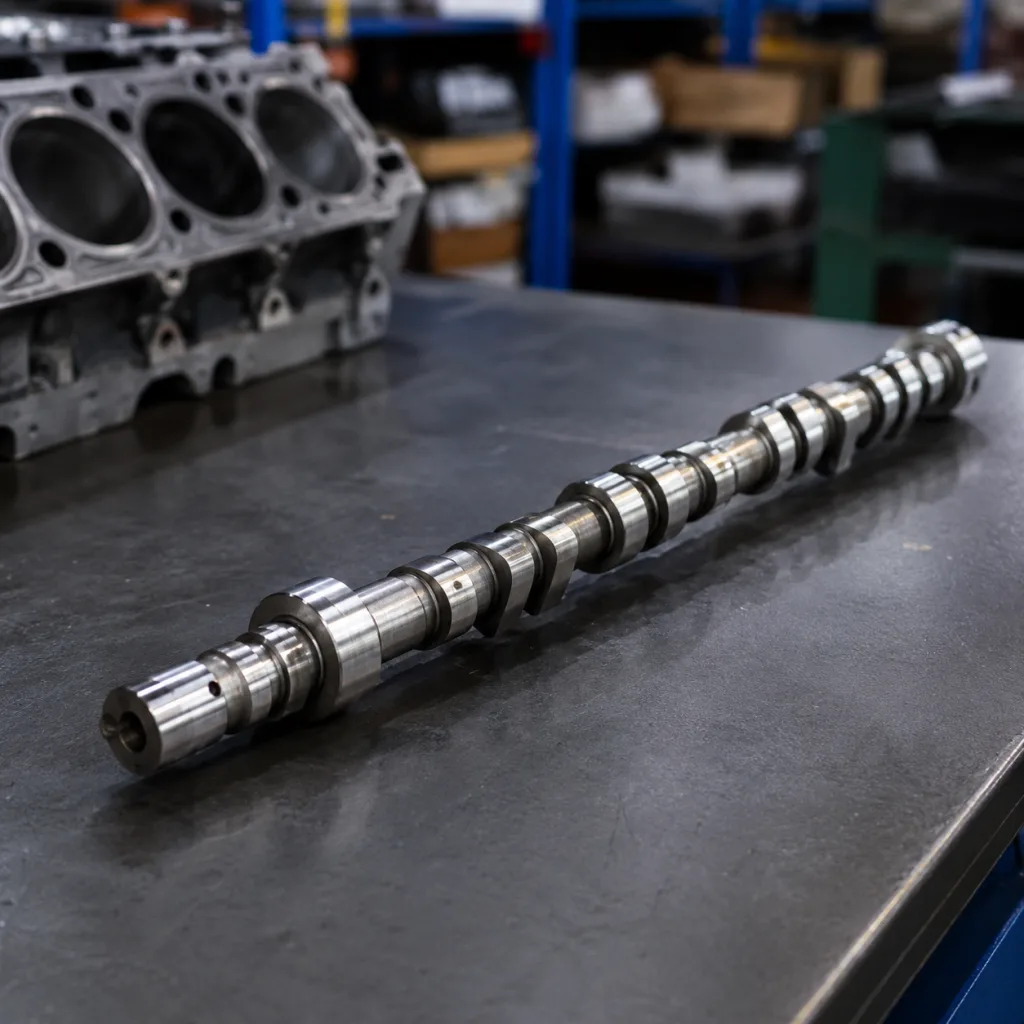
Camshaft for Land Rover Range Rover Aftermarket Replacement
A camshaft for Land Rover Range Rover aftermarket replacement only works if it solves the fitment question fast. The real test is not whether it looks correct, but whether the part reproduces OE geometry, matches the timing-drive interface, and survives the same duty cycle in service. Driventus supplies camshafts from an integrated engine-component manufacturing base in Taizhou, Zhejiang, with process control aligned to IATF 16949:2016 and ISO 9001:2015. Driventus is an independent aftermarket manufacturer; brand names are referenced for fitment only. For buyers sourcing for distributors, repair networks, or rebuild programmes, the safest path is to verify the engine code first, then confirm lobe profile, journal size, hardening route, and runout before release. If the catalog already lists an OE 06A… or 11251… cross-reference, keep that exact reference tied to the item record and avoid family-level assumptions without dimensional proof.
Start with the failure modes, not the brochure
Most camshaft sourcing problems show up after installation: noisy valve train operation, accelerated lobe wear, phaser mismatch, or poor timing stability. Those failures usually point to one of four root causes: the wrong profile, inconsistent hardness, poor surface finish, or a timing-drive interface that does not match the engine variant.
Before you approve a camshaft for Land Rover Range Rover aftermarket replacement, verify the controls that prevent those failures:
Journal diameter and bearing land spacing
Lobe lift, duration, and lobe separation angle
Chain, gear, or phaser mounting features
Sensor trigger wheel, keyway, and nose geometry
Surface hardness on lobes and journals
Straightness and total indicated runout after finishing
If any one of those items is missing from the supplier data, the part is not ready for production or service use.
Spec check: what must match the OE pattern
A valid replacement is defined by measurable equivalence, not by visual resemblance. For Land Rover Range Rover applications, the spec check should start with the camshaft drawing and end with the receiving inspection record.
Checkpoint
What to confirm
Why it matters
Journal diameter
Within drawing tolerance
Bearing fit and oil clearance
Overall length
Matches the OE pattern
Correct location in the valvetrain
Lobe lift and duration
OE-equivalent profile
Valve timing and airflow
Runout
Measured after finishing
NVH and long-term durability
Surface hardness
Matched to heat-treatment route
Wear resistance
Cleanliness
Residual contamination controlled
Assembly reliability
</tr></thead><tbody> </tbody></table>If the program needs a tighter fit band, Driventus can review the print through custom manufacturing and align the control plan before release.
How Driventus validates a replacement run
Driventus validates replacement camshafts against the target pattern before mass supply. The sequence typically covers metrology, material verification, and functional checks, because one weak control can spoil the whole batch.
The most relevant checks are:
Dimensional inspection against the approved drawing
Heat-treatment confirmation for the selected material route
Post-finishing runout and profile verification
Surface roughness control on lobes and journals
Crack screening on critical parts
Packaging review to prevent edge damage in transit
For procurement teams, the value is simple: you get fewer surprises at receiving, fewer warranty claims, and less rework at the workshop level.
Material choice changes the risk profile
Camshaft durability depends on the material, the heat-treatment route, and the final grind. If any of those drift, wear shows up early.
Common failure risks include lobe spalling, journal scuffing, phaser-interface wear, and timing drift caused by profile error. The controls that reduce those risks are equally direct:
Alloy or cast iron selection matched to duty cycle
Induction hardening or equivalent surface hardening where required
Post-heat-treatment straightening before final grinding
Magnetic-particle or equivalent crack screening
Controlled packaging to avoid nicks on lobe edges
In fleet work, short service life often traces back to inconsistent hardness or incorrect geometry rather than installation error. Ask for the test record, then compare it with the engine’s lubrication conditions and service interval.
Range Rover fitment has to be controlled by engine code
The vehicle nameplate is not enough. Range Rover applications can use different cam profiles, phaser arrangements, and sensor references across model years and emissions variants, even when the badge is the same.
Use this order in the item master:
1. Confirm the engine code and model year range. 2. Verify the OE cross-reference against the catalog entry. 3. Check whether the engine uses one or two camshafts per bank. 4. Confirm phaser and sensor trigger compatibility. 5. Match packaging, preservation oil, and label data to the receiving procedure.
Driventus does not claim vehicle-manufacturer approval or endorsement. The right approach is dimensional verification, document control, and batch traceability before stock release.
When a custom run makes more sense
A custom run is usually the better answer when the OE part is obsolete, the fleet needs a life-cycle change, or the customer wants a controlled update to metallurgy or finish. In those cases, Driventus can evaluate drawings, samples, and application data through custom manufacturing.
A clean RFQ should include:
Engine code and vehicle application
OE cross-reference, if available
Annual demand and forecast horizon
Target hardness, finish, and runout limits
Packaging and labeling requirements
If the program is time-sensitive, add failure photos, measurement reports, and any returned-core data. That shortens sampling and helps lock the process faster.
What distributors and repair chains should ask for
Replacement programs need repeatable supply, not a one-off shipment. The procurement review should cover lead time, carton configuration, traceability, and re-order stability alongside price.
Driventus supports B2B supply into aftermarket distributors, wholesalers, OEM and Tier-1 channels, and multi-location repair chains. Buyers can review our catalog and the broader engine components range to align camshafts with related items such as lifters, gaskets, and water pumps.
For supplier audits, the most useful documents are a current quality manual, incoming inspection criteria, and a traceability summary by batch or heat number. The quality system should also show how nonconforming parts are segregated, reworked, or rejected.
Frequently asked questions
No. Driventus is an independent aftermarket manufacturer; brand names are referenced for fitment only. The part is supplied as an OE-equivalent replacement where the application data and measurements match.
Ask for dimensional data, material and heat-treatment details, batch traceability, and the relevant quality control record. If needed, compare the listing with the quality system page before ordering.
Yes. If the programme needs a revised profile, hardness target, or packaging format, use the custom manufacturing route and submit the target engine code, annual volume, and OE cross-reference.
Review the specification against your engine code, then use the contact form to start sourcing or engineering review at /contact.html.