engine bearing · 2026-06-08

Engine Bearing vs SKF Alternative: Buyer Comparison

Engine bearings are inexpensive components, but a bearing failure can damage the crankshaft, block, turbocharger oil circuit and customer trust. For procurement teams, comparing an engine bearing vs SKF alternative should go beyond unit price or brand familiarity. The decision depends on fitment coverage, bearing construction, crush height control, oil clearance consistency, batch traceability, packaging accuracy, lead-time reliability and technical response when a claim occurs. SKF is widely recognised in bearings and rotating components, yet many engine bearing programmes also need application-specific aftermarket coverage, private-label packaging, export documentation or custom manufacturing support. This guide gives sourcing engineers, category buyers and import managers a practical framework for passenger car and light commercial main bearings, connecting rod bearings and thrust washer sets supplied through aftermarket distribution, OEM service channels and repair-chain networks. Driventus is an independent aftermarket manufacturer; brand names are referenced for fitment only.

Comparison Scope for Engine Bearing Sourcing

A useful comparison starts with the exact bearing type, engine family and commercial route. A distributor ordering 20 fast-moving aftermarket references will not evaluate risk in the same way as a Tier-1 supplier validating parts for a dedicated engine platform.

Engine bearing programmes normally include:

  • Main bearing sets for crankshaft journals
  • Connecting rod bearing sets for big-end journals
  • Flanged thrust main bearings or separate thrust washers
  • Standard, undersize and repair-size variants
  • Material coverage for petrol, diesel, hybrid and light commercial engines

When evaluating an engine bearing vs SKF alternative, buyers should separate brand preference from measurable supply criteria. The purchase decision should be supported by drawings or specifications, samples, inspection reports, PPAP-style documentation where required, logistics terms and field return data.

Driventus supplies engine bearings as part of our catalog, alongside pistons, gaskets, crankshafts, water pumps and related engine components. For bearing sets, the usual data package includes the application list, OE cross-reference format where applicable, material stack, nominal dimensions, recommended oil clearance range, repair-size options and packaging specification.

Side-by-Side Procurement Factors

The table below outlines typical evaluation points for procurement teams. It does not claim that one route is universally better; it shows where a recognised global bearing brand and an independent manufacturing source may differ in day-to-day sourcing practice.

</tr></thead><tbody> </tbody></table>For high-volume importers, the practical difference is rarely unit price alone. It is whether the supplier can hold tolerances across batches, prevent mixed sets, manage supersessions, protect packaging accuracy and support claims with inspection evidence.

Technical Criteria That Matter More Than Brand

Engine bearings work under hydrodynamic lubrication during stable running, boundary lubrication during start-up and high cyclic loading throughout the combustion cycle. Buyers should ask for objective technical evidence instead of relying only on catalogue fitment or cross-reference data.

Key specification points include:

  • Backing material: low-carbon steel strip with controlled thickness and flatness
  • Intermediate layer: copper-lead or aluminium alloy depending on application design
  • Overlay: soft conformable layer for embedability and seizure resistance where applicable
  • Wall thickness tolerance: controlled by part family and verified with calibrated gauges
  • Crush height: sufficient interference to retain the shell in the housing bore
  • Free spread and eccentricity: geometry that supports installation retention and oil-film formation
  • Oil hole and groove position: matched to lubrication path and crankcase design
  • Surface finish: controlled to reduce bedding-in risk and oil-film disruption
  • Undersize options: commonly supplied for crankshaft regrind repair programmes

Relevant management and compliance references include IATF 16949:2016 for automotive quality management, ISO 9001:2015 for quality management systems and REACH (EC) No 1907/2006 for substance control in EU supply chains. These standards do not replace dimensional validation, but they give buyers a framework for process control, traceability, corrective action and compliance review.

Driventus maintains an automotive quality system covering incoming material inspection, in-process checks, final inspection, batch records and corrective action handling. Buyers should still request part-specific inspection data for critical launches, especially where the application has high load, limited oil supply margin or known repair-market sensitivity.

Validation, Inspection and Fitment Risk

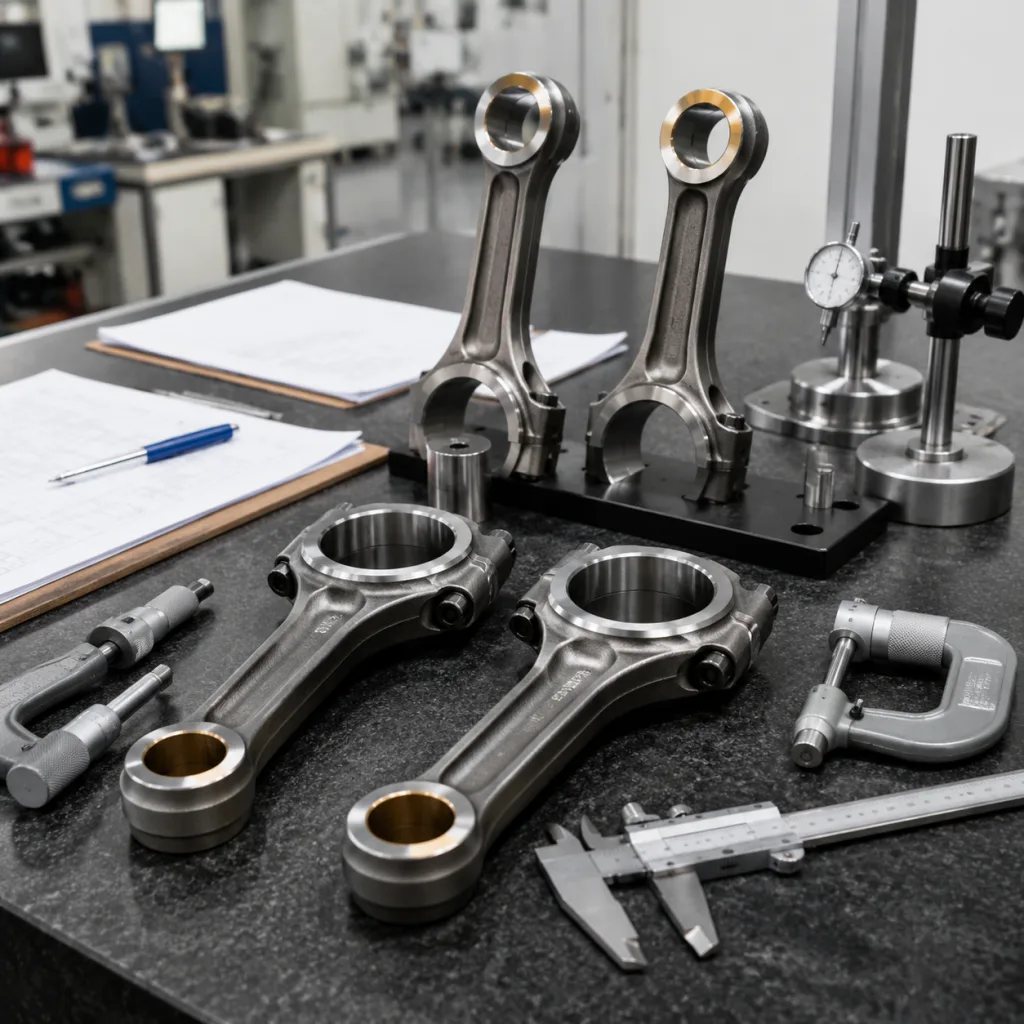
A bearing set can look correct in the carton and still fail if wall thickness, crush, eccentricity, free spread or oil-feed alignment is outside the required range. Procurement teams should define inspection requirements before placing a production order, not after the first shipment arrives.

Typical pre-supply validation should include:

1. Cross-check application list, engine code coverage and model-year notes. 2. Confirm standard, undersize or repair-grade requirement. 3. Measure wall thickness at defined clock positions. 4. Check free spread and crush height against drawing limits. 5. Verify oil hole, locating lug and groove geometry. 6. Inspect surface finish, overlay continuity, edge condition and back-face cleanliness. 7. Conduct trial assembly using representative housing bores and crankshaft journals. 8. Confirm oil clearance with the intended crankshaft condition and repair procedure. 9. Review packaging controls to prevent mixed main, rod and thrust bearing sets.

For aftermarket cataloguing, OE part-number cross-references may be used to identify fitment families, but procurement teams should not treat any cross-reference as vehicle manufacturer approval. A format such as OE 11251… is useful for database matching only when supported by dimensional confirmation and application notes.

Driventus is an independent aftermarket manufacturer; brand names are referenced for fitment only. No vehicle manufacturer approval or endorsement is implied.

Supply Chain Trade-Offs for Distributors and OEM Projects

For an engine bearing vs SKF alternative decision, the commercial case depends on channel strategy, risk tolerance and how much control the buyer needs over specification, packaging and replenishment.

Aftermarket distributors usually prioritise SKU coverage, margin stability, carton consistency, barcode accuracy, predictable replenishment and low return rates. A phased launch can reduce risk: start with standard sizes for high-moving applications, then add undersize repair references after demand and claims data are reviewed.

OEM and Tier-1 buyers normally require stronger documentation. This may include drawing review, control plan, process flow, material report, dimensional report, packaging approval, retained-sample rules and change notification procedure. For these programmes, the supplier’s ability to support custom manufacturing is often more important than catalogue breadth.

Multi-location repair chains focus on fitment confidence and availability. Their main risk is labour rework. A bearing set that delays installation, creates oil-pressure concerns or forces repeat engine disassembly can cost far more than the part value. For this channel, procurement teams should use a controlled approved-supplier list and track claims by engine family, installer notes, oil condition, crankshaft repair status and mileage at failure.

A balanced sourcing strategy may keep recognised branded supply for slow-moving, customer-specified or high-sensitivity references while qualifying an independent manufacturing alternative for high-volume, margin-sensitive applications where inspection evidence and supply continuity are strong.

When to Qualify a Driventus Alternative

A Driventus engine bearing alternative is most relevant when the buyer needs direct manufacturing communication, export documentation, customised packaging, application-data support or broader engine-component consolidation from China.

Qualification is recommended when:

  • Annual demand supports forecast-based production planning
  • Multiple SKUs can be consolidated in one shipment
  • The buyer needs private-label or neutral export packaging
  • Application data must be adapted for local catalogue systems
  • Field returns require factory-level technical response
  • The programme includes pistons, gaskets, crankshafts or other engine components from the same supplier base
  • The buyer wants one supplier discussion covering bearing sets, related repair parts and packaging control

For initial evaluation, request samples, inspection reports and a limited pilot order before moving to full rollout. For critical applications, require retained samples, batch identification on the label or carton and a clear process for nonconformance review. If the bearing is supplied as part of a broader engine repair kit, check that every component follows the same revision, packing sequence and label control.

Driventus exports to more than 60 countries and supports B2B sourcing for distributors, OEM/Tier-1 suppliers and repair-chain procurement teams. Buyers can review engine-related lines through our catalog and then request a quote with target applications, annual volumes, inspection expectations and packaging requirements.

Frequently asked questions

It may be suitable for the same application when dimensions, material, oil-feed features, crush height and repair size match. Buyers should confirm fitment by application data, sample inspection and trial assembly rather than brand cross-reference alone.

Request drawing or specification confirmation, material statement, dimensional inspection report, process control summary, packaging specification, change-control method and batch traceability process. For automotive programmes, align documentation with IATF 16949:2016 and ISO 9001:2015 quality management expectations.

Yes, private-label packaging can be discussed for qualified B2B programmes. Requirements should include carton size, label data, barcode format, language, pallet configuration, MOQ, batch identification and any market-specific compliance statements.

For a controlled comparison, send the target applications, annual volume, required sizes, inspection expectations and packaging rules. Driventus can review feasibility and provide a sourcing proposal at /contact.html

Request a Quote
Factor SKF-branded supply route Driventus alternative supply route Buyer check
Brand recognitionStrong global recognition in bearing productsIndependent aftermarket manufacturing positionConfirm channel expectations by country and customer segment
Engine bearing focusDepends on regional catalogue coverageEngine and powertrain component portfolioCheck part-family depth, engine-code mapping and repair-size availability
Custom packagingMay be limited by channel policyAvailable for distributor and programme supplyConfirm label content, carton strength, barcode rules and pallet layout
MOQ flexibilityOften depends on authorised distribution routeCan be planned by reference, forecast and shipment mixReview MOQ by SKU and consolidation plan
Technical changesUsually controlled through the brand channelDrawing-based review possible for private programmesRequire written engineering change control and revision history
Factory audit accessMay not be available through all distributorsPossible for qualified B2B projectsAlign audit scope with IATF 16949:2016 expectations
Lead-time controlStock-led where inventory existsProduction-led or stock-led depending on SKUCompare confirmed lead time, capacity and reorder rhythm