engine bearing · 2026-06-22

Engine Bearing Volvo Supplier: Sourcing Criteria

Choosing an engine bearing Volvo supplier is a technical risk decision, not a catalogue exercise. A low unit price can disappear quickly if wall thickness drifts, crush is inconsistent, oil holes are off datum, or standard and undersize sets are mixed in the warehouse. Procurement teams need proof that the supplier can repeat the same bearing geometry, material structure, packing method, and traceability across engine families and order cycles. Driventus Auto Parts manufactures engine and powertrain components in Taizhou, Zhejiang, for aftermarket distributors, wholesalers, repair-chain programmes, and OEM/Tier-1 sourcing projects. Our bearing programme includes main bearings, connecting rod bearings, thrust washers, and selected repair-size options for passenger, light commercial, and heavy-duty applications. This article gives buyers a practical way to qualify Volvo-fit engine bearings before placing production orders. Driventus is an independent aftermarket manufacturer; brand names are used for fitment identification only.

Start with the decision: catalogue match or controlled bearing programme?

The first sourcing question is simple: are you buying an occasional catalogue item, or are you building a repeat supply programme? The answer changes how deeply you should qualify an engine bearing Volvo supplier.

For one-off replacement stock, a part-number match may start the conversation. For import, private-label, engine-rebuilding, or repair-chain supply, it is not enough. Bearing shells that look similar can behave differently once the cap is torqued, the oil film forms, and the engine sees heat and cyclic load.

For Volvo-fit programmes, buyers should organise references by engine code, bearing position, size grade, and internal cross-reference. Generic OE-style references, such as OE 11251… or OE 06A…, should only be used when the buyer’s file already includes those numbers and the supplier has confirmed the matching specification. Do not let an unverified interchange become the approval standard.

Before approving a supplier, check these points:

  • Main bearing and connecting rod bearing coverage by engine family and engine code
  • Standard size and repair sizes, typically 0.25 mm and 0.50 mm undersize where applicable
  • Bearing shell wall thickness, width, eccentricity, and taper against the approved drawing
  • Crush height, locating tang geometry, oil groove profile, and oil hole position
  • Steel backing thickness, lining alloy, overlay type, and anti-friction surface treatment where specified
  • Target oil clearance range used by the buyer’s rebuild market, verified after housing bore and journal checks
  • Batch traceability from strip material coil or sheet lot to finished packed set
  • Neutral, private-label, or distributor packaging requirements, including barcode and carton label format
  • Shelf-life and corrosion-prevention method for ocean freight and warehouse storage

Ask for actual inspection tolerances, not the phrase “according to standard”. Depending on the bearing size and drawing class, shell wall thickness may need micron-level control. Oil-hole location should be checked from datum features. Crush and spread should be verified with gauges or fixtures that reflect the housing geometry. If the supplier cannot explain how those values are measured, the quote is carrying hidden risk.

Buyers can review related engine parts in our catalog, including items listed under engine components. A bearing set should not be approved because the shell shape resembles a sample. Small changes in wall thickness, spread, crush, or oil-hole alignment can alter oil clearance, reduce retention after assembly, and shorten service life.

Where bearing sourcing fails: material, process, and change-control gaps

Most bearing problems do not begin at final inspection. They begin earlier: inconsistent strip material, unclear drawings, weak deburring, uncontrolled coating changes, or packaging that lets shells rub during sea freight. A strong supplier qualification looks for those failure modes before the first container ships.

Engine bearings operate under mixed lubrication, high cyclic load, start-stop boundary conditions, thermal expansion, and possible oil contamination. The manufacturing route must therefore hold geometry, surface finish, and layer integrity from batch to batch.

Typical construction includes a steel backing, an intermediate lining, and an overlay or surface layer selected for fatigue resistance, embedability, seizure resistance, corrosion resistance, and compatibility with the crankshaft journal material. Common aftermarket structures may include steel-backed aluminium-tin material for selected petrol applications or copper-lead/bronze-based lining with overlay for higher-load use, subject to the approved specification. Do not substitute one construction for another without reviewing fatigue load, overlay thickness, crankshaft material, oil quality, and duty cycle.

Key process stages include strip material inspection, blanking, forming, heat or surface treatment where applicable, boring or broaching, groove and oil-hole machining, flange or thrust-face processing, deburring, washing, drying, coating, corrosion protection, and final inspection. Driventus applies production control under IATF 16949:2016 and ISO 9001:2015 systems, with PPAP-style documentation available for qualified projects when agreed in the sourcing plan.

Use the table below to separate a controlled programme from a loose catalogue quote:

</tr></thead><tbody> </tbody></table>Change control deserves special attention. Material substitutions, coating changes, new tooling, revised gauges, new subcontracted processes, or altered inspection methods should not be introduced silently. Treat any change affecting layer structure, bearing geometry, surface coating, marking, or packaging as a controlled change requiring approval before shipment.

Spec deep-dive: dimensions that decide oil clearance and retention

The phrase “fits Volvo” is too broad for procurement approval. The bearing specification must match the engine application, crankshaft condition, housing bore, and rebuild practice in the target market. Repair shops may need standard bearings for routine overhauls. Machine shops may need undersize bearings after crankshaft grinding. A supplier that understands both demand patterns can help buyers avoid dead stock and misapplication claims.

Key specification points include:

  • Bearing position: main bearing, connecting rod bearing, thrust bearing, or washer set
  • Size grade: standard, 0.25 mm undersize, 0.50 mm undersize, or other repair dimensions where applicable
  • Journal reference: crankshaft journal diameter after grinding, housing bore size, and expected oil clearance
  • Shell thickness tolerance: controlled according to the approved drawing, with actual measured data by cavity or tooling station
  • Crush and spread: sufficient to retain the shell after the cap is torqued to specification without fretting or loss of seating
  • Oil groove and oil hole location: matched to lubrication passage requirements, including groove length, width, and edge quality
  • Thrust face control: thrust washer or flanged bearing width, flatness, and surface finish where applicable
  • Surface finish: free from burrs, dents, handling scratches, staining, oxidation, and contamination
  • Material and overlay: selected for the load profile, oil film conditions, and operating environment of the engine family
  • Packaging: protected from humidity, salt air, abrasion, and set mixing during ocean freight and warehouse handling

Put numbers into the approval sheet wherever possible. Request measured shell thickness at multiple points per half-shell, groove width and depth, oil-hole diameter and position, back surface condition, and visual defect limits. For service-life control, ask the supplier to define acceptable burr height after oil-hole machining and explain how edges are deburred without rounding functional surfaces.

Inspection methods buyers can include in an audit

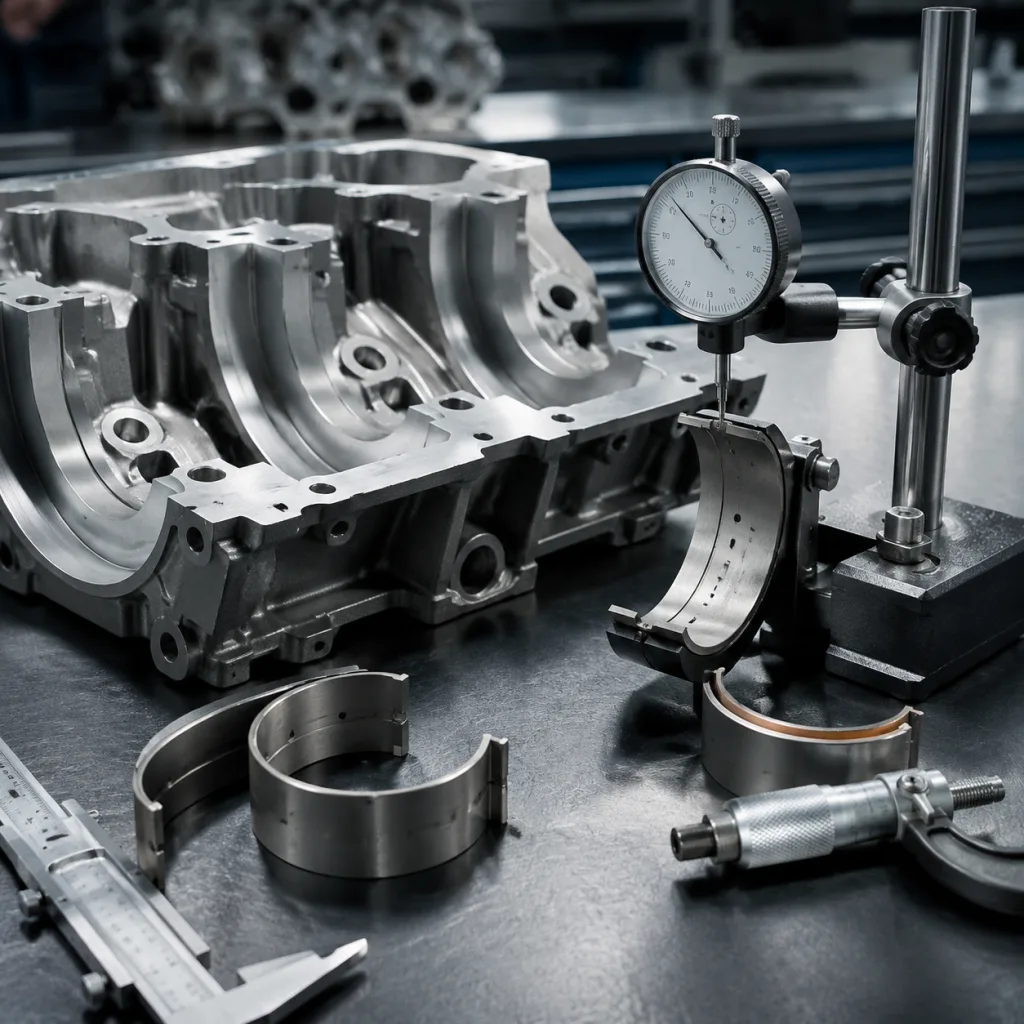
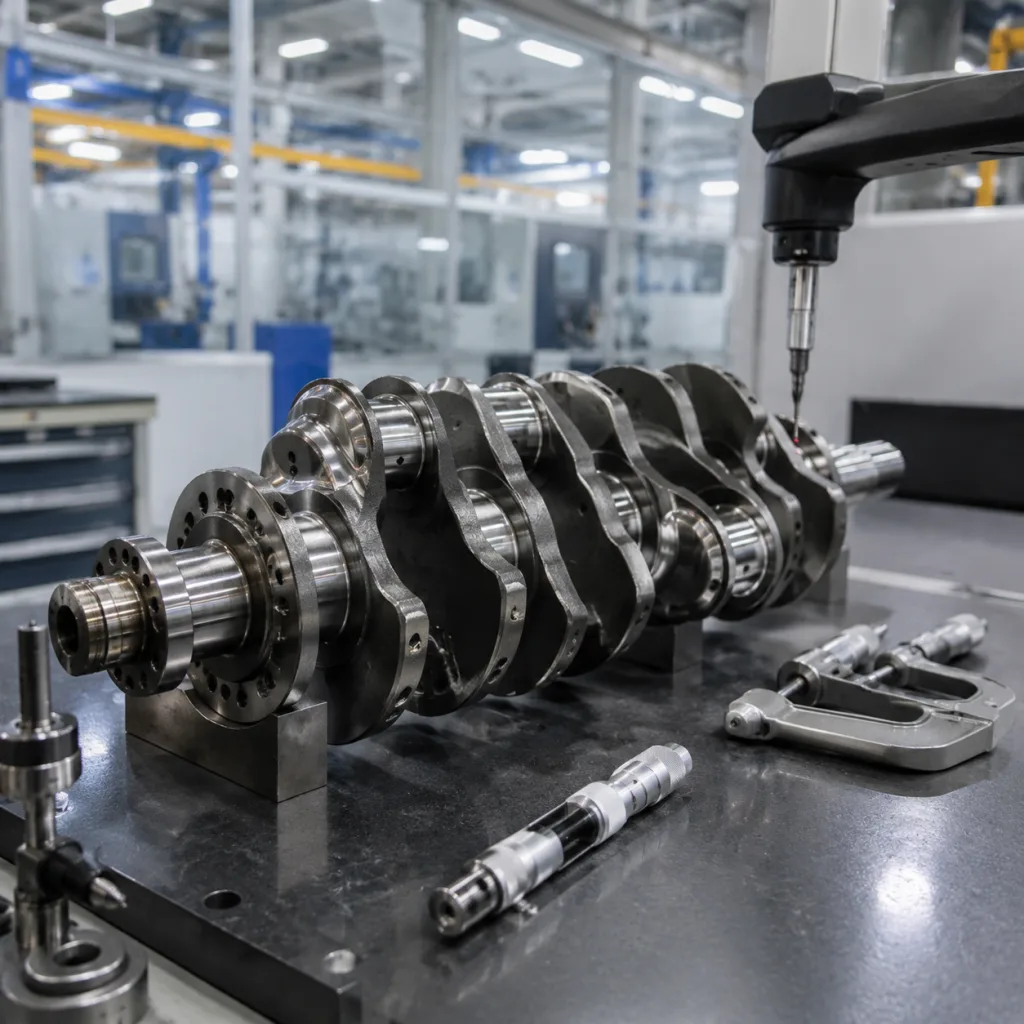
A serious audit should test measurement capability, not just cleanliness and visual sorting. Depending on the bearing type and agreed control plan, relevant equipment may include coordinate measuring machines, digital micrometers, air gauges, dial bore gauges, dedicated crush/spread fixtures, surface roughness testers, hardness testing, coating-thickness checks, and controlled-light visual inspection.

Gauge discipline matters. Ask whether the operator can repeat a shell-thickness measurement within the required tolerance band. Confirm the gauge is referenced to a traceable master. For suppliers working with automotive customers, this is normally reviewed under the quality system, including incoming material inspection, in-process inspection, final inspection, nonconforming product control, containment actions, and corrective-action records.

When approving samples before a first order, record both dimensional data and packaging condition on receipt. Measure several sets from the sample lot. Keep one approved golden sample. Photograph inner packing. Note corrosion, staining, or impact marks. This baseline helps distinguish manufacturing defects from transport damage, storage corrosion, or incorrect application in the field.

Spec deep-dive: dimensions that decide oil clearance and retention

Commercial planning scenario: 20 SKUs, uneven demand, and no room for mixed sizes

Engine bearing programmes rarely consist of one fast-moving SKU. A buyer may need 20 or more references, with different engine families, repair sizes, labels, and reorder patterns. If MOQ and packaging rules are not agreed early, the result is predictable: excess inventory on slow movers, shortages on popular sizes, rushed air freight, and warehouse claims caused by mixed standard and undersize sets.

Define the commercial terms before tooling confirmation, sample approval, or first production. Driventus typically discusses MOQ by item complexity, raw material availability, packaging type, and whether the order uses an existing specification or a new development route. Repeat catalogue items may be quoted by SKU or by mixed order value. New or low-volume items may require a minimum material batch, tooling amortisation, or a higher first-run quantity.

Separate sample timing from mass-production lead time. Drawing review, sample production, courier transit, and approval testing can add several weeks before the production clock starts.

Sourcing item What to request Buyer action
Drawing control2D drawing or controlled specification sheet with revision numberConfirm dimensions, repair size, oil features, and drawing owner before PO
Material declarationLayer structure, coating description, and restricted-substance statementScreen for REACH (EC) No 1907/2006 and buyer material rules
Dimensional reportWall thickness, width, oil hole, groove, crush, spread, and visual dataCompare sample data against later shipment lots
Process control planCTQ points, inspection frequency, sample size, and reaction planCheck whether special characteristics are controlled in process
Capability evidenceCpk/Ppk on key dimensions where volume justifies itUse Cpk ≥1.33 as a common target for stable critical dimensions
Traceability sampleCarton label, lot code, production date, and packing referenceLink field claims to production date and inspection records
Packaging specAnti-rust paper, VCI bag, separator, carton strength, and set groupingPrevent corrosion, mix-ups, and transit damage

</tr></thead><tbody> </tbody></table>These are planning ranges, not fixed offers. Final MOQ and price depend on bearing size, layer structure, coating, tooling status, annual forecast, packaging artwork, inspection level, payment terms, and destination. A buyer ordering small quantities across many SKUs should expect different pricing from a buyer placing a scheduled six- or twelve-month programme with rolling forecasts and repeat cartons.

Export buyers should specify pallet requirements, carton weight limits, barcode format, country-of-origin marking, and moisture protection before order release. For many bearing sets, keeping export cartons below about 15–20 kg improves warehouse handling and reduces compression damage, but the final limit should follow the buyer’s distribution rules.

For EU and UK importers, material declarations may be requested to support REACH (EC) No 1907/2006 compliance screening. For North American and Australian buyers, carton strength, humidity control, and corrosion protection are often priorities because distribution chains are longer and shipments may pass through several warehouses before reaching the installer.

Packaging is part of the specification. Bearing shells can be damaged by abrasion, pressure marks, poor separation inside the box, or moisture exposure during sea freight. Labels should identify part number, size grade, quantity, lot code, production date or batch reference, and any buyer barcode required for receiving.

Audit sequence: qualify the supplier before comparing the final price

A quotation is only comparable when the scope is the same. One engine bearing Volvo supplier may include controlled material, dimensional reports, anti-corrosion packing, and lot traceability. Another may quote only the part in a box. The price gap is not always a saving.

Use this sequence when qualifying a supplier:

1. Certification status: confirm IATF 16949:2016 and ISO 9001:2015 certificates, scope, issuing body, and validity. 2. Application data: confirm engine code, model-year range, bearing position, and repair size before sample production. 3. Drawing control: check revision status, critical dimensions, and whether buyer drawings can be protected under NDA. 4. Raw material control: review supplier approval, incoming inspection, storage conditions, lot traceability, and FIFO rules. 5. Critical dimensions: verify inspection records for wall thickness, width, crush, spread, oil-hole position, groove profile, and thrust width. 6. Measurement capability: check calibrated micrometers, fixtures, roughness testers, hardness equipment, and operator records. 7. Process capability: request capability data for high-volume SKUs; Cpk ≥1.33 is a common expectation for controlled critical dimensions. 8. Cleanliness and handling: check deburring, washing, drying, rust prevention, glove-use rules, and separation of finished shells. 9. Packaging validation: inspect inner protection, set grouping, label accuracy, barcode readability, carton durability, and palletisation. 10. Change control: confirm how tooling, material, process, gauge, coating, or packaging changes are communicated before implementation. 11. Claims process: confirm response time, evidence required, containment action, replacement policy, and corrective-action reporting. 12. Shipment release: confirm whether final inspection, AQL sampling, photos, packing list, and pallet dimensions are provided before balance payment.

Agree the field-claim evidence package before the first shipment. Useful evidence includes installation mileage or hours, engine code, oil and filter condition, crankshaft journal measurement, housing bore measurement, torque procedure, photos of failed shells, carton label, and lot number. This prevents every failure from being treated as a manufacturing defect and helps both sides identify incorrect application, contaminated oil, poor machining, or transport corrosion.

For private-label distributors or Tier-1 sourcing teams, Driventus can discuss custom manufacturing covering drawings, packaging, inspection criteria, and scheduled production. No aftermarket supplier should claim vehicle manufacturer approval unless a formal approval exists. Driventus does not make that claim.

Audit sequence: qualify the supplier before comparing the final price

RFQ Q&A: what Driventus needs to quote Volvo-fit bearings accurately

What should a buyer send first? Send enough information to identify the application and the commercial route. For Volvo-fit engine bearing enquiries, the recommended RFQ package includes:

  • Engine code and vehicle application range
  • Bearing type: main, connecting rod, thrust, or complete set
  • Required size grade: STD, 0.25 mm, 0.50 mm, or other agreed repair size
  • Annual volume forecast, first-order quantity, and target reorder frequency
  • Target price level or incumbent reference where available
  • Sample quantity and target approval schedule
  • Packaging format: neutral, buyer brand, bulk, set box, barcode, and carton label rules
  • Destination country, preferred shipping method, and carton or pallet limits
  • Any drawing, OE cross-reference, or internal part number already used by the buyer
  • Required documentation, inspection report format, material declaration, and labelling rules

What does Driventus check before replying? We review whether the item is existing, semi-developed, or new; whether the available specification matches the buyer’s application; whether tooling or sample charges apply; what lead time starts from deposit or sample approval; and what inspection documents are included in the quoted price.

How can recurring buyers reduce supply risk? Share a 6–12 month forecast. Group slow-moving SKUs into planned production windows. Confirm artwork before ordering custom cartons. These steps reduce emergency production, air-freight pressure, and mixed warehouse claims.

Who does Driventus supply? Driventus is based in Taizhou, Zhejiang, and supplies engine and powertrain components to more than 60 countries. Our bearing supply work supports procurement teams that need repeatability, documentation, and commercial predictability across catalogue supply, distributor programmes, and selected custom projects.

Can reporting and packaging be aligned with buyer systems? Yes. We can discuss inspection report formats, labelling rules, barcode requirements, carton structure, and private-label packing during the RFQ stage.

Driventus is an independent aftermarket manufacturer; brand names are referenced for fitment identification only. They do not indicate approval, endorsement, or supply status with any vehicle manufacturer.

Frequently asked questions

Availability depends on the engine family, drawing status, tooling, and current production plan. Standard and common undersize options such as 0.25 mm and 0.50 mm can be reviewed during RFQ. Buyers should provide engine code, bearing position, size grade, sample needs, and forecast volume for confirmation.

For qualified projects, Driventus can provide certification information, inspection reports, material information, packaging specifications, and agreed control documents. Documentation scope depends on order type, confidentiality terms, and whether the item is catalogue supply or custom development.

No. Driventus is an independent aftermarket manufacturer; brand names are referenced for fitment only. Fitment references help buyers identify applications, but they do not indicate approval, endorsement, or supply status with any vehicle manufacturer.

For a sourcing review, send engine codes, bearing positions, size grades, annual volume estimates, packaging rules, and destination market. Our team can confirm availability, MOQ, lead time, documentation, and price logic through [request a quote](/contact.html).

Request a Quote
Item Standard programme Custom or new development
MOQ basisOften 100–300 sets per SKU or mixed-SKU order value, subject to stock planOften 300–1,000 sets per SKU, tooling, material batch, and validation needs
Sample lead timeCommonly 7–20 days if drawings and stock material existCommonly 25–45 days due to engineering review and trial production
Mass production lead timeOften 30–45 days after deposit and order confirmationOften 45–75 days after sample approval and specification freeze
Price logicLower unit price with regular batch planning and standard packingHigher unit price if tooling, coating, low volume, or special inspection is required
PackagingNeutral or buyer label with standard inner protectionCustom artwork, barcode rules, separators, and carton testing available
DocumentationInvoice, packing list, inspection reportMay include control plan, material file, and agreed validation package