Engine Bearing Peugeot OEM Supplier Sourcing Guide
Peugeot-type engine bearing sourcing breaks down when it is treated as a simple catalogue match. One vehicle model may use different engine codes, crankshaft sizes, bearing positions, and repair undersizes. A wrong shell can still look plausible in the box. The failure appears later: unstable oil clearance, poor housing retention, mixed size sets, premature wear, or a claim that is hard to trace.
For importers, wholesalers, and category managers, the useful question is not only “who has the part?” It is: can this supplier prove the fitment logic, control wall thickness and crush, keep standard and undersize stock separated, mark batches clearly, pack for export, and respond with evidence when the market reports a problem?
Driventus manufactures engine and powertrain components in Taizhou, Zhejiang, and exports to more than 60 countries. We support B2B customers that need documented process control, batch-level traceability, practical MOQ and lead-time planning, and export-ready packaging. Driventus is an independent aftermarket manufacturer; vehicle brand names are referenced for fitment identification only. This guide explains how to qualify an engine bearing Peugeot OEM supplier for catalogue supply, private-label programmes, and engineered bearing projects.
Start with the fitment decision, not the catalogue number
The first sourcing decision is application certainty. Peugeot-related demand can include passenger cars, light commercial vehicles, and engines shared across European platforms. Model name is a weak identifier. Engine code, year range, bearing position, and service size are stronger.
A reliable enquiry normally answers five questions before price is discussed:
1. Which engine family or engine code is being covered? 2. Is the requirement for main bearings, connecting rod bearings, thrust washers, or a complete set? 3. Is the size standard, 0.25 mm undersize, 0.50 mm undersize, or another market-specific undersize such as 0.75 mm? 4. What set composition is expected, for example a 4-cylinder rod set of 8 half shells or a main set with separate thrust pieces? 5. What packaging and documentation does the target market require?
For Peugeot-type engine bearings, buyers should confirm the following data where available:
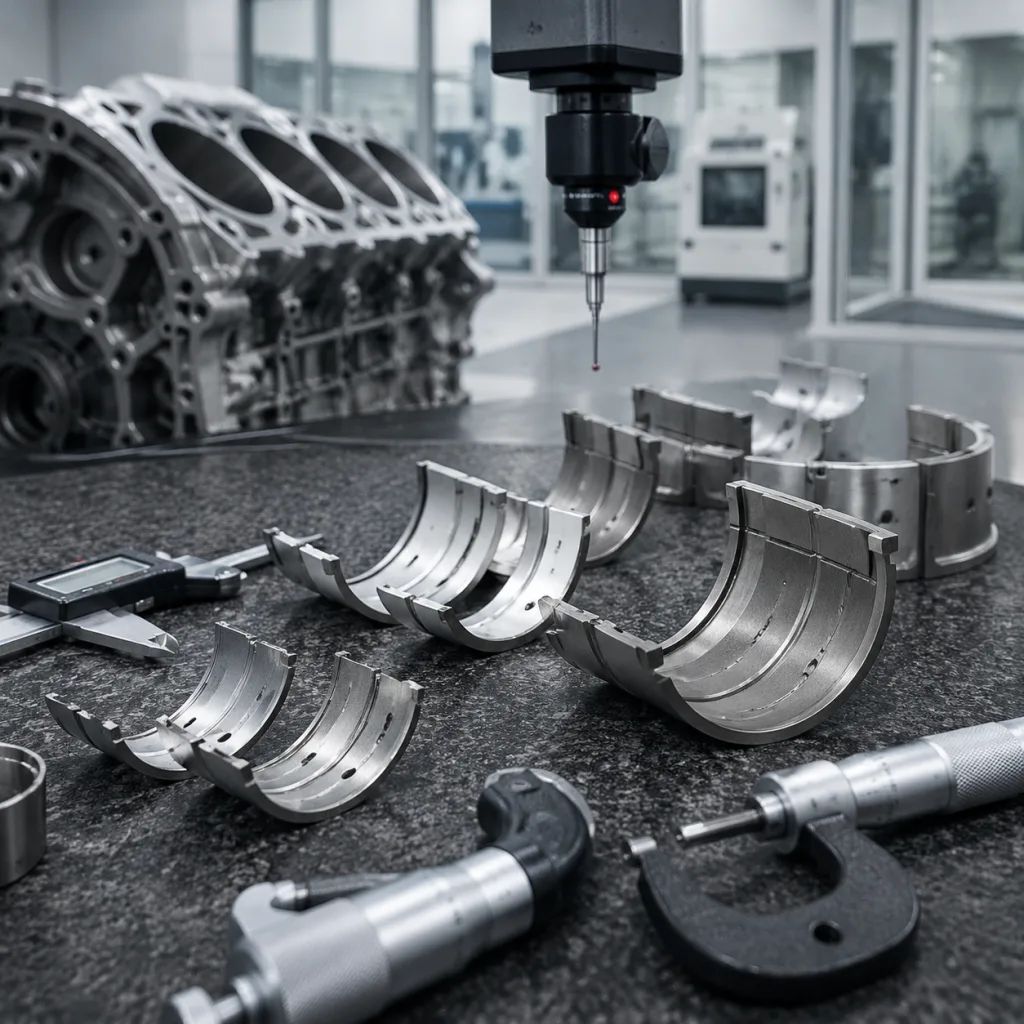
- Shell width, outside arc length, back radius, wall thickness, and locating lug position
- Crankshaft journal diameter and housing bore size from service data, drawing, or customer measurement
- Oil groove design, oil hole diameter and position, relief geometry, and crush-height requirement
- Material structure, such as steel-backed aluminium alloy or steel-backed copper-lead intermediate layer with electroplated overlay
- Standard and undersize markings on the shell, inner box, and export carton
- Packaging format: bulk export carton, individual set box, neutral pack, Driventus pack, or customer private-label box
- Target market documentation for the EU, UK, US, Canada, Australia, Brazil, or other regions
Cross-reference numbers are useful, but they are not proof. They may appear in generic OE-style or aftermarket formats depending on the engine family and local catalogue practice. Before confirming an order, compare at least wall thickness, shell width, oil-hole position, lug direction, set composition, and undersize marking. This small check prevents many expensive mismatches.
Driventus does not claim approval, authorisation, or endorsement by any vehicle manufacturer. Brand references are used only to identify fitment. Buyers can review related engine lines in our catalog and the engine component range at /products/engine-components.html.
Audit the failure modes before approving the supplier
A bearing supplier should be qualified by the failures it can prevent. Bearings operate under high cyclic load, thin oil film, heat, and repeated start-stop conditions. Minor variation can become a field problem: too much clearance, insufficient crush, poor oil feed, weak overlay control, corrosion during storage, or mixed undersize stock in one shipment.
Use the audit to test control, not presentation. The most useful questions are evidence-based:
| Failure mode to prevent | What to request | Why it matters | |
|---|---|---|---|
| Wrong material or mixed batches | Steel strip, backing material, bearing alloy, overlay chemistry, and batch traceability records | Reduces unverified material risk | |
| Oil-clearance instability | Wall thickness, width, bore seating, and dimensional inspection reports | Confirms the shell can meet the intended clearance window | |
| Poor housing retention | Crush, free spread, parting-line, and back surface inspection data | Supports correct seating after cap assembly | |
| Oil-feed mismatch | Oil-hole and groove inspection records against the approved drawing | Prevents lubrication errors from incorrect geometry | |
| Premature wear or seizure | Surface finish, plating, overlay or lining, cleaning, deburring, and anti-corrosion records | Controls bearing face condition and storage stability | |
| False acceptance | Calibration records for micrometers, air gauges, height gauges, bore gauges, and profile checks | Ensures measurements are reliable | |
| Repeated customer claims | 8D reports, containment procedure, sorting records, and recurrence-prevention evidence | Shows whether problems are contained and corrected | |
| Transit and warehouse damage | VCI or anti-rust method, drop resistance, label control, inner-box specification, and carton specification | Protects parts through ocean freight and distribution handling |
| Sourcing case | Common MOQ approach | Lead-time considerations | Documentation level |
|---|---|---|---|
| Existing catalogue item | Lower MOQ by set or carton; mixed sizes may be possible in consolidated shipments | Shorter lead time if shells, inspection capacity, and packaging are available | Inspection report and batch traceability |
| Private-label packaging | MOQ depends on box print, label format, carton artwork, and barcode rules | Extra time for artwork approval, packaging proofing, box production, and label master confirmation | Packing specification, label approval, and carton-marking sample |
| New application development | Higher pilot and production MOQ because tooling, gauges, and material allocation may be required | Tooling, sample approval, validation, and production scheduling required before mass production | Drawing review, control plan, dimensional report, and PPAP on request |
| Multi-SKU stocking programme | Consolidated MOQ by shipment, often planned by annual forecast and SKU velocity | Requires forecast, SKU grouping, safety-stock logic, and export consolidation planning | SKU list, carton plan, inspection records, and export documents |