When buyers evaluate an `engine bearing Mazda supplier`, the question is not simply whether the part fits on paper. The real test is whether the supplier can hold clearance, coating, and metallurgy steady from lot to lot.
For Mazda applications, a small drift in bearing thickness or housing fit can change oil-film behavior and shorten service life. That makes sourcing a decision about process control, not just catalog coverage.
Driventus is an independent aftermarket manufacturer; brand names are referenced for fitment only. We produce engine and powertrain components in Taizhou, Zhejiang, and export to more than 60 countries under IATF 16949:2016 and ISO 9001:2015 systems.
This article takes a practical route: how to compare suppliers, where failures usually appear, what specs matter most, and how to verify quotes before you issue a PO.
Decision checklist before you shortlist a supplier
Start with the few variables that determine whether a bearing will survive in service. Price matters, but only after fit, material control, and repeatability are clear.
Confirm the exact OE cross-reference and engine code, for example `Mazda LF17-11-221` or the valid OE reference for the target engine family
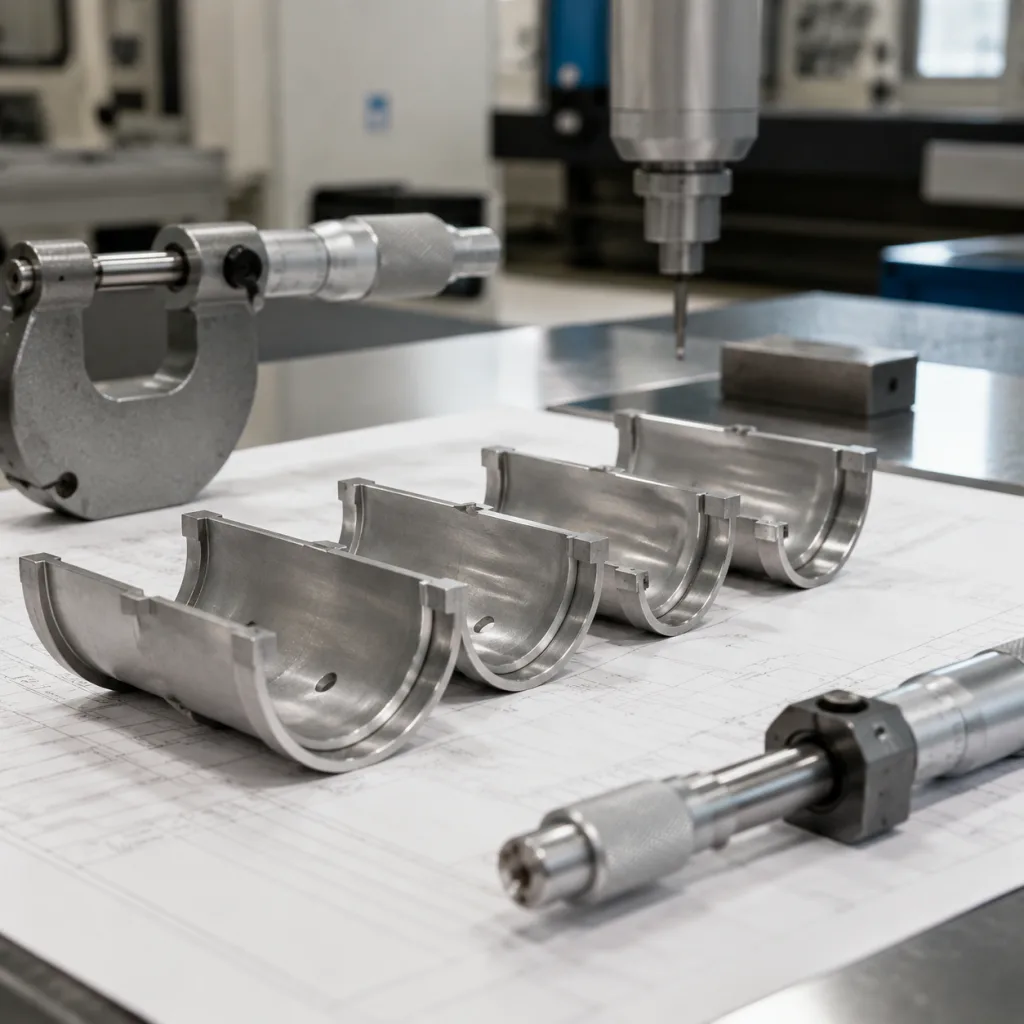
Ask for measured shell thickness with tolerance, not just a nominal value, and request clearance data by lot
Verify backing material, overlay type, and whether the shell is bi-metal or tri-metal
Require traceability records, heat-number linkage, and inspection data for each lot
Check whether the supplier can provide PPAP-style documents such as dimensional report, material certificate, and control plan
Confirm any regulatory needs for EU supply, including REACH (EC) No 1907/2006 where applicable
A serious supplier answers with measured data. If the reply is only a brochure or a generic fitment claim, treat that as a warning sign. For an RFQ, ask for the tolerance sheet first; it tells you more than the price line does.
Where Mazda bearing programs fail in practice
Most bearing problems do not start with a dramatic defect. They start with small inconsistencies that escape approval and show up later as noise, wear, or a warranty return.
The common failure modes are predictable:
1. Clearance drift between lots, which narrows the oil-film margin and changes crank behavior 2. Coating variation, especially when overlay thickness is not controlled by measured range 3. Out-of-round shells or inconsistent wall thickness that affect housing fit 4. Poor packaging that allows corrosion, edge damage, or mixed lot shipment 5. Weak traceability, which slows containment when a batch is questioned 6. Mixed expectations between buyer and supplier on journal condition, viscosity, and service duty
If a supplier cannot explain how it prevents these issues, the risk is likely hidden in the first field complaint. The best follow-up question is simple: what happens when a measured lot starts to drift, and how quickly is it isolated?
Spec details that deserve a second look
Engine bearings are usually supplied as bi-metal or tri-metal shells depending on load, speed, oil pressure, and engine design. The spec sheet should show more than a part number.
Item
Common requirement
Procurement note
Shell type
Bi-metal or tri-metal
Match to application duty cycle and oil condition
Backing material
Steel
Confirms crush strength and assembly stability
Overlay
Polymer, lead-free, or soft metal
Check the declaration and regulatory fit
Thickness tolerance
±0.005 mm to ±0.010 mm
Ask for measured values by lot
Clearance range
Application-specific
Confirm against engine code and crank journal condition
Surface finish
Controlled, low defect rate
Inspect for scoring, flaking, or burrs
Packaging
Rust protection and lot labelling
Needed for traceability and export handling
</tr></thead><tbody> </tbody></table>For Mazda fitment programs, repeatability matters more than a headline-low unit price. Buyers should also request first-article data for ovality, thickness, and coating thickness, because those values affect oil-film stability and wear life more directly than most catalog descriptions suggest.
How to run a supplier comparison that is actually fair
A useful comparison starts by forcing each vendor to quote the same requirement. Otherwise, the cheapest line item may be hiding a different coating, a looser tolerance band, or a lighter packaging spec.
Use the same request package for every supplier:
Same OE reference and engine family
Same acceptance criteria for thickness, clearance, and ovality
Same Incoterms and shipping destination
Same carton count and packing method
Same request for inspection report and certificate pack
This is also where landed cost comes into focus. A quote with a slightly higher unit price may still win if it reduces receiving inspection time, avoids claims, or keeps replenishment stable. If your demand is irregular, ask for a blanket PO with scheduled releases so you can protect price without carrying unnecessary stock.
What Driventus can support in a Mazda program
Driventus supplies engine bearings as part of a broader powertrain range, including pistons, crankshafts, gaskets, water pumps, and turbochargers. That matters when buyers want to consolidate sourcing across engine rebuild programs.
Our sourcing model is designed for B2B buyers:
Stable MOQ for distributors, wholesalers, and repair-chain programs, typically from 300 to 1,000 pairs per part number depending on packaging and tooling status
Lead-time planning for regular replenishment and seasonal demand, with samples often 7 to 15 days and standard production commonly 25 to 35 days after order confirmation
Export documentation for cross-border shipments, including packing list, commercial invoice, and certificate pack on request
Quality control under IATF 16949:2016 and ISO 9001:2015 with lot traceability and final inspection records
Customization support through custom manufacturing when a program needs special thickness, coating, private label cartons, or carton-count changes
If you are aligning adjacent engine parts, start with our catalog and the broader engine components page. That helps you sync bearing sourcing with gasket, crankshaft, and oil-pump requirements in one RFQ.
Audit questions that separate claims from controls
A factory audit should test whether the supplier can repeat the same result over multiple lots. Presentation matters less than process control.
Ask to see:
1. Incoming material inspection and heat-number traceability, including retained sample control and supplier COA review 2. Shell forming and coating control points, with documented setup verification and line-change checks 3. In-process dimensional inspection frequency, such as every 2 to 4 hours or per lot depending on volume 4. Final audit criteria for thickness, ovality, surface defects, and packaging integrity 5. Packing controls for corrosion prevention, lot separation, and carton count confirmation 6. Complaint handling and corrective-action closure time, with 8D response targets and containment timing
If the supplier cannot show these controls, the risk usually appears later in the field, not in the sample stage. Buyers should also ask for calibration records for micrometers, bore gauges, and coating-thickness instruments, because measurement integrity is part of process control. Our quality system page summarizes the framework we use for production control and traceability.
Frequently asked questions
Yes. Driventus supplies engine bearings for aftermarket and B2B channels, using OE cross-reference data where available. Driventus is an independent aftermarket manufacturer; brand names are referenced for fitment only.
Our production system is aligned with IATF 16949:2016 and ISO 9001:2015. For EU supply, material control may also be reviewed against REACH (EC) No 1907/2006.
Yes. We support custom manufacturing, private label packaging, and program-specific labeling for distributors and repair chains. Share your target MOQ and artwork files through the contact form.
If you are building a supplier shortlist for Mazda engine bearings, send your OE reference, target volume, and packaging needs. We can review the requirement and prepare a quote at /contact.html.