Engine Bearing IVECO Manufacturer China: Sourcing Guide
Buying engine bearings for IVECO applications is a procurement decision, not a catalogue exercise. The real job is to confirm fit, material stack, and repeatability before the first order leaves the factory. For distributors, repair networks, and OEM programmes, the questions are simple but unforgiving: Does the bearing match OE geometry? Does the overlay suit the duty cycle? Can the supplier hold the same result on batch two, batch ten, and batch fifty? Driventus is an independent aftermarket manufacturer; brand names are referenced for fitment only. As a China-based supplier in Taizhou, Zhejiang, Driventus supports B2B buyers with engine and powertrain components built under IATF 16949:2016 and ISO 9001:2015 systems. This article focuses on how to qualify the part, compare supplier claims, and reduce sourcing risk when buying engine bearings for IVECO-fit applications.
The first RFQ should answer fit, not price
Before sending an RFQ, ask for:
- Engine code or VIN-derived application data
- OE reference and repair size
- Target quantity and forecast
- Required surface finish, hardness, and coating type
- Packaging and label requirements
- Compliance needs for REACH (EC) No 1907/2006 or other market rules
- Target annual volume, first order quantity, and reorder pattern
- Target price band and required Incoterms
- Required lead time for samples and mass production
For engine bearings, the most useful request is not the part name. It is the dimension set. Ask for nominal measurements in millimetres, then verify the journal diameter, bearing width, oil clearance target, and any undersize or oversize repair class. If your team can share a removed sample, the supplier should measure against it and confirm the fitment path before quoting. That one step often prevents the most expensive mistake in sourcing: buying a part that is technically “for the right engine” but wrong in clearance, crush, or width.
Material stack is where durability is won or lost
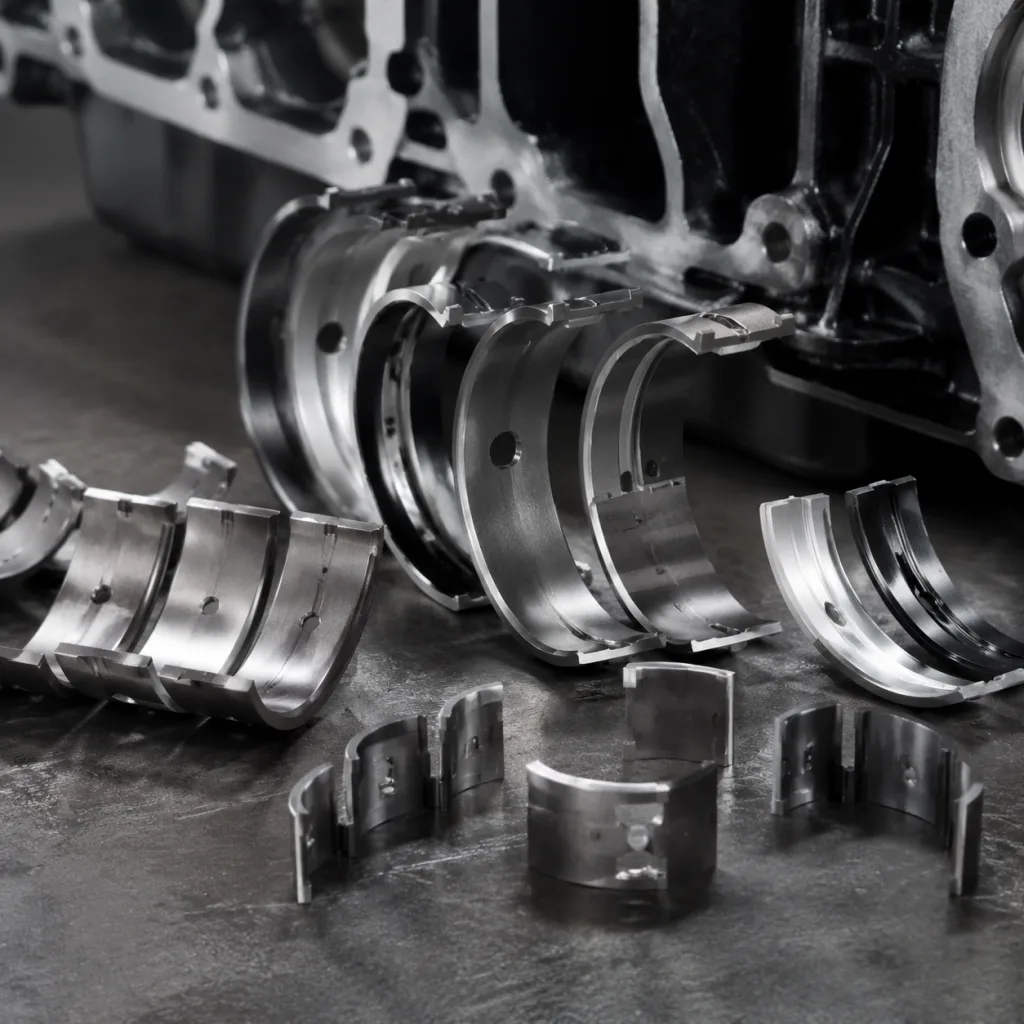
Bearing performance depends on the full material stack, not only the catalogue reference. Backing metal, intermediate layer, overlay, and any anti-wear or corrosion coating all affect fatigue resistance, embeddability, and seizure protection. If a supplier cannot explain that stack clearly, the quotation is not ready for production.
Typical quality checks include:
- Wall thickness measured on sampled shells
- Backing hardness verification
- Coating adhesion inspection
- Visual checks for edge damage and contamination
- Dimensional confirmation against a drawing or OE sample
- Overlay thickness recorded by batch
- Tang height and crush measured for fit control
- Surface roughness checked where specified
A tighter specification is usually better than a generic catalog callout. Buyers often do well to lock main dimensions on a drawing, define the clearance window, and specify width, parting line, and chamfer geometry against the OE sample. That matters even more in heavy-duty use, where load, oil quality, and drain interval can expose weak overlay systems quickly. If your programme runs fleets, ask whether the coating is built for extended service loads or only standard-duty replacement.
Compare suppliers on control, not claims
A good supplier comparison starts with process control. Two factories can offer the same part number, but only one may control tooling, inspection, sorting, and packing tightly enough for repeat business. That difference shows up later as warranty returns, not on the quote sheet.
How Driventus supports IVECO-fit sourcing:
- Stable batch production for repeat purchasing
- Technical matching against supplied samples or drawings
- Controlled inspection under ISO 9001:2015 and IATF 16949:2016 systems
- Export-ready documentation for customs and receiving inspection
- Support for private label and programme-specific packaging
- Lot-level traceability tied to production records
- Sample submission with dimensional report before mass order release
For larger programmes, our custom manufacturing option helps category buyers align bearing dimensions, coating selection, and packaging with internal part-number systems. If you are comparing a bearing line with other engine components, review our catalog and the broader engine components range.
Driventus is an independent aftermarket manufacturer; brand names are referenced for fitment only.
The commercial sequence should also be explicit: sample validation first, trial order second, repeat production only after fitment, packaging, and inspection paperwork are approved. That sequence is slower than a blind stock order, but it avoids committing volume before the engine family is validated.
Lead times, MOQ, and audit readiness form one decision
When you compare suppliers, lead time and minimum order quantity should be tied to the programme structure, not just the lowest unit price. A supplier that can hold process stability, document traceability, and support audit requests usually creates less downstream risk than one focused only on quotation speed.
Commercial questions to include in the RFQ:
- What is the MOQ per bearing reference?
- What is the sample lead time?
- Can you support mixed part numbers in one shipment?
- Which inspection documents ship with the order?
- Can packaging carry customer labels and barcodes?
- Is the quoted price based on EXW, FOB, or CIF?
- What is the price break at 500, 1,000, and 5,000 sets?
- What tooling or setup charge applies to a new profile?
- How long is the standard production lead time after deposit?
Treat sample lead time, production lead time, and reorder lead time as three separate clocks. Sample lead time is usually the shortest. Production lead time starts after technical approval, order confirmation, and deposit. Reorder lead time should only shrink if tooling, material, and scheduling are already locked. Price changes for the same bearing often come from alloy choice, coating complexity, packaging specification, and order volume. A trial order may cost more per set because inspection and setup are spread across fewer units. A stable monthly programme usually earns better tier pricing. Audit readiness matters too: if a supplier cannot provide traceability records, incoming material data, process flow, and final inspection reports, the low price is usually false economy.
Replacement failures usually start with small mismatches
For replacement programmes, the main risk is dimensional mismatch. A bearing that looks correct can still fail if oil clearance, crush, or thrust width falls outside the engine’s working envelope.
Use this order of checks:
1. Confirm OE reference and engine code. 2. Compare sample dimensions with the removed part and the OEM drawing if available. 3. Verify journal condition and housing bore before installation. 4. Check oil system cleanliness and filter condition. 5. Replace in matched sets and record the batch number. 6. Measure oil clearance with plastigage or a bore gauge where the workshop process allows. 7. Confirm end play and torqued housing dimensions before start-up.
If the customer wants field testing, define the acceptance route before production release. Durability methods may be relevant for adjacent components, but bearing approval should be tied to the exact engine application and buyer specification. For emission-related markets, vehicle-level rules may shape the wider context, yet they do not replace part-level validation.
A controlled replacement strategy reduces warranty claims, especially in commercial fleets with long drain intervals and extended service loads. Buyers should also require a clear nonconformance process: if a lot fails incoming inspection, the supplier should identify the lot code, segregate stock, and agree on replacement or rework terms before the next shipment. That level of process detail matters as much as the nominal part number when sourcing an engine bearing IVECO manufacturer China can supply at scale.
Frequently asked questions
Yes, when the buyer provides the OE reference, engine code, or sample. Driventus supplies independent aftermarket parts with fitment-based cross-references only, not manufacturer approval claims.
You can request quality certificates, inspection records, traceability format, process flow, and export documents. Driventus operates under IATF 16949:2016 and ISO 9001:2015 systems.
Yes. Driventus supports customer-specific packaging, barcode labels, and private label programmes through our custom manufacturing service, subject to technical and commercial review.
If you are sourcing engine bearings for IVECO-fit applications and need technical confirmation, batch control, or programme pricing, please [request a quote](/contact.html).
Request a Quote