Engine Bearing Iveco Wholesale: Sourcing Guide
Procurement teams sourcing engine bearing Iveco wholesale need more than a part name and a price. The real decision is whether the bearing matches the engine code, crankshaft size, load profile, and repeat-order requirements. Small errors in wall thickness, crush, or oil clearance can create early failures after assembly, so the first review should be technical, not commercial. Driventus is an independent aftermarket manufacturer; brand names are referenced for fitment only. We supply B2B customers that need stable repeat ordering, documented inspection, and export-ready packing for distributors, repair networks, and engine rebuilders. Driventus operates under IATF 16949:2016 and ISO 9001:2015 controls, with production and inspection aligned to dimensional traceability and batch consistency. This article focuses on how to screen offers, where wholesale quotes go wrong, and when a custom drawing is the safer route.
Start with fitment, not price
When sourcing an engine bearing Iveco wholesale line, the first question is whether the bearing is actually the right one for the engine build. Main bearings and connecting rod bearings are not interchangeable, and an OE cross-reference only helps when the engine code and crankshaft size are confirmed.
Check these points on every enquiry:
- Engine model, displacement, and engine code
- Main bearing or rod bearing position
- Standard size, oversize, or undersize
- OE part-number cross-reference where available, such as `OE 06A107065`
- Oil clearance target and crankshaft journal diameter
- Pack quantity, label language, and destination market
A sample or dimensional drawing is often better than a part name alone. It helps catch wrong width, incorrect locating tab position, or shell thickness mismatch before the first production order.
Where bearing failures usually start
Most wholesale mistakes are not dramatic. They are small mismatches that show up only after assembly or after the first run.
Common failure modes include:
- Wrong shell thickness, which changes clearance
- Incorrect crush, which affects seating in the housing
- Mixed size cartons, which confuse warehouse picking
- Oil groove or tab location errors, which prevent proper installation
- Surface defects such as scoring, pits, or edge burrs
- Coating changes that were not disclosed between reorders
For engine rebuilders and distributor networks, the safest workflow is to approve the bearing against a sample set or drawing before scale-up. That keeps returns down and gives receiving teams a clear reference for future batches.
Compare suppliers on the same basis
Unit price is only one line in the quote. Landed cost is usually shaped by packing, lead time, and whether the supplier can repeat the same specification on the next order.
The fastest comparison method is to align every quote on the same checklist:
- MOQ by part number and by size variant
- Production lead time after sample approval
- Carton configuration and barcode labelling
- Documentation set: invoice, packing list, certificate of origin, and inspection record
- Incoterms and destination port handling
- Reorder consistency for long-running programmes
- Custom printing or private-label carton cost
A lower quote can be misleading if the supplier changes coating, outsources a process, or ships mixed-size cartons. Ask each supplier to quote the same material spec, tolerance band, and packing format before you compare numbers.
Spec checks that matter before release
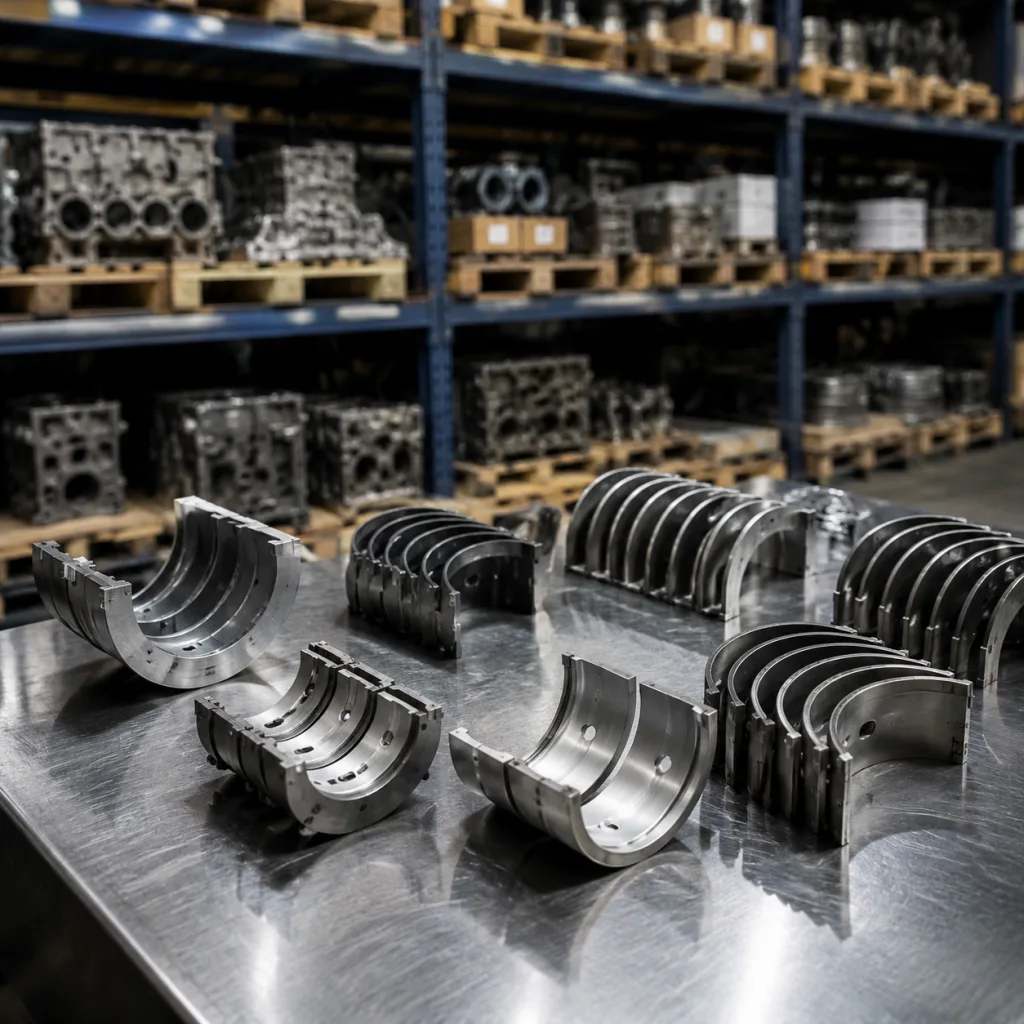
Engine bearings are usually built on a steel backing with a tri-metal or bi-metal sliding layer, depending on engine family and duty cycle. For wholesale supply, the material declaration should match the intended load, lubrication conditions, and service interval.
| Control item | Typical buyer check |
|---|---|
| Backing material | Steel strip grade and thickness |
| Overlay | Lead-free or leaded layer, as specified |
| Shell thickness | Measured to drawing and batch record |
| Crush and spread | Consistent seating in the housing |
| Oil groove | Position, depth, and finish |
| End play / width | Fits the crankcase and cap geometry |
| Surface finish | No scoring, pits, or edge burrs |