engine bearing · 2026-06-20

Engine Bearing Isuzu Supplier for B2B Sourcing

Choosing an engine bearing Isuzu supplier is not a catalog exercise. For an importer, wholesaler, or repair-chain buyer, the real question is whether the bearing will hold oil clearance, seat correctly in the housing, survive freight and storage, and arrive with paperwork that does not slow customs or receiving.

The weak point is often hidden. A part number may appear correct while the dimensional stack is not: crankshaft journal diameter, housing bore, installed oil clearance, wall thickness, crush height, free spread, locating lug position, oil-hole geometry, thrust face location, and load profile all matter after installation. Approving a listing without checking those controls is how low-cost sourcing becomes high-cost claims.

Driventus manufactures engine and powertrain components in Taizhou, Zhejiang, under IATF 16949:2016 and ISO 9001:2015 quality management systems. We support B2B buyers in aftermarket distribution, OEM service channels, and multi-location repair networks. This article reframes Isuzu-fit bearing sourcing as a purchasing decision with technical, quality, MOQ, documentation, and replenishment consequences. Driventus is an independent aftermarket manufacturer; brand names are referenced only to identify fitment.

Start With a Go/No-Go Decision Matrix, Not a Price Sheet

A useful first screen separates suppliers that can run a bearing program from suppliers that can only quote a number. Isuzu diesel applications cover light commercial vehicles, pickups, industrial equipment, and medium-duty trucks. Demand may include main bearings, connecting rod bearings, thrust washers, flanged shells, and complete overhaul sets. The supplier must handle fast-moving references and slow fleet-coverage items without relaxing material, inspection, or packing controls.

Use the first RFQ round as a decision matrix:

  • Application coverage by engine code, vehicle platform, market, year range, and bearing position
  • Cross-reference sheet using the buyer’s internal numbers and OE-style references where applicable
  • Drawings for main and conrod bearings, including journal diameter, housing bore, wall thickness, width, oil-hole position, and thrust location where relevant
  • Material structure, such as steel back plus copper-lead or aluminum-tin alloy, nickel barrier, overlay, and optional polymer coating where specified
  • STD and undersize options, commonly 0.25 mm, 0.50 mm, and 0.75 mm where the repair or remanufacturing channel needs them
  • Traceability method from raw strip or semi-finished shell to packed carton
  • MOQ by reference, bearing family, and mixed order
  • Sample, pilot-order, and repeat-production lead time
  • Export carton dimensions, gross weight, pallet format, anti-rust protection, and label format

The go/no-go issue is measured evidence. Catalog data is not enough. Ask for actual values or a sample inspection report. Depending on the drawing, controls may include wall thickness within the approved tolerance band, width controlled to hundredths of a millimeter, oil-hole and lug position checked by fixture, and crush or spread verified against the housing design. The acceptance limit must follow the confirmed drawing. Do not apply one generic tolerance to every Isuzu-fit engine or bearing material.

Driventus groups bearing programs with other internal engine components in our catalog, including related items under engine components. That matters when an overhaul program also requires pistons, rings, gaskets, water pumps, and bearing sets in one purchasing plan.

Where MOQ and Lead Time Usually Break Down

MOQ problems rarely come from one cause. They come from tooling use, strip material purchasing, inspection frequency, packaging efficiency, and production-slot planning colliding with a buyer’s stock requirements. Very low MOQs can look attractive. Repeated small splits, however, may raise setup cost, introduce material variation, waste cartons, and create replenishment gaps.

A better model is to classify references by movement. Fast-moving fleet parts should usually be quoted by carton or pallet quantity. Medium-volume service parts fit production-lot planning. Slow-moving references may work best in mixed-family batches if material and tooling allow it. Private-label cartons add another layer because printed boxes, labels, and master cartons often have their own minimum quantities.

</tr></thead><tbody> </tbody></table>For new accounts, Driventus normally recommends a technical sample set or pilot order before annual blanket purchasing. A typical sequence is simple: RFQ review within 1–3 working days after a complete list is received, sample preparation after drawing confirmation or sample approval, pilot production after packaging and inspection requirements are frozen, and repeat production scheduled by material availability and line capacity. Coating, private-label artwork, and multi-reference consolidation can add time, so exact dates are confirmed in the quotation.

We confirm lead time, MOQ, payment terms, Incoterms, and document scope in writing. This is not formality. In consolidated container shipping, one delayed low-volume bearing reference can hold a larger engine-parts order.

Quality Controls That Separate Bearing Makers From Parts Traders

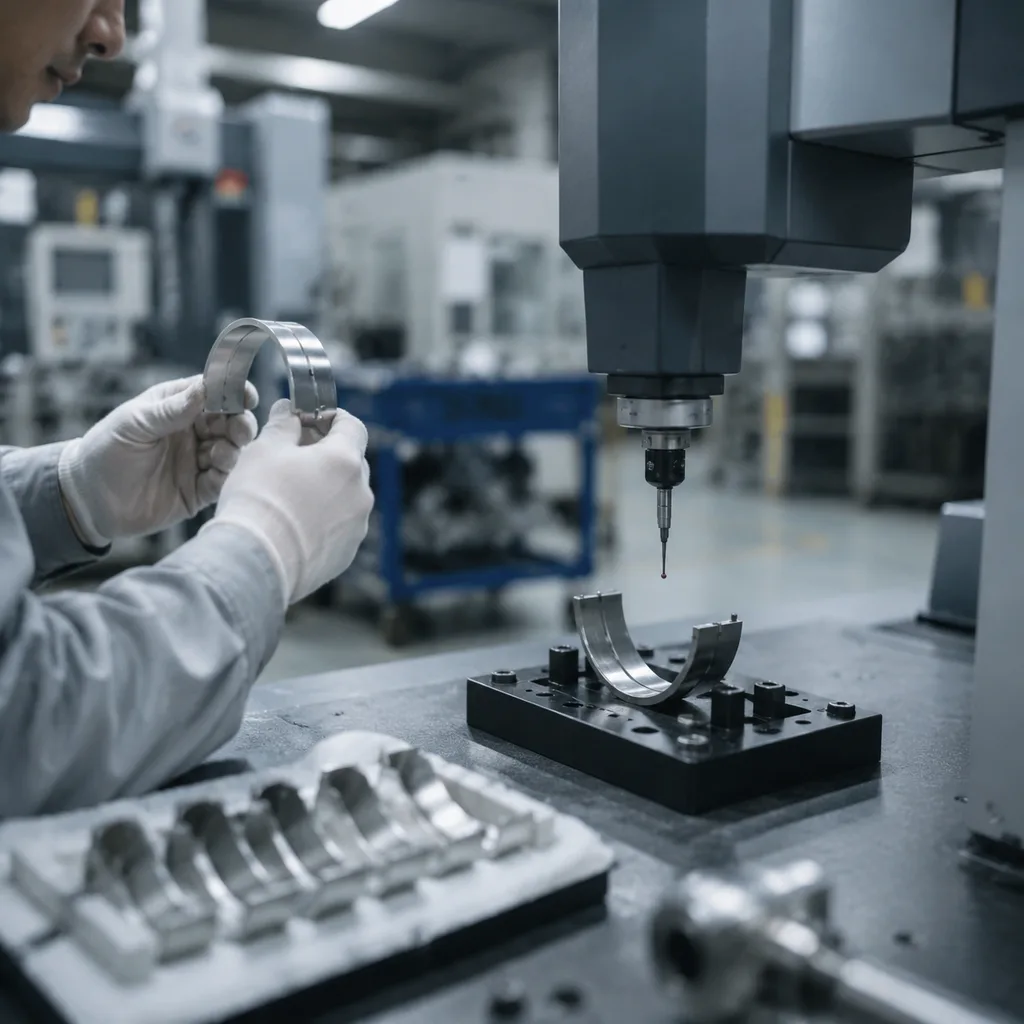
Engine bearings work on a thin oil film. Small deviations can change clearance, retention, oil pressure, temperature, and service life. Photos and price sheets do not prove process control. A credible manufacturer should be able to show controlled drawings, incoming material checks, in-process inspection, final inspection, and batch traceability. Driventus operates under an IATF 16949:2016 and ISO 9001:2015 quality system, with controls built for repeat B2B supply.

Key checkpoints include:

  • Incoming steel strip or semi-finished shell identification, thickness check, and material certificate review
  • Steel backing thickness and hardness verification according to drawing or control plan
  • Bond integrity between steel back and bearing alloy, using bend, peel, metallographic, or approved process checks where required
  • Wall thickness measurement at defined points, usually near the crown and away from parting-line relief areas
  • Bearing width, parting face, chamfer, lug location, and oil-hole geometry
  • Crush height and free spread control for correct seating and retention in the housing bore
  • Surface roughness, overlay condition, and coating thickness or appearance where applicable
  • Visual inspection for scoring, dents, delamination, burrs, corrosion, contamination, or handling damage
  • Cleanliness control during packing to reduce dust and chip contamination
  • Corrosion-resistance checks where coating, storage duration, sea freight, or destination humidity requires them
  • Lot coding and retained samples for claim investigation

A strong inspection plan separates critical, major, and cosmetic features. Critical features include wall thickness, crush, oil-hole alignment, lug position, and material bonding. Major features include width, surface finish, coating condition, and parting-face condition. Cosmetic features cover non-functional marks that do not affect installation or oil film performance. For larger orders, buyers may request AQL sampling or buyer-specific inspection frequency. For first orders, 100% checks may be agreed for selected critical dimensions before quotation.

Buyers serving EU and UK markets may also request material compliance declarations relevant to REACH (EC) No 1907/2006 and other destination-market requirements. If restricted-substance rules, packaging standards, or buyer-specific declarations apply, freeze them before production release. Performance validation is application-specific and may include bench checks, metallographic inspection, hardness testing, surface roughness measurement, and engine durability validation under a buyer-approved plan. Driventus does not claim approval or endorsement by any vehicle manufacturer.

Quality Controls That Separate Bearing Makers From Parts Traders

RFQ Spec Deep-Dive: The Details That Change the Quote

An application name is not enough for quotation control. Two engines with similar displacement may use different crankshaft journal diameters, bearing widths, thrust positions, oil-hole layouts, locating lugs, or undersize repair options. Importers should provide samples, drawings, engine codes, or a verified cross-reference list. If the program serves remanufacturers, undersize bearings for reground crankshafts may be essential.

Minimum RFQ data

  • Engine family and market application, including vehicle or equipment model where available
  • Bearing type: main, conrod, thrust washer, flanged bearing, or complete set
  • STD size and any undersizes required, such as 0.25 mm, 0.50 mm, or 0.75 mm where applicable
  • Quantity by reference, carton quantity target, and expected annual volume
  • Packaging: bulk, pair pack, set box, neutral carton, Driventus carton, or private-label carton
  • Destination port, preferred Incoterms, and shipment mode: courier, air, LCL, or FCL
  • Required inspection report format, including dimensions that must be recorded
  • Buyer-specific restricted-substance, marking, barcode, date-code, or documentation requirements

Dimensional controls that affect fit and claims

Sourcing item The failure mode What Driventus provides
MOQA low-volume item delays the whole order or becomes uneconomicMOQ review by bearing family, carton quantity, annual forecast, and shared material/tooling plan
Price logicUnit price changes without a clear reasonBreakdown of setup, material, coating, inspection, packing, and export-handling assumptions where appropriate
Lead timeA confirmed container waits for one slow referenceSample, pilot, and repeat-order schedule by production slot and reference mix
PackagingDistributor cartons fail, arrive damaged, or need relabelingNeutral, Driventus, or buyer-specified export packing subject to compliance review and carton testing
DocumentationCustoms or receiving is delayed by missing documentsPacking list, commercial invoice, certificate of origin where applicable, inspection summary, and lot list
TraceabilityA complaint cannot be tied to a production batchLot code, production date, operator or line record, inspection record, and retained sample process
Audit supportThe buyer cannot verify process capability before scalingRemote document review or on-site audit coordination for qualified B2B accounts

</tr></thead><tbody> </tbody></table>For quotation, define acceptance by drawing revision rather than part number alone. State whether the price request covers STD only or mixed STD and undersize references, because lower-volume undersizes can change tooling allocation and MOQ. If coating is required, specify coating type, color, location, thickness target, or performance target. A polymer-coated shell should not be treated as interchangeable with an uncoated overlay bearing unless the application has been validated.

If the buyer’s file includes OE-style references such as OE 11251… or OE 06A…, Driventus can map those numbers to internal drawings after technical confirmation. Such references are used only for identification and fitment discussion. They do not indicate affiliation with, or approval by, the vehicle manufacturer.

Audit the Supply Program Before the First Large PO

A supply program should be judged on stability, not only unit cost. A low piece price can be erased by returns, incomplete carton labeling, slow claim response, inconsistent lead time, poor anti-rust packing, or missing documents. Before issuing a large purchase order, ask for an audit pack that shows how the factory will control the bearing family after the first shipment.

A useful audit pack can include:

  • Business license and export capability documents
  • IATF 16949:2016 and ISO 9001:2015 certificates
  • Process flow chart and control plan for the bearing family
  • PFMEA or equivalent risk review for critical bearing features where available
  • Incoming material inspection procedure and material certificate sample
  • Measurement equipment list, gauge resolution, and calibration status
  • Final inspection report template with actual-value recording for critical dimensions
  • Nonconforming product control procedure and segregation process
  • Corrective action procedure, including 8D format where required
  • Packaging specification, anti-corrosion method, and carton drop-test approach where relevant
  • Traceability example connecting lot code, inspection record, retained sample, and packed carton

Long-term management also needs forecast discipline. Distributors should separate A, B, and C references, set minimum stock by monthly sales and ocean-freight lead time, and agree a rolling forecast for high-running items. For example, if a buyer sells 300 sets per month and sea freight plus customs takes 35–50 days, the reorder point must cover production lead time, transit time, and safety stock. Otherwise urgent air freight can erase the saving from a lower unit price.

Driventus supports remote document review and scheduled factory audits for qualified B2B buyers. For customers with their own drawing, material stack, or performance target, our engineering team can review custom manufacturing options. This may include private-label packing, drawing-controlled production, special material requirements, coating changes, inspection fixtures, or consolidated shipment with other engine components.

Driventus is an independent aftermarket manufacturer; brand names are referenced for fitment only. Any brand, model, or engine reference in buyer communications is used solely to identify compatibility and does not imply manufacturer approval, sponsorship, or endorsement.

Audit the Supply Program Before the First Large PO

A Practical Buying Sequence From Sample to Repeat Supply

A controlled buying sequence prevents avoidable disputes. It also exposes weak data early, before a container schedule or distributor launch depends on the parts. Driventus recommends a staged path for new bearing programs, especially where the market includes multiple vehicle generations, fleet maintenance, or remanufacturing demand.

1. Initial RFQ: Buyer sends part list, engine applications, quantities, packaging needs, destination, and Incoterms. A complete RFQ includes annual forecast and first-order quantity by reference. 2. Technical review: Driventus checks drawings, sample requirements, dimensional data, material structure, undersize demand, and whether the reference is active, newly developed, or custom. 3. Quotation: Pricing, MOQ, lead time, packaging method, inspection level, payment terms, and documentation scope are confirmed in writing. Price is affected by raw material, alloy or coating system, order quantity, private-label printing, inspection intensity, and shipment packing. 4. Sample or pilot order: Buyer validates dimensions, carton format, labels, fitment data, and installation feedback. For critical programs, record journal size, housing bore, installed clearance, and assembly comments. 5. Production release: Confirmed references move into batch production with agreed inspection controls, lot coding, anti-rust protection, and packing method. 6. Pre-shipment review: Inspection summary, packing list, carton marks, pallet details, gross/net weight, and shipment documents are checked before release. 7. Repeat supply: Forecasts and reorder points are reviewed to improve availability, reduce urgent freight, and keep high-running references in a stable replenishment cycle.

When comparing suppliers, calculate total landed reliability, not only ex-works unit price. A bearing that is a few cents cheaper can become expensive if it triggers claims, emergency replenishment, repacking, customs document corrections, or distributor stockouts. Consistent dimensions, durable packing, accurate carton marks, lot-level traceability, and fast document response protect margin.

If your team is building a supply program for Isuzu-fit engine bearings, send the application list, drawing or sample status, annual volume, target MOQ, packaging requirement, and destination port to request a quote.

Frequently asked questions

Please provide engine application, bearing position, STD or undersize requirement, quantity by reference, annual volume, destination, Incoterms, and packaging preference. Drawings, samples, or verified cross-reference lists help confirm wall thickness, width, oil-hole position, lug position, and material structure before quotation.

Yes. Driventus can review private-label cartons, labels, barcodes, set boxes, and export packing for qualified B2B orders. Artwork, legal marking, carton strength, anti-rust protection, and destination-market compliance should be confirmed before mass production.

No. Driventus is an independent aftermarket manufacturer; brand names are referenced for fitment only. We do not claim approval, endorsement, sponsorship, or affiliation by any vehicle manufacturer.

For sourcing review, MOQ confirmation, price and lead-time planning, or an audit document pack, send your bearing list, target volumes, packaging needs, and destination port. Contact Driventus to discuss the next purchase cycle at /contact.html

Request a Quote
Parameter Why it matters in procurement Verification method
Wall thicknessControls oil clearance after installation; small deviations can change oil pressure and bearing temperatureMicrometer, ball micrometer, or air gauge at defined measuring points
Bearing widthAffects seating, side clearance, and interference with crankshaft filletsCaliper, height gauge, or fixture measurement
Crush heightMaintains retention in the housing bore and prevents bearing movementCrush test fixture under specified load or master housing method
Free spreadHelps initial housing fit before cap tighteningSpread gauge or fixture check
Oil-hole locationHelps prevent lubrication restriction or partial blockageOptical check, pin gauge, or dedicated fixture
Lug positionPrevents assembly error and supports correct shell locationProfile projector or go/no-go fixture
Parting face qualityReduces assembly damage risk and high spots near the split lineVisual and dimensional inspection
Surface finishSupports stable oil film formation and running-in behaviorRoughness measurement where specified