Engine Bearing Genesis Supplier: Sourcing Guide
If you are sourcing an engine bearing genesis supplier, start with the questions that affect production, not the brochure language: can the factory hold tight dimensional control, traceable metallurgy, and audit-ready records? For procurement teams, the decision usually comes down to fitment accuracy, coating or backing specification, lead time, and the quality evidence behind each lot. Driventus is an independent aftermarket manufacturer; brand names are referenced for fitment only. We manufacture engine and powertrain components in Taizhou, Zhejiang, and export to more than 60 countries. Our programs are built around stable production, traceable inspection, and support for aftermarket distributors, OEM and Tier-1 buyers, and multi-location repair networks. This article breaks the sourcing decision into what to verify first, where suppliers fail, how commercial terms compare, and what approval should look like before mass production.
Start with the exact bearing application
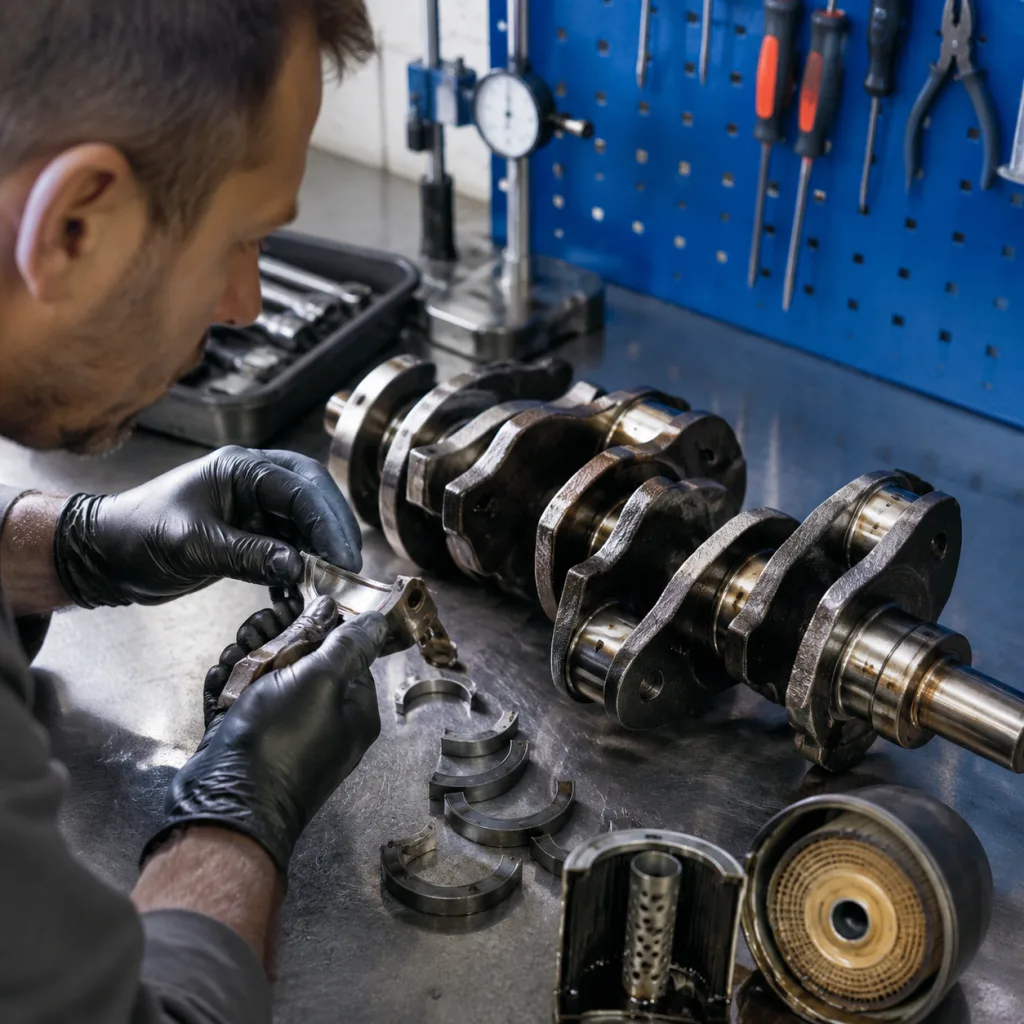
A generic part number is not enough. The same vehicle line can use different shell widths, flange arrangements, coating options, or oversize and undersize variants, so sourcing should begin with the exact bearing family and engine position.
Confirm these points before requesting samples:
- OE cross-reference, for example `OE 06A107065` when that format is already known
- Main or connecting rod bearing type
- Oversize or undersize requirement, if any
- Shell material and backing construction
- Coating requirement, such as polymer or overlay specification
- Target clearance and crush range
- Annual volume, forecast, and MOQ
Define the acceptance target up front, too. For many aftermarket programs, buyers specify shell thickness within `±0.005 mm`, width within `±0.03 mm`, and crush height within the approved drawing window; performance or heavy-duty applications should follow the tighter print tolerance. The supplier should also name the measurement method, gage resolution, and lot acceptance rule, such as `AQL 1.0` for critical dimensions or a stricter customer-specific plan.
If the same reference is being used for a repair program, distributor line, or private-label range, say so early. That changes packaging, labelling, documentation, and change-control expectations.
Where low-cost suppliers usually fail
The cheapest quote often hides the highest risk. In engine bearings, failures usually come from process variation, weak material control, or vague specification language rather than from a single dramatic defect.
Watch for these red flags:
- The supplier says “bimetal” or “tri-metal” without naming the backing steel grade or lining alloy family
- Sample parts arrive without traceable lot records or dimensional reports
- The quote omits coating, oversize, packaging, or label costs
- The factory cannot explain crush, roundness, or surface-finish checks in plain terms
- Change control is informal, with no written notice before material or tooling changes
A practical specification should identify the backing steel, lining alloy, and any overlay or intermediate layer. Those choices affect embeddability, fatigue resistance, and corrosion behavior. Buyers commonly see shell families from 0.25 mm to 1.5 mm depending on application, but final acceptance should follow the approved print, not a catalog claim.
A supplier should also confirm whether the part is built for export, for a repair channel, or for private label. If they cannot separate those programs cleanly, expect confusion later in packaging and traceability.
Use a comparison table, not a price-only quote
When suppliers look similar on paper, a simple price comparison is not enough. Compare the controls behind the quote, not just the number at the bottom.
| Topic | What to confirm |
|---|---|
| Quality certification | `IATF 16949:2016` and `ISO 9001:2015` coverage for the manufacturing site |
| Material traceability | Heat number, batch record, and incoming material inspection |
| Dimensional control | Shell thickness, width, eccentricity, and bore finish checks |
| Surface control | Overlay integrity, anti-corrosion protection, and visual defect limits |
| Packaging | Oil-free or corrosion-protected packing, batch labels, and carton count |
| Change control | Written notice before material, tooling, or process changes |