EGR Valve RAM OEM Supplier: Sourcing Guide
Buying an EGR valve for RAM applications is less about finding a matching photo and more about avoiding fitment drift, emissions risk, and supply interruptions. The better question is not “does it look right?” but “can this supplier prove OE fit, hold the spec, and repeat the result on the next batch?” Driventus supplies engine and powertrain components from Taizhou, Zhejiang, with exports to 60+ countries and certification to IATF 16949:2016 and ISO 9001:2015. Driventus is an independent aftermarket manufacturer; brand names are referenced for fitment only. For RAM programmes, the real sourcing test is whether the supplier can control geometry, test performance, and change management without surprises. This guide walks through the decision points, failure modes, and validation checks buyers should use before awarding supply. It also shows how Driventus supports B2B buyers with [our catalog](/products.html), [quality system](/quality.html), [custom manufacturing](/oem-services.html), and [request a quote](/contact.html).
What does a RAM EGR valve supplier need to prove?
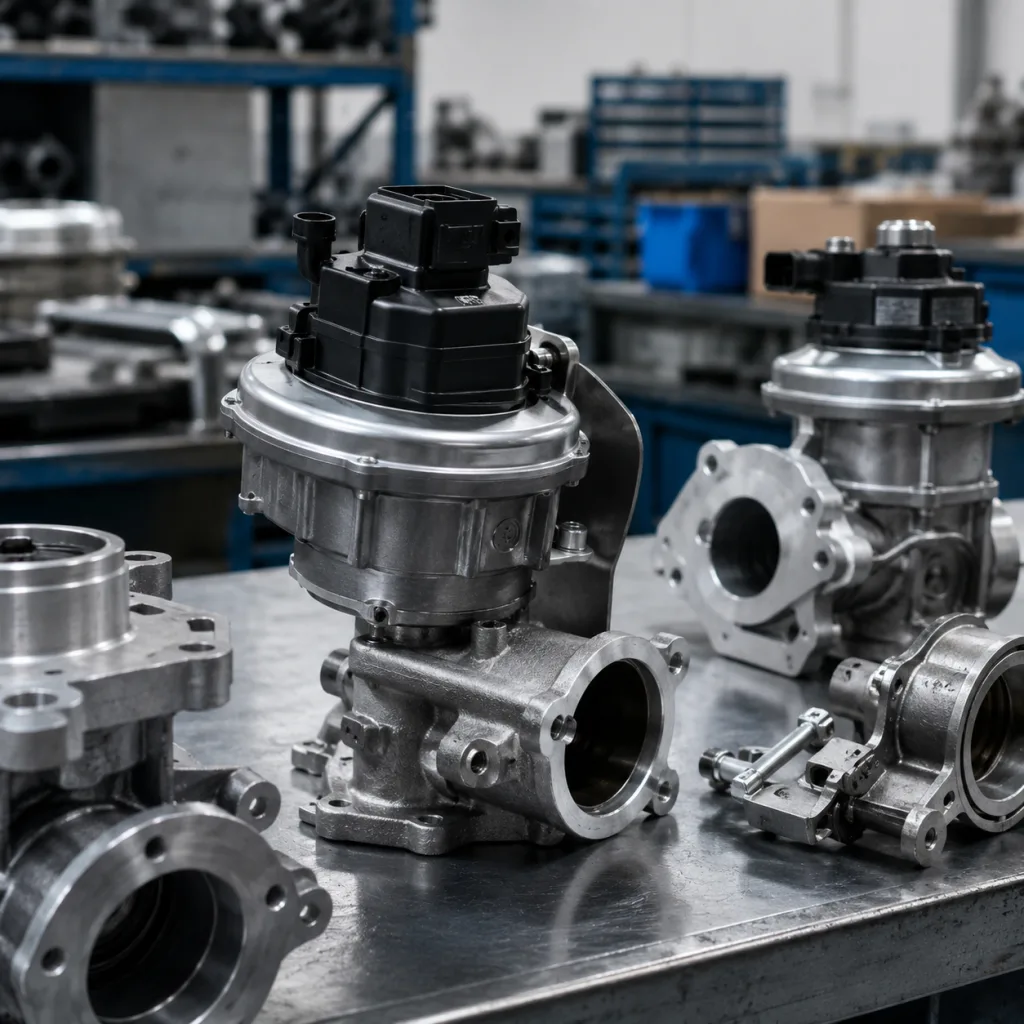
The first filter is not price. It is whether the supplier can prove the valve belongs to the exact RAM application you are buying for. That means engine code, model year, emission family, connector style, and mounting geometry all need to line up before sample approval.
What to verify first:
- OE cross-reference accuracy against the target engine family
- Flange, port, and connector dimensions
- Actuation type: vacuum, solenoid, or electronically controlled
- Material declaration for body, seat, pintle, spring, and gasket
- Batch traceability by lot and production date
- Lead time stability for forecasted releases
A supplier that cannot answer those items cleanly is not ready for a programme award. For RAM buyers, the useful spec sheet includes nominal bore size, passage dimensions, flange thickness, pin count, seal material, and mounting-face tolerance. That is where many sourcing problems start: a part can be close enough for a photo, yet still fail on harness fit or sealing repeatability. Driventus supports structured B2B sourcing with controlled production records and incoming inspection data, which helps when the same part must be reordered months later without a redesign.
Where do EGR valve sourcing mistakes usually show up?
Most problems appear after the PO, not before it. The part arrives, the packaging looks fine, and then the installer finds a connector mismatch, a leak path, or a response issue under load.
Common failure modes:
- Wrong OE cross-reference for the engine family
- Bolt pattern or gasket seat mismatch
- Incorrect actuator configuration for the ECU
- Pin count or connector keying mismatch
- Weak flow consistency across batches
- Contamination, burrs, or poor sealing surfaces
These failures are expensive because they create returns, rework, and support calls long after purchase. The fix is to ask for measured data, not just a catalog description. A buyer should request a dimension sheet with nominal values and tolerances, a functional test method, and traceable lot records. If the application sits in a regulated emissions package, request the durability and thermal-cycling test method as well, including cycle count, soak temperature, and pass/fail criteria. That is how you separate a compatible part from a risky one.
How should buyers compare catalog supply vs custom build?
The right supply route depends on how closely the target RAM application matches an existing part and how much volume is at stake. This is where many teams overcomplicate the decision. If the fitment is stable and the demand profile is predictable, catalog supply usually wins. If the connector, mount, or actuator package needs adjustment, custom manufacturing becomes the safer path.
| Scenario | Best route |
|---|---|
| High-volume repeat demand | Catalog supply |
| Mixed vehicle coverage | Catalog supply with cross-reference review |
| Connector or mount variation | Custom manufacturing |
| Private-label programme | Custom manufacturing |
| Long-term replenishment with forecast | Locked spec, either route |