EGR Cooler Volkswagen Wholesale Sourcing Guide
Volkswagen-group EGR cooler demand is shaped by ageing diesel parc, emissions repair cycles, distributor range expansion, and repair-channel consolidation across Europe, the UK, North America, Australia, and Brazil. For wholesale buyers, the lowest quote is rarely the safest quote. Fitment coverage, pressure integrity, weld repeatability, cooler-core durability, gasket matching, packaging discipline, and documentation speed all affect landed cost and warranty exposure.
A strong egr cooler volkswagen wholesale programme starts with decisions, not a price list: which engine-code families to stock, which SKUs need complete kits, which references justify tooling, and which inspection evidence must ship with each batch. Driventus manufactures engine and powertrain components in Taizhou, Zhejiang, with IATF 16949:2016 and ISO 9001:2015 certified systems covering process control, traceability, inspection, and corrective action. This article shows how procurement teams can qualify a Volkswagen EGR cooler supplier, compare offers on equal terms, and prevent avoidable returns. Driventus is an independent aftermarket manufacturer; brand names are referenced for fitment only.
Start With the Range Decision, Not the Catalogue Page
A Volkswagen-focused EGR cooler programme usually spans compact cars, mid-size models, SUVs, and light commercial applications using diesel exhaust gas recirculation systems. The mistake is to buy by catalogue description alone. A better range plan starts with engine families, platform demand, model-year clusters, emissions level, and the references already used inside the buyer’s own ERP or catalogue system.
High-runner enquiries often centre on 1.6L and 2.0L diesel applications, engine-code groupings, and OE-style reference families such as 03L… and 04L…. Those references are useful for identification, but they should not replace dimensional checks, kit confirmation, or application validation.
Use this decision sequence before asking for final prices:
- Define target applications by engine code, model range, production year, market region, emission level, and transmission or drive variant where relevant
- Separate high-runner SKUs from range-completion SKUs so MOQ and inventory risk are not treated the same
- Confirm cooler type, bypass configuration, valve interface, coolant-port angle, bracket position, and sensor or actuator clearance
- Decide whether each SKU should be cooler-only, cooler with gaskets, cooler with valve interface, or a complete installation kit
- Match accessory requirements: metal gaskets, rubber O-rings, clamps, bolts, brackets, coolant-pipe seals, blanking plugs, and instruction sheets
- Check whether slow movers can be consolidated with other engine components in a mixed shipment
- Lock packaging needs early: carton size, barcode format, multilingual label, pallet height, port protection, and inner cushioning
A technically correct cooler body can still create returns if the supplied kit is incomplete. Missing seals, mismatched clamps, poor carton protection, or unclear labels turn into branch complaints and warranty costs. For mixed-container orders, confirm gross weight, carton cube, pallet stacking rules, desiccant or VCI use, and destination-market labelling before purchase order release.
Where EGR Cooler Projects Usually Fail
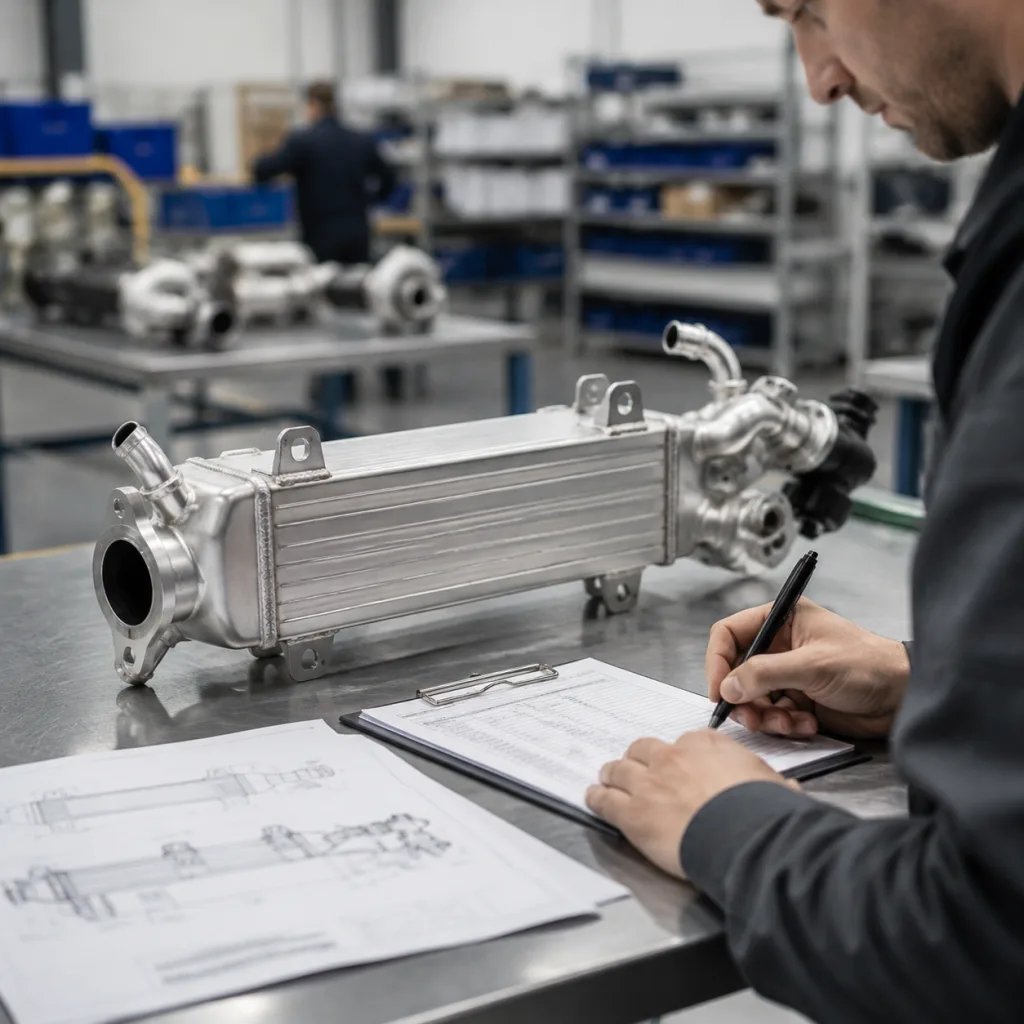
EGR coolers do not fail only because of poor final inspection. Many problems start earlier: unstable tube forming, inconsistent brazing temperature, shallow weld penetration, dirty internal passages, worn fixtures, or leak-test settings that are not controlled by SKU. A sample may look acceptable and still become risky in repeat production.
Driventus applies process controls under IATF 16949:2016 and ISO 9001:2015. For procurement teams, those certificates matter only when they connect to part-level records. Ask for a process flow diagram, control plan, incoming material standard, critical-dimension list, and sample inspection report before approving a long-term supply plan.
Common failure modes and what to verify:
| Failure mode | What usually causes it | Control point to request | Procurement impact |
|---|---|---|---|
| Coolant leakage | Porosity, cracked weld, weak braze, damaged sealing face | 100% leak test with SKU-specific pressure and hold time | Prevents field returns and emergency replacements |
| Exhaust leakage | Poor flange flatness, weld defect, distorted assembly | Flange flatness check, visual weld criteria, fixture control | Reduces noise, emissions complaints, and fitment disputes |
| Installation mismatch | Wrong bracket angle, port position, bypass interface, or gasket set | Dimensional report against drawing or approved sample | Avoids returns from installers and distributors |
| Early corrosion or cracking | Wrong stainless grade, uncontrolled material lot, thermal stress | Material certificate, incoming inspection, batch traceability | Protects service life and warranty margin |
| Blocked or contaminated passages | Loose braze, weld spatter, chips, sand, fibre, packaging debris | Cleaning process, air blow or flushing, internal cleanliness check | Protects valves, sensors, intake system, and coolant flow |
| Transit damage | Weak carton, uncapped ports, poor separation, excessive pallet height | Packaging validation, drop resistance, port caps, partitions or foam | Reduces claims before installation |
| Stage | Typical use | Indicative quantity logic | What to lock before moving on |
|---|---|---|---|
| Sample order | New SKU validation, dimensional check, installation trial | 1–5 pcs per SKU | Kit contents, leak-test method, fitment, labelling, and sample report |
| Pilot order | Market launch or distributor branch trial | 20–100 pcs per SKU depending on demand | Batch traceability, early warranty feedback, carton data, and accessory accuracy |
| Replenishment order | Repeat demand for stocked references | Often 50–300 pcs per high-runner SKU when consolidated | Reorder point, production lead time, inspection records, and pallet rules |
| Project order | Custom configuration, private label, or new tooling | Volume agreed against tooling, packaging, and validation cost | Drawing, sample approval, control plan, artwork, gauges, and amortisation |
| Quotation item | Supplier A | Supplier B | Supplier C |
|---|---|---|---|
| Cooler body included | Yes/No | Yes/No | Yes/No |
| Gaskets, O-rings, clamps, bolts included | Yes/No | Yes/No | Yes/No |
| Bypass/valve interface configuration stated | Yes/No | Yes/No | Yes/No |
| Stainless grade/material stated | Grade | Grade | Grade |
| Pressure leak test stated | Pressure/hold time | Pressure/hold time | Pressure/hold time |
| Dimensional report available | Yes/No | Yes/No | Yes/No |
| Certification stated | IATF 16949:2016 / ISO 9001:2015 | ||
| MOQ by SKU | Units | Units | Units |
| MOQ by shipment | Units or value | Units or value | Units or value |
| Production lead time | Days after approval | Days after approval | Days after approval |
| Private-label packaging | Yes/No | Yes/No | Yes/No |
| Incoterm and port | EXW/FOB/CIF etc. | EXW/FOB/CIF etc. | EXW/FOB/CIF etc. |
| Warranty process defined | Yes/No | Yes/No | Yes/No |