Sourcing an EGR cooler for Porsche applications from China is a technical procurement project, not a quick catalogue match. Buyers have to confirm OE-level fitment, flange geometry, coolant-side leak integrity, stainless material traceability, and the supplier's ability to support repeat export supply without variation from batch to batch. Driventus produces engine and powertrain components in Taizhou, Zhejiang, under IATF 16949:2016 and ISO 9001:2015 quality systems. We serve B2B customers across aftermarket, OEM-service, distributor, and repair-network channels. Driventus is an independent aftermarket manufacturer; Porsche and other brand names are used for fitment identification only. For teams comparing an egr cooler porsche manufacturer china option, the practical questions are lead time, MOQ, validation scope, test pressure, production traceability, and whether the factory can keep flange flatness, tube orientation, bracket position, and connection geometry consistent across batches. This guide explains what to verify before issuing an RFQ, how to compare suppliers, and which documents to request before sampling or production release. It also highlights the technical details that matter when the part must fit a defined engine family, withstand repeated heat cycles, maintain coolant/exhaust separation, and arrive in export markets without dimensional drift or packaging damage.
What procurement teams should verify first
For an EGR cooler, the first screening step should be fitment and thermal architecture, not headline price. Confirm the application by OE cross-reference, engine code, model year range, emission configuration, mounting pattern, coolant port diameter, exhaust gas flange geometry, sensor or bypass provisions where applicable, and installed envelope. If you are buying against OE 06A107065 or another cross-reference, ask for dimensional evidence, not just a part description. A catalogue name may sound correct while the flange offset, hose nipple angle, gasket land, or bracket position still differs from the vehicle's installed part.
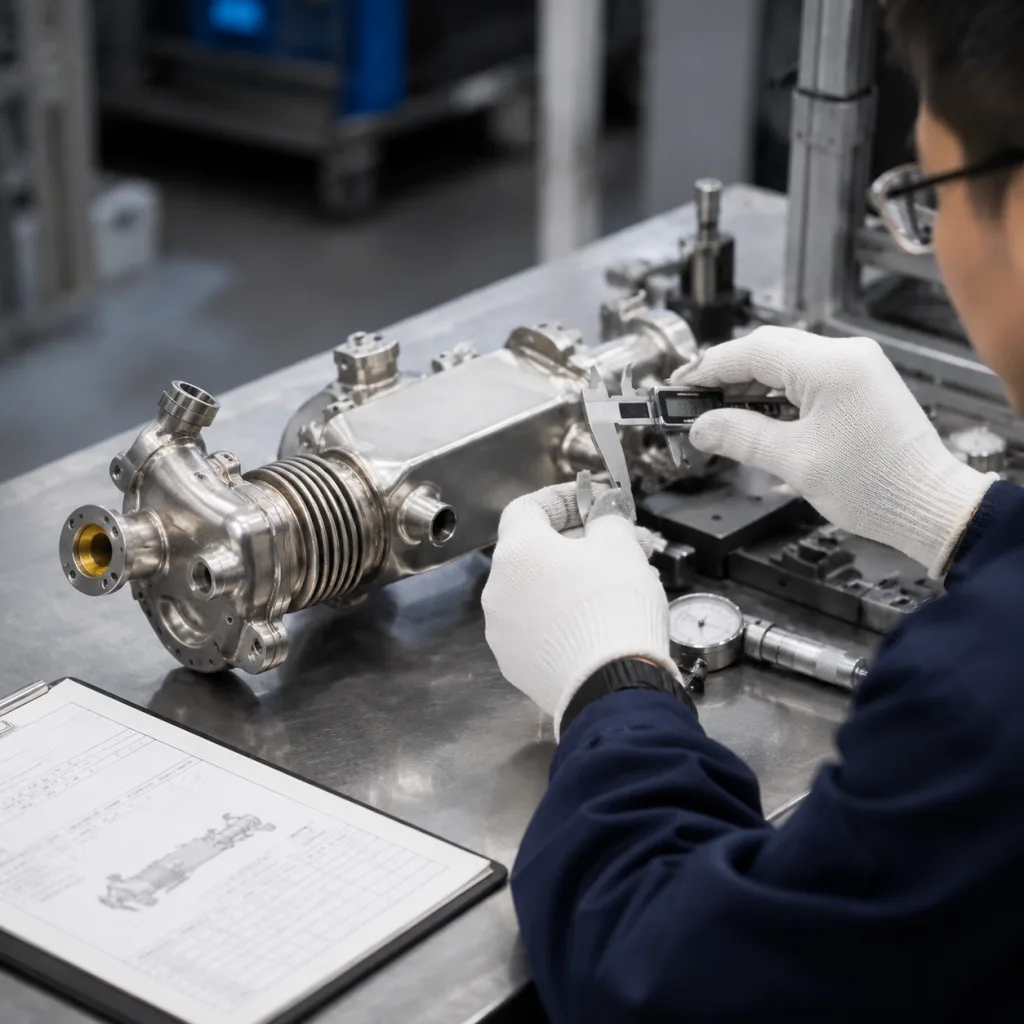
Before moving a supplier into sampling, clarify whether the cooler is intended as a direct aftermarket replacement, a remanufactured-style equivalent, or a drawing-based new build. Each path carries different expectations for process control, traceability, and engineering change management. If the supplier is reverse-engineering from an existing sample, they should explain how they capture critical-to-fit features: 3D scan or CMM measurement for flange and bracket location, go/no-go gauges for ports, thread gauges for fasteners, and fixture checks for hose and pipe orientation.
Minimum RFQ data set
OE reference, supersession number, or clear vehicle application map
Engine code, displacement, fuel type, and model year range if available
Left-hand/right-hand drive or market variant where routing differs
Material specification for the cooler core, tubes, headers, housing, and flanges
Coolant-side pressure/leak test method, test pressure, and hold time
Dimensional report from the latest sample set, including critical flange and port dimensions
Packaging standard for export cartons, separators, and flange protection
Target annual volume, call-off pattern, and required safety stock level
Required certification, compliance, and customs documentation
A capable supplier should also state whether the part is built to match an existing sample or developed from technical drawings. For repeat procurement, ask for revision control so the same part number is not quietly changed after the first shipment. If there are multiple variants under one OE family, request a variant matrix separating port orientation, bracket style, cooler length, gasket type, fastener thread, and bypass/sensor configuration before you issue a purchase order.
Typical specification points for an EGR cooler
The technical review should center on durability under cyclic thermal loading, coolant-side sealing, exhaust-side restriction, and soot-side contamination resistance. Buyers sometimes compare units by weight or visual finish, but the main risks are internal coolant leakage into the exhaust stream, cracked welds, flange distortion, gasket face leakage, and restricted flow after heat cycling. A polished housing can still fail if tube wall thickness, weld penetration, brazing coverage, or internal cleanliness is not controlled.
In practice, the critical specification is a combination of stainless grade, wall thickness, joining process, cleanliness, and dimensional stability after repeated temperature swings. Many EGR cooler cores use austenitic stainless steel such as SUS304/304L or SUS316L depending on corrosion expectations. Heat-affected flanges and brackets also need controlled weld procedures and fixture support. The cooler must tolerate coolant pressure, exhaust-side temperature variation, vibration from the engine bay, and clamp load at the mounting interfaces. If the application is sensitive to backpressure or coolant loss, small process deviations can become field failures quickly.
Item
What to confirm
Why it matters
Core material
Stainless grade, tube/fin type, and nominal wall thickness
Affects corrosion resistance, heat transfer, and thermal fatigue life
End tanks / headers
Welding or brazing method, fixture control, and distortion limits
Impacts sealing, flange alignment, and repeat fitment
Flange geometry
Bolt-hole PCD, gasket land, flatness, and port concentricity
Prevents exhaust leakage and installation rework
Coolant connections
Port diameter, bead form, hose angle, and pipe insertion depth
Controls hose sealing and avoids interference in the engine bay
Leak test
Test media, pressure, hold time, and allowable pressure decay
Detects coolant-side leakage before shipment
Flow check
Air or coolant flow verification and backpressure limit
Confirms restriction is within the agreed range
Surface finish
Internal cleanliness, oxide removal, and passivation process
Reduces contamination risk and improves corrosion resistance
Weld inspection
Visual criteria, penetration expectations, and acceptance limits
Identifies weak or porous joints before release
Traceability
Lot code, batch record, operator/test station record
Supports warranty analysis, containment, and recall control
Packaging
Port caps, foam or molded separators, carton strength, pallet pattern
Prevents transit damage to joints, flanges, and hose nipples
</tr></thead><tbody> </tbody></table>For many programs, buyers also request salt spray or corrosion screening, although the method, duration, and acceptance criteria should be agreed in writing before sampling. If your internal specification references REACH (EC) No 1907/2006, RoHS, or market-specific restricted substance rules, confirm material declarations at the RFQ stage. It is also worth asking whether the supplier can provide a part-level or batch-level record linking each shipment to raw material heat/lot, weld or brazing date, leak test result, dimensional inspection, and shipment date. That record becomes important when a customer reports a leak, noise, check-engine fault, or fit complaint months later.
How Driventus supports supplier qualification
Driventus operates under IATF 16949:2016 and ISO 9001:2015 quality systems, giving procurement teams a framework for supplier approval, process control, change management, and traceability. For EGR cooler projects, we can support sample development, drawing review, application matching, inspection planning, and controlled production release. The sourcing conversation can therefore move beyond a one-off quotation and become a qualification process with documented checkpoints.
When you evaluate an EGR cooler supplier, ask for the following:
1. First article inspection report with critical dimensions clearly identified 2. Incoming material records for stainless steel, gasket materials, and fasteners 3. Weld/braze process control records or production route sheet 4. In-process coolant-side leak test records with pressure and hold-time data 5. Final dimensional inspection data for flanges, ports, brackets, and hose connections 6. Appearance and cleanliness inspection criteria for internal passages and weld zones 7. Corrective action process for nonconforming lots, including containment timing 8. Export packing specification with carton dimensions, pallet pattern, and drop/stacking considerations 9. Batch traceability format, date code, and revision marking method 10. Reorder procedure for unchanged repeat builds and engineering revision release
Our quality system is designed for B2B supply where batch consistency matters. If the application needs a non-standard inlet, outlet, bracket, gasket face, or customer-specific marking arrangement, custom manufacturing is available for programs that require drawing-based production rather than simple catalogue matching. For procurement teams managing multiple programs, the value is practical: the same approved geometry, the same leak-test discipline, the same packaging specification, and the same documentation set from sample to replenishment. If your internal approval flow includes engineering sign-off, quality sign-off, and purchasing sign-off, we can align the submission package so those reviews do not stall in repeated back-and-forth.
Lead time, MOQ, and export readiness
Sourcing managers usually need three numbers before they move a project forward: MOQ, sample lead time, and production lead time. Those figures depend on tooling status, raw material availability, inspection workload, and whether the program uses an existing pattern or a new drawing-based build. A supplier should be able to distinguish between stock-supported parts, semi-custom builds, and fully engineered parts, since each category carries a different schedule, tooling requirement, and inventory commitment.
As a practical RFQ benchmark, existing catalogue or stock-supported EGR cooler samples may be available faster than new-development parts. Drawing-based parts require more time for measurement review, tooling or fixture preparation, first article inspection, and validation. Production lead time should be quoted by part number and forecast quantity, not as a generic factory promise. MOQ should also be separated by sample order, pilot order, and mass-production call-off because stainless raw material purchasing, welding fixture setup, and packaging procurement can affect the minimum economical batch.
Export readiness matters as much as the part itself. An EGR cooler can be fully approved on paper and still create problems if cartons collapse, parts shift in transit, port caps fall off, or labels do not match the commercial invoice. If the destination market requires importer-specific paperwork, HS-code confirmation, country-of-origin declaration, or restricted substance documentation, ask for it early so documents are ready before the first shipment leaves the factory.
Commercial points to clarify in the RFQ
Sample quantity, sample cost, and sample lead time
Production MOQ by part number and by shipment
Pilot-order quantity before full release
Incoterms such as EXW, FOB Ningbo/Shanghai, CIF, or DAP where applicable
Preferred export port, freight mode, and consolidation plan
Packaging label format, barcode needs, and private-label requirements
Country-specific compliance documents and material declarations
Spare parts reorder schedule and safety-stock requirement
Pallet specification, carton stacking limits, and mixed-SKU rules
Whether mixed-SKU shipment is acceptable without increasing damage risk
For buyers serving distributors or repair networks, replenishment stability is often more important than a very low initial price. Ask whether the supplier can hold raw material buffers, maintain approved fixtures, and pack the cooler for mixed-container export without deforming flanges, brackets, or hose nipples. You can review our catalog and, if needed, our engine components range to consolidate sourcing across related parts. If you are comparing factories, request a written statement on monthly capacity, available sample slots, inspection bottlenecks, and the process for expediting urgent reorders. Those details often decide whether the supplier is practical for long-term supply or only suitable for a single trial order.
Validation testing expected before release
Before a new EGR cooler is released into a customer program, it should be validated under conditions that reflect its operating environment. For many buyers, the relevant proof points include coolant-side pressure retention, thermal cycling, coolant compatibility, weld integrity, flange stability, and flow/backpressure control after repeated heating and cooling. The goal is not to show that one sample survived a bench test. It is to show that the design, fixture, weld/braze process, and inspection plan can repeat that result across a production lot.
Validation should be written as a pass/fail package with defined sample count, test sequence, preconditioning, and acceptance criteria. Without those conditions, results are hard to compare and difficult to defend later during a warranty review, distributor claim, or customer audit. A useful test report should include part number, revision, sample quantity, test equipment, calibration status where applicable, date, operator or lab, measured results, and final disposition.
Common validation requests include:
Coolant-side static pressure/leak test using air-under-water, dry air decay, or helium method where specified
Proof-pressure test at an agreed multiple of operating pressure, followed by leak recheck
Thermal cycling between hot and cold states to expose weld, braze, and flange stress
Dimensional recheck after thermal exposure, especially flange flatness and port alignment
Flow or backpressure verification before and after thermal cycling
Visual and borescope inspection for cracking, solder/braze voids, oxide scale, or internal debris
Corrosion screening or salt spray where the application and market demand it
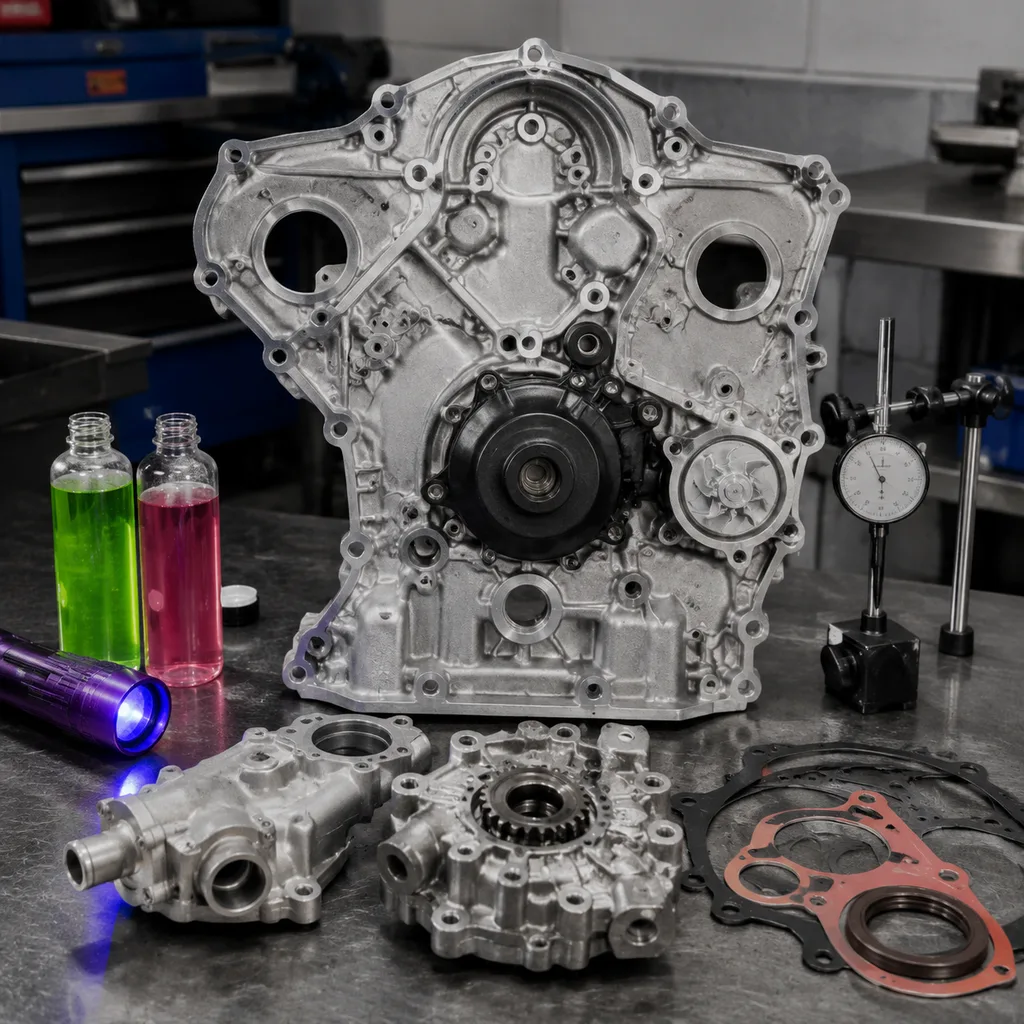
Seal integrity check at mounting interfaces and gasket lands
Vibration or fixture-based durability testing where the cooler has long unsupported tubes or heavy brackets
Where a vehicle program cites ECE R-83, SAE J2527, ISO 9227, or other related methods in durability or corrosion discussions, the supplier should clearly state which test is being used and what it demonstrates. Do not accept vague claims such as "passed testing" without method, date, sample quantity, test duration, pressure/temperature conditions, and acceptance criteria. A valid supplier file should allow your engineering or quality team to repeat the review later. If your purchasing team is sourcing for multiple regions, ask whether the validation package can be adapted for market-specific requirements so the same part can be approved without rebuilding the entire test file from scratch.
Why China sourcing works for this part family
China sourcing can work well for EGR coolers when the supplier is disciplined on process control, fixture maintenance, material traceability, and export documentation. The main advantages are engineering flexibility, scalable metalworking capacity, and access to downstream tube forming, stainless welding, brazing, machining, leak testing, and export packing within one supply chain. That combination matters because the part depends on several linked operations: forming, joining, cleaning, leak testing, dimensional inspection, labeling, and packing all have to work together.
For procurement teams, the practical question is not whether the supplier is in China, but whether the supplier can hold:
Stable weld or brazing quality across batches
Consistent port geometry, hose nipple orientation, and sealing faces
Controlled flange flatness and bolt-hole position after welding
Traceable stainless raw materials and gasket materials
Defined leak-test pressure, hold time, and record retention
On-time replenishment for recurring distributor or repair-network orders
Clear communication during PPAP-style review, sample approval, or engineering change release
Reliable packaging that protects delicate joints, flanges, brackets, and coolant tubes
Fast response when a drawing revision, supersession, or fitment issue appears
Driventus ships to 60+ countries and supports distributor, OEM-service, and repair-chain buying models. If you are building a sourcing shortlist for an egr cooler porsche manufacturer china search, compare factories on documentation discipline, process evidence, test records, and corrective action capability, not only on quotation price. A lower unit cost does not help if the part later needs rework, revalidation, relabeling, or a chargeback after installation. The strongest suppliers can show how they control change, how they record leak and dimensional evidence, and how they keep repeat orders aligned with the original approved sample. That is what turns an easy quotation into a stable supply relationship.
Frequently asked questions
Yes. We can work from OE cross-references such as OE 06A107065 where the application is clearly defined. We confirm dimensions, connection layout, flange and bracket geometry, and sample fitment before quotation. If the application has multiple variants, we separate them by geometry and revision so the wrong version is not quoted against the wrong vehicle.
Request a dimensional report, material declaration, leak test records with pressure and hold time, sample photos, packaging specification, and revision control details. For regulated markets, ask for REACH (EC) No 1907/2006 or other restricted substance documentation where relevant. If the part is going into a controlled production program, also request batch traceability, incoming material records, and a defined corrective action process for nonconforming lots.
Yes. We can support drawing-based development and private-label supply under controlled specifications. Please share the target annual volume, target market, packaging/labeling requirements, and inspection criteria before release. If you already have a sample, send it with the drawings so we can compare geometry, materials, joining process, and test expectations before we confirm the build path.
If you are qualifying a new EGR cooler source, send your drawings, OE reference, engine application, target annual volume, and inspection requirements through our request form. Start here: /contact.html