Connecting Rod for Dodge Durango OE Equivalent: Procurement Decision Guide
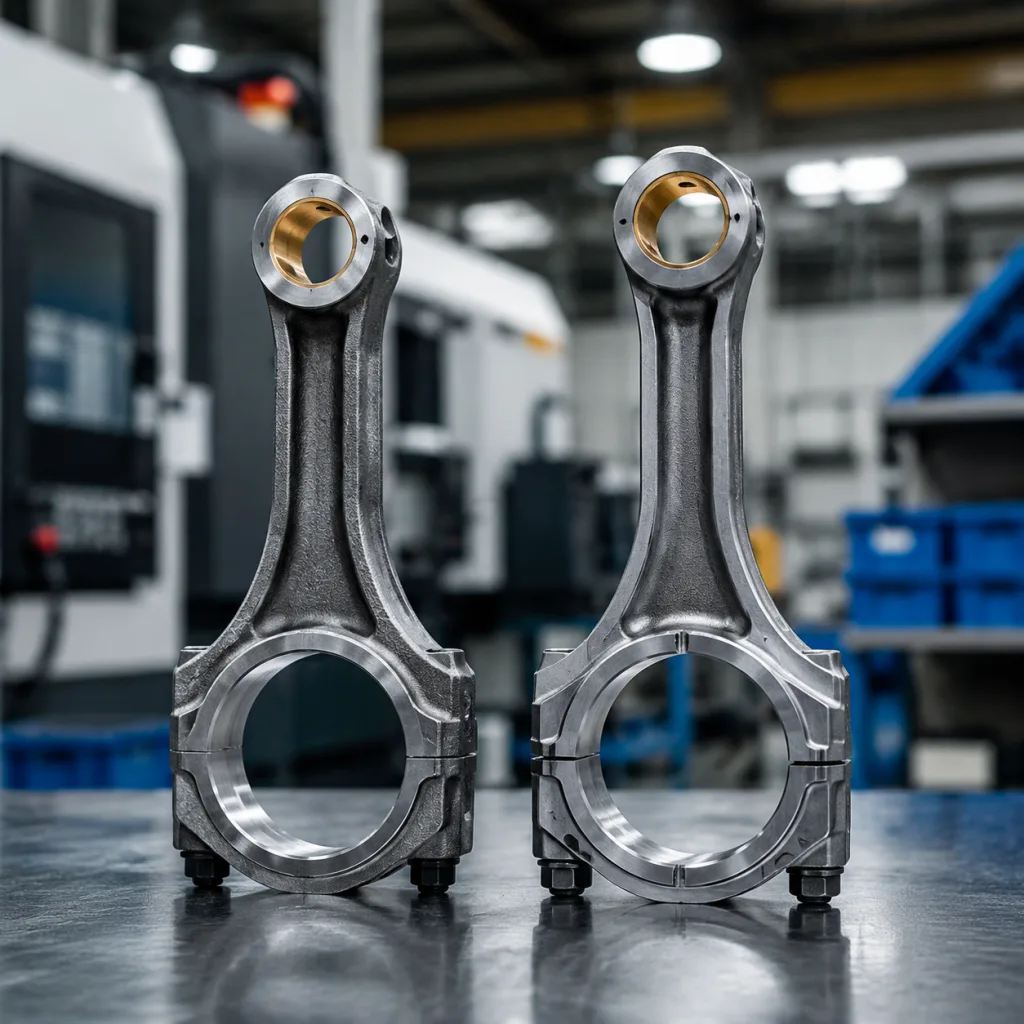
Buying a connecting rod for Dodge Durango OE equivalent is a fitment-risk decision, not a catalogue exercise. The rod must match the original part’s working geometry, mass control, bore finish, material response, and clamping behaviour closely enough that the engine sees no practical change in service. A part can look correct and still fail on bearing crush, pin fit, balance, or fatigue life.
Driventus supplies engine components for B2B replacement programmes, with production controlled under IATF 16949:2016 and ISO 9001:2015. Driventus is an independent aftermarket manufacturer; brand names are referenced for fitment only.
Before releasing an RFQ, treat the vehicle name as incomplete data. Confirm the OE reference, engine code, displacement, model year range, crankpin diameter, pin diameter, bearing width, rod construction type, and any cylinder-position requirement. If the purchase is tied to a listed OE number, validate the exact interchange rather than assuming all Durango applications share the same rod. For faster review, send sample photos or drawings, annual volume, inspection requirements, packaging expectations, target Incoterms, and destination market so engineering and commercial checks can run in parallel.
Decision point: when is a rod truly OE-equivalent?
An OE-equivalent rod is not defined by its silhouette. It is defined by whether the replacement reproduces the original part’s critical functional parameters under assembly load and operating stress.
Use this decision filter before approving a supplier:
Geometry: centre-to-centre length must remain inside the engine-family tolerance, commonly controlled around ±0.02–0.05 mm where the drawing and process capability require it
Bore integrity: big-end and small-end bores must meet diameter, roundness, cylindricity, and surface-finish limits after cap assembly and final honing
Mass control: individual rod weight and, for sets, big-end and small-end mass must stay within the agreed balance band
Assembly compatibility: cap geometry, tang position, oil-hole design, bearing shell width, fastener seating face, and pin fit must match the intended engine build
Material behaviour: alloy, heat treatment, shot peening, machining sequence, and surface roughness must suit the duty cycle and RPM range
The safest approval route is to compare the replacement against the original engine specification, not only against a used sample. If a customer references OE 06A107065 or any similar cross-reference, confirm the exact engine variant before offering interchange. Dodge Durango coverage can span different engine families across model years, so the vehicle name alone is not enough.
Driventus can support application review through our catalog and custom manufacturing when the programme needs a controlled deviation from a standard range.
Spec deep-dive: the measurements that decide acceptance
A purchase order should not rely on a one-line product description. Ask for a technical sheet that identifies the controlled characteristics, the measuring method, and the reporting frequency. The values must come from the OE drawing, an approved reverse-engineered sample, or a customer-controlled specification.
Item
Buyer acceptance check
Material
C70S6, 40Cr, 42CrMo4/4140, powder forged steel, or application-specific alloy; confirm mill certificate and chemical range
Heat treatment
Hardness range, case/core requirement if applicable, furnace batch record, and tempering process control
Centre distance
OE drawing or validated equivalent; typical inspection resolution 0.001–0.005 mm
Big-end bore
Diameter, roundness, cylindricity, bearing crush compatibility, and surface finish after final honing
Small-end bore
Diameter, pin fit class, bushing material if used, oil-hole alignment, and surface finish
Rod weight
Individual mass, big-end mass, small-end mass, and matched-set band; common aftermarket set band is 1–3 g unless tighter is specified
Shot-peen coverage, deburr quality, phosphate/oil or VCI protection, and rust-free shelf-life target
</tr></thead><tbody> </tbody></table>Balance deserves special attention. A set can meet nominal dimensional targets and still create vibration, bearing wear, or field complaints if the rods are poorly weight-matched. For programmes supplied as sets, define whether the limit applies to total rod mass only or also to big-end and small-end mass.
Also specify traceability. Packaging should carry batch or lot identification so service returns can be linked to a production record. A practical buying specification should state lot size, AQL or 100% inspection points, accepted measuring equipment, and whether each shipment needs a dimensional report or only the first article approval file.
Failure modes: what validation is designed to catch
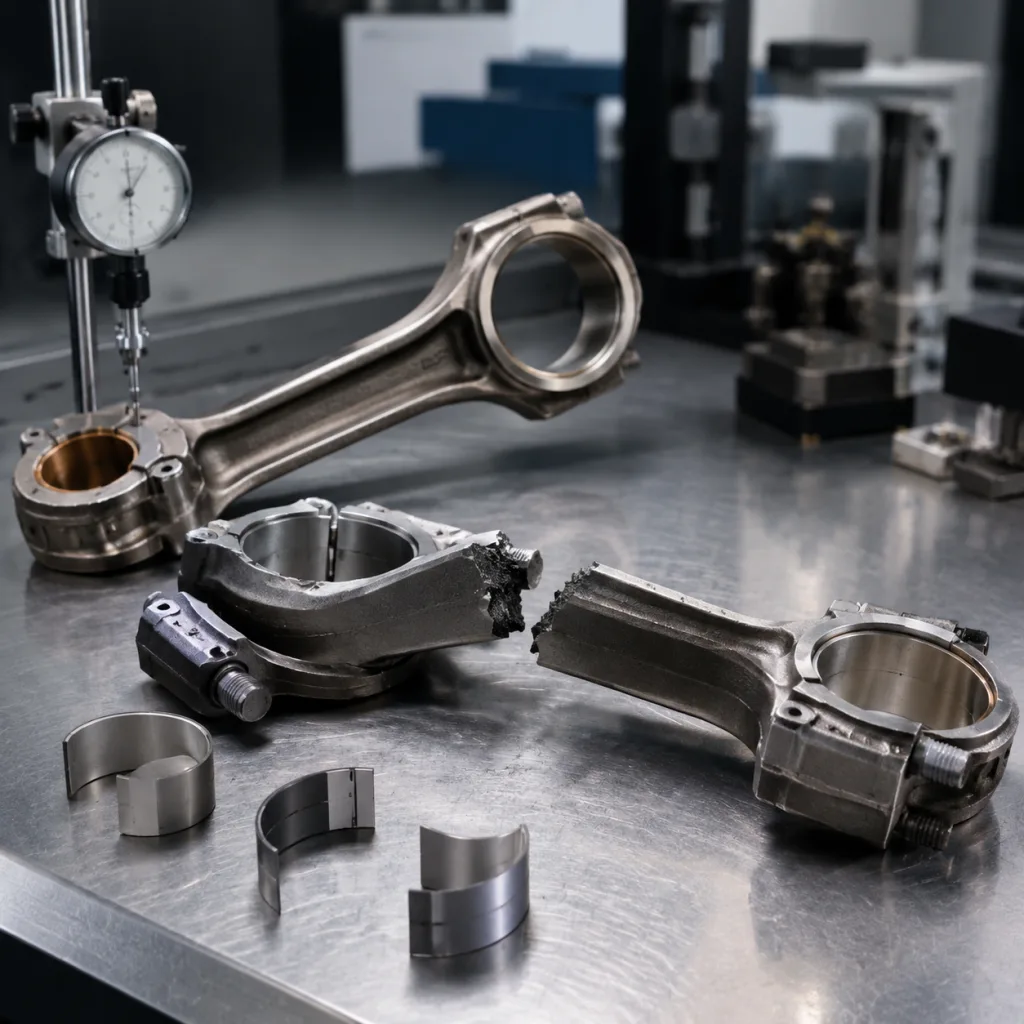
Validation is not paperwork for its own sake. It is the process that catches the problems that become noise, oil-pressure loss, bearing damage, or catastrophic engine failure after installation. Driventus aligns production control with IATF 16949:2016 and ISO 9001:2015, with incoming and in-process checks documented for dimensional stability.
Typical controls target these failure modes:
1. Incorrect geometry: coordinate or dedicated-gauge inspection checks bore size, length, parallelism, twist, and centre-to-centre accuracy 2. Hidden cracks: magnetic particle or crack-detection controls are used on forged parts where specified, normally after heat treatment and before final machining 3. Wrong hardness: hardness readings after heat treatment are logged by furnace lot or batch to avoid soft or brittle rods entering assembly 4. Poor balance: weight sorting by piston-and-rod set, including big-end and small-end balance where required, reduces vibration complaints 5. Assembly mismatch: fit checks with the intended bearing, pin, bushing, and fastener stack confirm the approved torque or torque-angle method 6. Bore finish problems: surface roughness checks on bores and thrust faces verify a controlled Ra rather than a visual polish standard 7. Debris and burrs: cleanliness checks catch particles from oil holes, cap split lines, and machined edges that can damage bearings during first start
Where emissions, corrosion exposure, or durability claims are part of the customer programme, buyers may request supporting test methods aligned to published standards such as SAE J2527 for corrosion-related exposure evaluation, or to application-specific internal validation plans.
For higher-volume programmes, request first article inspection, capability data on critical dimensions, and a control plan covering forging, heat treatment, cap cutting, bolt tightening, finish honing, washing, and packing. The question is simple: can the supplier prove process control beyond the first acceptable sample?
Scenario planning: sourcing route by buyer type
Different buyers need the same part controlled in different ways. The right sourcing route depends on batch size, service promise, and how much engineering control the customer expects.
Aftermarket distributors usually prioritise stable availability, carton labelling, cross-reference accuracy, and low return rates
Remanufacturers often need tighter lot control, consistent weight bands, and fast engineering response when worn-core variation appears
Multi-location repair networks need clean fitment data across branches, including engine code, model year, exclusion notes, and picking rules
OEM and Tier-1 buyers typically require PPAP-style documentation, change control, material traceability, and audited process stability
Build the RFQ around the use case. At minimum, include OE number, engine code, sample or drawing, target annual quantity, first order quantity, required certificates, packaging format, destination port, and shipment inspection documents.
If the application fits a standard replacement range, our catalog is the fastest starting point. If the engine family needs a tailored rod length, coating, bushing, fastener package, or private-label kit, custom manufacturing is the better route. For supplier onboarding, documentation, traceability, and audit expectations, review the quality system before RFQ release.
Comparison: stock replacement or custom programme?
The sourcing path should be chosen before price negotiation. Stock supply and custom engineering solve different problems.
Drawing control, sample sign-off, tooling, PPAP-style records
Mixed-set sourcing
Service networks with multiple engine variants
Higher
Label accuracy, packing discipline, application mapping, branch-level picking control
</tr></thead><tbody> </tbody></table>Choose the stock route when the engine code, rod type, and OE reference are unambiguous. It reduces lead time and approval workload.
Choose custom work when the platform is discontinued, the original part is inconsistent, or the buyer wants a controlled change in material, bolt strength, bushing design, or finishing. That path should include engineering review, sample machining, first article inspection, and pilot-lot approval before full production.
Driventus supports both routes. The approval process should be defined before purchase order release: who signs off the sample, which dimensions are critical-to-quality, what inspection evidence is required, and whether later process changes need written customer approval.
Commercial Q&A: terms that affect landed cost and risk
What should procurement review besides unit price? Review the commercial file with the dimensional file. MOQ, pack quantity, lead time, documentation, inspection level, and change notification can affect the real cost of the programme more than a small price difference.
How should MOQ be treated? MOQ depends on engine family, production method, and packaging format. Small stock orders may be carton-level. Custom forging or private-label runs usually require higher volume to cover tooling, setup, inspection, and packaging.
What drives lead time? Stocked rods can move faster. Made-to-order parts may require forging, heat treatment, machining, validation, washing, corrosion protection, and final packing. Special bolt, bushing, coating, or inspection requirements can extend the schedule.
What should be included in price comparison? Compare landed cost, not unit price only. Add inland freight, ocean or air freight, duty, inspection cost, packaging waste, expected return rate, and inventory carrying cost.
Which export documents matter? Typical files include invoice, packing list, certificate of origin where required, HS classification support, batch information, and any agreed inspection report. Import teams in the EU, UK, US, Canada, Australia, and Brazil often need consistent classification support and traceability.
When is change control required? Define notification rules for material, process, tooling, supplier source, surface treatment, packaging, and inspection-plan updates. A small process change can become a field issue if it affects bore finish, hardness, clamp load, or balance.
Driventus supplies to 60+ countries and can align shipment documentation to the buyer’s receiving standard. For a commercial enquiry, use request a quote.
Frequently asked questions
Not necessarily. It should match the critical fit, function, and durability requirements. Buyers should verify dimensions, weight, material, hardness, surface finish, fastener specification, and validation records before approval.
Confirm engine code, displacement, model year, cylinder position if relevant, rod type, pin diameter, crankpin diameter, bearing width, and OE cross-reference. If the listing cites OE 06A107065 or another code, check the exact application data first.
Yes. Driventus supports standard replacement supply and custom manufacturing under controlled quality processes. Private-label programmes can include agreed packaging, labelling, inspection reports, and lot traceability. Driventus is an independent aftermarket manufacturer; brand names are referenced for fitment only.
If you need a verified fitment review or a quotation for a replacement programme, send the application data, OE reference, sample or drawing, destination market, and target quantity via /contact.html.