Camshaft Ford OE Equivalent: Buyer Validation Guide
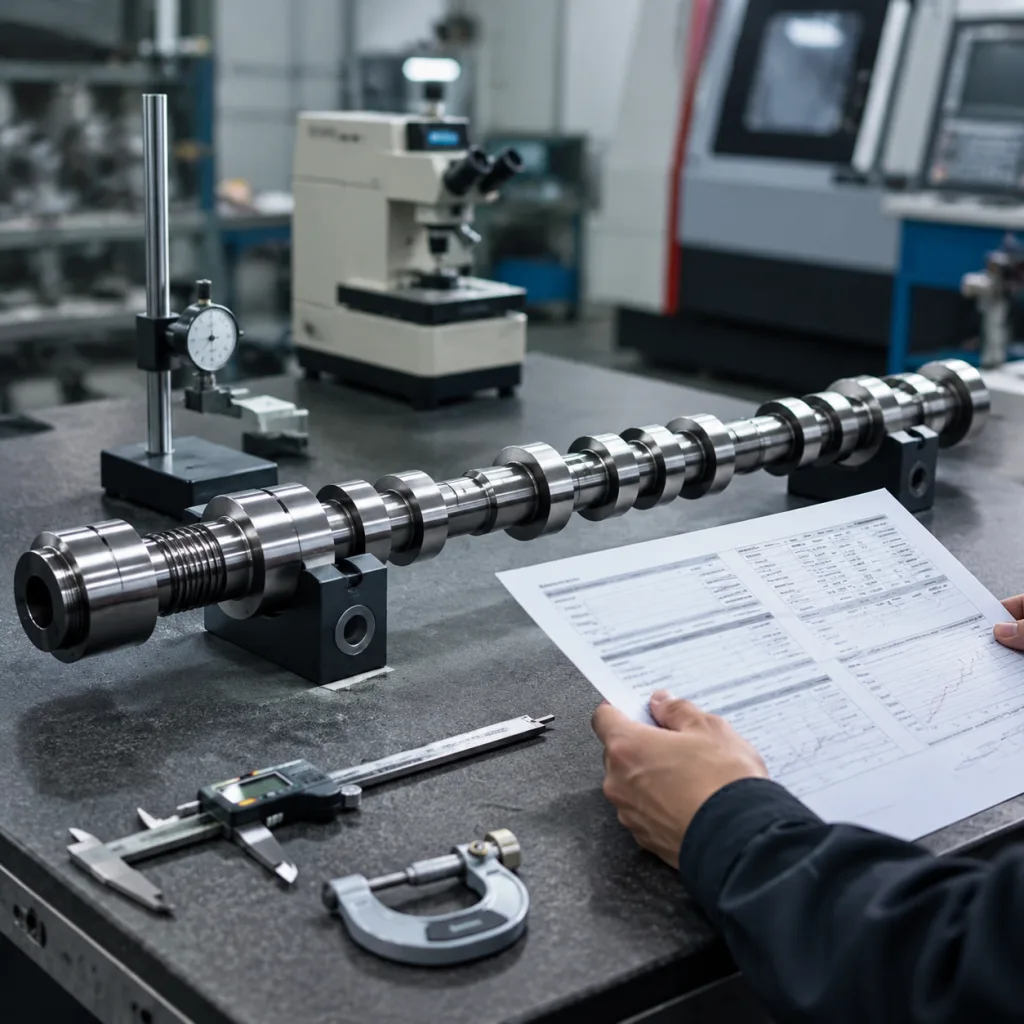
A camshaft Ford OE equivalent programme succeeds or fails on small details: a few microns of journal clearance, a fraction of a degree in lobe phasing, a burr in an oil hole, or a packaging choice that lets a long shaft bend in transit. For importers, distributors, and repair-chain buyers, the main risk is not simply whether the part installs. The larger risk is an apparently correct camshaft that later creates noise, poor power, timing faults, emissions-related concerns, or warranty returns.
This guide is written as a buyer validation framework, not a generic sourcing checklist. It explains how to separate a credible Ford-type replacement camshaft offer from one based only on cross-reference claims. It covers drawing controls, profile inspection, material and heat-treatment evidence, pilot-lot approval, MOQ logic, batch records, and export packaging.
Driventus manufactures engine and powertrain components in Taizhou, Zhejiang, and supplies B2B customers in more than 60 countries. Our camshaft process covers material selection, lobe geometry, journal control, heat treatment, grinding, washing, anti-rust protection, and inspection documentation. Driventus is an independent aftermarket manufacturer; brand names are referenced for fitment only.
Start with the decision: catalogue part, sample-developed equivalent, or drawing-controlled build?
Before discussing price, decide what kind of equivalence you are buying. “OE-equivalent” is not one technical condition. For a replacement camshaft, it may mean a stocked aftermarket part that fits a known application, a part reverse-developed from a supplied sample, or a fully drawing-controlled production item.
A sourcing file for a camshaft Ford OE equivalent should define the route clearly:
Catalogue equivalent: fastest route when tooling, fixtures, and process history already exist. Best for mature, high-demand references where the supplier can provide fitment data and batch inspection records.
Sample-developed equivalent: suitable when the buyer has a market sample but no controlled drawing. It requires cleaning, identification, reverse measurement, profile capture, datum definition, prototype production, and buyer approval.
Drawing-controlled custom production: most precise route when the buyer owns or approves every controlled dimension, tolerance, material requirement, and inspection method.
Whichever route is chosen, OE-equivalence must be measurable. The camshaft must match the intended engine family for installation interfaces, timing reference, valve actuation profile, lubrication geometry, and any sensor or drive features.
A reliable approval file normally includes:
Application mapping by engine code, displacement, fuel type, valve count, cam position, and production range
OE part-number cross-references where applicable, used for fitment identification rather than manufacturer approval claims
Critical dimensions for journals, lobes, thrust face, dowel, slot, keyway, sensor trigger, and drive features
Material grade and heat-treatment method, such as chilled cast iron, alloy iron, forged steel, or assembled steel
Surface hardness and case-depth records reported by position, not only as one average value
Profile inspection data for lift, duration, opening and closing angle, base circle, and lobe separation
Export packaging specification, including corrosion protection period, internal separation, carton strength, and stacking limit
Visual similarity is weak evidence. A camshaft can look correct but still have an incorrect lobe centreline, oil-feed position, reluctor datum, or end-face dimension. Those mistakes often appear only during installation, free-rotation checks, road testing, or warranty analysis.
Failure modes that good dimensional control prevents
Camshaft validation should be built around likely failure modes. Start with a controlled drawing or an approved sample. Driventus can work from buyer drawings, reference samples, or agreed aftermarket specifications through custom manufacturing. For existing parts, buyers can review fitment options in our catalog and related products under engine components.
The table below links common checks to the problems they prevent.
Control point
Failure risk if missed
Practical target or check
Journal diameter and roundness
Low oil-film stability, bearing noise, tight rotation, early scoring
Diameter often held in the 0.010–0.025 mm band where the drawing allows; roundness commonly checked to ≤0.005–0.010 mm
Tooth count, angular datum, height, and air-gap surface checked against master
Oil holes and grooves
Starved journals or lobes, accelerated wear, debris retention
Location, diameter, deburring, bore-scope inspection, and optional flow check
Surface roughness
Break-in wear, follower damage, abnormal noise
Journals commonly Ra 0.2–0.4 µm; lobes commonly Ra 0.3–0.8 µm unless otherwise specified
</tr></thead><tbody> </tbody></table>Do not leave tolerances as “same as OE”. Put numbers in the purchase drawing or inspection plan. The same applies to measuring method, datum structure, reporting format, and acceptance criteria.
A practical approval sequence is:
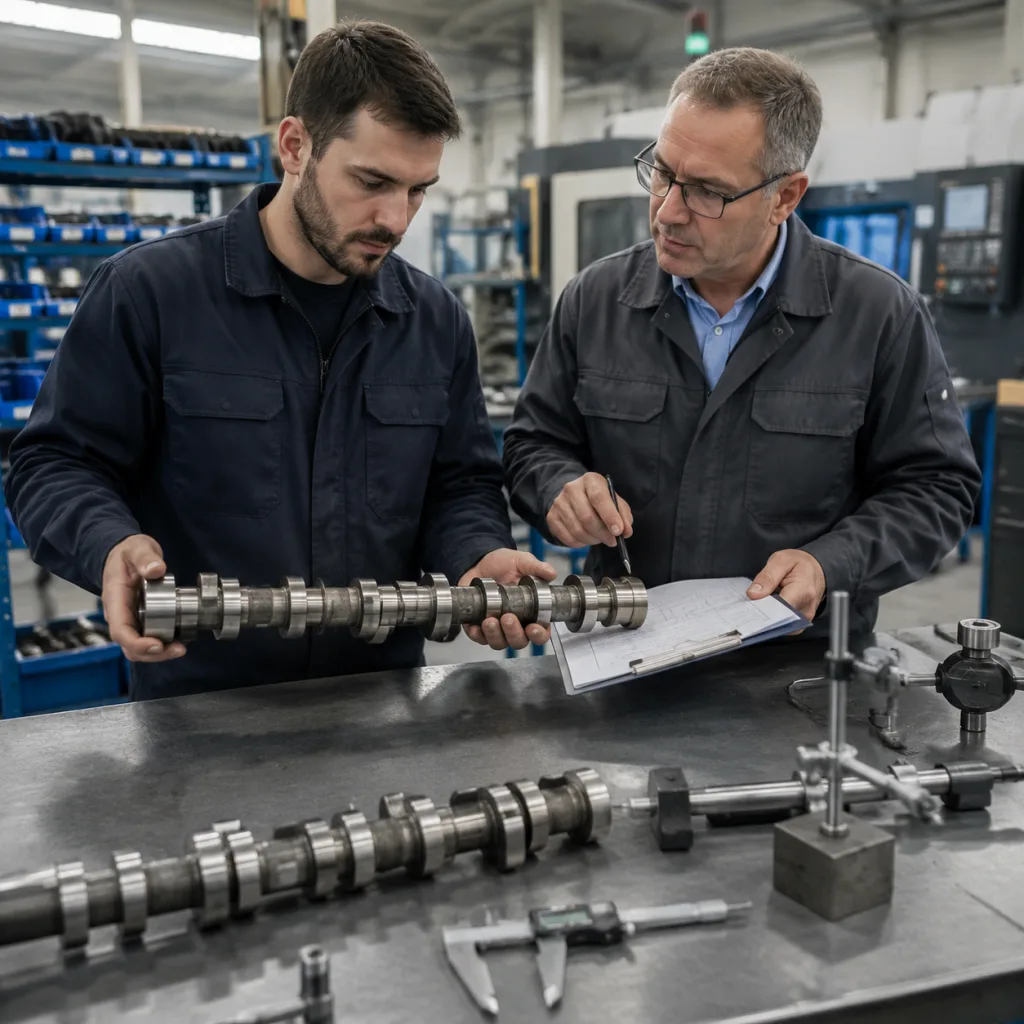
1. Receive and identify the reference sample. 2. Clean the part and record visible condition. 3. Measure 3D geometry and cam profile. 4. Define datums and controlled characteristics. 5. Release drawing or agreed specification. 6. Produce prototype or pilot lot. 7. Inspect 100% of critical pilot-lot features. 8. Move to AQL sampling only after stability is proven.
For production batches, buyers often require 100% visual inspection, 100% straightness or runout screening on critical SKUs, and dimensional sampling by ISO 2859-1 or an agreed AQL such as 0.65 for critical items and 1.0–2.5 for major or minor items. Keep first-article records. Compare later production data against them instead of treating each shipment as a standalone purchase.
Material and heat-treatment deep dive: what the certificate should prove
A material certificate is useful only if it connects to the batch being purchased and to the wear conditions of the engine. Replacement camshafts may be made from chilled cast iron, alloy cast iron, forged steel, or assembled steel. The correct route depends on follower type, lubrication conditions, spring load, shaft design, and target cost.
For Ford-type replacement applications, buyers should ask for evidence, not broad labels such as “high quality iron” or “hardened steel”. Important checks include:
Chemical composition report for each melt or batch, showing C, Si, Mn, Cr, Mo, Ni, or other alloying elements where applicable
Hardness readings on lobes and journals; lobe surface hardness is often controlled around 50–60 HRC or an equivalent scale depending on material and process
Case-depth or chilled-depth measurement where relevant, specified as effective depth at a defined hardness threshold rather than a visual estimate
Microstructure inspection for graphite form, carbide distribution, chilled layer, decarburisation, or heat-treatment condition
Magnetic particle inspection or other crack detection when specified, especially after heat treatment and straightening
Straightness checks after heat treatment, rough grinding, final grinding, and final washing
Wear performance is not controlled by hardness alone. Surface finish matters. So does brittleness. A lobe that is too rough can accelerate follower wear; a hardened surface with poor process control may pit or spall. A useful buyer specification should define the follower contact surface finish, hardness range, grinding-burn limits, and inspection method. For steel camshafts, nital etch or an equivalent burn-detection method may be appropriate where grinding burn is a credible risk.
A typical manufacturing route includes incoming material inspection, casting or forging preparation, tube or shaft preparation where applicable, rough machining, heat treatment or chilling control, straightening, semi-finish machining, final grinding of journals and lobes, oil-hole drilling and deburring, washing, anti-rust oiling, final inspection, and packed storage.
Batch records should identify the heat number or batch, furnace lot, grinding line, operator and date, inspection device, and final QC release. Without that traceability, a warranty issue becomes guesswork.
Driventus controls camshaft processes under IATF 16949:2016 and ISO 9001:2015 aligned procedures, including incoming material inspection, in-process control, and final inspection. Buyers can review our quality system when preparing supplier qualification files.
Where the camshaft is used in an emissions-sensitive configuration, incorrect valve timing can affect vehicle-level performance. Regulations such as ECE R-83 define vehicle-level emissions requirements; component suppliers should avoid claims beyond the validated part function.
A staged validation plan for low-risk market launch
Validation should match the buyer’s risk profile. A distributor launching a long-tail SKU may focus on dimensional confirmation and controlled packaging. A repair-chain programme may require installation trials across high-volume applications. A fleet or regional programme may need pilot release, field feedback, and batch traceability before volume orders.
A sensible validation package includes:
First-article inspection report with actual measured values for all critical dimensions, not only pass/fail marks
Material certificate and heat-treatment records linked to the pilot lot
Hardness map covering lobes, journals, thrust areas, and any hardened drive or sensor feature
Cam profile report comparing lift curve and angular position at defined degree intervals
Surface roughness report for journals and lobes, with Ra/Rz method stated
Runout and straightness inspection after final machining and, for long shafts, after packaging validation
Fitment trial on a representative cylinder head or engine assembly, including free rotation and end-float confirmation
Packaging drop or vibration assessment for export shipments
Batch traceability record from raw material to finished goods
For higher-volume programmes, add endurance testing where the business case supports it. This may be rig testing under controlled lubrication conditions, engine bench testing, or field validation through the buyer’s approved channels. The plan should define duration, load, oil specification, temperature range, speed cycle, inspection interval, and pass/fail criteria.
A practical launch sequence may look like this:
1. Reference review: confirm application data, sample condition, cross-references, and buyer expectations. 2. Prototype or first article: measure the part against agreed critical dimensions and profile data. 3. Installation trial: test 5–10 engines or cylinder heads for fit, free rotation, end float, timing alignment, and abnormal noise. 4. Pilot release: place 50–200 pieces into controlled market channels before full container or quarterly blanket orders. 5. Production release: approve standard sampling, packaging, labelling, and corrective-action rules.
Packaging deserves its own validation. Camshafts should be individually separated, protected against impact on lobes and journals, sealed or oiled for corrosion resistance, and packed to prevent bending during sea freight. For long export routes, buyers may specify neutral or private-label cartons, VCI bag or anti-rust oil, desiccant where needed, pallet wrapping, and a corrosion protection target such as 6–12 months in normal warehouse conditions.
Driventus is an independent aftermarket manufacturer; brand names are referenced for fitment only.
Procurement trade-offs: price, MOQ, lead time, and documentation scope
The lowest quote is often just the quote with the most assumptions removed. Replacement camshaft sourcing combines commercial decisions with technical risk. If the offer excludes controlled inspection, corrosion protection, private-label cartons, or batch documentation, the unit price may look attractive while the programme risk increases.
Before placing a production order, procurement teams should confirm:
1. Application data: engine code, model year range, valve-train type, cylinder count, fuel system, and cam position where multiple shafts are used. 2. Cross-reference policy: OE references used only for identification and fitment, not as approval or endorsement claims. 3. Inspection plan: critical dimensions, sampling level, measuring equipment, reporting format, and retention sample rules. 4. Material control: batch certificates, heat numbers, furnace lots, and traceability. 5. Process capability: grinding, heat treatment, straightening, crack detection, washing, and profile measurement capability. 6. Packaging: corrosion protection, individual separation, carton strength, palletisation, label format, and barcode requirements for sea or air freight. 7. Warranty handling: return analysis process, photos, installation information, mileage, oil condition, mating follower inspection, and batch tracking. 8. Compliance documents: where relevant, REACH (EC) No 1907/2006 declarations for materials and substances in supplied articles.
MOQ, price, and lead time should be evaluated together. Existing catalogue camshafts usually allow lower MOQ because tooling and fixtures are already available. A practical B2B MOQ may be 50–100 pieces per fast-moving SKU, or a mixed-SKU shipment when the buyer consolidates engine parts. New development or low-volume references may require 200–500 pieces per SKU, tooling or fixture charges, and a pilot approval stage before mass production.
Price is driven by material route, weight, heat treatment, grinding time, number of lobes and journals, sensor features, inspection level, packaging, and whether 100% profile or hardness checks are required. Compare quotations only after normalising the scope. “Part only, bulk packed, standard sampling” is not comparable with “private label, export cartons, 100% critical inspection, and full documentation”.
Lead-time planning should include approval time as well as production time. A normal sample-development timeline may require 2–4 weeks for sample analysis and drawing confirmation, 4–8 weeks for tooling or fixture preparation and pilot production, and 30–45 days for first mass production after approval. Repeat orders for stocked or mature items can often be planned around 30–60 days depending on quantity, season, and packaging requirements.
For multi-SKU programmes, use a phased launch plan. Validate high-volume references first. Add long-tail applications after inspection criteria, labelling, packing, and return-analysis routines are stable. It is slower than launching everything at once, but it reduces avoidable claims.
Q&A: how Driventus supports Ford-type camshaft replacement sourcing
What can Driventus supply? Driventus supplies engine components to aftermarket distributors, wholesalers, OEM/Tier-1 customers, and multi-location repair chains. For replacement camshafts, support can include sample evaluation, reverse engineering within agreed legal and technical limits, drawing development, tooling, pilot production, and production inspection.
How does the RFQ process usually begin? A practical RFQ should include annual forecast, first order quantity, target market, required brand or neutral packaging, inspection document list, and whether the buyer will provide drawings or samples. The more complete the fitment data, the faster the technical review.
What technical support is available during development?
Fitment review against buyer-provided application data, engine codes, and cross-reference lists
Dimensional benchmarking of reference samples using micrometers, CMM, gauges, and profile measurement equipment
Cam profile measurement and comparison reports for lift curve, angular datum, base circle, and lobe separation
Material and hardness validation records, including batch-linked certificates where required
Pilot-lot control with agreed sample size, marked traceability, and retained master samples
Private-label packaging options for distributors, including carton label, part number, barcode, and corrosion protection requirements
Consolidated shipment with other engine components such as pistons, gaskets, water pumps, and timing-related parts
Corrective action reporting for confirmed quality issues, including 8D-style root-cause analysis where applicable
What if the buyer has no drawing? Driventus can propose a controlled specification based on sample measurement and agreed inspection points. The buyer should still approve critical dimensions, tolerance logic, and validation criteria before mass production.
How should target price be handled? Tie it to MOQ, material route, documentation scope, inspection level, and packaging. Otherwise the quote may appear lower while moving risk into quality, warranty, or logistics.
Does Driventus claim vehicle manufacturer approval? No. We do not claim approval or endorsement by any vehicle manufacturer. Our role is to manufacture and supply replacement components according to agreed specifications, inspection plans, and contractual requirements. Buyers who need a camshaft Ford OE equivalent programme can combine catalogue supply with engineered development for regional demand, fleet platforms, or distributor range expansion.
Frequently asked questions
Yes, Driventus can work with buyer-provided application data and OE cross-references for fitment identification. We do not claim vehicle manufacturer approval or endorsement. Brand names are referenced for fitment only.
Request a first-article inspection report, cam profile report, material certificate, hardness data, heat-treatment record, surface roughness report, runout data, and batch traceability. For import programmes, packaging, REACH, labelling, and corrosion-protection documents may also be required.
Yes. Driventus can evaluate reference samples, create controlled specifications, and manufacture to agreed inspection criteria. Development feasibility depends on volume, material, complexity, tooling needs, and validation requirements.
For application review, inspection requirements, MOQ, lead time, or programme pricing, send drawings, samples, annual forecast, target SKUs, and fitment data and [request a quote](/contact.html).