Choosing an egr cooler mitsubishi oem supplier is not a catalogue exercise. It is a risk decision: heat, coolant pressure, exhaust pulsation, vibration, and fixed mounting points all meet in one compact assembly. If a flange is slightly off, a tube is restricted, or a weld is weak, the problem shows up as fitment complaints, coolant loss, overheating, emissions faults, or warranty claims.
Driventus manufactures EGR coolers and related engine components in Taizhou, Zhejiang for aftermarket distributors, wholesalers, repair networks, and OEM/Tier-1 programmes. Our production covers stainless tube forming, core assembly, brazing or welding control, flange machining, leak testing, cleaning, passivation or surface finishing, final inspection, and export packing.
This guide is written for procurement teams comparing Mitsubishi-fit EGR cooler suppliers in China. It covers supplier approval, specification control, MOQ and lead-time planning, factory audits, custom development, commercial terms, and documentation. Driventus is an independent aftermarket manufacturer; brand names and OE references are used only for fitment identification.
Approval Decision: What Can Fail After the Sample Looks Correct?
A Mitsubishi-fit EGR cooler can look acceptable on a desk and still fail in service. The highest-risk gaps are usually hidden: weak brazing, restricted coolant flow, flange distortion, incorrect pipe angle, poor internal cleaning, thread mismatch, or packaging damage during export.
Before approving a supplier, check the part against an OE drawing package, application list, master sample, or buyer-supplied OE cross-reference where available. If a customer provides an OE reference such as OE 06A… or OE 11251…, Driventus uses it for fitment mapping, quotation control, and internal sample tracking only. We do not claim approval, authorisation, or endorsement by any vehicle manufacturer.
Use these checks as approval gates, not as afterthoughts:
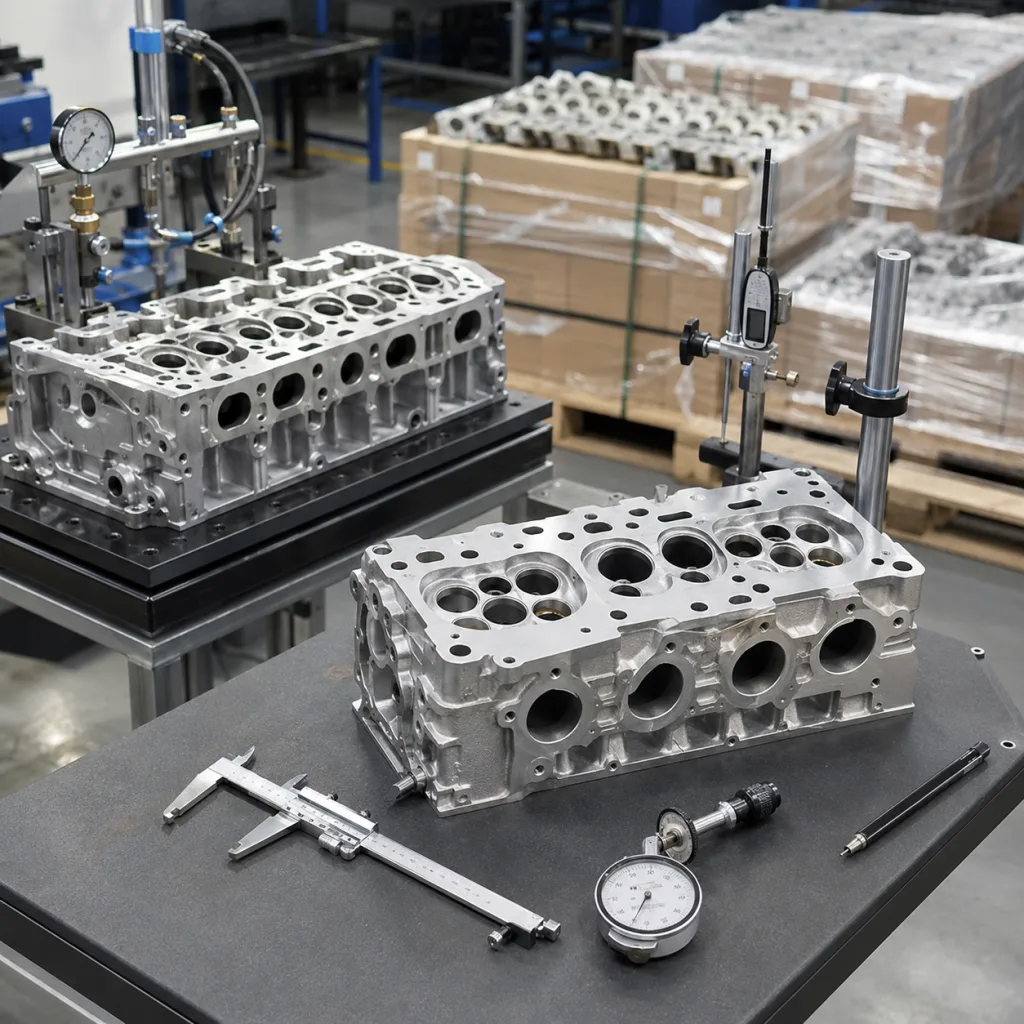
Dimensional risk: verify flange flatness, bolt-hole centres, pipe angle, gasket face position, bracket height, and sensor boss thread. Common critical controls include bolt-hole centre distance within ±0.20-0.30 mm, gasket face flatness within 0.10-0.20 mm, pipe angle within ±1.0-1.5°, and thread go/no-go gauge acceptance.
Leak risk: require coolant-side and gas-side pressure testing at agreed pressure and hold time. Many aftermarket programmes use air-under-water or dry leak testing at 2.0-4.0 bar for coolant circuits and 1.0-2.0 bar for gas circuits, with 30-60 second holds unless the drawing requires otherwise.
Heat-cycle risk: define the cycling method instead of accepting “tested for durability.” A practical plan may use 50-200 cycles between ambient and a defined hot-side temperature, followed by leak testing, visual inspection, and flange or bracket recheck.
Material risk: specify stainless grade, flange material, brazing filler, weld wire, gasket face finish, and corrosion expectations. Buyers commonly request 304, 316L, 409, 441, or project-specific stainless certificates depending on heat load, coolant chemistry, and cost target.
Cleanliness risk: set limits for welding residue, brazing flux, metal chips, oil, and internal contamination. For high-risk references, request capped ports after cleaning and a final visual or borescope check.
Transit risk: define caps, separators, carton strength, pallet labels, and moisture control. Heavy coolers should not rely on thin retail cartons alone; double-wall export cartons and corner protection reduce bent pipes and flange damage.
Traceability risk: require batch code, inspection record, production date, and line or operator reference. The cooler, inner box, master carton, and packing list should point to the same production batch.
Specification Deep-Dive: Details That Separate Real Quotes from Guesswork
A serious quotation does more than say “equivalent.” It defines what will be built, measured, tested, packed, and recorded. Without that detail, two suppliers may quote the same part number while assuming different materials, inspection levels, leak-test methods, and packaging rules.
Sourcing item
What to request from supplier
Buyer-ready acceptance detail
Application data
Engine code, model year range, emissions configuration, OE cross-reference where supplied
Match by engine, chassis market, valve/cooler layout, and sensor/pipe position; do not quote only from a photo
Core construction
Tube type, fin structure, shell material, weld or brazed joint method
Confirm tube count, wall thickness, core length, end-plate design, and heat-transfer area against the reference sample
Interface dimensions
Flange thickness, bolt-hole centres, gasket face tolerance, pipe orientation
Define critical dimensions on an inspection drawing; typical controls include ±0.20-0.30 mm on hole centres and ±1.0-1.5° on pipe angle
Leak test record
Test medium, pressure, hold time, acceptance criteria
Record part number, batch, pressure, hold time, operator, date, and pass/fail result; common holds are 30-60 seconds after pressure stabilisation
Use a master sample, drawing value, or agreed flow bench method so visual equivalence does not hide heat-transfer loss
Surface treatment
Passivation, coating, cleaning method, residue control
Confirm no loose scale, flux residue, oil film, sharp burrs, or corrosion staining before capping and packing
Packaging
Unit protection, carton quantity, pallet size, moisture control
Define inner bag, port caps, separators, carton grade, pallet height, gross weight limit, and barcode position
</tr></thead><tbody> </tbody></table>Management standards help buyers judge whether the factory can repeat these controls beyond the first sample. Driventus operates under IATF 16949:2016 and ISO 9001:2015. For EU-bound programmes, material declarations may also need to support REACH (EC) No 1907/2006 review.
If the cooler is supplied into a vehicle emissions system, the importer should confirm local compliance duties for the complete vehicle, repair programme, and distribution channel. Component sourcing alone does not equal certification under emissions regulations such as ECE R-83.
MOQ and Lead-Time Planning: Build the Order Around the Part Type
MOQ is not one fixed number. It changes with the reference status, label requirement, tooling need, packaging rule, and forecast reliability. A standard aftermarket cooler can often be planned by carton or pallet quantity. A new development part must also absorb fixture setup, material preparation, trial production, inspection time, and packaging approval.
Use this structure when planning demand:
Sample order: 5-20 pieces for dimensional checks, installation trial, leak testing, flow comparison, and packaging review. Samples cost more because setup, inspection, and small-batch handling are spread across few units.
Pilot order: 100-300 pieces for market introduction, distributor validation, regional branch allocation, and early warranty monitoring. Keep pilot orders to one label version and one packing rule where possible.
Regular order: 300-1,000+ pieces per reference, depending on complexity, packing specification, and forecast stability. Pallet-quantity repeat orders normally reduce handling cost and carton waste.
Private label: MOQ may rise when printed cartons, customer barcodes, or dedicated pallet labels are required. Freeze artwork before production to avoid repacking.
New development: MOQ is agreed after drawing review, tooling assessment, sample plan, annual forecast, and confirmation of any dedicated fixtures, stamping dies, tube bending tools, or test adapters.
Lead time follows the bottleneck. Stainless tube availability, flange machining, brazing or welding capacity, surface finishing, inspection workload, and export packing can each control the schedule. As a planning rule, allow 7-15 days for samples when an existing reference and materials are available, 25-45 days for repeat production after deposit and artwork approval, and 45-90+ days for new development that needs tooling, fixture trials, or multiple validation rounds.
Price is driven by stainless grade and thickness, cooler core size, tube and fin complexity, flange machining time, weld or brazing process, leak-test requirement, reject-rate risk, order quantity, packaging specification, and Incoterm. State annual volume and first-order quantity in the RFQ. A 20-piece sample price is not a reliable basis for a 1,000-piece programme. For stable programmes, Driventus can quote sample, 300-piece, 500-piece, and 1,000-piece price levels once the specification is fixed.
Repeat orders work best with an 8-12 week rolling forecast. Forecast visibility supports material reservation, smoother scheduling, and fewer urgent-batch price changes. For mixed containers, EGR coolers are often consolidated with gaskets, water pumps, pistons, crankshafts, and other engine components. Confirm carton labelling, HS code preference where applicable, country-specific packing rules, barcode format, pallet limits, and destination warehouse rules early in the RFQ.
Factory Audit: Follow One Cooler from Tube to Carton
When auditing an egr cooler mitsubishi oem supplier, do not stop at the meeting room. Follow one cooler through production. The purpose is to see whether the same controls used for the approved sample are present during normal manufacturing.
A practical audit should trace these points:
Incoming inspection for stainless steel tube, flanges, castings, brackets, gasket interfaces, purchased fittings, caps, cartons, and labels. Material certificates should match heat number or supplier lot where required.
Fixture management for pipe angle, flange position, gasket-face flatness, bracket height, and sensor boss alignment. Ask how often fixtures are checked and what happens when wear exceeds the control limit.
Welding or brazing parameter records, operator qualification controls, equipment maintenance, and settings such as current, travel speed, temperature profile, holding time, and cooling method where applicable.
Leak testing method, either 100% or risk-based sampling. High-risk and new references should normally use 100% leak testing before packing.
Gauge calibration for pressure testers, callipers, thread gauges, height gauges, torque tools, flow checks, and flatness checks. Calibration status should be visible at the workstation, not only stored in an office file.
Cleaning controls for debris, flux residue, oil contamination, loose scale, and moisture before packing. Ports should be capped after cleaning.
Nonconforming product segregation, root-cause analysis, corrective action, and recurrence prevention. Reworked leak-test failures should be tested again before release.
Batch traceability from raw material lot to finished part, inner label, export carton, pallet label, packing list, and invoice. This allows a distributor to isolate one batch without freezing all inventory.
Driventus supports customer audits with process flow charts, control plans, inspection records, and sample approval documentation where agreed. Our quality system is structured around IATF 16949:2016 and ISO 9001:2015 requirements, including documented corrective action and continual improvement processes.
For higher-volume programmes, buyers may request PPAP-style elements such as dimensional reports, material certificates, process capability data for critical characteristics, leak-test summaries, appearance approval, packaging approval, and sample retention records. Agree the submission level before tooling, sampling, or pilot production starts. A practical pre-shipment file usually includes the purchase order, final inspection report, leak-test summary, carton label proof, packing list, commercial invoice, and pallet loading photos.
Custom Scenario: When a Catalogue Cooler Is Not Enough
Custom manufacturing becomes necessary when the required Mitsubishi-fit EGR cooler is discontinued, regional, bracket-specific, port-specific, or tied to a private-label programme. It may also apply when an OEM/Tier-1 customer supplies drawings and requires controlled production under a separate specification.
Typical triggers include a changed mounting bracket, alternate coolant pipe, different sensor boss, modified port position, unusual emissions configuration, or a package that must match a distributor’s warehouse and brand rules.
A practical development path looks like this:
1. Buyer provides sample, drawing, OE cross-reference, application list, engine code, annual forecast, target market, test requirements, and packaging expectations. If no drawing is available, two good samples are preferred: one for measurement and one for functional comparison. 2. Driventus reviews manufacturability, material availability, tooling requirement, fixture concept, inspection plan, leak-test adapter need, estimated MOQ, and target lead time. 3. Measurement and engineering review define critical-to-fit points such as flange datum, bolt-hole centres, gasket face height, pipe angle, sensor thread, bracket position, and cooler envelope clearance. 4. Prototype or sample batch is produced for dimensional, leak, thermal, flow, and functional review. A development batch may include 5-20 pieces depending on tooling maturity and validation needs. 5. Buyer confirms installation fit, packaging, labelling, documentation, and commercial terms. Any change after approval should be handled through an engineering change note so old and new versions are not mixed. 6. Pilot production runs under agreed inspection controls and traceability rules, usually with tightened checks on critical dimensions and 100% leak testing. 7. Regular supply begins with batch records, shipment documentation, agreed quality feedback channels, and a repeat-order forecast.
Our custom manufacturing service can cover reverse engineering support, fixture development, sample approval documents, packaging specification, private-label carton review, and export documentation. Budget development time separately from mass-production lead time. New fixtures or test adapters may need 2-4 weeks after drawing confirmation, while complex cooler assemblies can require several sample rounds before release.
For regulated markets, buyers remain responsible for confirming that final use, installation, sale, and distribution comply with local emissions, safety, chemical, and consumer protection requirements. If the project is for off-road, marine, industrial, or replacement-use channels, state that market status clearly in the RFQ so documentation and labelling do not create compliance risk.
Commercial Q&A for Import Buyers
What should be fixed before the purchase order?
Confirm Incoterms, payment terms, inspection point, warranty handling, spare packaging quantities, and document format. The quotation should state whether price is EXW, FOB Ningbo/Shanghai, CIF, or another Incoterm, because packaging, inland freight, port charges, and insurance can change landed cost.
What belongs in the RFQ?
Part description, application list, engine code, year range, and photo or drawing reference.
OE cross-reference if supplied by the buyer, used only for fitment matching and quotation control.
Annual volume, first-order quantity, replenishment cycle, and requested price tiers such as 100, 300, 500, and 1,000 pieces.
Target market: EU, UK, US, Canada, Australia, Brazil, Middle East, Africa, or other region.
Required certificates, test reports, inspection records, material declarations, PPAP-style documents, and language requirements.
Private-label artwork, barcode format, carton dimensions, carton gross weight limit, pallet size, pallet height, and warehouse scan rules.
Requested Incoterm, destination port, shipment mode, consolidation requirements, and LCL, FCL, or mixed-container plan.
Inspection method: pre-shipment inspection, customer audit, video inspection, production-line photos, or third-party inspection.
Warranty reporting process, claim evidence, replacement handling, field diagnostic responsibility, and response time for 8D or corrective action.
Which regional details are often missed?
For Brazil and other markets with detailed import procedures, confirm Portuguese or local-language label needs, customs documents, NCM or HS code preference where applicable, and distributor warranty flow. For the EU and UK, importers often request REACH (EC) No 1907/2006 material support, clear traceability labels, and carton data aligned with warehouse systems. For North America and Australia, carton durability, scanability, pallet stack strength, and branch-level barcode consistency may matter more than retail graphics.
How do buyers compare suppliers fairly?
Ask each factory to quote against the same drawing, test requirement, packing rule, documentation list, Incoterm, first-order quantity, and annual forecast. A low unit price may be misleading if it excludes caps, double-wall cartons, leak-test records, private-label packing, palletisation, or required export documents.
Frequently asked questions
Yes. Driventus can support private-label cartons, barcode rules, pallet labels, and customer-specific packing after artwork and compliance review. MOQ depends on whether the reference is standard, needs printed packaging, or requires tooling.
Typical documents include IATF 16949:2016 and ISO 9001:2015 certificates, process flow, control plan, dimensional report, leak test record, material certificate, packing specification, and PPAP-style submission elements depending on the project scope.
No. Driventus is an independent aftermarket manufacturer; brand names are referenced for fitment only. OE references supplied by customers are used for application matching, quotation control, and internal traceability.
Send drawings, samples, OE cross-references, annual forecast, target market, target order quantity, test requirements, and packaging rules if you need pricing or development review. You can [request a quote](/contact.html).