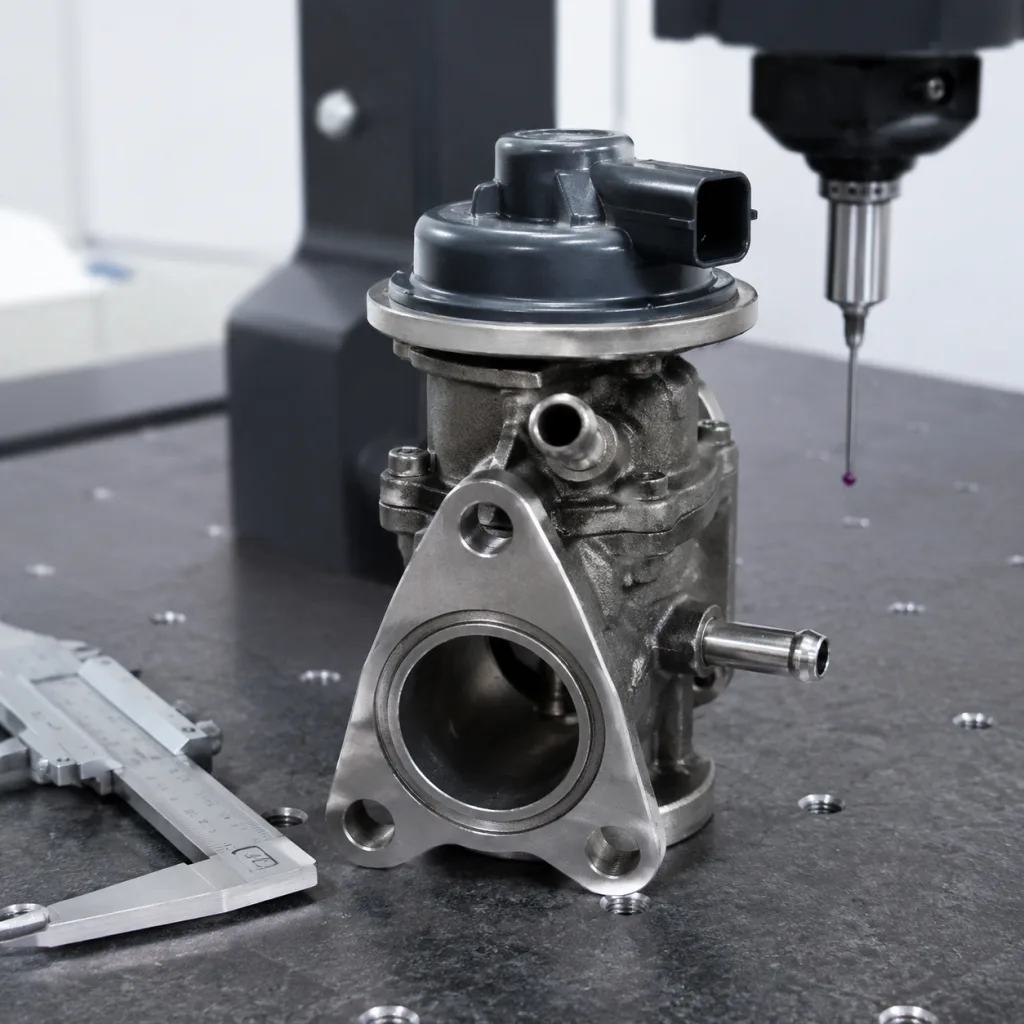
Choosing an EGR cooler Mini supplier is not a catalogue exercise. For importers, aftermarket distributors, repair chains, and sourcing engineers, it is a risk decision that links part fitment, leak integrity, warranty cost, and delivery reliability.
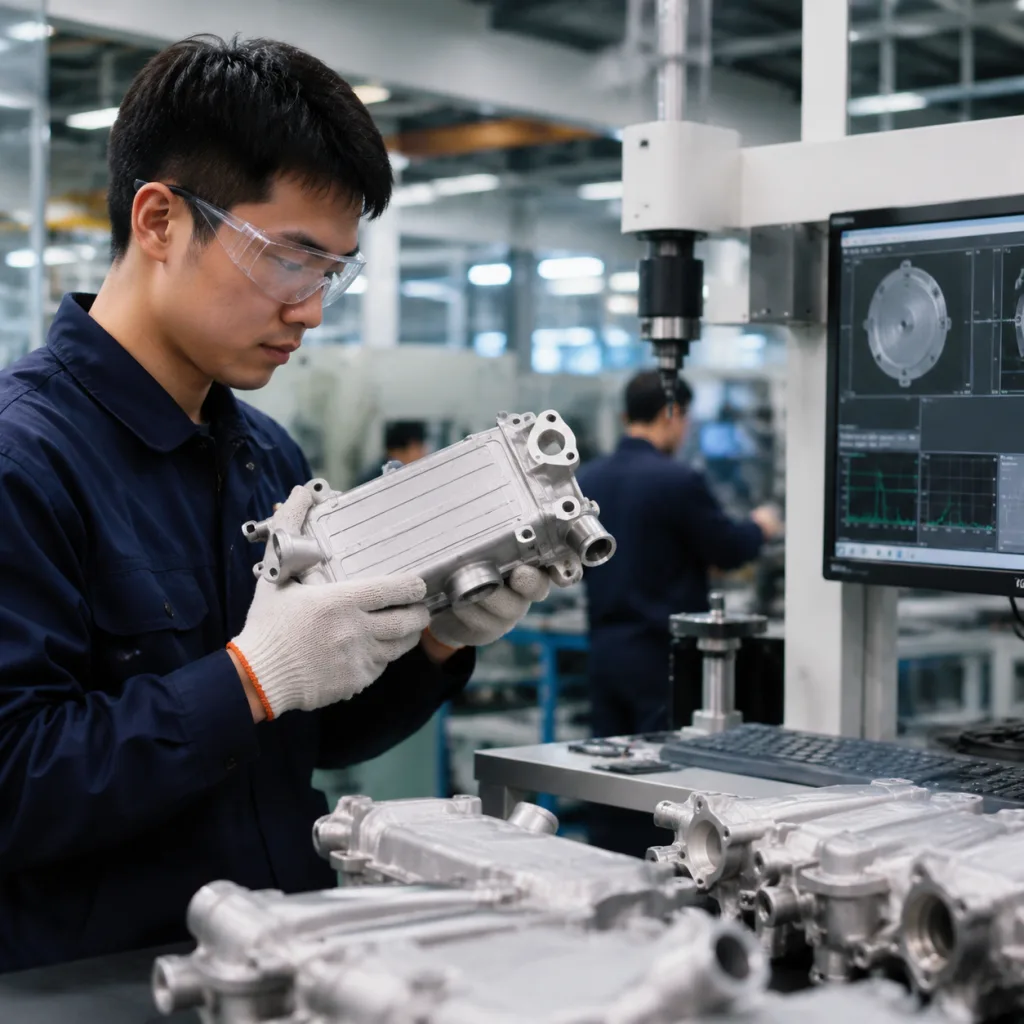
The part works in a harsh position. Exhaust gas can exceed 500°C during load events. Coolant pressure is commonly validated around 1.5–2.5 bar depending on the programme. Repeated heat soak can expose weak brazing, weld porosity, flange distortion, blocked passages, or contamination left inside the core. A cooler that looks correct in photos may still fail on port angle, bracket datum, gasket-face flatness, or internal cleanliness.
Driventus manufactures EGR coolers and related engine components in Taizhou, Zhejiang, with export supply to more than 60 countries. Procurement discussions usually cover annual volume, target applications, OE part-number cross-references where provided, inspection records, packaging, labelling, and forecast flexibility. Driventus is an independent aftermarket manufacturer; vehicle brand names and OE references are used only to identify fitment.
This guide is written as a practical sourcing framework for buyers shortlisting an egr cooler mini supplier. It covers scope definition, MOQ logic, lead-time pressure points, audit evidence, failure modes, supplier comparison, and RFQ preparation without assuming every project needs the same process.
Start With the Fitment Decision, Not the Quote
A Mini EGR cooler sourcing project should begin with one question: what exactly must this SKU fit, and what cannot change? Confirm the application range, engine code coverage, model years, regional vehicle variants, transmission notes where relevant, and any OE part-number cross-references already used in the buyer’s system. Those references help identify the part. They do not prove vehicle manufacturer approval.
Do not consolidate similar-looking coolers too early. When several references share the same general shape, check the port direction, bracket position, flange pattern, sensor boss, hose connection OD, bypass-valve detail, and gasket face before treating them as one SKU. Small differences create big returns.
Define the sourcing scope in writing:
Annual demand by SKU and destination market, split into monthly or quarterly call-offs where possible
Trial order quantity, repeat-order cadence, and forecast window, usually 3–6 months for stable planning
Packaging format: neutral, distributor brand, or programme-specific carton with defined ECT, burst strength, label size, barcode type, and pallet height
Import-market documents, including material declaration, HS code, country of origin, and restricted-substance statements where required
Inspection level, acceptance criteria, retained-sample rules, and lot-record requirements
Warranty process, claim evidence, response timeline, and debit-note approval rules
This early work prevents avoidable disputes over accessory kits, label content, carton strength, finish expectations, and missing documents after production has started. It also tells the supplier whether an existing SKU is enough or whether sample development, tooling confirmation, or extra validation is needed.
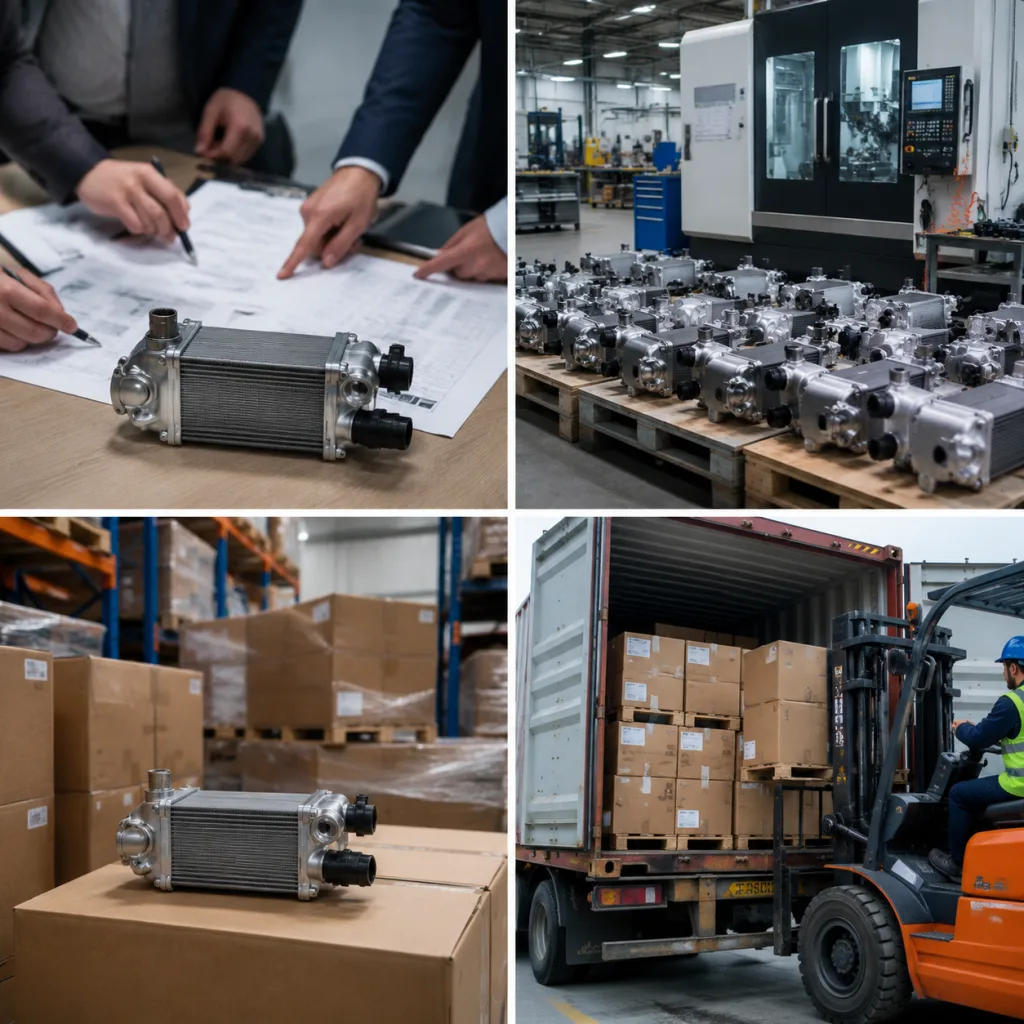
A 100-piece trial order in neutral cartons may be quoted from an existing fixture. A 1,000-piece branded programme with GS1 barcodes, pallet labels, and batch-level inspection reports needs artwork approval, packing-line setup, and controlled label release. The part may be the same. The procurement workload is not.
Driventus can review standard SKUs from our catalog and application-specific projects through custom manufacturing. Buyers consolidating engine component purchasing can also source EGR coolers alongside gaskets, water pumps, pistons, crankshafts, and other engine components.
Where MOQ and Lead Time Actually Come From
An EGR cooler Mini supplier should be judged by repeatability, not by the first number on the quotation. The real question is whether the factory can keep tube, shell, flange, bracket, and coolant-port dimensions stable across repeated lots while controlling cleaning, welding or brazing, leak testing, and packing.
Ask where the bottleneck sits. It may be tube forming, brazing furnace loading, TIG/MIG welding capacity, CNC flange machining, fixture availability, leak-test stations, accessory packing, or carton and label preparation. Each constraint affects MOQ and lead time differently.
Typical planning ranges for standard aftermarket references are:
Procurement item
Typical planning range
Buyer note
Trial order MOQ
50–200 pieces per SKU
50 pcs is realistic for stocked or confirmed tooling; 100–200 pcs is more common for production setup
Repeat order MOQ
100–300 pieces per SKU
Mixed-container planning can reduce logistics cost when SKUs share material and packaging rules
Indicative unit-price drivers
Material grade, core size, flange machining, accessories, inspection level, packaging
Stainless grade, brazing yield, and low-volume setup time often matter more than carton quantity
Standard lead time
30–60 days after deposit or order confirmation
30–40 days for mature SKUs; 45–60 days when material, packaging, or batch testing is added
New sample development
45–90 days
Includes sample receipt, measurement, fixture review, prototype build, and first-article checking
Tooling or fixture review
10–25 working days
Applies when bracket, port angle, or flange datum needs confirmation before production
Export markets
EU, UK, US, Canada, Australia, Brazil, and others
Documentation and labelling requirements differ by market
</tr></thead><tbody> </tbody></table>A low trial quantity usually carries higher setup cost per part because fixture preparation, first-piece inspection, leak-test setup, packing approval, and export documents are spread over fewer units. Repeat orders become more competitive when the buyer provides a rolling forecast, approves common packaging components, and avoids late accessory changes.
For mixed-SKU orders, ask three direct questions: can cartons be combined on one pallet, does each SKU carry a separate minimum, and are accessories counted inside the same MOQ? These details often decide whether a quote is workable.
For distributor programmes, packaging can shape the practical MOQ more than metalworking capacity. Branded cartons, barcode rules, label control, pallet height, and carton strength create setup work. For OEM-style or Tier-1 sourcing, the first gate is usually technical data review, sample approval, process audit, and an agreed control plan before recurring delivery is confirmed.
A controlled 45-day lead time is usually safer than a promised 30-day shipment with no checkpoints. Freeze packaging and label data 10–15 working days before packing. Freeze technical changes before material cutting. Review open orders weekly once production starts.
Audit the Process Trail, Not the Certificate Wall
Quality claims need evidence tied to the EGR cooler family being sourced. Driventus operates under IATF 16949:2016 and ISO 9001:2015 certified processes, using process control, incoming inspection, calibration, traceability, corrective action, and change management to reduce production risk.
Certificates are only the entry ticket. Before appointing a supplier, request documents that show how the part is controlled from material receipt to packed carton:
Process flow chart for cutting, forming, brazing, welding, machining, cleaning, leak testing, drying, final inspection, and packing
Control plan showing critical characteristics, inspection methods, sampling frequency, acceptance limits, and reaction rules
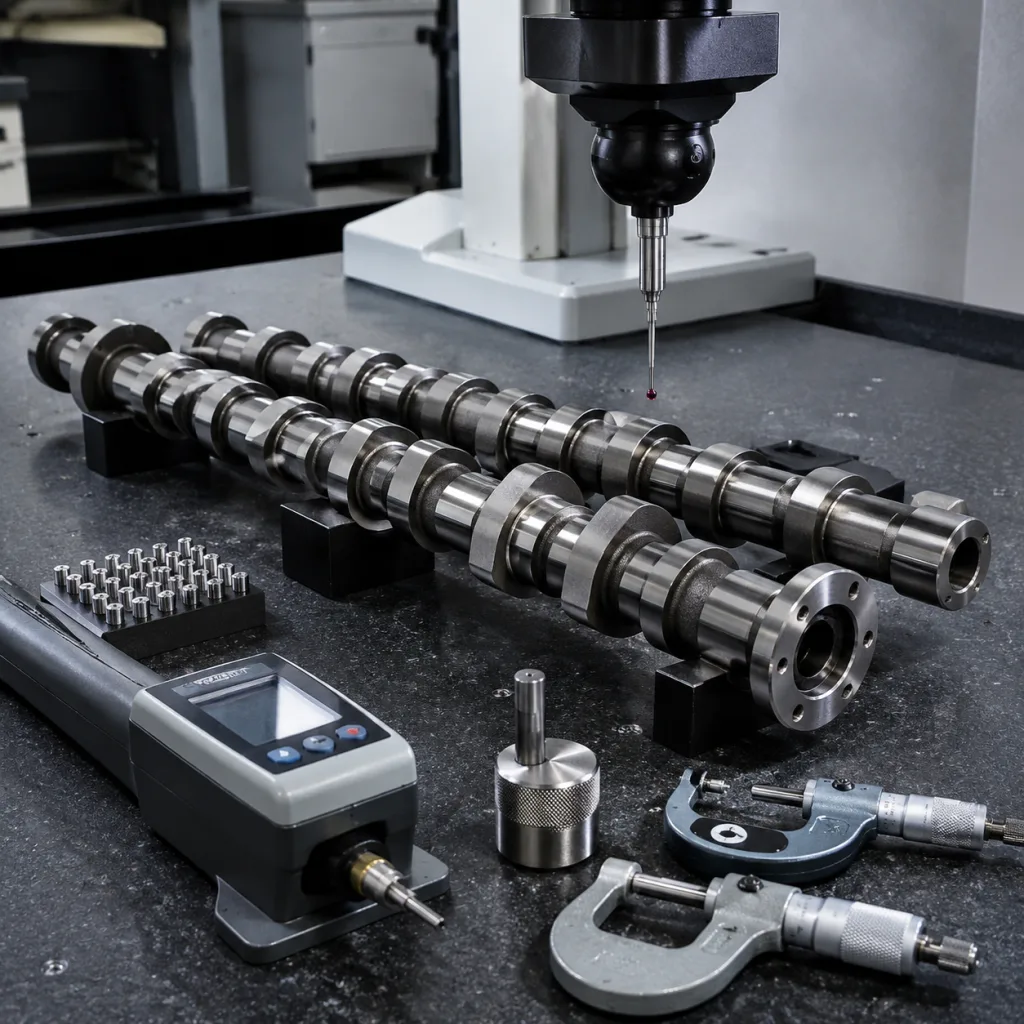
Gauge list and calibration records for pressure gauges, decay testers, vernier calipers, height gauges, thread gauges, flatness plates, and torque tools
Material certificates for stainless steel, aluminium alloy, or other specified metals, linked to heat number or incoming batch where possible
Leak-test parameters with retained production records by lot or batch, including test medium, pressure, hold time, and pass/fail criteria
Corrective and preventive action examples for previous nonconformities, preferably using 8D, 5 Why, or a similar root-cause format
Change-control procedure for materials, fixtures, tooling, process parameters, packaging, suppliers, and subcontracted operations
The strongest records are recent, specific, and traceable. A batch-linked pressure-test record is more valuable than a statement that every part is tested. A control plan that names flange flatness, port alignment, weld quality, and leak integrity is more useful than a checklist with no measurable limits.
For higher-risk programmes, buyers can request PPAP-style evidence: process flow, PFMEA, control plan, dimensional report, material report, initial sample inspection report, capability data for key dimensions, and master sample approval.
During an audit, follow the part. Start with incoming tube, plate, casting, and accessory inspection. Then review fixture setting, weld or braze parameter control, in-process dimension checks, cleaning and drying, leak testing, final visual inspection, packing, and traceability. Ask how nonconforming parts are segregated, who can release rework, and whether reworked parts are leak-tested again.
Lot traceability should connect finished cartons to production date, inspection record, operator or line, and material batch where the process allows. Our quality system page summarises the framework used for production control. For formal sourcing projects, buyers may request a supplier questionnaire, remote audit, production record review, or on-site factory audit package.
Failure Modes That Should Shape the Specification
EGR coolers connect exhaust gas and engine coolant circuits. That makes minor deviations expensive. A sourcing specification should be built around the failures the buyer wants to prevent, not around appearance alone.
Common field risks include internal leakage, external coolant seepage, cracked welds, blocked passages, loose debris, gasket-face distortion, bracket misalignment, stripped threads, sensor-port mismatch, and thermal fatigue. Each risk should map to a measurable check.
Key specification points include:
Core construction: tube type, fin structure, shell thickness, plate thickness, and weld or braze process; record actual thickness instead of relying only on nominal drawings
Material confirmation: stainless steel or aluminium alloy grade as specified by drawing, sample analysis, or buyer standard; request PMI or material certificate when grade substitution risk is high
Flange geometry: bolt-hole position, flatness, gasket face finish, port alignment, bracket location, and datum reference; buyers often set flatness targets around 0.10–0.30 mm depending on gasket design and sealing load
Leak integrity: air-under-water, pressure-decay, helium, or equivalent testing for coolant and gas paths; define pressure, hold time, temperature condition, and allowable pressure drop before production
Surface condition: absence of burrs, loose particles, weld spatter, oil residue, cleaning residue, sharp edges, and blocked passages; internal debris must be controlled because particles can damage downstream components
Accessory fitment: gaskets, clamps, brackets, plugs, fasteners, sensor ports, bypass elements, and blanking caps where applicable; define whether accessories are pre-installed, bagged, or excluded
Dimensional consistency: comparison of approved sample, production parts, and retained samples across batches, especially bolt pattern, port angle, hose connection OD, thread size, and bracket datum
Typical inspection plans include 100% leak testing, first-piece dimensional approval at production start, in-process checks every 1–2 hours or every defined batch, and final AQL sampling before packing. For leak testing, many programmes use compressed air in water or pressure-decay equipment at a controlled pressure above normal coolant operating pressure. The exact value must match the drawing or approved standard. The record should always show pressure, duration, operator, equipment ID, and result.
For threaded ports, specify go/no-go gauges and torque checks where plugs or fittings are installed. For contamination control, define what counts as unacceptable debris. “Clean inside” is not a specification.
Published emissions regulations such as ECE R-83 define vehicle-level pollutant requirements, but they do not replace component-level inspection for an aftermarket EGR cooler. Importers may also need environmental substance compliance, including REACH (EC) No 1907/2006 for restricted substances in the EU supply chain.
For higher-risk programmes, define the validation package before price confirmation. Depending on the project, this may include burst or proof-pressure checks, thermal-cycle review, salt-spray expectations for external components, weld-section evaluation, fitment checks, vibration review, temperature-shock exposure, and packaging drop-test requirements. A useful validation request states the test quantity, pass/fail criteria, whether parts are production-intent, and whether failed samples must be retained for joint review.
Supplier Route Comparison for Different Buying Scenarios
There is no single best supplier type for every EGR cooler programme. The right route depends on volume, technical risk, warranty exposure, documentation needs, and how much process visibility the buyer requires.
A buyer testing 50 pieces in one market may value broad SKU access and flexibility. A distributor buying 500–2,000 pieces per year across several Mini references needs traceability, warranty discipline, stable packaging, and repeatable lead time. A repair-chain programme may care most about low return rate and fast claim resolution.
Supplier route
Strength
Limitation
Best fit
Trading company
Broad SKU access and flexible sourcing
Limited process control, weak batch traceability, and shallow audit depth
Small mixed orders or market testing
Single-product workshop
Low tooling barrier and simple communication
Variable documentation, capacity, calibration control, and change management
Low-risk local applications
Vertically integrated manufacturer
Stronger traceability, engineering support, fixture control, and lot records
Requires clearer forecast, specification discipline, and approval workflow
Distributor, repair chain, and Tier-1 programmes
OE dealer channel
Original service supply route
High cost, limited B2B flexibility, and limited packaging control
Low-volume urgent service demand
</tr></thead><tbody> </tbody></table>Driventus fits the vertically integrated manufacturing route. That matters when buyers need retained production records, controlled engineering changes, packaging consistency, technical feedback, and direct communication with quality and engineering teams. It also supports multi-SKU programmes where EGR coolers are purchased with related powertrain parts.
Lowest unit price is not always lowest total cost. Delayed shipments, unclear claim handling, carton relabelling, undocumented process changes, and inconsistent fitment can erase a small saving quickly.
Use a weighted comparison. Score ex-works or FOB price, MOQ, lead time, sample cost, tooling cost if any, inspection-report availability, claim response time, spare accessory availability, packaging compliance, and forecast flexibility. If one quote is 5–8% lower but requires a larger MOQ, longer lead time, no leak-test records, or vague warranty handling, calculate the carrying cost and potential claim cost before selecting it.
Build the RFQ So the Supplier Can Answer Precisely
A strong RFQ removes guesswork. It tells the supplier what must be quoted, what must be tested, what must be packed, and what evidence must ship with the order.
For an EGR cooler Mini programme, include as much of the following as possible:
1. Target vehicle application, engine code, market region, model year range, steering position if relevant, and emission-level notes 2. Sample photos from all sides, including ports, brackets, gasket faces, labels, sensor bosses, bypass features, and accessories if available 3. OE part-number cross-reference if already used internally, such as OE 06A… only where relevant to the buyer’s data 4. Annual forecast, first order quantity, repeat-order plan, required delivery split, Incoterm, and destination port 5. Packaging, barcode, carton, pallet, and labelling requirements, including carton size limits, label language, pallet height, and mixed-pallet rules 6. Required inspection documents, material declarations, IMDS or REACH-related needs where applicable, and third-party audit expectations 7. Target warranty period, claim documentation process, defective-sample return rule, credit-note or replacement process, and response-time expectations 8. Approved sample, drawing, test standard, buyer-specific quality requirement, key tolerance, or no-change requirement
If drawings are unavailable, send a physical sample for reverse engineering, material checks, dimensional comparison, and fitment confirmation. Clear photos help the first discussion, but they are rarely enough for final production approval when brackets, internal geometry, bypass details, or sensor-port positions are critical. When possible, send one clean reference sample and one field-return sample showing the failure mode to avoid.
Separate non-negotiables from preferences. Mandatory items may include 100% leak testing, flange flatness limit, stainless grade, accessory kit content, branded carton, barcode format, and required lead time. Preferences may include pallet layout, carton print position, report format, or shipment split. This distinction prevents inflated quotes and avoids late arguments.
For custom projects, Driventus will clarify tooling cost, sample schedule, validation plan, inspection records, packaging requirements, and production lead time before quotation. A typical development path is RFQ review, sample or drawing confirmation, feasibility check, prototype quotation, sample build, first-article inspection, buyer approval, pilot order, and mass-production release.
To start a sourcing review, buyers can request a quote with their RFQ file, sample details, forecast, and destination market.
Frequently asked questions
Provide application data, photos or drawings, OE cross-reference if available, annual forecast, first order quantity, Incoterm, destination market, packaging needs, accessory list, and required inspection documents. A physical sample is useful when drawings are not available or when bracket, port, flange, bypass, and sensor details need confirmation.
Yes. Packaging can be neutral or buyer-branded, subject to artwork approval, carton specification, MOQ, barcode format, pallet rules, and labelling requirements for the destination market. Branding is for aftermarket distribution and does not imply vehicle manufacturer endorsement.
IATF 16949:2016 and ISO 9001:2015 are the main quality management references for automotive component sourcing. Depending on the destination market, buyers may also request material declarations linked to REACH (EC) No 1907/2006, plus batch-level inspection records, leak-test records, and PPAP-style documents for higher-risk programmes.
If you are evaluating an EGR cooler Mini supplier for a distributor, repair-chain, or OEM-style sourcing programme, send your application list, annual forecast, first-order target, MOQ expectation, lead-time target, destination market, packaging rules, and documentation requirements for review. Start a technical and commercial discussion at /contact.html