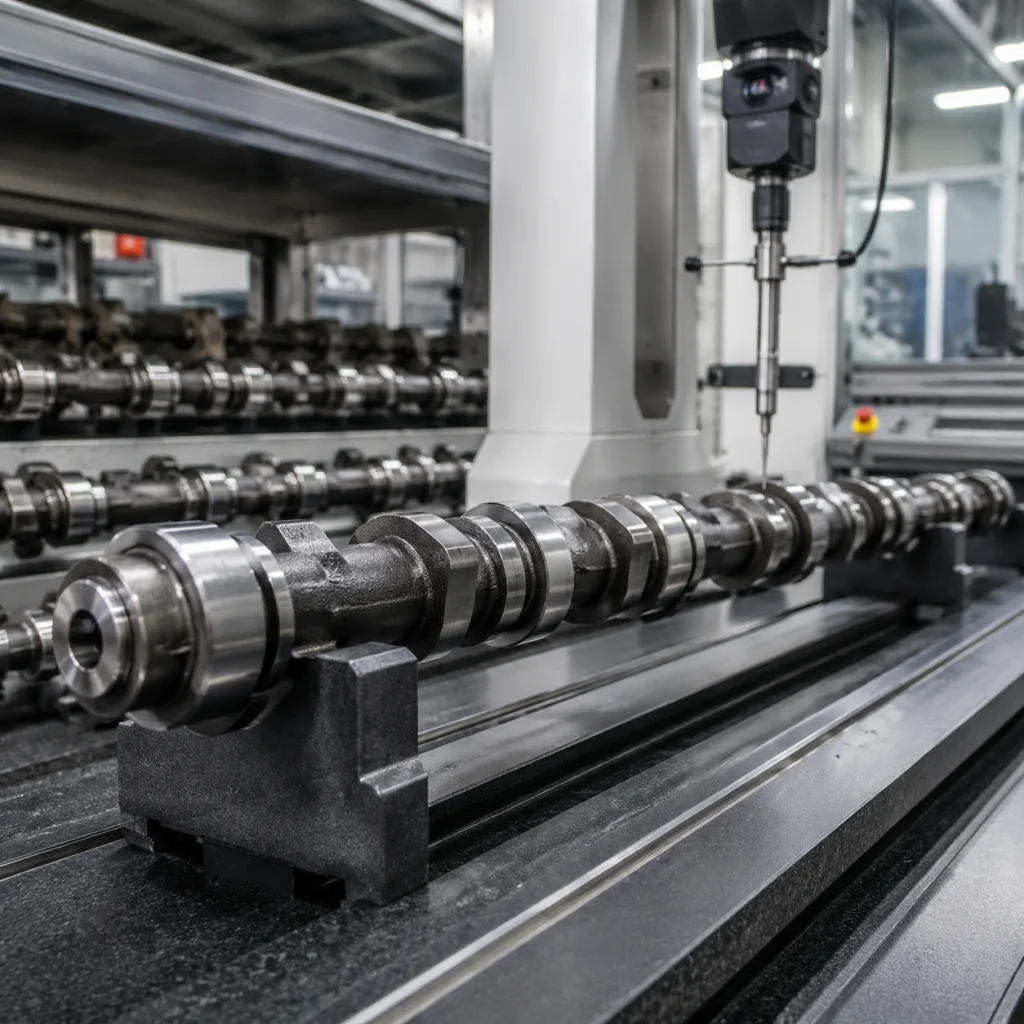
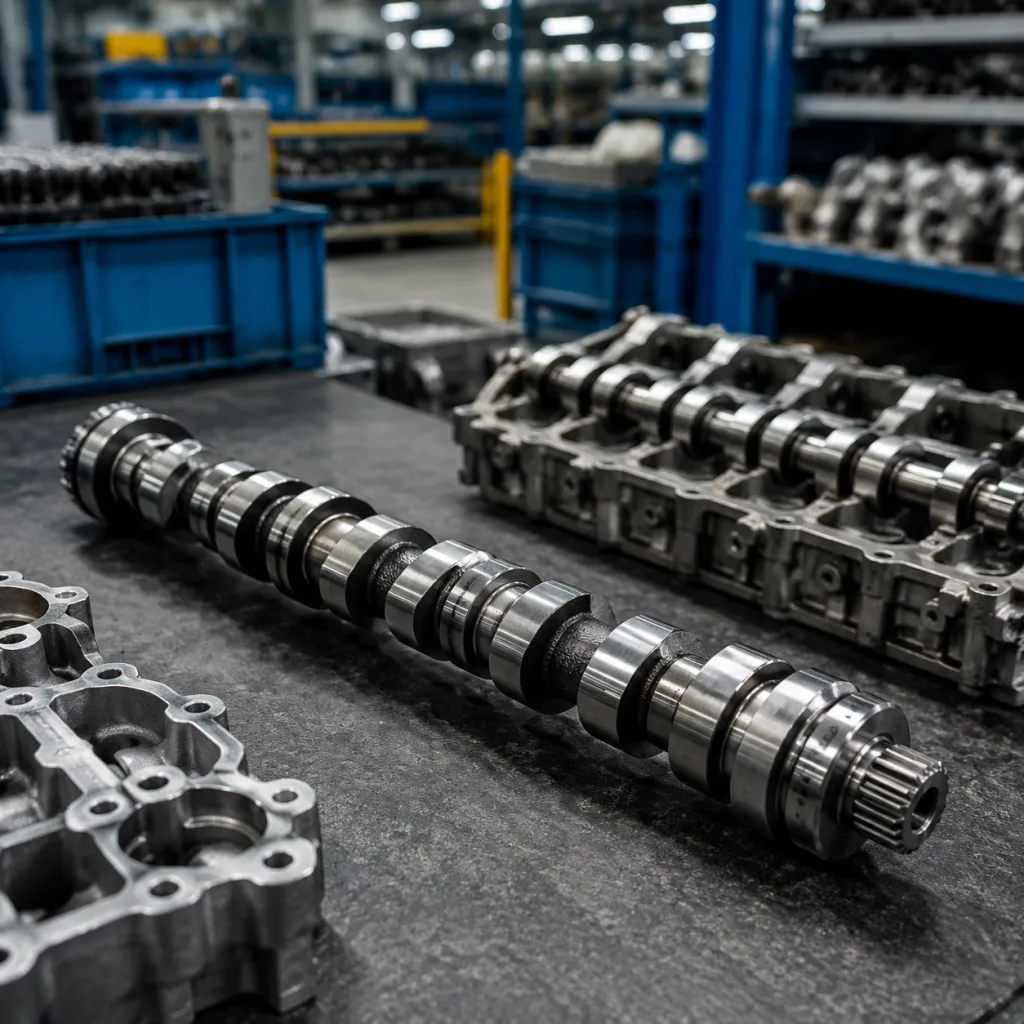
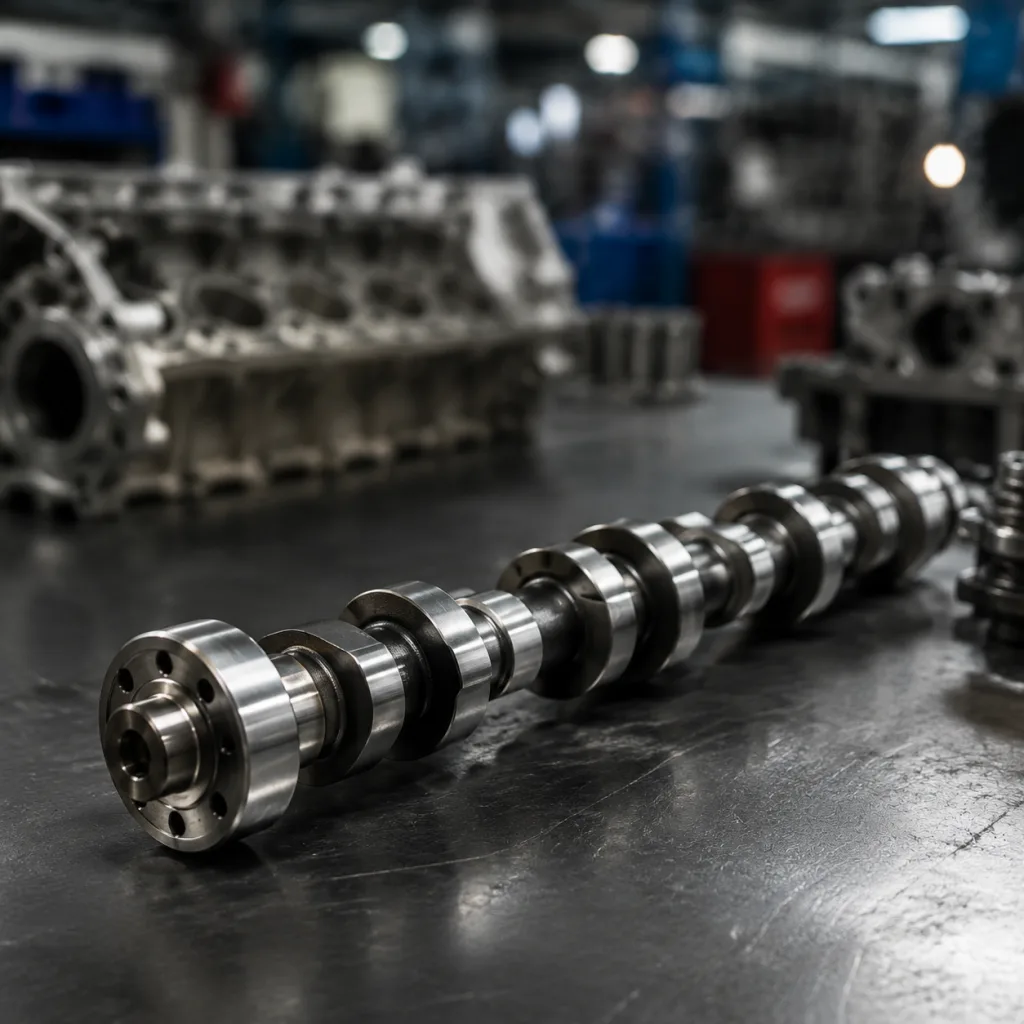
A camshaft for Genesis GV70 replacement is not a commodity line item. For distributors, repair networks and importers, the sourcing risk sits in the details: engine split, intake versus exhaust position, phaser interface, trigger pattern, surface hardness, runout, packaging protection and batch documentation. Miss one, and the program can create returns before it creates revenue.
Use the RFQ as a control document. It should identify the target engine, OE cross-reference logic, expected annual volume, first order quantity, inspection level, private-label requirements and delivery window. Those inputs shape tooling, MOQ, price and lead time as much as the physical camshaft does.
Driventus manufactures engine and powertrain components in Taizhou, Zhejiang, with export supply to more than 60 countries. For camshafts, our work centers on OE-equivalent geometry, validated surface hardness, controlled runout and traceable production under IATF 16949:2016 and ISO 9001:2015. Driventus is an independent aftermarket manufacturer; vehicle brand names are used for fitment identification only.
Start With the Fitment Decision, Not the Model Name
The GV70 nameplate is only the beginning. Replacement demand may come from timing system repair, valvetrain noise, oil starvation damage, cam phaser faults or engine rebuild work, but the sourcing decision has to narrow the application before price is discussed.
A strong fitment file answers these questions first:
Which vehicle model and production year range, including start/end month if available?
Which engine code, displacement, induction type and fuel system type?
Is the camshaft intake or exhaust?
Does the engine layout require bank identification?
Does the phaser mounting pattern match the approved part?
Are the dowel/pin location and oil-feed ports identical?
Does the sensor trigger pattern match in tooth count, window width and angular orientation?
Are overall length, journal count and thrust-control location confirmed from the master part?
Which target market applies: EU, UK, US, Canada, Australia, GCC, Brazil or another region?
Two errors cause many aftermarket problems: choosing the right engine family but the wrong camshaft position, or trusting a catalog model name while missing a market-specific engine change. For launch orders, Driventus recommends a fitment matrix with one row per engine, position and bank combination. Lock it before sampling. If VIN coverage data is available, test 10–20 VINs across the planned year range before cartons or catalog data are released.
Driventus can support replacement programs from drawings, samples or validated cross-reference lists. Buyers can review related engine components in our catalog and the engine parts range at /products/engine-components.html. We do not claim vehicle manufacturer approval or endorsement.
Spec Deep-Dive: Dimensions That Decide Whether the Engine Runs Right
A replacement camshaft has to match more than overall length. Journal diameter controls oil film. Lobe lift and base circle affect valve motion. Thrust face width controls axial movement. Oil-feed geometry influences phaser response. Trigger orientation affects sensor synchronisation. Small deviations can create repeat faults, especially in engines using variable valve timing and cam position feedback.
For a camshaft for Genesis GV70 replacement sourcing specification, buyers can use the table below as an RFQ starting point. Final values should always be confirmed against the target OE sample, buyer drawing or approved master part.
Control item
Practical sourcing target
Typical verification method
Journal diameter
Drawing nominal, commonly controlled within ±0.010–0.015 mm
Micrometer, air gauge, CMM sampling
Lobe lift
Master profile match, commonly within ±0.020 mm on lift
Common aftermarket target ≤0.030 mm TIR; tighter where drawing requires
V-block and dial indicator or CMM
Straightness after heat treatment
Common target ≤0.030–0.050 mm depending on length
Centers, V-blocks, CMM
Surface hardness
As specified by material/design; often checked on lobes and journals lot by lot
Rockwell, Vickers or equivalent hardness testing
Surface roughness on journals
Typical target Ra 0.2–0.4 µm unless the OE design specifies otherwise
Contact profilometer
Surface roughness on lobes
Typical target Ra 0.3–0.8 µm depending on follower system
Contact profilometer
Thrust face width
Drawing nominal, commonly within ±0.020–0.050 mm
Vernier, micrometer or CMM
Sensor trigger orientation
Angular position locked to master part, commonly within ±0.5° where measurable
Dedicated fixture check against master part
</tr></thead><tbody> </tbody></table>Material selection may include chilled cast iron, ductile iron or forged steel, depending on the original design and buyer specification. A workable control plan defines melt or heat number traceability, machining datum, grinding allowance, heat-treatment route, straightening limits and final washing standard. Heat treatment and surface finish must match the follower design. A camshaft built for the wrong contact system may look correct on the bench and still fail in service.
For higher-volume distribution, Driventus recommends first article inspection, batch-level dimensional reports and retained samples.
Failure Modes to Validate Before Scale-Up
Sample approval should not be a visual sign-off. It should test the failure modes repair chains actually see: lobe wear, journal scoring, timing correlation faults, abnormal noise, phaser oil-control problems and premature seal leakage. One good sample is useful. Repeatable process capability is better.
A practical validation package can include:
Chemical composition report for the selected alloy, tied to melt or heat batch
Metallographic inspection of chilled depth, induction-hardened layer or nitrided case where applicable
Hardness mapping on lobes, journals and thrust faces, with at least 3–5 points on critical surfaces during sample approval
Lobe profile comparison against an approved master sample, including lift curve and opening/closing ramp review
Runout and straightness inspection before and after heat treatment where the route requires it
Surface roughness data for journals, cam lobes and thrust faces
Cam phaser interface check, including bolt pattern, dowel location, oil hole alignment and face flatness
Sensor trigger fixture check for tooth/window geometry and angular phase position
Residual magnetism, cleaning and oilway blockage checks where the engine design is sensitive to debris
Salt spray or corrosion protection checks for packaged inventory where specified, commonly 24–96 hours depending on packaging standard
Packaging drop or vibration checks for export shipments, especially for courier or mixed-pallet distribution
A clean launch sequence is: drawing or sample review, 3–10 piece prototype or reverse-engineering sample lot, first article inspection, limited trial order, then scheduled production after buyer approval. For repeat orders, buyers can request AQL inspection, for example critical dimensions at 0 defects accepted and general appearance under AQL 1.0–2.5 depending on order size and risk level.
Driventus operates under IATF 16949:2016 and ISO 9001:2015 principles, including document control, corrective action and traceability. Buyers can review our quality system before onboarding or factory audit planning.
For regulated markets, material declarations may also be required. Driventus can support compliance documentation aligned with REACH (EC) No 1907/2006 when requested. Emissions regulations such as ECE R-83 apply to vehicle emissions performance, not to a loose camshaft as a standalone approval item. Still, replacement components must not compromise intended engine function.
Step-by-Step RFQ File for Distributors and Repair Chains
A distributor ordering GV70 camshaft stock needs a purchasing file that a sales branch, warehouse team, quality engineer and warranty desk can all understand. The file should reduce argument later: what was ordered, what was accepted and how a return will be judged.
Build the RFQ in this order:
1. Confirm engine variant, camshaft position and bank before supplier quotation. 2. Provide a sample, drawing or verified cross-reference list. 3. Define acceptance tolerances for journals, lobes, runout, oil holes and trigger position. 4. State whether the shipment needs a dimensional report, material report, hardness report or PPAP-style documentation. 5. Confirm surface treatment, final washing, rust prevention and packaging standard. 6. Define labels: SKU, batch number, country of origin, barcode format and carton quantity. 7. Check import documentation requirements for the destination market, including HS code review and origin marking. 8. Agree warranty return analysis rules before launch, including photos, installation mileage, oil condition and failure description.
For multi-location repair chains, decide the kit strategy early. A camshaft order may need matching timing components, seals, gaskets, cam phaser bolts, oil control valves or installation guidance inserts, depending on the repair procedure and internal service policy. Single-piece cartons, pair/set packaging and workshop kits do not cost the same. They change carton size, unit protection, barcode count and packing labour.
Driventus manufactures related powertrain parts and can evaluate custom manufacturing requirements for private-label programs, bundled service kits or program-specific packaging. A launch program should state whether the order is for catalog testing, regional stock fill or national rollout. That choice changes safety stock, first-lot pricing pressure and replenishment planning.
Q&A: What “OE-Equivalent” Can and Cannot Mean
Does OE-equivalent mean genuine?
No. OE-equivalent means the replacement part is engineered to match the functional dimensions and performance requirements of the original component for the stated application. It does not mean the part is supplied through, approved by or endorsed by the vehicle manufacturer.
How should catalog data describe the part?
A clean aftermarket listing should include:
Part type: camshaft
Application range, engine code and production year range
Position: intake or exhaust, plus bank where applicable
Cross-reference field supplied by the customer or verified data provider
Fitment disclaimer stating that vehicle names are used for identification only
Batch traceability code and production date or lot date code
Country of origin
Warranty handling rule and return documentation requirement
What should private-label artwork avoid?
Avoid vehicle-brand logos, protected model marks used as decoration and wording that implies genuine/OE supply unless the buyer has separate legal authorization. Packaging and invoices should make the independent aftermarket status clear.
Why does this matter commercially?
It protects the buyer’s catalog integrity and reduces trademark or approval ambiguity. It also supports warranty investigation because each batch can be traced back to inspection records, material data, process route, operator station and production conditions. For importers and national distributors, that traceability is part of the product value, not paperwork after the sale.
Driventus is an independent aftermarket manufacturer, and brand names are referenced for fitment only.
Commercial Scenario: Trial Lot, Stock Order or Private-Label Program?
The same camshaft can create three different sourcing projects. A trial lot tests fitment and market demand. A distributor stock order focuses on stable replenishment and freight efficiency. A private-label program adds artwork, carton structure, compliance review and stricter data control. Decide which route applies before tooling, sampling or packaging design begins.
Key RFQ data points include:
Annual forecast and first order quantity by camshaft position
Destination country and preferred Incoterms, such as EXW, FOB Ningbo/Shanghai, CIF or DAP
Required lead time after sample approval and target delivery date at the buyer warehouse
Packaging type: neutral, distributor brand, single carton, pair/set carton or bulk service packaging
Inspection documents required with shipment, such as dimensional report, material report, hardness report and certificate of conformity
Labelling language, barcode type, carton mark layout and pallet mark requirements
Any REACH (EC) No 1907/2006 documentation requests
Target launch date, reorder point and stock coverage plan
MOQ and price should use the same assumptions. Trial orders often start at 50–100 pieces per part number when existing tooling and raw material are available. Distributor stock orders commonly move to 200–500 pieces per part number to improve machining setup efficiency, packaging cost and export freight allocation. Private-label cartons, new fixtures, special surface treatment or drawing-controlled development may require a higher MOQ or a tooling/sample charge before mass production.
Lead time depends on the order route. Existing validated items may ship in about 30–45 days after deposit and packaging confirmation. New sample development commonly requires 45–75 days for reverse engineering, prototype machining, heat treatment, inspection and buyer review. Mass production after sample approval is usually planned at 45–60 days, with sea freight added separately by destination. Air freight can support urgent validation or warranty stock, but it changes the landed-cost calculation sharply.
Where the buyer needs a drawing-controlled part, Driventus can quote from technical files under a defined confidentiality process. Where the buyer has only a physical sample, reverse engineering is possible, but dimensional targets and responsibility for fitment approval must be agreed in writing before production release. Clear commercial data at RFQ stage lets the technical review, quality plan and export documentation follow the same program assumptions.
Frequently asked questions
Confirm by engine code, production year, intake or exhaust position, bank if applicable, cam phaser interface, sensor trigger pattern and verified cross-reference data. Model name alone is not sufficient for procurement release.
Yes. Driventus can support neutral packaging, distributor branding and program-specific labelling after artwork, compliance requirements, carton format and minimum order details are confirmed.
No. Driventus is an independent aftermarket manufacturer; brand names are referenced for fitment only. OE-equivalent refers to functional replacement design, not endorsement.
For drawings, sample review, MOQ planning or distributor pricing on GV70 camshaft replacement programs, [request a quote](/contact.html).