EGR cooler · 2026-06-08

EGR Cooler Ford Wholesale Sourcing Guide

Ford-fitment EGR coolers are a steady procurement category for diesel aftermarket distributors, fleet repair groups, importers and private-label parts programmes serving light commercial and pickup applications. Buyers need more than a matching part number: the cooler has to maintain dimensional accuracy, consistent brazing quality, controlled stainless steel material grades and export packaging strong enough for long-distance handling.

Price matters, but it rarely defines the real cost of supply. Warranty exposure often comes from coolant leakage, internal fouling, flange distortion, incorrect gasket interfaces, poor catalogue matching or transit damage. A sourcing programme should therefore connect commercial terms with engineering approval, batch traceability and a clear claim process.

This guide is written for wholesale teams evaluating EGR cooler supply from China. It covers qualification data, factory audit points, MOQ and lead-time assumptions, testing requirements and documentation that should be checked before volume orders. Driventus manufactures engine and powertrain components in Taizhou, Zhejiang, under IATF 16949:2016 and ISO 9001:2015 systems, and exports to distributors, OEM/Tier-1 programmes and multi-location repair chains in more than 60 countries. Driventus is an independent aftermarket manufacturer; brand names are referenced for fitment only.

Wholesale fitment scope and buyer priorities

For egr cooler ford wholesale programmes, procurement teams normally source by engine family, emissions generation, installation envelope and aftermarket cross-reference rather than by vehicle model alone. The cooler must match exhaust routing, coolant port geometry, mounting hole positions, sensor provisions, gasket compression faces and any bypass or bracket features. A small deviation in flange flatness, tube bundle alignment or port orientation can create coolant loss, exhaust leakage, installation rework or inaccurate warranty claims across the repair network.

Driventus supports Ford-fitment EGR cooler ranges through aftermarket cross-reference mapping, sample verification and batch-controlled manufacturing. Buyers can review related engine products in our catalog and, where the cooler is part of a wider engine repair programme, the engine components section at /products/engine-components.html.

Typical wholesale priorities include:

  • Stable SKU coverage for high-turnover diesel applications
  • OE-style installation geometry and gasket interface locations
  • Stainless steel tube and shell construction with controlled brazing
  • Pressure-tested coolant circuits before packing
  • Correct gasket or hardware inclusion according to buyer specification
  • Neutral, private-label or distributor-specified packaging
  • Export documentation for EU, UK, US, Canada, Australia and Brazil shipments

Brand and model references should be used only to identify fitment. They should not be interpreted as vehicle manufacturer approval, authorisation or endorsement.

Factory qualification, audit and certification checks

A reliable EGR cooler supplier should be evaluated beyond sample appearance. Buyers should request quality certificates, process flow charts, control plans, inspection records and examples of non-conformance handling. For a factory audit, the most important areas are brazing control, welding consistency, leak testing, incoming material verification, traceability and final packing inspection.

Driventus operates under IATF 16949:2016 and ISO 9001:2015. The quality system covers supplier control, incoming inspection, process control, traceability, corrective action and final release. This matters because many EGR cooler failures are caused by process drift, inconsistent material control or weak containment rather than by the basic product concept alone.

</tr></thead><tbody> </tbody></table>Buyers should also check whether inspection results are linked to production batches rather than stored only as general factory records. Where a buyer requires its own audit checklist, Driventus can align sample submission, factory review and corrective action format before mass production.

MOQ, lead time and order planning

Wholesale EGR cooler orders should be planned around SKU mix, tooling availability, material purchasing, production scheduling and packaging requirements. Fast-moving Ford-fitment references can usually be supplied more efficiently when buyers consolidate SKUs into scheduled releases instead of irregular emergency orders. This approach gives the supplier time to reserve stainless material, prepare fixtures and organise export packing without rushing inspection.

Indicative commercial planning points:

  • MOQ: normally discussed by SKU and packaging type; mixed-SKU container planning is available for distributors.
  • Sample lead time: usually shorter for active references with existing fixtures, gauges and approved drawings.
  • Mass production lead time: depends on order quantity, material availability, brazing capacity and packing specification.
  • Packaging: neutral carton, distributor label or private-label format can be reviewed before order confirmation.
  • Forecasting: 3- to 6-month rolling forecasts help stabilise stainless material supply and production slots.
  • Documentation: invoice, packing list, certificate of origin and product inspection records can be prepared according to shipment route.

Buyers sourcing egr cooler ford wholesale supply should separate first-article approval timing from repeat-order timing. The first order needs more engineering review: sample measurement, installation check, pressure test confirmation, gasket or hardware confirmation and packaging approval. Repeat orders should then focus on batch consistency, on-time shipment, carton accuracy and claim feedback.

For programmes needing non-standard brackets, coolant pipe routing, buyer-owned labels or customer-specific packing, Driventus can review custom manufacturing requirements with drawings, samples or inspection data.

Technical validation for Ford-fitment EGR coolers

EGR coolers operate under repeated thermal cycling, coolant pressure and exhaust gas exposure. Validation should therefore focus on sealing, thermal durability, corrosion resistance, internal cleanliness and dimensional stability. A low unit price is not useful if the cooler creates field returns through pinhole leaks, distorted flanges, blocked passages or poor installation fit.

Common validation and inspection points include:

  • Coolant-side pressure leak test on 100% of production units
  • Visual inspection of brazed joints, weld seams and tube bundle alignment
  • Mounting flange flatness and hole position inspection using gauges or CMM where required
  • Coolant port and exhaust port dimensional checks against approved samples
  • Surface cleanliness checks to reduce contamination during installation
  • Verification of gasket seating faces and accessory hardware where included
  • Packaging drop and vibration review for export shipments

Published standards and regulations are relevant to the sourcing process even when they do not create vehicle-maker approval. IATF 16949:2016 and ISO 9001:2015 define quality management expectations. REACH (EC) No 1907/2006 may be relevant for chemical substance declarations into the European market. ECE R-83 defines emissions requirements for vehicles, while the EGR cooler itself is normally supplied as a replacement component and must be correctly matched to the application.

For warranty control, buyers should agree in advance which evidence is required for a claim: photos, batch code, installation mileage, pressure-test result, failure location, diagnostic notes and return sample availability. Clear evidence rules reduce dispute time and help the factory identify whether the issue is production-related, installation-related or application-related.

Cross-reference control and catalogue accuracy

Catalogue accuracy is a major issue in EGR cooler procurement because similar-looking parts can differ in bracket angle, bypass provision, coolant pipe orientation, sensor boss design, gasket footprint or mounting height. Cross-reference data should be verified against physical samples, drawings or an agreed master reference list before bulk import. This is especially important for distributors supplying several repair chains, because one incorrect label can affect multiple branches quickly.

A practical cross-reference workflow is:

1. Buyer supplies existing SKU list, samples or aftermarket references. 2. Supplier maps each item to internal part numbers and application notes. 3. Critical dimensions are checked: flange spacing, port orientation, mounting holes and overall envelope. 4. Buyer approves sample fitment and packaging label content. 5. Supplier locks the approved drawing, inspection plan and carton data for repeat orders.

OE part-number cross-references should be handled carefully. If a buyer provides a generic reference such as OE 06A107065 or OE 11251…, it should be used only as a fitment aid and checked against the actual EGR cooler family being sourced. Driventus does not claim approval, authorisation or endorsement by any vehicle manufacturer.

For private-label distribution, catalogue data should include product photos without vehicle brand logos, installation position notes, gasket inclusion status, carton dimensions, gross weight, barcode format and country-of-origin information. Buyers should also maintain a change log when supersessions, packaging updates or application notes are revised.

Commercial risk control for importers

Importers should evaluate total landed risk, not only ex-works price. EGR coolers are relatively compact, but warranty cost can exceed margin if a batch has leakage, mislabelling, missing gaskets, poor carton protection or incorrect cross-reference data. A controlled sourcing programme should include sample approval, pre-shipment inspection, document review and claim response terms.

Recommended procurement controls:

Audit item What to verify Procurement risk if missed
Stainless material controlGrade, thickness and supplier recordsCorrosion, cracking or early leakage
Brazing and welding parametersTemperature, fixture control and operator recordsInternal leakage or weak joints
Flange machiningHole position, flatness and surface finishInstallation difficulty or exhaust leaks
Pressure testingTest medium, pressure level and hold timeCoolant leaks after installation
TraceabilityBatch code, production date and inspection fileSlow containment during warranty claims
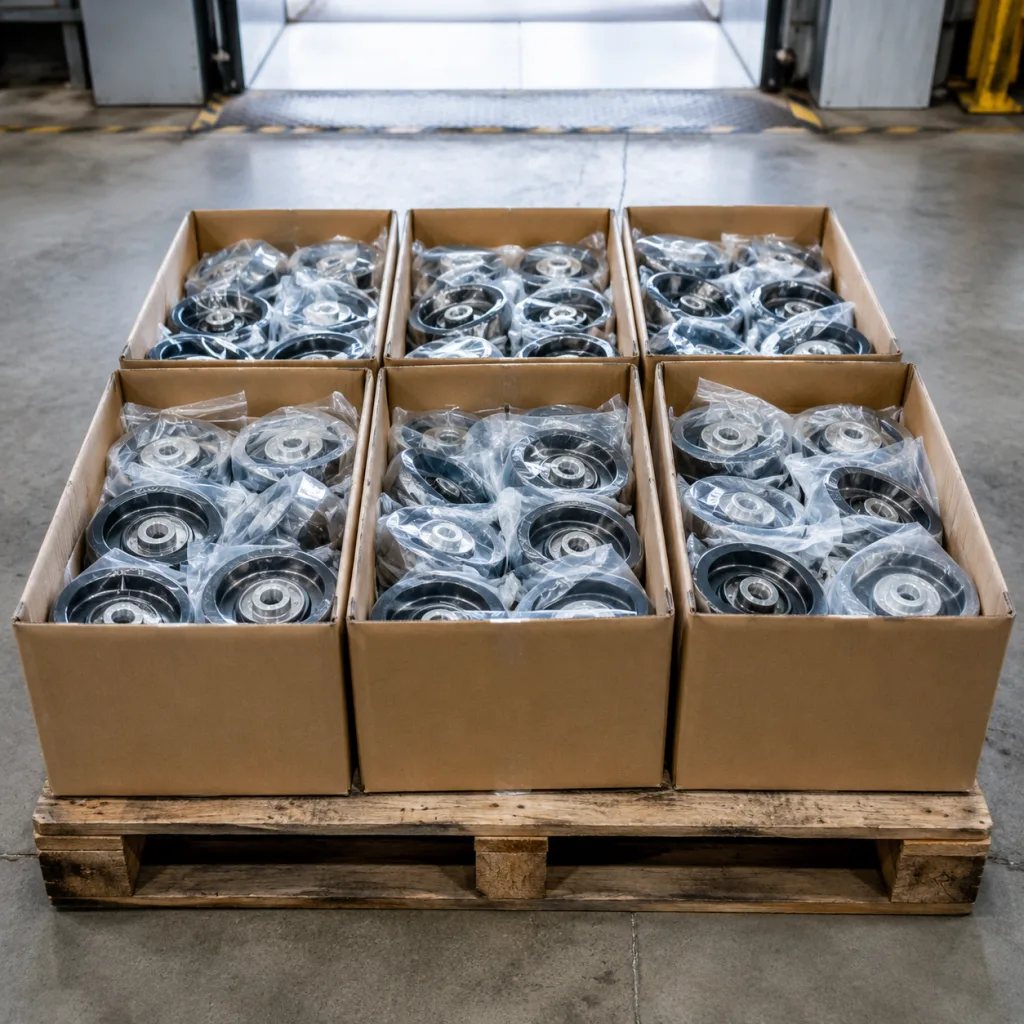
Packaging validationCarton strength, separators and corrosion protectionTransit damage and mixed claims

</tr></thead><tbody> </tbody></table>For egr cooler ford wholesale buyers, supplier selection should combine technical capability, communication discipline, export experience and willingness to work from verified application data. Driventus can support distributor programmes with SKU consolidation, private-label packing, sample comparison, batch inspection and production planning. To start a review, buyers can request a quote with target references, annual volume, destination country and packaging requirements.

Frequently asked questions

Send the target part references, photos or samples, annual volume, destination market, packaging requirements and any gasket or hardware requirements. If available, include drawings or inspection reports so dimensional matching can be checked before pricing.

Yes. Driventus can review neutral packaging, distributor labels and private-label carton requirements. Artwork, barcode format, carton strength and pallet layout should be approved before mass production.

No. Driventus is an independent aftermarket manufacturer; brand names are referenced for fitment only. Products are supplied as replacement components and should be selected using verified cross-reference and application data.

For Ford-fitment EGR cooler sourcing, share your SKU list, annual volume and target market so Driventus can review feasibility, MOQ and lead time. Contact the team at /contact.html

Request a Quote
Control point Recommended action Result for buyer
First articleApprove sample, dimensions and packagingReduces catalogue and fitment errors
Batch releaseRequest inspection summary and pressure-test recordsImproves shipment confidence
LabellingConfirm SKU, barcode and carton contentReduces warehouse sorting issues
Spare gasket policyDefine whether gaskets are includedAvoids repair-chain installation delays
Claim processAgree evidence and response timingSpeeds containment and replacement decisions
Forecast reviewShare demand by quarterImproves supply stability and lead-time control