EGR cooler · 2026-06-02

EGR Cooler Chevrolet Manufacturer China: B2B Sourcing Guide

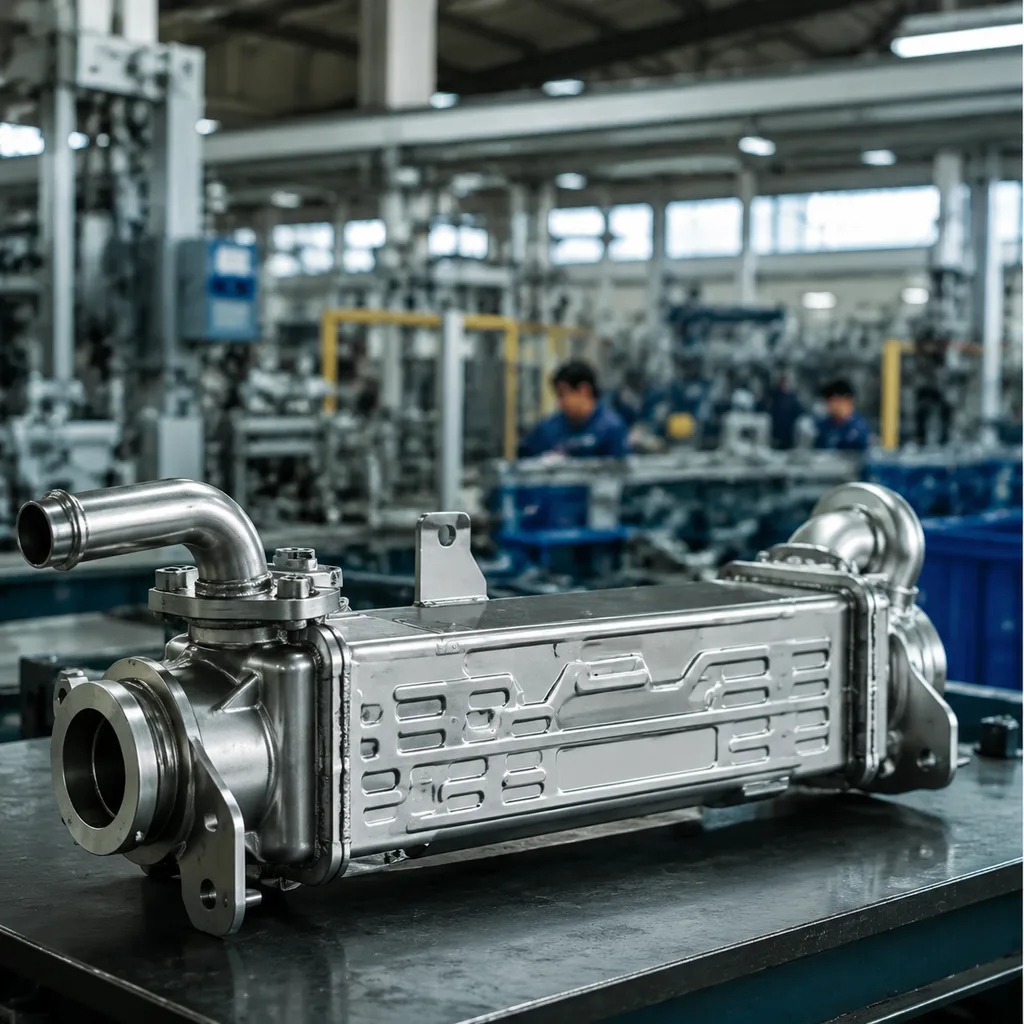
Sourcing Chevrolet EGR coolers from China is less about matching a catalog photo and more about controlling fitment, validation, and traceability. Buyers need clear data on engine family, emission calibration, mounting pattern, port orientation, coolant interface, package envelope, gasket faces, sensor bosses, bypass features where fitted, and the evidence behind thermal cycling and leak performance. For distributors, repair chains, fleet maintenance networks, and OEM-facing aftermarket channels, the main risks are familiar: dimensional drift, incomplete braze coverage, inconsistent TIG or laser weld quality, contaminated internal passages, incorrect coolant-neck clocking, and leak-test records that cannot be traced to a production lot. A capable supplier should confirm fitment from controlled data, quote against a defined revision, document the build route, and show how each process step reduces field failures such as coolant-to-exhaust leakage, external seam leaks, rising restriction, flange distortion, and bracket cracking. Driventus is an independent aftermarket manufacturer; brand names are referenced for fitment only. This guide explains what to specify, what to check during factory review, and how to compare suppliers on both technical and commercial terms. It is intended for procurement teams that need repeatable supply, controlled lead times, and traceable quality files, not consumer-facing replacement advice.

Start With Application Control

Before you ask for a price, define the exact application window. A Chevrolet EGR cooler can vary by engine code, model year, emission tier, vehicle layout, intake and exhaust routing, cooler bypass configuration, and whether the unit is gas-to-liquid or gas-to-gas. Parts that look nearly identical in a catalog image may still have different coolant neck clocking, flange thickness, bracket offsets, gasket faces, sensor boss positions, tube-pack volume, or internal flow restriction. For any buyer comparing an egr cooler chevrolet manufacturer china supplier group, the first filter is simple: can the factory control application data before it quotes?

Supply teams should send the target platform, OE cross-reference if available, sample photos, drawing revision, and any known supersession history. OE numbers and brand references should be used for fitment identification only, not as claims of original equipment supply. If you do not have a drawing, the minimum input set is:

  • engine family, displacement, fuel type, and model year range
  • vehicle platform, drive layout, GVW class where relevant, and emission tier
  • mounting point position, bracket layout, fastener size, and torque requirement where known
  • coolant inlet and outlet outside diameter, angle, clocking, bead form, and hose interface
  • exhaust gas port diameter, flange style, gasket face, bolt pattern, and stud clearance
  • overall envelope, tube routing, valve or bypass interface, sensor locations, and clearance constraints
  • gasket thickness, sealing land width, and machined face flatness requirement if available
  • mating part photos, failed sample photos, or 3D scan data when available
  • target annual volume, forecast split, service demand pattern, and launch timing

That level of detail prevents suppliers from pricing the wrong core design or offering a unit that fits only on paper. It also gives engineering teams a shared baseline for sample approval and production release. For multi-location buyers, insist on a revision-controlled data pack so the same part number does not drift across regions. The file should identify the drawing version, approved sample status, material specification, dimensional control plan, leak-test pressure and hold time, packaging specification, labeling rules, and any permitted deviations. If different markets need different labels, cartons, anti-corrosion protection, or pallet configurations, tie those requirements to the same controlled part file rather than relying on separate informal instructions.

Specify Materials And Construction

EGR coolers fail when the shell, core, and joints are not suited to the duty cycle. Exhaust gas temperature, coolant chemistry, road salt exposure, pressure pulses, vibration, and repeated thermal expansion all influence service life. For Chevrolet applications, ask for the full material stack and manufacturing method, not only a finished sample. A polished unit can still hide thin tube walls, incomplete furnace brazing, internal flux or weld residue, weak passivation, or distortion at the sealing face.

</tr></thead><tbody> </tbody></table>If the supplier cannot explain how tube forming, core assembly, brazing, welding, passivation, and final cleaning are controlled, expect batch-to-batch variation. Review the process route in order: incoming stainless inspection, tube forming, core stacking, fixturing, brazing or welding, pressure testing, machining if required, surface treatment, final cleaning, inspection, port capping, and export packing. Ask which operations are handled in-house and which are outsourced. Outsourced brazing, plating, passivation, or CNC machining can create traceability gaps unless purchase orders and batch records are properly linked.

Surface finish is not cosmetic in this category. Residue and scale can affect thermal performance, corrosion resistance, and leak risk. Weld discoloration beyond the agreed limit, excessive spatter, sharp burrs, distorted flanges, uneven bracket placement, and missing port caps are practical warning signs. For aftermarket programmes, confirm corrosion protection details and packaging that keeps ports and machined faces clean until installation. For higher-volume programmes, set control limits for tube wall thickness, flange flatness, bolt-hole position, leak rate, pressure hold time, flow restriction, and critical dimensions. Quality expectations should be measurable, not left to interpretation.

Ask For Validation That Matches Failure Modes

Validation needs to reflect the failures buyers actually see in the field: external coolant leakage, internal coolant-to-exhaust leakage, restriction increase, thermal fatigue cracking, pitting corrosion, vibration damage, blocked passages, and contamination. A basic visual inspection is not enough for an EGR cooler because many defects appear only after pressure, heat, coolant exposure, or shipping vibration. At minimum, request:

  • dimensional inspection against the released drawing or approved golden sample
  • 100% production leak testing by pressure decay, air-under-water, helium, or hydrostatic method with defined pressure, hold time, and acceptance limit
  • burst or proof-pressure testing on validation samples to confirm pressure margin above operating load
  • thermal cycling to expose joint movement, material expansion stress, and flange distortion
  • corrosion exposure relevant to road salt, acidic condensate, coolant vapour, and warehouse storage
  • flow and restriction measurement before and after cycling, with the same test fixture and pressure differential
  • weld, braze, or joint inspection records for critical areas, including section checks where appropriate
  • internal cleanliness checks such as particle size, particle count, or gravimetric residue where the application is sensitive to debris
  • packaging drop, compression, and vibration checks for export lanes
  • final inspection records linked to date code, batch, operator, fixture, and test equipment

For system governance, production should sit under IATF 16949:2016 and ISO 9001:2015, with material declarations aligned to REACH (EC) No 1907/2006 when the buyer or destination market requires them. Where buyers ask for durability evidence, test plans can be mapped to customer-specific cycles or recognized automotive methods for thermal shock, vibration, corrosion, and pressure integrity. The standard name matters, but the conditions matter more. The test should reflect the exhaust temperature swing, coolant pressure, vibration input, condensate chemistry, and environmental load expected in the programme.

Ask for raw data, not only a pass/fail statement. Procurement teams need the test curve, acceptance limit, sample count, test duration, equipment identification, calibration status, fixture description, and failure notes. These details support repeat orders and supplier audits. For first-article approval, request an inspection report that ties sample dimensions to the drawing and photographs the critical interfaces: coolant necks, exhaust flanges, gasket lands, brackets, sensor bosses, and bypass connections where fitted. For ongoing production, check how leak-test data is stored, how nonconforming units are segregated, how retest is controlled, and how corrective actions are issued when a batch shows abnormal leak decay, weld rework, or dimensional drift. A supplier that answers these questions clearly is usually better prepared for long-term B2B supply than one that can only offer a low unit price.

Compare Suppliers On Commercial And Audit Readiness

Supplier selection usually comes down to three factors: commercial stability, documentation quality, and engineering response time. Price still matters, of course, but an EGR cooler programme becomes expensive quickly if the supplier cannot hold fitment, repeat leak-test performance, or support claims analysis. Compare suppliers on their ability to quote from drawing, build prototype samples, lock a revision-controlled BOM, maintain a process control plan, and provide inspection records that match the shipped parts. Also review tooling ownership, fixture maintenance, replacement parts for failure analysis, controlled deviation approval, and long-run supply when a platform has low but steady service demand.

A practical supplier comparison should include:

  • quotation basis, including drawing revision, approved sample status, material grade, and included tests
  • MOQ, price breaks, tooling cost, fixture cost, sample cost, and payment terms
  • prototype lead time, PPAP or first-article lead time if required, production lead time, and repeat-order capacity
  • in-house versus outsourced process steps for tube forming, brazing, welding, machining, passivation, coating, and testing
  • traceability method by batch, date code, material lot, operator record, and leak-test station
  • inspection plan covering critical dimensions, flange flatness, port clocking, weld appearance, pressure decay, and flow restriction
  • packaging design, carton strength, port caps, VCI or desiccant use where needed, pallet pattern, labeling, and barcode support
  • claim response process, replacement policy, 8D or equivalent root-cause reporting format, and sample retention period
  • export experience, document support, HS code confirmation, and destination-market compliance declarations

For buyer workflows, start with our catalog, confirm the quality system, and use custom manufacturing when you need bracket changes, private label packaging, special labeling, sample reverse engineering, revised coolant neck orientation, or a non-standard port layout. If your programme also includes other engine parts, the broader engine components range can help consolidate sourcing. Consolidation may reduce supplier management work, but it should not replace part-level validation. Each EGR cooler still needs its own fitment, material, dimensional, flow, and leak-test approval.

The right supplier should be ready for factory audit questions on process flow, incoming material inspection, stainless grade verification, brazing or welding control, fixture management, in-process checks, final leak testing, gauge calibration, nonconforming material control, corrective action, and export packing. On the commercial side, ask for MOQ, sampling lead time, production lead time, and the cost impact of any coating, labeling, carton, pallet, port cap, or documentation change. Also confirm how forecast changes are handled, how long tooling and checking fixtures are retained, whether service parts can be produced after long gaps, and how obsolete revisions are blocked from shipment. That is the fastest way to separate a viable source from a low-price quote.

Driventus is an independent aftermarket manufacturer; brand names are referenced for fitment only.

Frequently asked questions

Provide the engine family, displacement, fuel type, model year range, vehicle platform, mounting photos, port sizes, gasket face details, drawing revision, target volume, launch timing, and any required leak, flow, corrosion, or thermal cycling test plan. If you have an OE cross-reference, include it for fitment review only.

Yes. Private label cartons, barcode labels, port caps, pallet labels, desiccant or VCI protection where required, and export packing can be set through drawing or sample approval. Confirm carton count, pallet pattern, retail-channel marking rules, and destination-market labeling requirements before release.

Check traceability, incoming stainless inspection, welding or brazing control, fixture condition, leak-test records, gauge calibration, nonconforming material handling, corrective-action flow, sample retention, and final packing. Ask for process records tied to IATF 16949:2016 and ISO 9001:2015, plus REACH declarations where needed.

If you are benchmarking suppliers, share the drawing, annual volume, required validation plan, and target launch date through [request a quote](/contact.html).

Request a Quote
Area Buyer check Why it matters
Core and tubesStainless grade such as 304, 316L, 409, or 441 as specified, wall thickness, tube geometry, fin or dimple design, braze alloy and furnace profileControls heat transfer, corrosion resistance, restriction, and fatigue life
Shell, end tanks, and housingsDrawn or stamped part quality, weld continuity, penetration control, distortion control, wall thickness consistencyAffects sealing, pressure strength, and repeatability
Flanges and machined facesFlatness target, bolt-hole true position, gasket surface finish, burr control, thread qualityPrevents installation leaks, gasket blow-by, and warranty returns
Gaskets and sealsTemperature rating, coolant and exhaust compatibility, compression set, material certificatePrevents coolant or exhaust leakage over repeated heat cycles
Brackets and fastenersLocation tolerance, coating thickness, torque retention, vibration resistanceReduces field noise, cracking, loosening, and installation issues
Internal cleanlinessPost-weld cleaning, particle control, drying, oil residue limit, port protectionProtects flow performance, valves, sensors, and downstream components