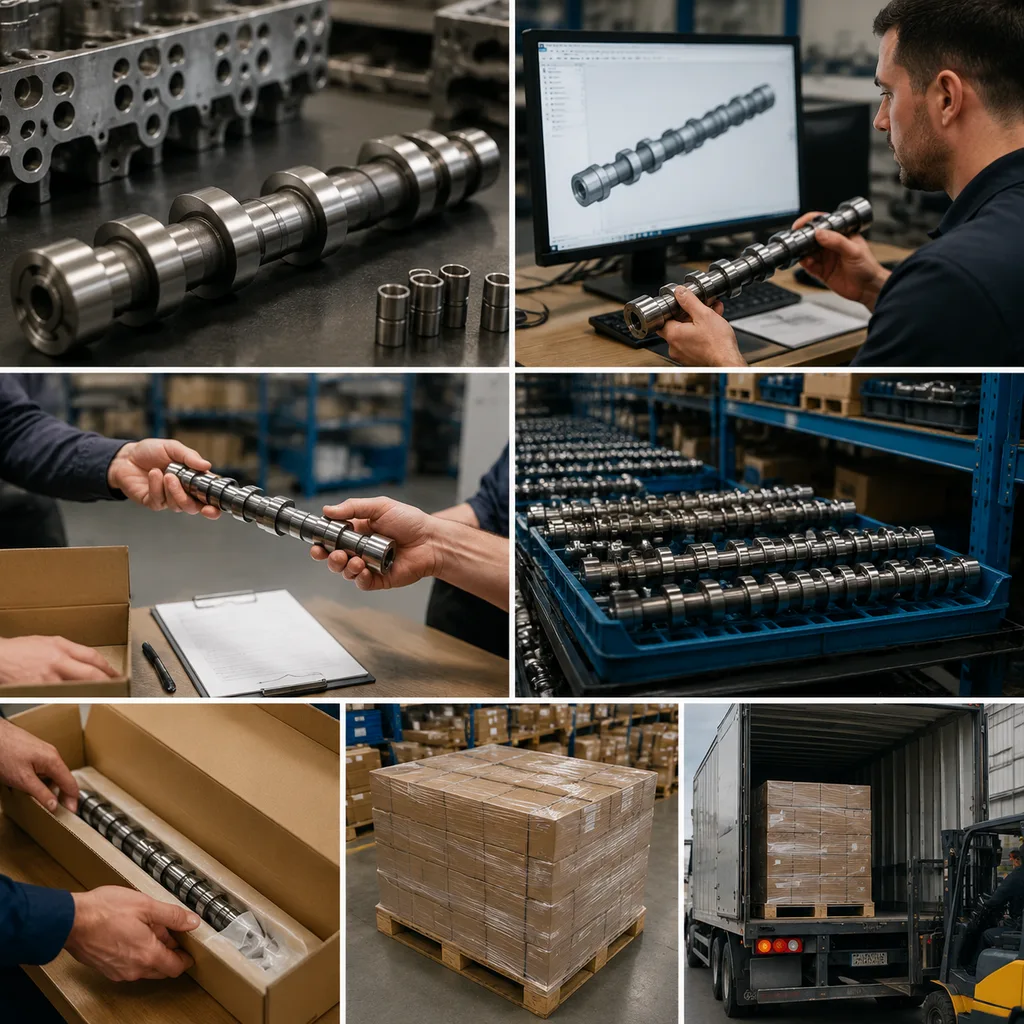
Wholesale buyers sourcing Chevrolet camshafts need stable dimensions, repeatable heat treatment, and traceable production records. The real risk is not the part category itself; it is variation in lobe geometry, journal finish, hardness, and package labelling across batches. Driventus is an independent aftermarket manufacturer; brand names are referenced for fitment only. We produce engine and powertrain components in Taizhou, Zhejiang, with IATF 16949:2016 and ISO 9001:2015 systems in place, and we export to 60+ countries. That matters when you compare suppliers on MOQ, lead time, and audit readiness instead of catalogue claims. Use this guide as a decision tool for camshaft Chevrolet wholesale programs: what to verify first, where specs usually break down, and how to build a repeat order process that does not drift after the first shipment.
Start with fitment, not price
For a Chevrolet camshaft program, the first decision is whether the reference actually fits the engine family, valvetrain layout, and OE cross-reference. Price comes after that. A cheaper part that misses journal length or lobe profile creates returns, downtime, and warranty noise.
Before you request samples or a production quote, confirm:
Engine code and application range
OE cross-reference, for example OE 06A107065 where applicable
Intake and exhaust profile, base circle, and lobe lift
Journal diameter, overall length, and thrust surface location
Surface hardness, runout limit, and finish condition
Packaging requirements for bulk or shelf-ready stock
If your customer base includes mixed repair networks, keep one approved data sheet per application. That reduces avoidable mismatches that are hard to spot at order stage but easy to detect in the field.
Where camshaft specs fail in wholesale sourcing
Wholesale camshaft sourcing usually breaks in the same few places: a spec sheet looks complete, but it hides tolerances, test methods, or heat-treatment detail. The fix is to compare suppliers on the same units and the same basis.
Item
What to confirm
Why it matters
Material
Alloy steel or cast iron grade, with heat number on the lot record
Affects wear resistance, machinability, and traceability
Journal diameter
Nominal size plus tolerance, commonly held within ±0.01 mm to ±0.03 mm depending on engine family
Prevents bearing interference or oil-clearance loss
Lobe lift
Intake and exhaust lift stated to the approved drawing, often within ±0.02 mm to ±0.05 mm
Controls valve opening and engine output consistency
Overall length
Measured end-to-end against the OE cross-reference
Prevents timing and thrust-fit issues
Runout
Total indicated runout measured on V-blocks or a precision fixture, typically limited to 0.03 mm or tighter for critical applications
Excess runout increases valvetrain noise and wear
Surface finish
Lobe and journal Ra value stated, with journals often targeted around Ra 0.2–0.8 μm depending on process
Supports stable oil film and break-in behaviour
Hardness
Lobe surface and core hardness values, with hardness map by point if requested
Confirms wear life and heat-treatment consistency
Traceability
Lot number, heat number, inspection record, and packing date
Needed for warranty, recall control, and claim segregation
</tr></thead><tbody> </tbody></table>Published quality and environmental expectations should align with IATF 16949:2016, ISO 9001:2015, and material compliance requirements such as REACH (EC) No 1907/2006 where applicable. For serious bids, ask for the actual inspection method, gauge resolution, and sampling standard instead of accepting a one-line compliance statement.
A practical buying sequence for stock and repeat orders
Wholesale buying is usually decided by stock risk. A camshaft program should be planned around the highest-turn applications first, then expanded to slower-moving references after demand is proven.
A practical purchasing sequence is:
1. Approve one sample against the target OE cross-reference. 2. Run fitment validation on a pilot batch, usually 20–50 units for low-volume channels or 100+ units for multi-branch distribution. 3. Place a stocking order sized to 60–90 days of demand for fast movers, or 30–60 days where warehouse capacity is limited. 4. Reorder only after defect rate, fill rate, and claim rate are stable for at least one cycle.
For importers, the most useful supplier data is not only unit price. Ask for MOQ, standard lead time, inspection method, carton quantity, and whether lead time is ex-works or includes packing. Typical wholesale camshaft MOQs are often 50–200 units per reference for stocked items and higher for custom machining or special coating requests, while standard production lead times commonly run 20–35 days after deposit and sample approval. If you need mixed references for regional fleets, use a forecast with separate bins for fast movers and long-tail applications so you do not overbuy slow references just to hit a single order minimum. Price should be evaluated on landed cost, not ex-factory price alone, because carton density, palletisation, and defect risk can materially change the actual cost per saleable unit.
How Driventus fits into supplier qualification
Driventus manufactures engine components in a vertically integrated plant, which gives buyers better control over machining, heat treatment, inspection, and packaging. For camshaft sourcing, that means one supplier can manage dimensional control and traceability across the order cycle.
Our quality system is documented on the quality system page, and our broader component range is listed in our catalog. Buyers who need a larger program across the valvetrain and rotating assembly can also review engine components.
Where a catalogue part needs adaptation for a specific market, custom manufacturing is available for approved programs. This is most useful when the engine family is known, but the packaging, coating, or inspection format must match a distributor or Tier-1 requirement. In practice, qualification usually starts with drawing review, sample sign-off, process-flow confirmation, and a first-article report covering critical dimensions, hardness points, and packing method before the buyer releases repeat production.
Validation that prevents returns
Before you launch a Chevrolet camshaft wholesale order, validate the part under the same conditions your customers will see in the field. A short test plan should include:
Dimensional inspection against the approved drawing, with a CMM or dedicated gauge set for critical points
Hardness verification at defined lobe and journal points, usually across 3–5 locations per sample
Visual inspection for scoring, pitting, burrs, or edge damage under 10x magnification
Fitment check with matched lifters, bearings, and timing set
Engine run-in or bench test where the application justifies it, typically 30 minutes to 2 hours for early-stage verification
For coated or corrosion-sensitive programs, request salt-spray or comparable corrosion data if the application demands it; 72-hour, 96-hour, or 240-hour exposure targets are commonly used depending on market requirements and coating type. For road-going validation, buyers sometimes reference industry test methods such as SAE J2527 for durability-related exposure contexts, but the exact protocol should match the application, expected service life, and internal qualification plan. Make sure the approval record ties the tested sample to the lot number that will ship, otherwise the validation does not protect the wholesale program from batch variation.
Commercial terms that keep programs stable
A reliable wholesale supply chain depends on clear commercial terms. Specify whether the program is spot-buy, stocking, or annual contract supply. Include target annual volume, forecast flexibility, and approved substitute policy.
Useful clauses for procurement teams:
Maximum acceptable dimensional deviation from approved sample, stated in the same unit system as the drawing
Lot traceability and retention of inspection records for at least 12–24 months, depending on warranty exposure
Labelling format for carton and unit pack, including part number, lot number, and country of origin
Nonconformance response time, ideally within 24–48 hours for acknowledgement and a defined containment window
Replacement or credit process for confirmed quality defects, with photo evidence and return conditions spelled out
For programs that cross multiple regions, standardise the document set early. That keeps customs, warehouse intake, and warranty teams aligned when shipments arrive from more than one production lot. A clean commercial setup also helps when price changes are tied to steel cost, plating cost, or annual volume tiers, because everyone can see the trigger points in advance instead of renegotiating after the first shipment.
Frequently asked questions
Yes. We support wholesale supply for distributors, repair chains, and importers with controlled production, inspection, and export packing. Program details depend on reference, volume, and validation requirements.
We work from OE cross-reference data where provided by the buyer, including generic references such as OE 06A107065. Brand names are used for fitment only, and no manufacturer endorsement is claimed.
Request the dimensional drawing, material and heat-treatment data, inspection criteria, traceability format, MOQ, lead time, and compliance status. For EU-bound programs, confirm REACH-related material declarations where needed.
If you are building a Chevrolet camshaft supply program, send your target references, annual volume, and inspection requirements. We will review fitment, lead time, and commercial terms through /contact.html