Camshaft Fiat OE Equivalent: Replacement Sourcing Guide
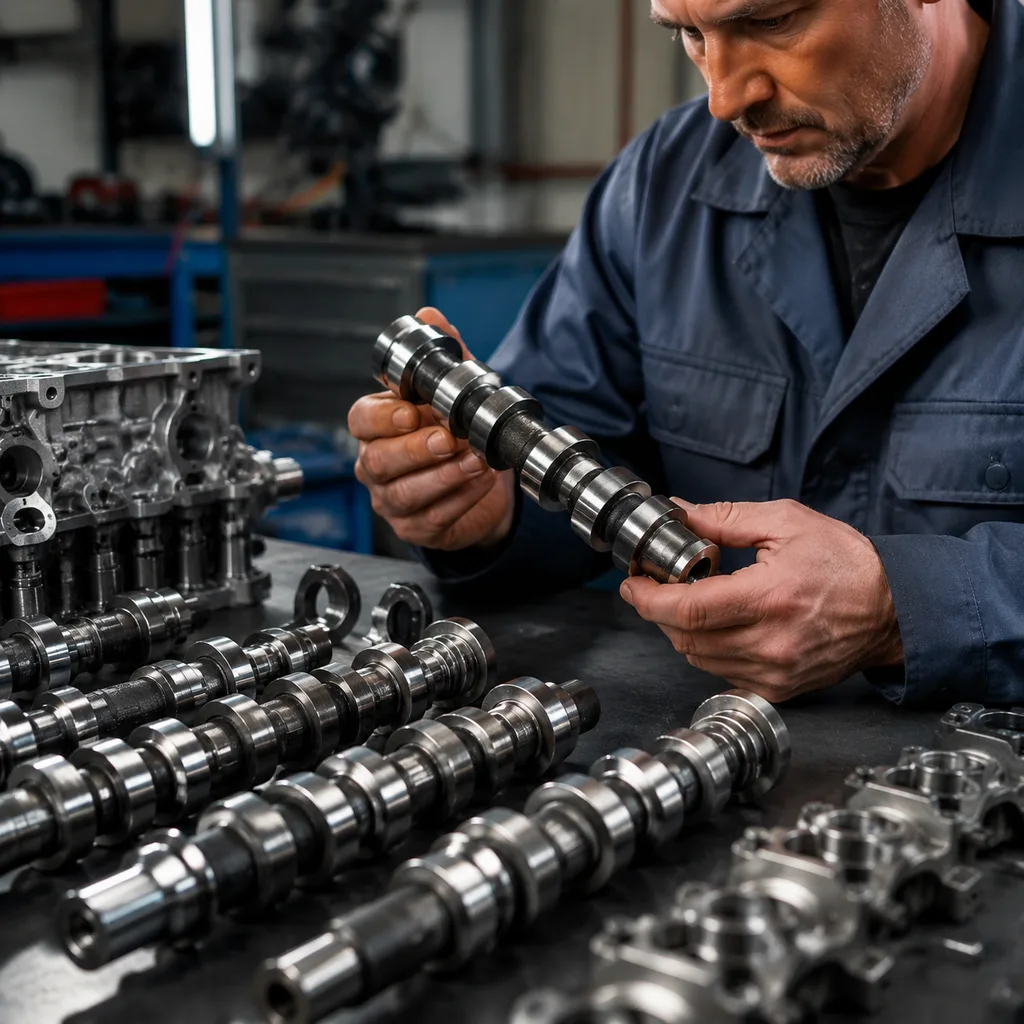
A camshaft Fiat OE equivalent has to match more than the headline vehicle fitment. Buyers should verify the OE reference, engine code, timing drive type, journal sizes, lobe lift, base circle, nose height, end play features, and surface finish against a measured sample or drawing before release. For distributors, repair chains, and OEM-facing procurement teams, the practical test is whether the replacement can be proven against the original part number with repeatable numbers, not just a catalogue cross-reference. Driventus is an independent aftermarket manufacturer; brand names are referenced for fitment only. We manufacture engine and powertrain components in Taizhou, Zhejiang, and supply B2B customers in more than 60 countries under IATF 16949:2016 and ISO 9001:2015 systems. This article explains what to verify, which tolerances and test data to request, and how to move from sample approval to stable volume supply.
How to judge an OE-equivalent camshaft
For a replacement camshaft, “OE-equivalent” should mean measured fit and function against the original, not a claim of factory approval. In procurement terms, that means the part must match the OE profile closely enough to pass assembly, timing, oil-clearance, and durability checks on the target engine family.
Check point
Typical buyer requirement
Practical tolerance target
Overall length
End-to-end match to reference sample or drawing
Within drawing tolerance; commonly ±0.10 mm to ±0.25 mm depending on engine family
Journal diameter
Measured at every bearing land and in two axes
Typically within ±0.01 mm to ±0.02 mm; roundness and taper controlled separately
Journal-to-journal spacing
Center distance verified across all bearing positions
Usually within ±0.03 mm to ±0.05 mm
Lobe lift
Compared with reference profile
Commonly within ±0.02 mm to ±0.05 mm
Base circle diameter
Matched to OE master
Typically within ±0.02 mm to ±0.05 mm
Lobe indexing / phase
Checked against timing reference
Usually within ±0.5° to ±1.0° cam angle unless the OE spec is tighter
Thrust face width and location
Confirmed against end-play control design
Must stay within functional drawing tolerance
Surface roughness
Journals and lobes measured separately
Journals often Ra 0.2–0.4 μm; lobes commonly Ra 0.4–0.8 μm depending on process
Hardness
Confirmed by process report or test
Often 52–60 HRC for hardened steel lobes, or equivalent case hardness for cast parts
</tr></thead><tbody> </tbody></table>For Fiat applications, the reference can be an OE number, engine code, or a verified service sample. Do not approve a replacement on name alone. Ask for dimensional reports, hardness data, material identification, and traceable batch records for each pilot lot.
What to check before you approve a replacement
Procurement teams should define acceptance criteria before sampling so supplier quotes can be compared on the same basis. A camshaft that looks correct can still fail at assembly if the journal spacing, keyway position, oil-hole orientation, or lobe phasing is off by a small amount.
Core specification list
Journal diameter at every bearing land, with measured actual values
Journal roundness, taper, and concentricity
Centre distance between journals and total accumulated spacing error
Lobe lift, lobe width, lobe nose radius, and lobe indexing
Cam nose height and base circle diameter
End play control features, including thrust face width and axial location
Keyway, dowel, drive gear, or sensor target position if present
Material grade, heat treatment route, and final hardness range
Surface finish on journals and lobes
Runout and straightness of the full shaft
A practical tolerance sheet for buyer approval should include both nominal and allowable deviation values. For example, many programs use a total indicated runout limit of 0.03 mm to 0.08 mm, with tighter limits on high-speed applications. Journal clearance should be validated against the engine builder’s bearing spec, and the supplier’s measurement report should show the actual values rather than only pass/fail marks.
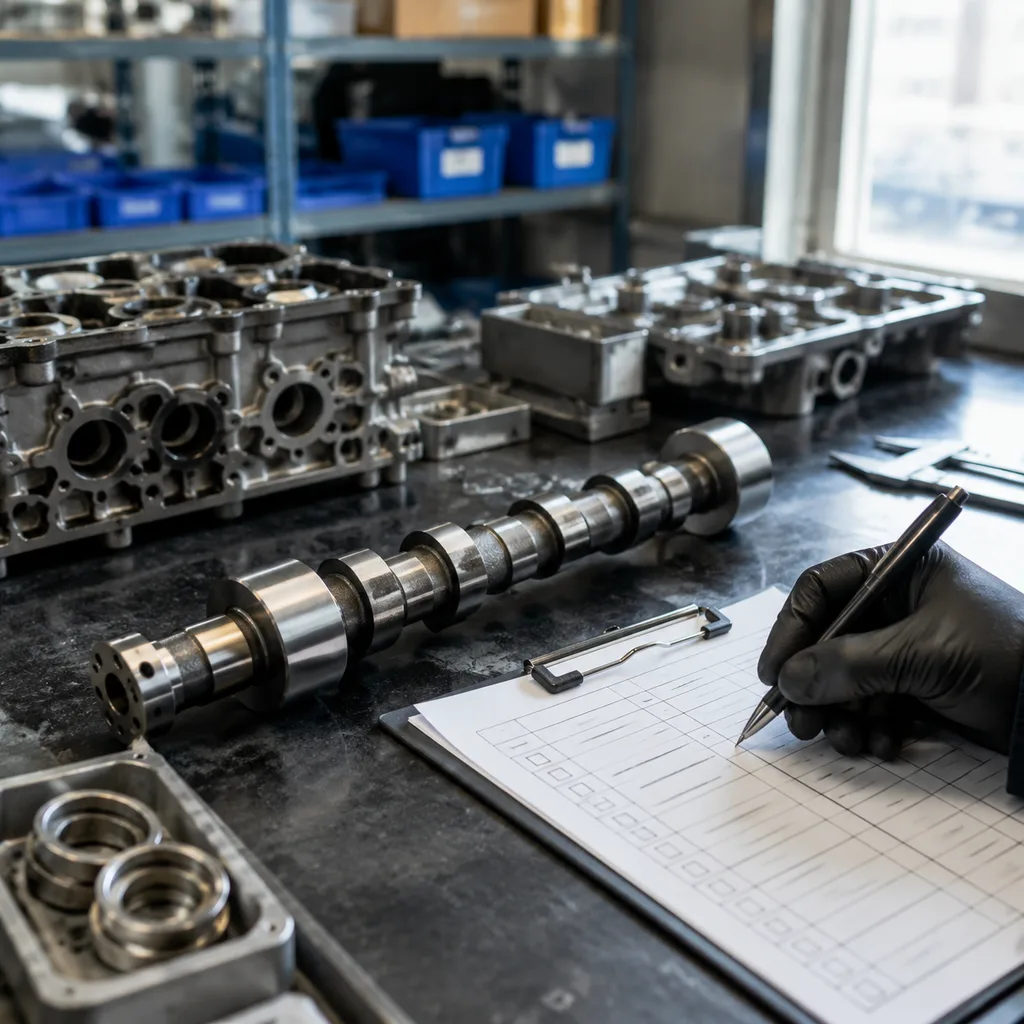
Request the supplier’s inspection report with actual readings from multiple locations, not only nominal values. For replacement programs, a typical buyer should also require first-article approval, a retained master sample, and a repeatability check across at least three to five pieces from the same batch. If your program includes mixed sourcing, standardise the measurement method, gauge block calibration, and ambient temperature condition so all incoming lots are checked against the same fixture and gauge set.
Materials and processes: where camshafts succeed or fail
OE-equivalent camshafts are commonly produced from chilled cast iron, ductile iron, or alloy steel, depending on the engine load, production route, and expected wear target. The right choice depends on engine speed, valve spring load, lubrication quality, and whether the design uses flat tappets, roller followers, or a mixed valvetrain.
Common process points include:
Precision rough machining before heat treatment
Induction hardening, chilled casting, or through-hardening where specified
Finish grinding of journals and lobes to final size
Controlled runout, straightness, and concentricity checks
Cleanliness control to reduce early bearing wear and oil contamination
Chamfer and edge-break control to prevent assembly damage
Typical buyer-requested data should include material certificate, heat-treatment summary, hardness map, and dimensional capability on the first production lot. For steel camshafts, buyers often request core hardness and surface hardness values, such as surface hardness in the 58–62 HRC range with a softer core for toughness, depending on design. For cast-iron camshafts, buyers should ask for chill depth or equivalent wear-resistant layer data if that is part of the process.
Published standards matter here. Buyers can ask for compliance support aligned with IATF 16949:2016 and ISO 9001:2015 for quality management, plus material declarations that support REACH (EC) No 1907/2006 when required for EU supply chains. For durability validation, ask whether the part has been verified using cycle or wear testing methods relevant to the application, such as bench endurance runs, oil-compatibility checks, or environmental exposure testing where applicable to coated or treated components.
How Driventus validates fit and function
Our replacement camshaft programs are built around sample matching, controlled inspection, and repeatable production control. For buyers sourcing Fiat applications, the usual validation path is designed to reduce risk before a purchase order is released for volume.
1. Receive OE sample, drawing, or verified cross-reference. 2. Confirm critical dimensions, especially journals, lobe profile, indexing, and thrust features. 3. Review material and hardness targets against the target engine duty and follower type. 4. Produce pilot parts and inspect them against the agreed master. 5. Run installation feedback and, where needed, bench or fleet validation. 6. Lock the approved sample, measurement method, and lot acceptance criteria for reorder control.
A buyer-ready validation pack should include the dimensional report, hardness results, runout values, photos of the inspection setup, and batch traceability. If the application is not fully standardised, our custom manufacturing route can adapt the design to the target build while keeping the external fitment stable. That is especially useful where the same engine family has different emissions, valve-train, or market-specific revisions that share a commercial description but not identical geometry.
Sourcing checklist for distributors and repair chains
A practical sourcing file should include the OE reference, engine code, part markings, packaging target, and inspection requirements. That keeps returns low and helps purchasing compare suppliers on measurable data instead of catalogue claims.
Use this checklist before approval:
Confirm OE number or verified cross-reference from the vehicle application
Match engine code, valve count, fuel system, and timing drive type
Verify whether the engine uses belt, chain, or gear drive and whether phasing features are present
Require dimensional report for at least one pilot lot, plus an agreed master sample
Confirm finish, hardness, runout, and concentricity limits
Verify label, carton, barcode, and batch traceability needs
Align warranty terms with installation method, service interval, and intended market
Ask for MOQ, target annual volume, and reorder lead time before sample approval
For commercial planning, buyers should ask suppliers to quote MOQ and price tiers together. A common B2B structure is a higher sample or pilot-unit price, then lower unit pricing at breakpoints such as 100, 300, or 500 pieces, with the exact tier based on material, machining complexity, and packaging. Typical lead time for a validated program can be 25–45 days for first production after sample sign-off, with repeat orders often moving faster if raw material is stocked. If inventory is required, confirm whether the supplier can hold safety stock, whether the MOQ applies per part number or per shipment, and whether mixed-model consolidation is allowed.
If you are building a wider engine programme, review our catalog and the related quality system before placing a sample order. Buyers managing broader engine lines can also review engine components for adjacent parts that need the same validation discipline.
When to move from sample approval to volume supply
Move to volume supply only after the camshaft passes dimensional inspection, installation fit, and the first operating check under the intended duty cycle. For aftermarket distribution, that usually means confirming zero interference at assembly, stable valve timing, correct oil pressure behavior, and no abnormal wear pattern after the initial run-in period.
A practical release rule is to approve volume only after the following have been closed:
First-article dimensions are within tolerance on all critical points
Surface hardness and finish meet the agreed range
Runout, straightness, and indexing are repeatable across multiple samples
Installation on the target engine shows no clearance issues or sensor interference
A run-in or road-test window shows stable operation with no abnormal noise or wear
Packaging, labeling, and traceability match the approved commercial spec
For repeat programs, lock down the approved master sample, test method, and lot acceptance criteria. This makes reorders consistent even when packaging, labor, or freight routes change. If the target is a Fiat application with regional variation, keep a controlled record of the engine code, OE reference, measured dimensions, and acceptance tolerance tied to the approved part number. That reduces mismatch risk when the same commercial description is used across multiple markets and sourcing teams need a fast reorder decision.
Frequently asked questions
No. OE-equivalent means the part matches the required fit, dimensions, and function. It does not mean manufacturer approval or endorsement. Driventus is an independent aftermarket manufacturer; brand names are referenced for fitment only.
Start with journal diameter, overall length, lobe profile, thrust features, and surface hardness. Then confirm the engine code, timing drive type, runout, and measured phasing against the approved sample.
Yes. We can support custom manufacturing for specific fitment or programme needs, including pilot samples, dimensional control, batch traceability, and reorder planning for B2B supply.
If you need a validated replacement camshaft program for Fiat fitments, send the OE reference, engine code, target annual volume, or sample details and we will review it with you. Start here: /contact.html