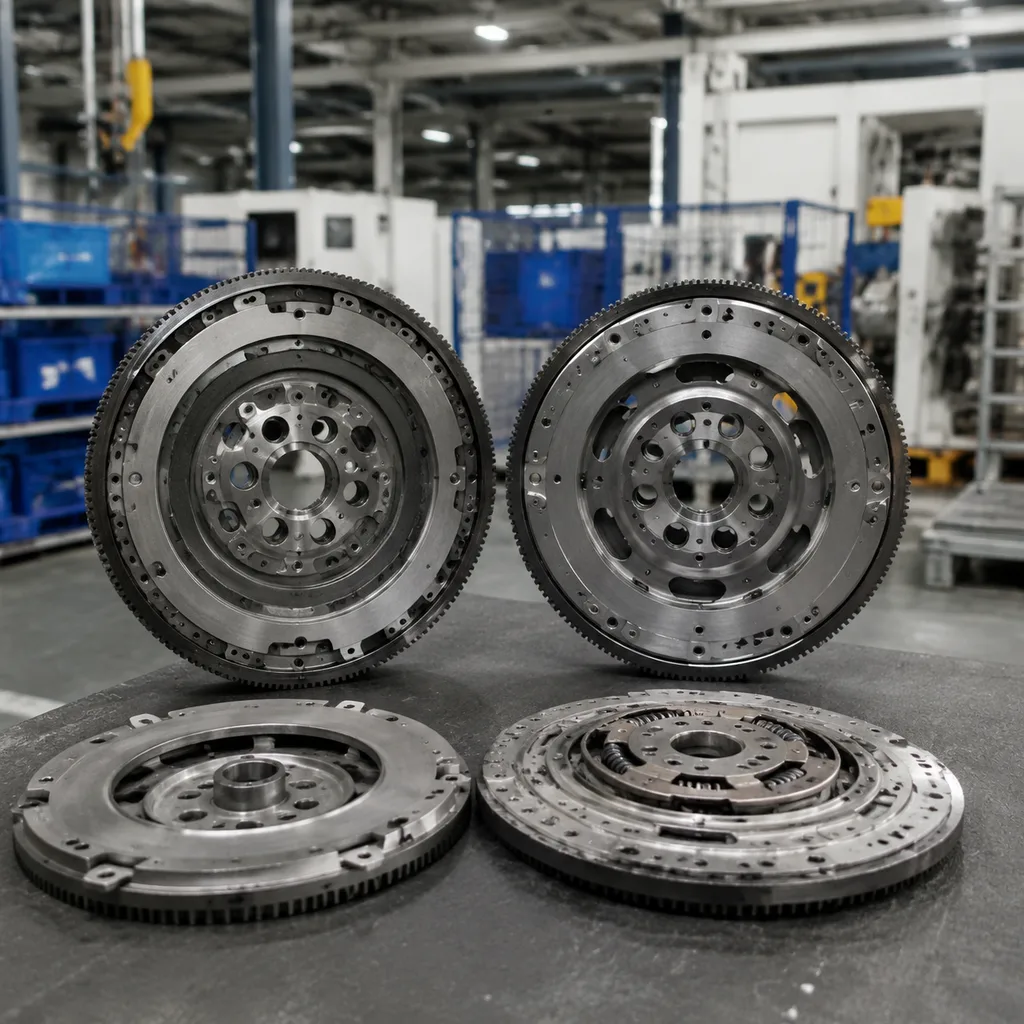
Dual Mass Flywheel Nissan Manufacturer in China
A Nissan-fitment dual mass flywheel program can fail for reasons that never appear on a price sheet: a regional engine variant, a wrong crank offset, poor balance control, weak packaging, or a supplier that cannot explain its own inspection plan. For importers, distributors, and repair-chain buyers, the sourcing decision has to connect fitment data, damping performance, batch traceability, validation evidence, and export execution.
Driventus manufactures Nissan-fitment dual mass flywheel assemblies in Taizhou, Zhejiang, for aftermarket distributors, private-label brands, and procurement teams looking for a China-based production partner rather than spot-market trading. We support export programs for the EU, UK, US, Canada, Australia, Brazil, the Middle East, and other markets.
This article is structured as a practical buyer’s review for anyone evaluating a dual mass flywheel Nissan manufacturer China program: what to confirm first, where failures usually start, which specifications matter, how validation should be staged, and how MOQ, packaging, and supplier qualification affect the final purchase order. Driventus is an independent aftermarket manufacturer; vehicle brand names are used for fitment identification only.
Start with the application, not the model name
The fastest way to create a fitment dispute is to source by vehicle model alone. Nissan model names can cover different engines, transmission families, clutch diameters, production ranges, and regional specifications. A part that fits one market version may not fit another.
A cleaner sourcing decision starts with the powertrain. For Nissan-fitment dual mass flywheels, buyers should confirm the engine code, gearbox family, clutch diameter, production year range, drive configuration where relevant, and destination market. Only then should price comparison begin.
Driventus supports aftermarket and private-label supply for common Nissan-fitment dual mass flywheel requirements, including sample matching and drawing-based development when sufficient technical data is available. For active references, RFQ review usually begins with OE-style number, clutch diameter, ring gear tooth count, crankshaft bolt pattern, overall height, and known market usage. Buyers can review adjacent engine and powertrain lines in our catalog and submit gaps through a structured RFQ.
Include these details in the RFQ where possible:
- Destination market: EU, UK, US, Canada, Australia, Brazil, Middle East, or other region
- Vehicle platform, model year range, and drive configuration where relevant
- Engine displacement, fuel type, output range, and engine code
- Transmission code, gearbox family, and 5-speed or 6-speed manual-transmission type
- Clutch disc outside diameter, spline count, hub profile, and spline specification
- Existing OE-style, aftermarket, or customer reference numbers
- Measured sample data: ring gear teeth, pilot location, bolt count, bolt PCD, offset, and stack height
- Annual forecast, trial order quantity, and expected reorder pattern by SKU
- Packaging format: neutral box, Driventus packaging, or private-label carton
- Required label language, EAN/UPC/Code 128 barcode format, carton marks, and pallet configuration
Photos matter. Send 8–12 clear views of the sample: front face, crank side, side profile, ring gear, bolt holes, markings, clutch contact face, locating pins, and any wear pattern worth noting. A strong cross-reference file reduces sample loops and avoids the familiar problem of two suppliers quoting “the same” application while using different technical assumptions.
Driventus does not claim approval, sponsorship, or endorsement by any vehicle manufacturer.
Where China sourcing programs usually go wrong
Most dual mass flywheel sourcing problems are not dramatic at the beginning. They start as small gaps: a missing inspection record, an unconfirmed ring gear position, a private-label carton approved too late, or a supplier that cannot separate an existing reference from a new-development item.
Procurement teams sourcing from China need evidence that a manufacturer can repeat the same dimensions, damping behavior, assembly quality, and traceability across batches. Driventus operates under IATF 16949:2016 and ISO 9001:2015 management systems. These frameworks support process control, incoming inspection, nonconforming material handling, corrective action, supplier management, and production traceability.
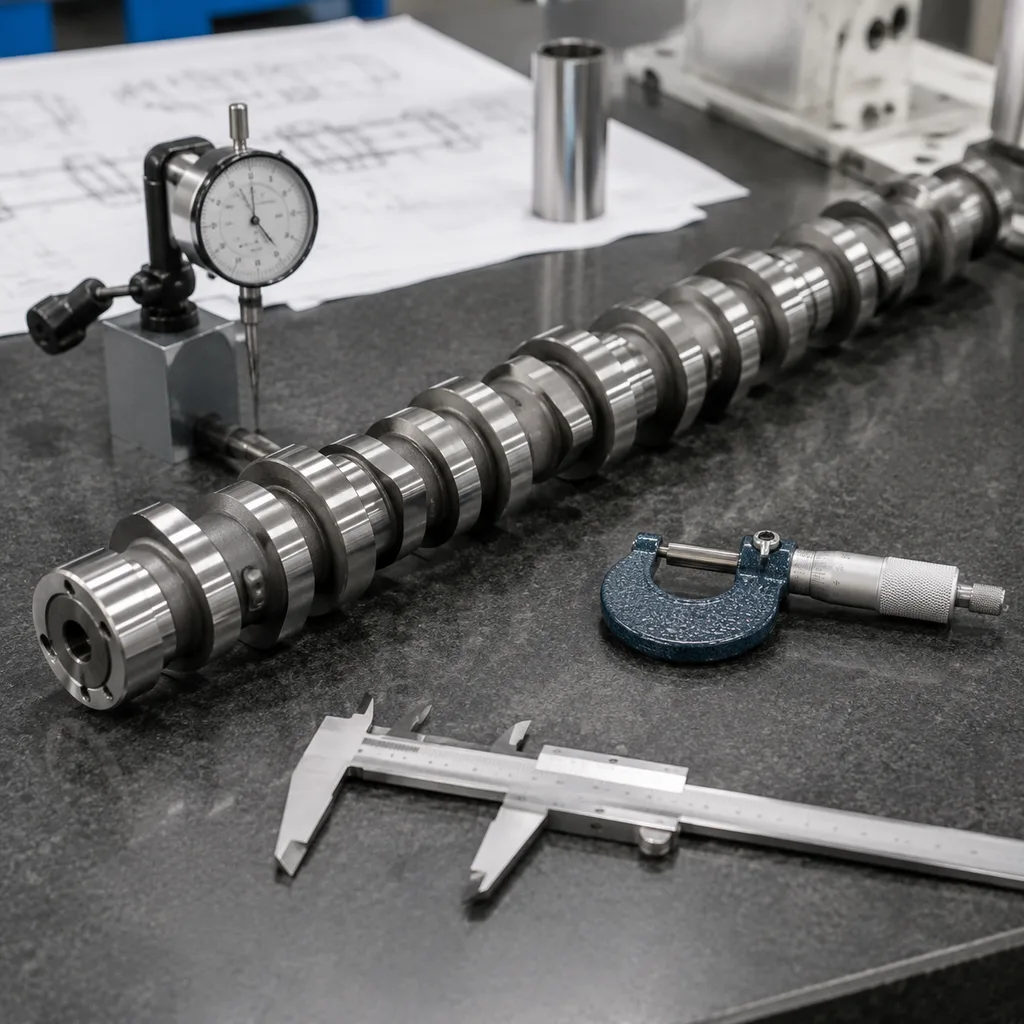
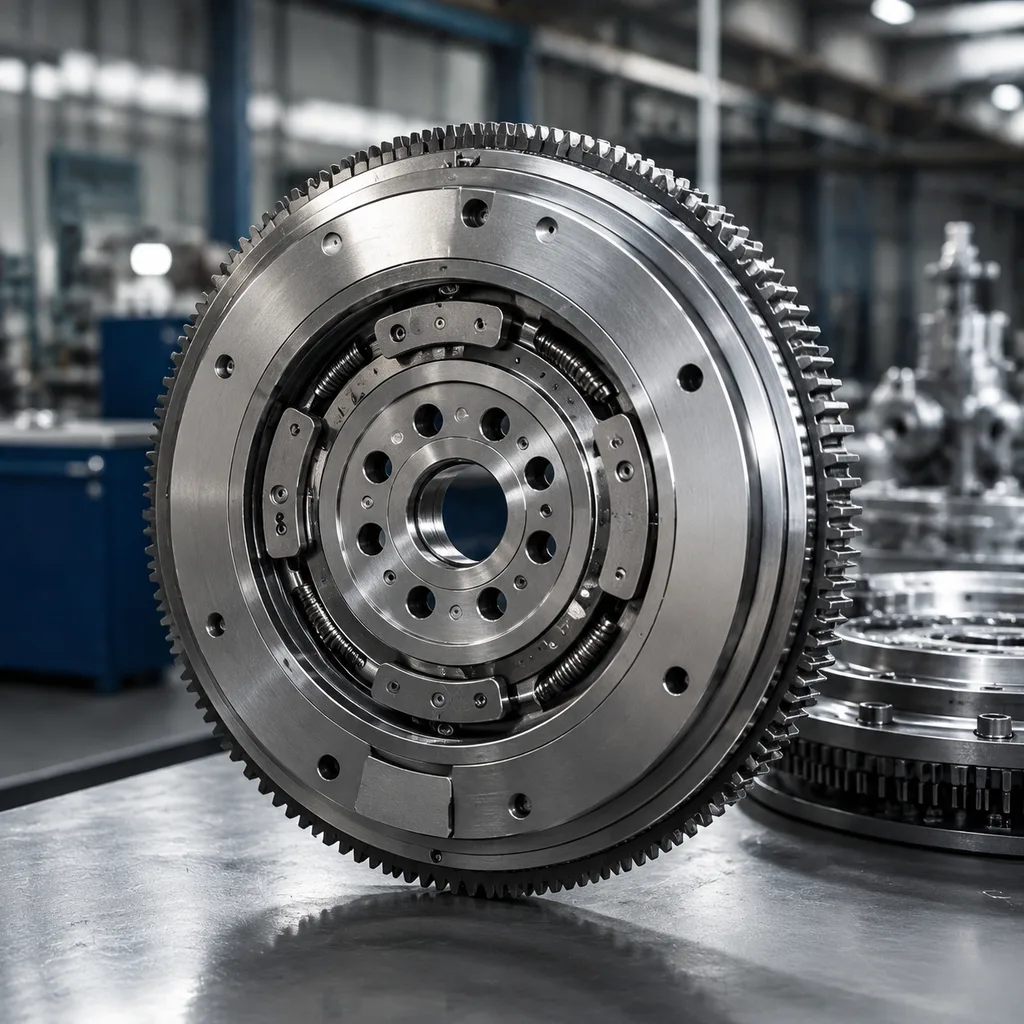
For dual mass flywheels, the highest-risk controls include machining accuracy, spring set selection, friction interface finish, rotational balance, grease quantity, fastener retention, angular free-play verification, and final surface protection. In a typical control plan, critical dimensions are checked with CMM, height gauge, dial indicator, micrometer, thread gauge, spline gauge, and runout fixture as appropriate.
A traceable batch should connect the finished carton back to the heat or batch lot, machining lot, assembly date, operator record, inspection record, and packing record. Without that chain, warranty investigation becomes guesswork.
Typical process flow includes incoming casting or forging inspection, rough machining, stress-relief or heat-treatment confirmation where applicable, CNC finishing, ring gear fitting, friction surface machining or grinding, cleaning, damper spring and grease assembly, rivet or fastener locking, free-play inspection, dynamic balancing, corrosion protection, final inspection, and export packing.
A buyer audit file may include:
- Business licence and export qualification documents
- IATF 16949:2016 and ISO 9001:2015 certificate information
- Process flow chart, control plan, PFMEA summary, and inspection standards
- Incoming material inspection records and material certificate review
- In-process and final inspection forms with AQL or 100% critical-characteristic checks defined
- Measuring equipment calibration records by equipment ID and calibration date
- Traceability and batch coding procedure from raw material to finished carton
- Nonconforming product control procedure and segregation method
- Corrective action report template using 8D or equivalent root-cause format
- Packaging specification, pallet photos, and drop-handling verification records
Buyers can review Driventus’ quality system before arranging a remote review or on-site factory audit. For new private-label programs, audit preparation should be scheduled early. If it is left until after price negotiation, it often delays shipment more than buyers expect.
Specification deep-dive: the dimensions that decide fit and NVH
A dual mass flywheel is not a simple heavy disc. It is a tuned assembly that must match the crankshaft, clutch, starter, gearbox, and expected torsional behavior of the application. Small deviations can produce clutch judder, starter engagement noise, poor release travel, vibration at idle, gearbox rattle, or early warranty returns.
| Specification item | Why it matters | Buyer verification point | |
|---|---|---|---|
| Ring gear tooth count and position | Affects starter engagement and cranking noise | Match tooth count, tooth width, chamfer direction, axial position, and OD to sample or drawing | |
| Clutch friction diameter | Determines clutch cover and disc compatibility | Confirm disc OD, cover bolt pattern, contact band width, and pressure plate seating face | |
| Crankshaft bolt pattern | Controls installation fitment | Check PCD, bolt count, bolt size, counterbore, dowel holes, and locating features | |
| Axial height and offset | Influences release system geometry | Compare stack height, crank face to clutch face, and pilot depth against approved sample | |
| Rotational free play | Indicates torsional damping range | Verify angular free play, stop position, return feel, and limit torque against the approved standard | |
| Tilt or rock angle | Relates to wear control and NVH performance | Inspect after assembly and during validation review; excessive rock can create noise and uneven clutch contact | |
| Balance condition | Affects vibration and bearing load | Conduct dynamic balance inspection before packing; record balance grade or residual unbalance requirement by project | |
| Friction surface finish | Impacts clutch bedding, heat behavior, and engagement feel | Control turning or grinding marks, Ra target, runout, flatness, and surface cleanliness | |
| Grease and spring set | Determines damping durability under load and heat | Validate grease fill weight, spring rate selection, torque cycling, and temperature exposure | |
| Ring gear hardness | Supports starter durability | Verify hardness, tooth condition, and heat-treatment record where required |
| Item type | MOQ guide | Lead-time guide | Notes |
|---|---|---|---|
| Existing application, neutral box | 100–300 pcs per reference | 35–50 days after deposit | Subject to current production plan, raw casting status, and stock status |
| Existing application, private label | 300–500 pcs per reference | 45–60 days after artwork approval | Includes label, carton, barcode, print colour, and carton-strength confirmation |
| New sample development | Case by case, often 10–30 pcs pilot after sample approval | 60–90 days for sample stage | Requires sample, drawing, or detailed cross-reference data; tooling adds cost and time |
| Mixed-container program | Negotiated by total volume, often 500+ pcs combined | 45–70 days | Suitable for distributors with broad SKU demand and repeat forecast |