Sourcing a dual mass flywheel for Mazda applications is a technical and supply-chain decision, not only a price comparison. Importers, distributors, and repair-chain buyers need reliable fitment coverage, consistent torsional damping performance, controlled production batches, and documentation that supports internal supplier approval. In wholesale programmes, the most common risks include dimensional mismatch, incorrect ring gear specification, unsuitable sensor reference geometry, inconsistent grease sealing, and noise or vibration complaints after clutch replacement. Practical sourcing should define critical dimensions in millimetres, allowable runout, ring gear tooth count, free angular movement, axial play, balancing grade, packaging drop protection, MOQ by SKU, and lead-time by approval stage before a purchase order is released. Driventus manufactures engine and powertrain components in Taizhou, Zhejiang, and supplies B2B customers in more than 60 countries. Our dual mass flywheel programme is designed for aftermarket distributors, wholesalers, Tier-1 purchasing teams, and multi-location repair networks that require batch traceability, inspection records, and export-ready packaging. Driventus is an independent aftermarket manufacturer; vehicle brand names are used for fitment reference only.
Wholesale Fitment Scope for Mazda Applications
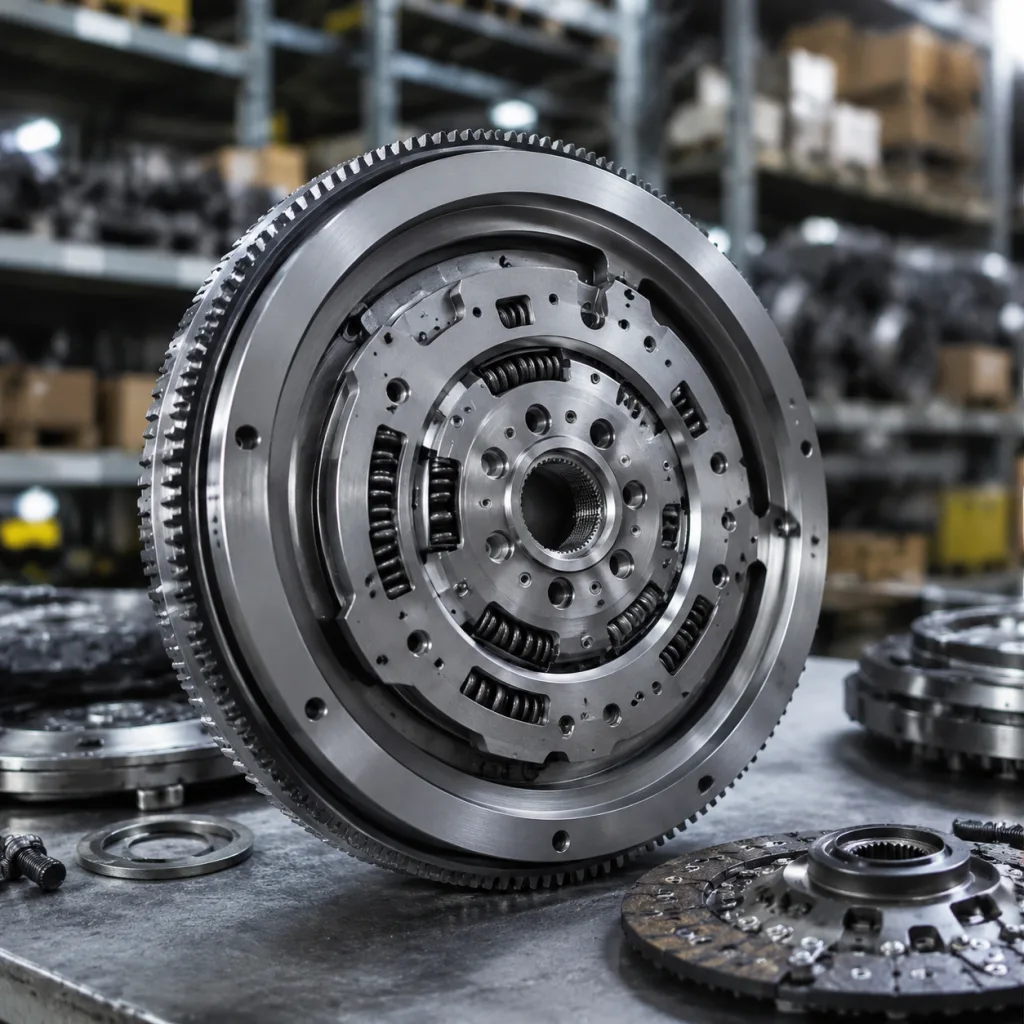
A dual mass flywheel for Mazda applications must be matched by engineering specification, not by visual similarity alone. Important fitment points include the engine family, transmission interface, clutch diameter, crankshaft bolt pattern, pilot location, ring gear tooth count, mounting height, friction face position, and any crankshaft or speed sensor reference features. A flywheel that looks close to the original part can still create drivability problems if the primary-to-secondary mass angle, damper spring rate, axial clearance, or balance condition differs from the intended design.
For importers building a Mazda coverage range, Driventus can support part-number mapping against buyer-supplied samples, drawings, TecDoc-style references, fitment lists, or existing aftermarket numbers. A workable fitment file should include engine code, gearbox code, model year range, clutch disc diameter, spline count where known, starter type, ring gear tooth count, crankshaft bolt quantity and PCD, centre bore, total height, friction face offset, and any trigger-window or sensor-reference details. For sample reverse-checking, buyers should provide at least one unused OE or proven aftermarket sample per target SKU; for high-risk launches, two samples from different batches are preferable.
Where an OE part-number cross-reference is supplied by the customer, it should be used only as a fitment reference in the programme documentation and shown in a generic form where appropriate, such as OE 06A… or OE 11251…. We do not claim vehicle manufacturer approval, endorsement, or authorisation.
Typical applications include petrol and diesel passenger vehicles using manual transmission systems where torsional vibration isolation is required between the engine and driveline. Depending on the market, buyers may also need to confirm clutch kit pairing, starter engagement, repair information, and local warranty expectations before launch. For a wholesale launch, a practical first range is often 3–8 fast-moving SKUs, with 20–50 sample or trial units used for installer feedback before the buyer commits to deeper stock. Buyers can review adjacent powertrain lines through our catalog, including clutch-related and engine interface components where offered.
Supplier Criteria: MOQ, Lead-Time, and Audit Readiness
For dual mass flywheel Mazda wholesale procurement, a practical supplier evaluation should look beyond the quoted unit price. Buyers should confirm engineering capability, batch control, order flexibility, export experience, and corrective-action discipline before committing to container-volume supply. A lower price is not useful if it comes with weak fitment control, unclear inspection records, or packaging that fails in transit.
Sourcing item
Typical Driventus approach
Buyer verification point
MOQ
Normally 50–100 pcs per approved SKU; mixed-SKU consolidation may be discussed from about 300–500 pcs total
Confirm SKU count, annual forecast, carton quantities, and launch priority
Sample quantity
Usually 1–5 pcs per SKU depending on whether destructive inspection or installation trial is required
Decide whether samples are for bench measurement, installer test, catalogue photography, or all three
Sampling lead-time
Usually 30–60 days when tooling, sample comparison, or validation is required; repeat samples may be faster
Provide sample, drawing, photos, or full fitment list early
Mass production lead-time
Usually 45–75 days after order confirmation, deposit, artwork freeze, and material release, subject to capacity and material status
Check seasonal demand, booking windows, and shipping cut-off dates
Indicative price logic
Pricing is affected by casting/forging route, ring gear specification, damper design, machining time, balancing, packaging, documents, and order volume
Compare quotations on the same Incoterm, packing standard, inspection scope, and currency validity
Payment and booking logic
Production planning normally starts after commercial confirmation and agreed advance/payment terms
Align cash-flow approval with the factory lead-time and vessel booking window
Packaging
Neutral export carton, palletised packing, VCI/anti-rust protection, foam or moulded separators, and barcode labelling available
Batch number, inspection records, production date, and retained samples where agreed
Align identification method with distributor warranty and recall procedures
Audit support
Remote document review or on-site factory audit by appointment
Request process flow, control plan, capability data, sample inspection records, and corrective-action format
</tr></thead><tbody> </tbody></table>MOQ and price should be treated as connected variables. A 50-piece launch order may be appropriate for validation, but the per-unit cost is usually higher because set-up, inspection, packaging artwork, and export handling are spread across fewer units. A 200–500 piece order per SKU can improve material planning and machining efficiency, while mixed-SKU container consolidation may reduce landed cost even if individual SKU MOQ stays modest. Buyers should also ask whether the quote includes flywheel bolts, installation notes, private-label inserts, pallet fumigation treatment where required, or third-party inspection fees.
Driventus operates under IATF 16949:2016 and ISO 9001:2015 quality-management principles, with incoming inspection, in-process checks, quality planning, final inspection records, and continuous-improvement practices. Buyers can review our quality system before sample approval, supplier onboarding, or annual vendor review.
Technical Controls That Matter in a Dual Mass Flywheel
A dual mass flywheel has more functional variables than a single solid flywheel. Procurement teams should request objective inspection points and validation records because noise, vibration, harshness, clutch judder, and starter engagement complaints often originate from small deviations in geometry, damping behaviour, or assembly control. The specification must be agreed by drawing, golden sample, or approved inspection sheet; the values below are practical control examples and should be adjusted to the target application.
Key control points usually include:
Crankshaft mounting face runout: commonly controlled within about 0.03–0.08 mm TIR on the mounting datum to maintain clutch alignment and reduce driveline vibration risk.
Friction surface flatness and finish: typically checked for local flatness, parallelism to the mounting face, and surface roughness suitable for clutch bedding; many aftermarket programmes target roughly Ra 1.6–3.2 µm unless the approved sample requires otherwise.
Ring gear tooth geometry: verified for tooth count, OD, tooth chamfer, hardness, axial position, and starter engagement; incorrect tooth lead-in or axial offset can create starter noise even when the flywheel bolts on correctly.
Sensor trigger position: checked where the flywheel carries timing or speed reference features; angular window position, tooth absence, magnet/reluctor geometry, and air-gap surface should be matched to the approved reference.
Free angular movement: measured in degrees against the design range to confirm damping function; common DMF designs may show roughly 10°–30° total free movement, but the correct value is application-specific.
Axial play: controlled to prevent abnormal noise, contact wear, or excessive movement under load; typical inspection plans define both new-part axial movement and maximum allowable variation from the approved sample.
Grease retention and sealing: inspected for seal fit, crimp integrity, grease specification, and evidence of leakage after handling or heat exposure; poor retention can lead to rattle and damping fade.
Balance condition: verified to limit rotating imbalance at operating speeds; buyers should define whether the requirement is a residual unbalance limit in g·mm or a balancing grade such as ISO 21940 G16 or tighter where justified.
Fastener and mounting interface accuracy: checked so the flywheel seats correctly against the crankshaft and clutch assembly; bolt hole diameter, countersink depth, thread clearance, dowel location, and torque-seat condition must match the service procedure.
Heat treatment and hardness: ring gear and wear-contact areas should be controlled by agreed hardness range and case depth where applicable; the inspection record should state method, location, and sampling frequency.
Corrosion protection: machined surfaces should be protected with suitable anti-rust oil, VCI bag, or coated separator, while the friction face must remain cleanable and free from contamination that affects clutch bedding.
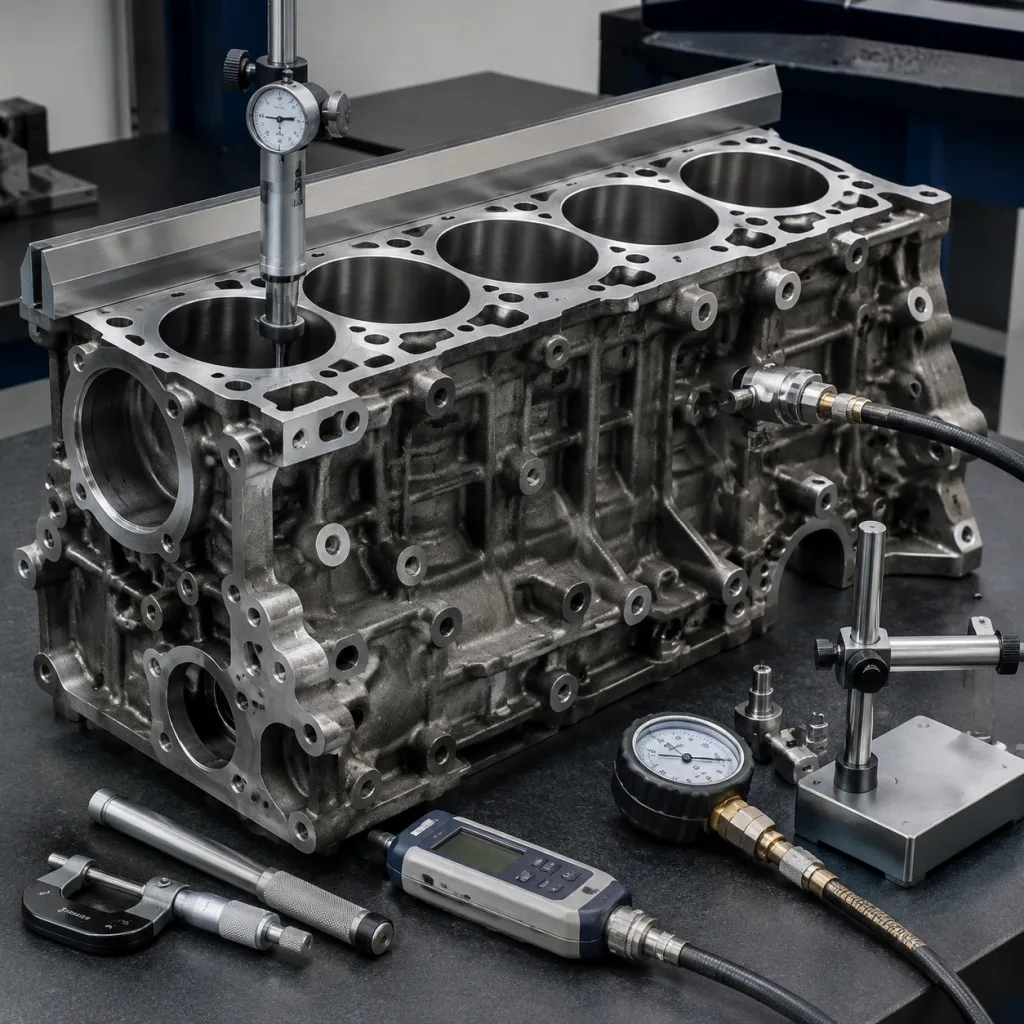
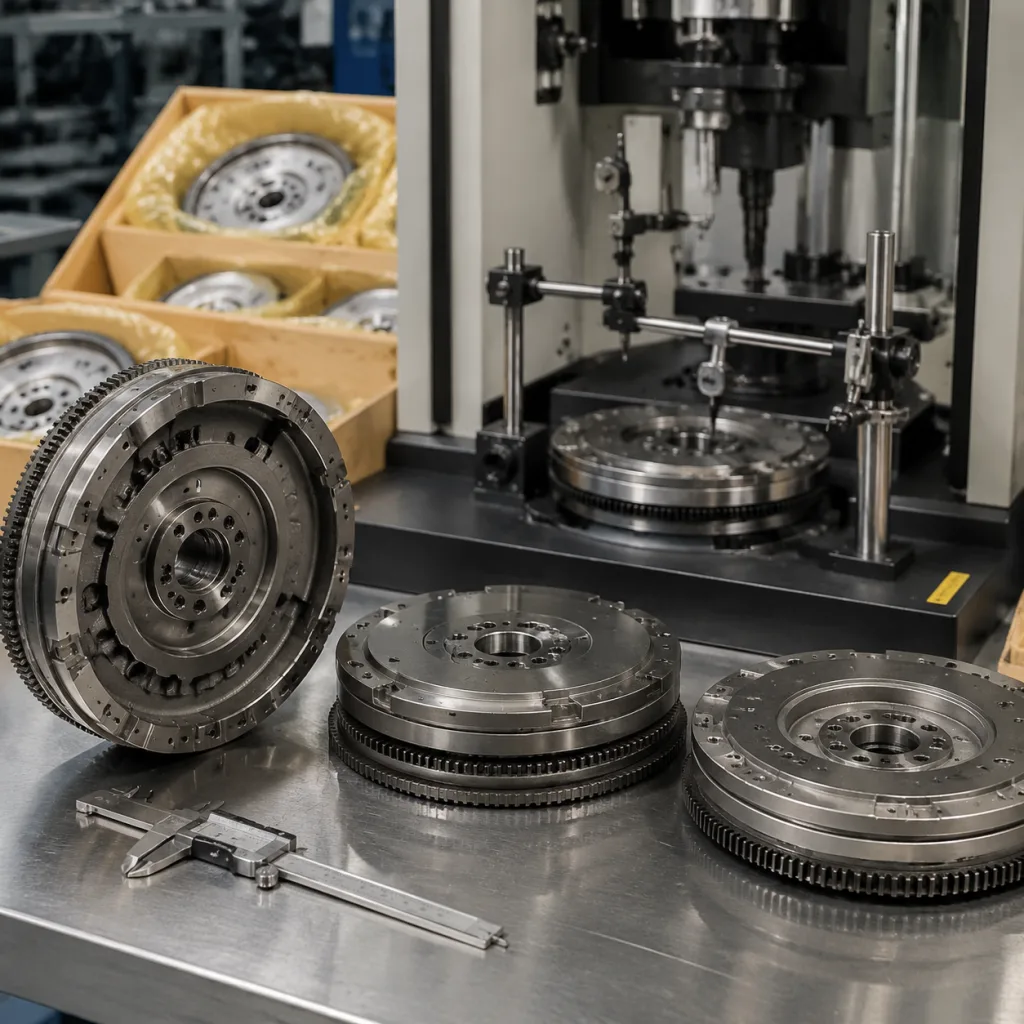
A useful inspection plan separates 100% checks from sampling checks. For example, visual condition, marking, packaging, and rotation feel may be checked on every unit; dimensions such as height, bore, PCD, and ring gear position may be sampled per lot; and material/hardness or destructive checks may be performed per batch or per agreed control plan. Critical characteristics should have the measuring tool specified, such as CMM, height gauge, dial indicator, runout fixture, dynamic balancer, hardness tester, or dedicated rotation-angle fixture.
Relevant published management and compliance frameworks include IATF 16949:2016 and ISO 9001:2015 for automotive quality systems, and REACH (EC) No 1907/2006 where EU chemical compliance declarations are required. For markets with vehicle-level emissions or durability obligations, buyers should manage their own regulatory responsibilities under applicable rules, such as ECE R-83 where relevant. A replacement flywheel should not be represented as a vehicle manufacturer-approved part unless formal approval exists.
Validation, Samples, and Production Approval
A structured approval process reduces disputes after launch and gives both sides a clear technical baseline. For Mazda-related flywheel programmes, Driventus recommends that buyers validate samples through bench inspection and installation feedback from qualified technicians before volume release. This is especially important when the project involves new coverage, cross-referenced part numbers, private-label launch, or replacement of an underperforming supplier.
Recommended approval checklist
1. Confirm application list, engine codes, transmission references, target markets, and model-year coverage. 2. Compare the supplied sample with the target flywheel for diameter, height, bolt pattern, pilot bore, ring gear, friction face location, and mounting interface. 3. Measure free rotation angle, axial movement, runout, and balance condition against the agreed specification. 4. Confirm clutch kit compatibility, including pressure plate mounting, release system assumptions, and friction disc spline pairing. 5. Perform a starter engagement check where ring gear tooth count, chamfer, or position may differ. 6. Record the installation torque procedure from the repair information used in the buyer’s market. 7. Check packaging protection, corrosion prevention, carton label content, pallet configuration, and warranty identification before mass production. 8. Freeze engineering changes before PPAP-style documentation or equivalent customer approval records are issued.
A practical approval route is: RFQ review, reference confirmation, sample build, sample inspection report, buyer bench check, installation trial, packaging approval, pre-production lot, and then mass production. For a new SKU, buyers should allow about 2–4 weeks for technical file review, 30–60 days for sample preparation where development is required, 1–3 weeks for local installation feedback depending on workshop availability, and 45–75 days for mass production after approval. If tooling, casting pattern change, ring gear redesign, or damper recalibration is required, the schedule should be revised before the purchase order is placed.
For first-article approval, Driventus can provide dimensional reports for agreed characteristics such as overall diameter, total height, friction face height, crank bore, bolt hole diameter and PCD, dowel position, ring gear OD and axial location, free angle, axial movement, runout, marking, and packaging. Buyers should state the sample acceptance rule in advance: for example, full conformity to a supplied drawing, conformity to a golden sample plus listed tolerances, or conformity to a mutually approved control sheet. Ambiguous approval language such as “same as OE” should be avoided unless an approved datum method and measurement list are attached.
For customers needing non-standard references, private-label packaging, altered marking, or development from sample, Driventus can discuss custom manufacturing. If the buyer requires PPAP-style submissions, inspection reports, retained samples, IMDS-style material data, capability studies, or golden-sample control, these requirements should be confirmed at the RFQ stage so the correct documents and production controls are planned from the beginning.
Commercial Documentation for Importers
Wholesale buyers usually need a document set that supports customs clearance, warehouse intake, catalogue listing, and warranty handling. Requirements vary by destination, buyer system, and sales channel, but early alignment helps avoid shipment delays and receiving disputes.
Common documents include:
Commercial invoice and packing list with SKU, quantity, net weight, gross weight, carton count, and pallet count
Certificate of origin when required
Material declaration or REACH-related statement for EU buyers
Product photos without vehicle manufacturer logos
Barcode or SKU label files, including EAN/UPC, buyer SKU, batch code, and country-of-origin text where required
Inspection report by batch
Dimensional report for approved samples
Carton and pallet specifications, including carton dimensions, burst strength if specified, pallet size, stacking limit, and gross weight limit
HS code confirmation by the importer or customs broker
Private-label artwork approval, where applicable
Warranty identification and batch-traceability instructions
Loading photos or container seal information where required by the buyer’s receiving process
For the EU, UK, US, Canada, Australia, and Brazil, distributors should also define local labelling language, packaging recycling marks where applicable, and warranty return procedures. Driventus can support neutral branding or buyer-owned branding, subject to trademark compliance and order requirements. We do not apply recognisable vehicle brand logos to aftermarket packaging or parts.
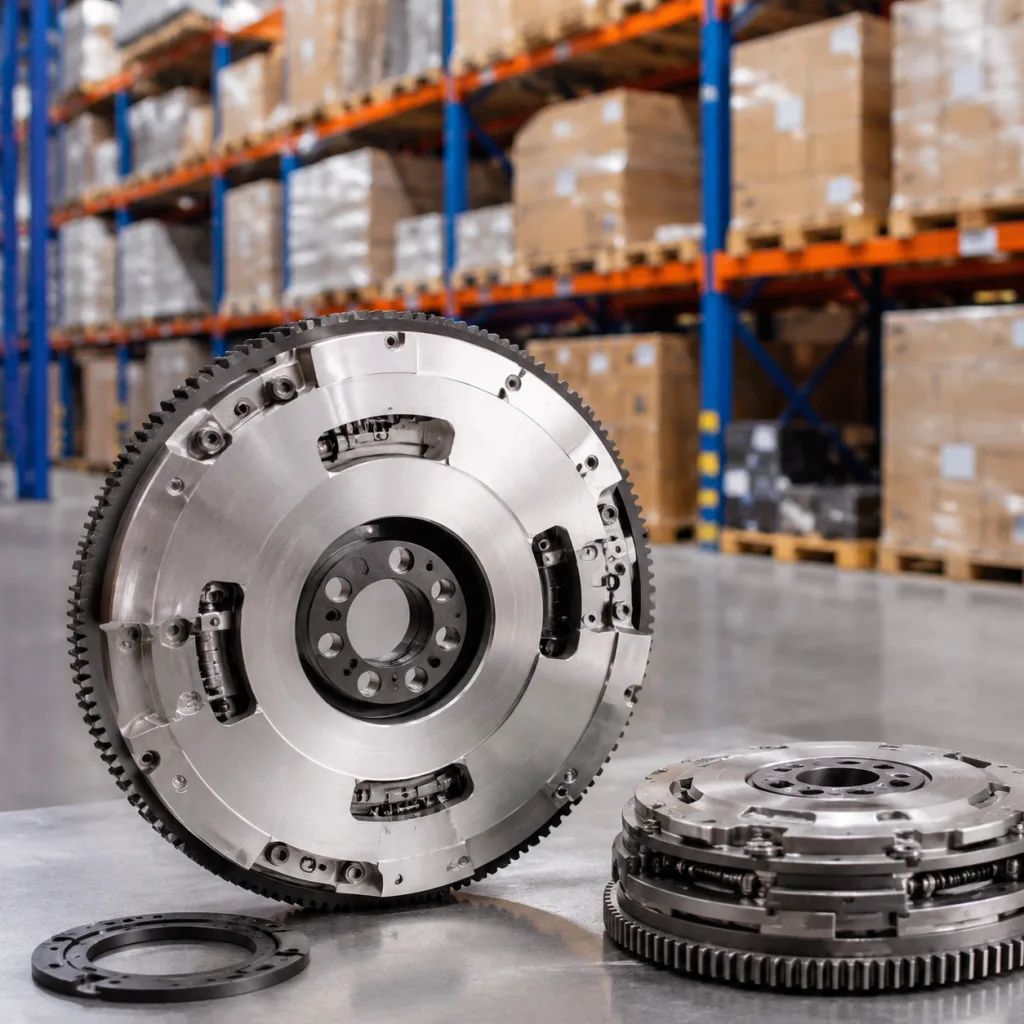
Packaging should be specified as a cost and risk item, not an afterthought. A dual mass flywheel is heavy, machined, and vulnerable to impact on the ring gear, friction face, and mounting surface. A common export configuration uses an individual VCI bag or anti-rust wrap, face protection, inner support or moulded separator, double-wall carton, clear orientation marking, and palletisation with corner protection and stretch film. Buyers should define maximum carton weight for warehouse handling, often around 20–30 kg depending on local rules, and maximum pallet height according to racking or container loading needs.
When comparing factories, ask whether the quoted price includes balancing, surface treatment, export cartons, palletisation, anti-corrosion protection, barcode labels, inspection records, and document preparation. A low quoted unit price can move cost into warranty exposure, warehouse rework, relabelling, rust claims, damaged ring gears, or urgent replacement orders if these items are excluded or poorly controlled. For landed-cost comparison, importers should calculate unit price plus inland freight, export handling, ocean or air freight, duty, customs brokerage, domestic delivery, inspection cost, warranty reserve, and expected inventory carrying cost.
How Driventus Supports Mazda Flywheel Programmes
Driventus is based in Taizhou, Zhejiang, with production and sourcing systems for engine and powertrain components including pistons, crankshafts, gaskets, water pumps, turbochargers, and selected driveline interface parts. For dual mass flywheel Mazda wholesale projects, our role is to help buyers convert a fitment requirement into a controlled supply programme with clear specifications, realistic lead-times, and export-ready documentation.
Support can include application review, sample comparison, part-number mapping, inspection planning, batch traceability, packaging design within neutral or private-label requirements, and export coordination. For multi-SKU distributors, we can consolidate compatible powertrain items to improve container utilisation, reduce procurement administration, and simplify supplier management. Consolidation planning should consider carton dimensions, pallet height, SKU priority, slow-moving versus fast-moving coverage, and whether the buyer wants one mixed shipment for launch or staggered replenishment by demand class.
A practical RFQ should include target annual volume, first-order quantity by SKU, market region, vehicle application list, current reference numbers, sample availability, required packaging, compliance requirements, required documents, expected launch date, target Incoterm, destination port, and any price-validity requirement. If the buyer already has a sales forecast, split it into launch stock, monthly replenishment, and safety stock. This helps determine whether the correct approach is a small sample order, a mixed-SKU pilot order, or a full production order timed to the buyer’s catalogue release.
If the project involves an existing warranty issue, include photos, measured dimensions, failure symptoms, installation mileage, clutch kit details, operating conditions, installer comments, and whether the symptom occurred immediately after fitting or after a defined mileage. Useful failure clues include starter grinding, idle rattle, clutch judder, gear-change vibration, grease leakage, ring gear wear, bolt loosening, or mismatch with the pressure plate. The more measurable data the buyer provides, the easier it is to separate part design issues from installation, clutch kit, gearbox, or vehicle-condition causes.
Driventus is an independent aftermarket manufacturer; vehicle brand names are referenced for fitment only.
Frequently asked questions
Send the application list, engine and transmission details, target market, annual forecast, first-order quantity by SKU, current reference numbers, sample availability, packaging requirements, Incoterm, destination port, and required compliance documents. Photos, measured dimensions, clutch kit information, and any known warranty issues help shorten the quotation and validation process.
Yes. Neutral and buyer-owned packaging can be discussed for approved orders, subject to MOQ, artwork confirmation, trademark compliance, and carton strength requirements. Barcode labels, batch identification, pallet specifications, corrosion protection, gross weight limits, and warranty coding should be agreed before production.
No. Driventus is an independent aftermarket manufacturer; vehicle brand names are referenced for fitment only. We do not claim approval, endorsement, authorisation, or sponsorship by any vehicle manufacturer unless formal documentation exists.
If you are evaluating a dual mass flywheel Mazda wholesale programme, share your fitment list, volume forecast, target MOQ, sample status, packaging standard, destination market, and documentation requirements. Our team can review the project and help you [request a quote](/contact.html).