Dual Mass Flywheel Iveco Manufacturer China | Driventus
Buyers searching for a **dual mass flywheel Iveco manufacturer China** supplier are usually trying to manage several risks at once: OE-fit geometry, stable torsional damping, repeatable production quality, and shipment documentation that works for international trade and downstream distribution. A dual mass flywheel (DMF) is not a generic turning part. It is a tuned torsional isolation assembly that affects idle NVH, launch smoothness, drivetrain rattle, clutch engagement, starter performance, and service life. For B2B buyers, that makes supplier selection an engineering and programme-control decision, not just a price comparison.
Driventus supplies dual mass flywheels for B2B programmes with dimensional control, material traceability, dynamic balance verification, and export packing designed for sea freight and cross-dock handling. We work to IATF 16949:2016 and ISO 9001:2015, and we can align materials and coatings with REACH (EC) No 1907/2006 where programme requirements apply. This page is written for procurement teams, importers, distributors, and fleet-focused sourcing managers evaluating supply risk from a China manufacturer, not for retail buyers. Driventus is an independent aftermarket manufacturer; brand names are referenced for fitment only. If you need broader part coverage, see our catalog and quality system.
What Buyers Need From An Iveco DMF Supplier
For this part family, the sourcing question is never only about price. A dual mass flywheel has to match the crankshaft interface, ring gear configuration, clutch pairing, rotational inertia window, internal spring-friction damping architecture, and operating torque expected by the target application. If any of those points are off, the result in the field can be idle gear rattle, launch shudder, hard starting, clutch slip complaints, abnormal release behaviour, accelerated facing wear, or shortened flywheel life. That is why buyers evaluating a dual mass flywheel Iveco manufacturer China source should put application control first and commercial terms second.
A capable supplier should be able to support the programme at three levels:
Fitment accuracy: crank bolt pattern, pilot dimensions, PCD, ring gear tooth count, clutch mounting geometry, installed stack height, and interface tolerances must align with the intended Iveco application.
Functional consistency: the damping system must deliver repeatable angular deflection, friction torque, and rotational free play from batch to batch so installed behaviour stays consistent in service.
Supply discipline: the factory should be able to manage samples, approvals, traceability, packaging, and repeat orders without uncontrolled changes to material grade, grease fill, internal components, or markings.
Most procurement teams should define the application before requesting a quote:
Vehicle model, engine code, and rated torque band
Transmission family and clutch kit pairing
OE cross-reference from the current service file
Annual volume, call-off pattern, and target market
Packaging format for export, warehouse, or workshop distribution
It also helps to clarify the service channel early. A distributor serving independent workshops may prioritise broad catalogue coverage, stable labelling, and low fitment error rates. A fleet-focused importer may care more about torsional durability, batch repeatability, and low warranty returns over repeated purchase cycles. Those are different sourcing models, and the supplier should understand which one applies.
For a China supplier, the real test is whether the factory can hold the drawing baseline, produce repeatable batches, support sample validation before first shipment, and document what was actually built. For DMFs, that usually means controlling not only machined dimensions but also runout, dynamic imbalance, ring gear fit, secondary mass rotational travel, and assembly traceability. That is the difference between simply buying a part and building a controlled supply programme.
Specification Points To Confirm
Before you price the part, lock the technical baseline. The same outside diameter can hide different internal arc spring packs, friction washers, ring gear counts, crank interfaces, clutch cover patterns, or damping windows. A quote based only on a vehicle name or partial cross-reference creates avoidable risk later, especially once the programme moves from sample review into container shipments.
The safest approach is to build the quotation around a confirmed application pack. That means the buyer and supplier agree on the target vehicle, engine, gearbox, clutch pairing, torque class, and expected duty cycle before pricing is treated as final. For a dual mass flywheel Iveco manufacturer China project, this reduces the gap between catalogue language and real fitment.
Checkpoint
What the buyer should confirm
Evidence to request
Fitment
Engine family, gearbox, starter ring gear, crank interface, and clutch kit pairing
Drawing, OE cross-reference sheet, or sample comparison report
Torsional function
Angular travel, friction control, idle chatter behaviour, and launch smoothness
Validation summary with test conditions and acceptance criteria
Mechanical accuracy
Axial runout, pilot concentricity, bolt pattern position, mounting face flatness, and dynamic balance
First article inspection report and balance record
Durability
Thermal exposure, fatigue target, grease retention, and service interval expectation
Test record, lot traceability, and change-control status
</tr></thead><tbody> </tbody></table>Beyond those headline items, buyers should verify several details that are often missed in early RFQs:
Ring gear tooth count, module, and starter engagement geometry
Crank mounting hardware specification, thread class, and bolt-seat dimensions
Clutch cover interface, friction surface compatibility, and pressure plate location features
Inertia range, dynamic balance grade, and maximum permitted face runout
Primary-to-secondary mass rotational free play and stop-limit arrangement
Surface finish and corrosion protection requirements
Marking, labelling, and country-of-origin requirements for customs or local regulation
When the programme is being set up, ask for the raw dimensional drawing, material specification, and inspection plan. If the customer wants a private label or customer-specific revision, build rules should be defined before tooling release, not after pilot parts are already in circulation. A supplier should also confirm which characteristics are treated as critical, major, or routine during inspection, because that affects process capability review, reaction plans, and claim handling.
For a new sourcing project, the cleanest approach is to approve samples against the target vehicle, then freeze the drawing and packaging together, not separately. That matters because many avoidable field issues start outside the metal itself: wrong label cross-reference, mixed cartons, missing VCI or separators, or packaging that allows corrosion or impact damage during ocean transit.
Typical buyer data set
Vehicle list, engine code, and transmission family
OE reference file from the customer or distributor
Existing clutch kit reference or mating part drawing
Expected service channel: aftermarket, fleet, or OE-related supply
Target carton count and pallet pattern
Required finish, labels, and country-of-origin marking
How We Control Production
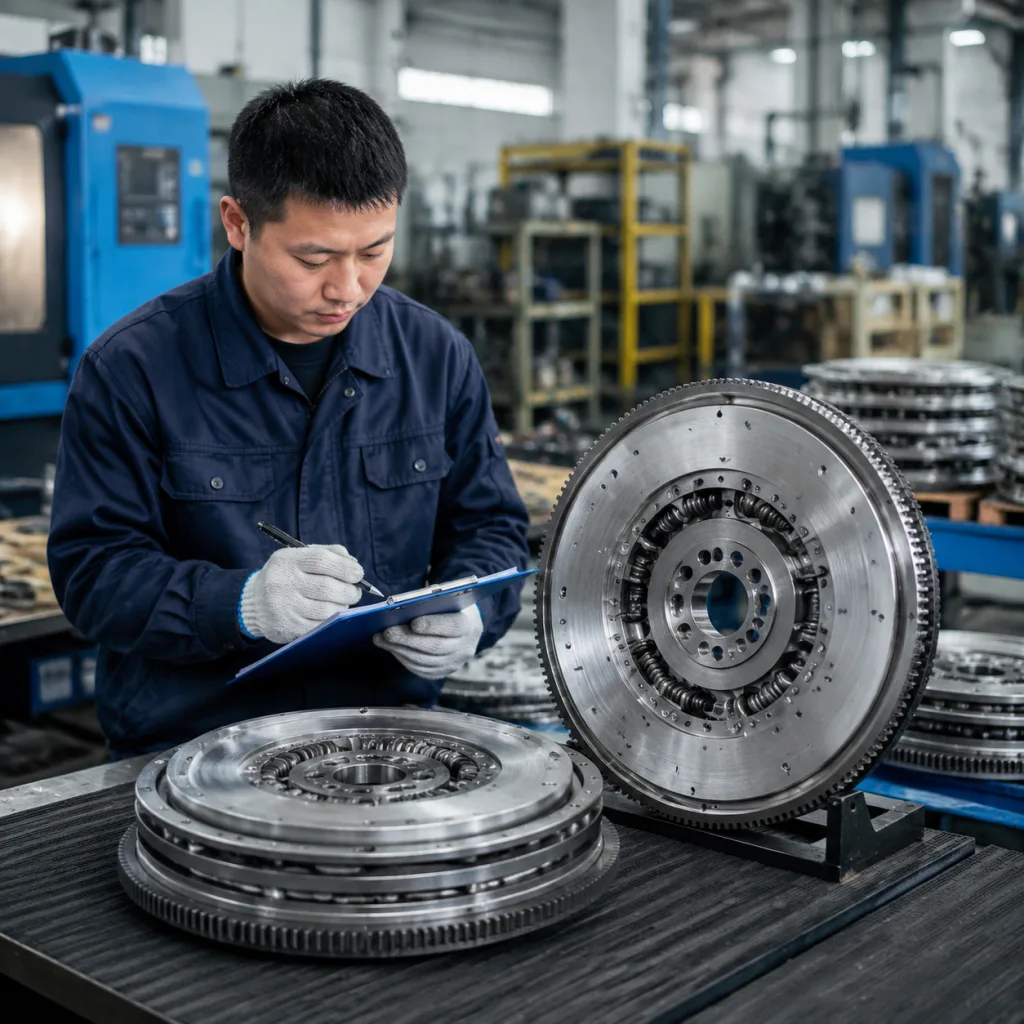
A dual mass flywheel has to survive machining, thermal load, torsional cycling, handling, storage, and long-distance transport before it ever reaches the vehicle. The factory process therefore needs to be managed as a controlled assembly route, not treated as simple turning work. Buyers assessing a dual mass flywheel Iveco manufacturer China supplier should expect visibility into how raw material, machining accuracy, balancing, assembly condition, and final release are controlled.
At minimum, a credible production flow should include:
Raw material or forging receipt with traceable lot identification
Incoming inspection for key dimensions, hardness where specified, and material conformity against the approved grade
Machining control for mounting faces, pilot diameters, bolt holes, ring gear seating, and runout-sensitive features
Heat treatment or related thermal process control where applicable to the design
Press-fit or thermal-fit control for ring gear installation
Assembly control for internal damping components, friction elements, grease loading, seals, and retained subcomponents
Dynamic balancing and final rotational verification
Final inspection, marking, rust prevention, and packaging release
Our quality system is built around IATF 16949:2016 and ISO 9001:2015. For procurement teams, the practical value is not the certificate itself; it is the discipline behind lot traceability, nonconformance control, inspection records, MSA-supported measurement use, and corrective action tracking. That matters when a distributor needs to isolate one shipment, when a fleet account reports a field complaint, or when a customer asks for evidence that one batch was produced to the same baseline as the previous batch.
For this product category, production control should focus especially on the characteristics that affect installed behaviour:
Bolt pattern accuracy and crank interface geometry
Mounting face flatness, axial runout, and concentricity
Dynamic balance condition after final assembly
Ring gear fit and starter engagement consistency
Internal damping assembly repeatability, including spring pack and friction stack control
Surface protection and packaging integrity after final inspection
Records worth asking for
Mill or forging traceability by heat or lot
Incoming inspection results for critical dimensions and material checks
First article and in-process inspection records for key interfaces
Final balance and runout records
Packaging inspection and carton drop-check results
Material declarations aligned with REACH (EC) No 1907/2006 when required
Surface treatment and corrosion resistance can be qualified with customer-specific methods, including cyclic corrosion test regimes such as SAE J2527 where the programme asks for them. That is useful for buyers shipping into humid storage environments, coastal distribution networks, or long transit lanes where unprotected metal surfaces face higher corrosion risk.
If a buyer wants deeper process control, the most useful discussion is usually not about generic factory capacity. It is about how the supplier handles deviation, rework, engineering change, batch identification, FIFO segregation, and shipment release. Those points determine whether a sourcing programme stays stable after launch. For more background, see our quality system and the related manufacturing scope in our catalog.
Commercial Terms Buyers Should Put In Writing
For this part family, the commercial sheet should be as clear as the drawing. Many sourcing problems are not caused by poor machining. They come from vague packaging rules, undefined sample approval steps, unclear fitment responsibility, and undocumented changes to labels, grease, hardware, or carton count. A serious dual mass flywheel Iveco manufacturer China sourcing project should turn these points into written commercial controls before the first production order is released.
A usable sourcing agreement should state:
MOQ by part number, not only by product family
Lead time for samples, pilot batches, and repeat orders
Carton quantity, gross and net weight limits, pallet pattern, and outer-label content
Whether barcodes, QR codes, serial labels, or batch codes are required
Which documents ship with the goods: packing list, commercial invoice, test record, and certificate of conformity
Buyers should also specify how approval works at each stage:
What data is required for quotation approval
Whether first article samples must be signed off before mass production
Who confirms packaging artwork and shipping marks
Which revisions control the order if drawing and label files are updated at different times
What happens if the buyer requests a running change after pilot approval
This is especially important for cross-border business. If customs marking, country-of-origin language, or carton labelling is incomplete, the shipment problem can appear at the port rather than in the factory. If pallet patterns are not fixed, the same ordered quantity can arrive with different cube efficiency from one shipment to the next, affecting receiving labour and warehouse utilisation.
If you are reviewing multiple suppliers, compare how each one handles engineering changes. A supplier that can keep the drawing, sample, inspection criteria, PPAP-style approval records where requested, and packing specification aligned is usually easier to manage over a long programme than one that offers a low unit price but changes labels, grease, internal sourcing, or box fill without formal notice. Commercial clarity reduces claim risk, protects landed cost assumptions, and makes reordering more predictable.
Which Supply Path Fits The Programme
Not every buyer needs the same commercial model. Some want fast replenishment from a stable catalogue. Others need a build-to-print route with tighter control over labels, cartons, and test documents. Choosing the right supply path at the start helps avoid delays later, because the approval workflow, MOQ, documentation depth, and flexibility will differ by programme type.
For a dual mass flywheel Iveco manufacturer China project, the three common routes are:
Supply path
Best for
Trade-off
Catalogue supply
Fast replenishment and short qualification
Less design freedom
Build-to-print
Stable OE-fit programmes
Requires stronger drawing control
Private label / custom
Distributor differentiation
Needs tighter MOQ and approval flow
</tr></thead><tbody> </tbody></table>Catalogue supply works best when the buyer wants speed, stable replenishment, and recognised fitment coverage from an existing product range. This route is often suitable for importers and distributors who need quicker launch timing and can work within the supplier's established technical baseline.
Build-to-print is better when the buyer already has a confirmed drawing, target inspection points, or a validated cross-reference pack. In that case, the main requirement is process discipline: the supplier must hold the agreed specification consistently and avoid uncontrolled substitutions in material, friction components, ring gear configuration, or protective packaging.
Private label or custom supply is usually chosen by distributors that want brand differentiation, customer-specific carton artwork, unique barcode control, or region-specific packaging. This model can create stronger channel separation, but it also requires more disciplined approval steps for labels, carton dimensions, pallet loading, and order batching.
Buyers should match the supply path to the real business model:
Multi-market distributors often need broad fitment coverage and repeatable packaging for warehouse handling.
Fleet or service-network buyers may care more about durability consistency, traceability, and claim response.
Brand owners usually need stronger control over labels, carton identity, and revision management.
For teams that need a broader component basket, see our catalog and the wider engine components range. If you already have an engineering pack, send the vehicle list, target annual volume, and packaging requirement. If the application is sensitive, include the existing failure mode, because that helps us review damping behaviour and validation scope before production starts.
Frequently asked questions
Use the engine code, gearbox family, OE reference, ring gear tooth count, crank interface dimensions, and clutch pairing already used in your service file. For a dual mass flywheel Iveco manufacturer China sourcing project, the most reliable path is to review drawing-level data first, then confirm with first article samples and dimensional reports before production release.
Typical shipment files include packing list, commercial invoice, certificate of conformity, inspection record, and lot traceability data. Depending on programme scope, buyers may also request first article data, balance or runout records, and material declarations aligned with REACH (EC) No 1907/2006.
Yes. We can adapt carton artwork, barcodes, master carton counts, pallet configuration, protective inner packing, and shipping marks under a build-to-print or private label flow. For new programmes, packaging should be approved alongside the part drawing so the first shipment matches both technical and logistics requirements.
If you are sourcing for an Iveco programme, share the application data, OE cross-reference, target volume, and packaging spec, then use [request a quote](/contact.html).