Dual Mass Flywheel Dodge Supplier: OEM-Grade Sourcing
Choosing a dual mass flywheel Dodge supplier is less about finding a part number and more about controlling risk. Fitment accuracy, torsional damping, balance quality, and lot-to-lot consistency all influence NVH performance, clutch life, and warranty exposure. Dodge applications may differ by engine code, transmission code, model year, torque output, starter engagement geometry, and regional specification, so every purchase order should be anchored to measurable requirements—not a catalog description alone.
For repair networks, wholesalers, importers, and private-label programs, the biggest concern is variation between replacement units. A flywheel that matches one sample can still lead to clutch shudder, idle rattle, gear-change vibration, premature bearing wear, or return claims if runout, offset, ring-gear position, or damping characteristics drift outside the approved range. A qualified supplier should be able to support drawing review, sample comparison, inspection records, and production traceability before a volume order is released.
Driventus supplies engine and powertrain components from Taizhou, Zhejiang, with in-house manufacturing control and export experience in more than 60 countries. We work under IATF 16949:2016 and ISO 9001:2015 systems, and we can support OE cross-reference sourcing when the application requires it. Driventus is an independent aftermarket manufacturer; brand names are used only for fitment identification. If you are building an approved buying list for North America, Europe, Australia, Brazil, or another export market, focus first on specification control, testing, MOQ, lead time, packaging, and documentation. This article explains how to source with lower supplier risk.
What buyers should verify before sourcing
Before approving a dual mass flywheel Dodge supplier, separate application matching from measurable product control. A dual mass flywheel is not a simple solid disc. It brings together primary and secondary masses, arc springs or damper elements, friction interfaces, bearing elements, stop features, ring gear geometry, and a clutch contact face. Even small shifts in these areas can change start-up behavior, idle quality, clutch engagement, and drivetrain vibration.
For Dodge-related programs, confirm the exact vehicle platform, engine displacement, transmission type, model year range, and regional specification before issuing a PO. The same vehicle line may use different flywheels depending on engine torque, manual transmission code, clutch diameter, crankshaft interface, starter position, and emission-market configuration. OE cross-reference is useful, but it should not be the only approval basis.
Minimum data to request from a supplier:
- OE reference or application range, such as OE 06A107065 when applicable
- Vehicle model, engine code, transmission code, and production year coverage
- Flywheel outside diameter, total height, offset, and friction-face position
- Crankshaft mounting hole count, pitch circle diameter, pilot features, and bolt size
- Clutch-side mounting pattern, dowel positions, and pressure-plate interface
- Starter ring gear tooth count, tooth profile, and chamfer direction
- Assembly balance target, correction method, and runout limit
- Free rotational angle, damping stage behavior, and stop clearance where applicable
- Spring pack or damper specification, including torque range if available
- Contact-face hardness, surface finish, and machining pattern
- Grease, bearing, or internal component requirements if service-critical
- Packaging type, corrosion protection method, and shelf-life expectation
The supplier should also state whether the unit is supplied as a bare DMF, with new bolts, or as part of a clutch service kit. That detail matters because many flywheel bolts are torque-to-yield or use application-specific coatings. For importers, kit content affects customs coding, landed cost, SKU structure, warehouse picking, and warranty evidence. For repair networks, a clear kit definition helps technicians avoid reusing fasteners or combining incompatible clutch components.
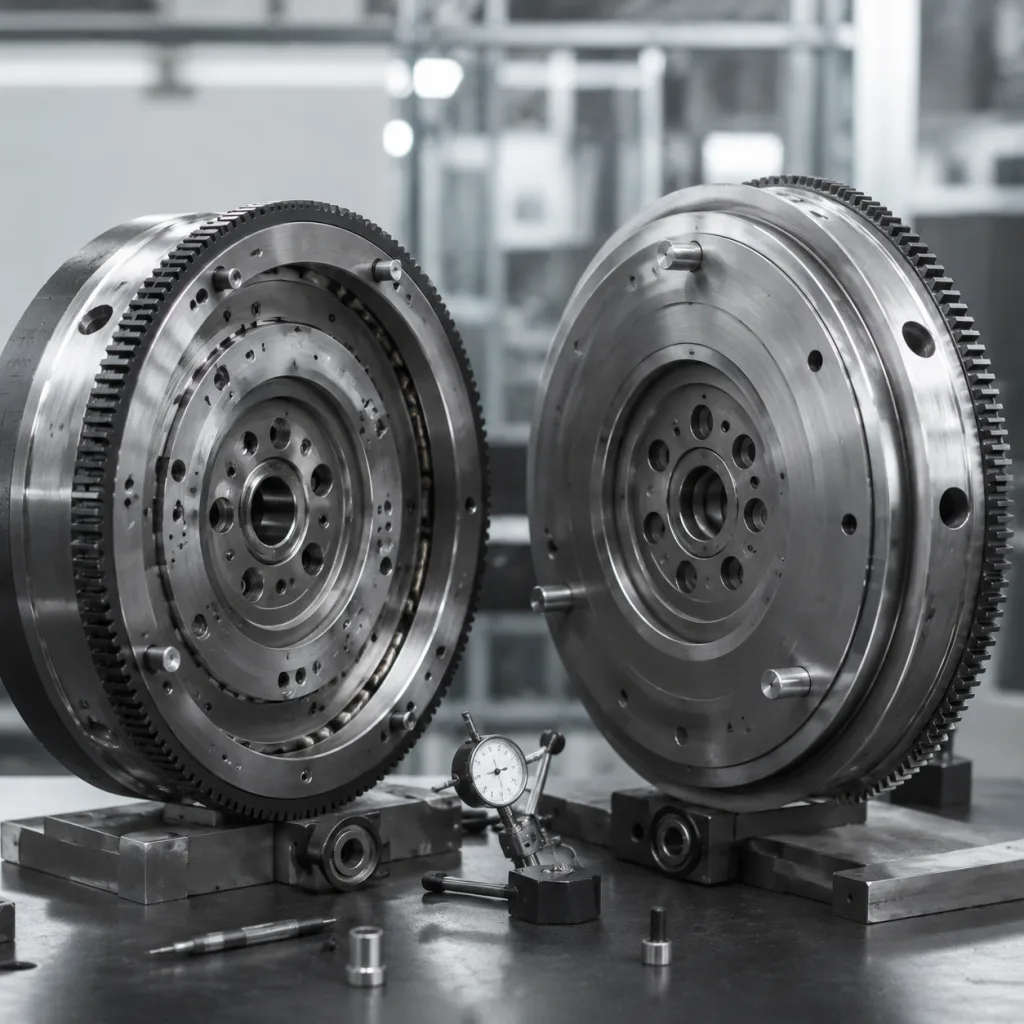
The safest sourcing route is to compare the supplier drawing, sample, and reference unit before mass production. If no drawing is available, request a marked inspection sheet with critical dimensions and tolerances. The file should show which measurements are controlled during production, which are checked at final inspection, and which are confirmed only at sample approval. In practice, many buyers set runout, balance, and offset limits at the start, then lock those values into the control plan before release.
Why certification and traceability matter
Procurement teams should look for documented process control, not just a product sample or catalog image. A dual mass flywheel operates under repeated torsional load, heat cycling, and speed variation. Changes in material selection, heat treatment, machining, surface finishing, assembly preload, or dynamic balancing can lead to noise, shudder, premature wear, and inconsistent installer feedback. Certification does not replace part validation, but it does show whether the supplier has a controlled system behind the product.
Driventus manufactures under IATF 16949:2016 and ISO 9001:2015 quality systems. For buyers, this means the supply file can include controlled inspection records, batch traceability, process discipline, and corrective-action handling. A structured quality system is especially valuable when a distributor plans repeat orders under one private-label item number, because replacement lots must remain consistent after the first approved shipment.
Traceability should link the finished flywheel to the production date, material batch, machining batch, assembly batch, and final inspection record. If a field issue appears, that information helps distinguish isolated handling damage from a production condition. It also allows buyers to quarantine specific lots instead of freezing an entire product line. Where export compliance is required, materials and coatings can be managed to support REACH (EC) No 1907/2006 requirements.
Documents to request in a supplier review
- Material certificate or heat number traceability for major metal components
- First article inspection report with critical dimensions clearly marked
- Dimensional inspection record for production lots
- Dynamic balance record or balance-control statement
- Runout, offset, and clutch contact-face inspection data
- Heat treatment or hardness confirmation where applicable
- Surface finish and anti-corrosion treatment confirmation
- Assembly inspection record for rotational play or damping-related features
- Packaging specification with carton, pallet, and corrosion protection details
- Country of origin statement and export document support
- Corrective-action procedure for non-conforming products or warranty returns
Also ask how long records are retained and whether batch information can appear on carton labels, pallet labels, or packing lists. This is useful for importers serving multiple regions because inventory teams can connect customer claims with production lots. If your internal audit requires supplier evidence, review our quality system before opening the commercial discussion.
Commercial terms that affect landed cost
For distributors and wholesalers, the true landed cost of a dual mass flywheel program extends well beyond the ex-works unit price. MOQ, packaging density, freight class, damage rate, warranty rate, payment terms, inventory turnover, and reorder lead time all affect margin. For OEM and Tier-1 buyers, engineering change control and validation stability are just as important, since even a small specification change can trigger re-approval.
A heavy rotating component such as a DMF also brings practical logistics costs. Poor inner protection may cause tooth damage, surface corrosion, or impact marks during sea freight. Weak cartons can collapse on mixed pallets. Oversized packaging can reduce container utilization. Before comparing suppliers, ask for a complete commercial and logistics profile for each part number.
| Commercial item | What to confirm | Buyer impact |
|---|---|---|
| MOQ | Per part number, per production batch, and per packing style | Inventory exposure and cash tied in slow-moving SKUs |
| Lead time | Sample, trial order, mass production, and repeat order timing | Program launch planning and replenishment reliability |
| Unit configuration | Flywheel only, flywheel with bolts, or service kit | SKU structure, technician acceptance, and claim reduction |
| Packing | Carton quantity, pallet pattern, inner protection, VCI or oil protection | Freight cost, corrosion risk, and damage rate |
| Incoterms | EXW, FOB, CIF, DAP, or other agreed terms | Cost comparison and responsibility for freight or insurance |
| Payment terms | Deposit, balance timing, and document release process | Cash flow and shipment scheduling |
| Warranty terms | Coverage window, claim evidence, and replacement or credit process | After-sales cost and distributor policy alignment |
| Change control | Notice period for drawing, material, process, or sub-supplier changes | Validation stability and customer approval protection |
| Documentation | Inspection records, COO, packing list, and label requirements | Import clearance and customer onboarding |