Cylinder Sleeve Seat Supplier Selection for B2B Buyers
A cylinder sleeve seat is a small interface with expensive failure potential. If the seating geometry is wrong, the result can be liner fretting, coolant leakage, uneven flange loading, head gasket damage, or early bore wear. For importers and sourcing engineers, the buying decision is not a lowest-price exercise. It is a control question: can the factory hold casting quality, machining accuracy, measurement discipline, traceability, packing, and export timing after the first approved samples? This guide shows how to evaluate a cylinder sleeve seat supplier for aftermarket distribution, OEM service programmes, and repair-chain procurement. It covers RFQ inputs, tolerance alignment, audit evidence, commercial trade-offs, lead-time planning, and purchase-order checks. Driventus is an independent aftermarket manufacturer; brand names are referenced for fitment only.
Start With the Decision: Catalogue Part, Repair Solution, or Custom Seat?
Do not send a vague enquiry and wait for the factory to guess. First decide what you are buying: a catalogue sleeve-related part, a repair solution for worn blocks, or a custom seat geometry tied to a drawing. Each path changes the data needed, the validation burden, and the cost structure.
Use this RFQ split:
- Catalogue replacement: engine family, application, liner type, target market, first-order quantity, and packaging rules
- Repair-chain programme: fleet engine coverage, oversize or repair dimensions, claim history, inspection evidence, and regional stocking needs
- Private-label range: neutral or branded carton, label format, pallet rules, forecast, reorder cycle, and document requirements
- OEM service or Tier-1 support: controlled drawing revision, PPAP-style documents, change-control rules, and audit access
- Custom development: sample part, 2D drawing, target tolerances, material requirement, prototype quantity, and validation plan
A useful enquiry normally includes engine application, displacement range, fuel type, duty cycle, wet or dry sleeve configuration, sealing groove details if applicable, and whether the design is flanged, stepped, or straight. Add the working dimensions: nominal bore, outside diameter, flange diameter, overall height, seat width, counterbore depth, flange thickness, and support shoulder dimensions.
Then separate fixed requirements from open questions. For example: bore 100.00 mm, OD 104.00 mm, counterbore depth 6.50 mm, seat width 4.20 mm, seating face roughness Ra 0.8–1.6 μm, first order 500 pieces, annual forecast 2,000 pieces, neutral carton, destination port Hamburg. If the final tolerance changes after engineering review, the cylinder sleeve seat supplier can still price the real work: machining time, inspection effort, packing, and freight.
For catalogue programmes, buyers can review our catalog and narrow the enquiry by engine component family. For non-standard geometry, worn-block repair solutions, or private-label specifications, custom manufacturing is usually the correct route.
Audit for Batch Stability, Not Sample Polish
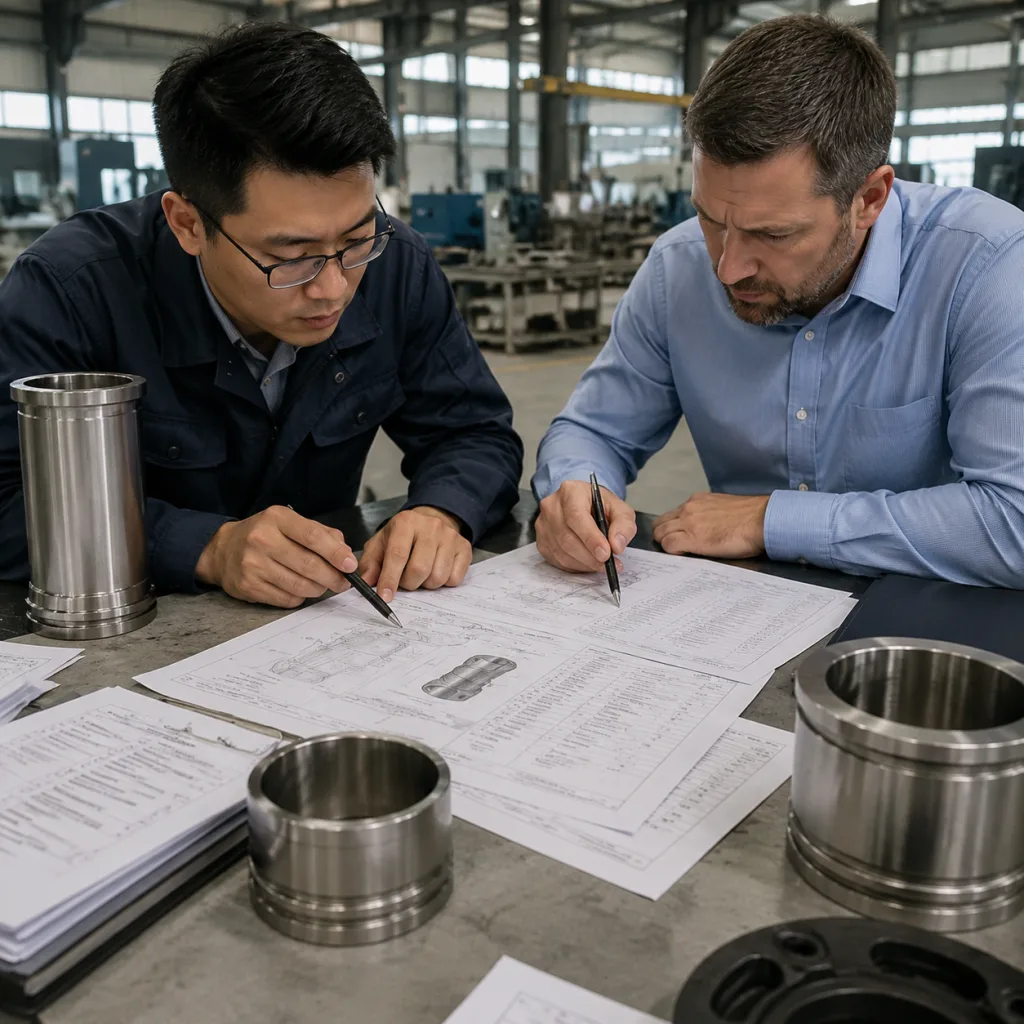
A bright sample can hide a weak process. The real test is whether the supplier can repeat seat flatness, concentricity, flange contact, and surface finish across later batches, different operators, and urgent production runs.
Use the audit to follow one active sleeve or seat programme from material receipt to shipment. Ask for the casting lot, machining traveller, first-piece report, in-process gauge record, final inspection sheet, packing record, and shipment label. A capable factory should connect a finished part back to the material lot and inspection batch within minutes.
| Audit area | What to verify | Procurement relevance | |
|---|---|---|---|
| Incoming material | Foundry source, chemical analysis, hardness checks, casting lot control | Reduces cracking, poor wear resistance, and machining variation | |
| Machining | CNC turning, boring, honing, chamfering, deburring, fixture control | Controls bore geometry and seating contact | |
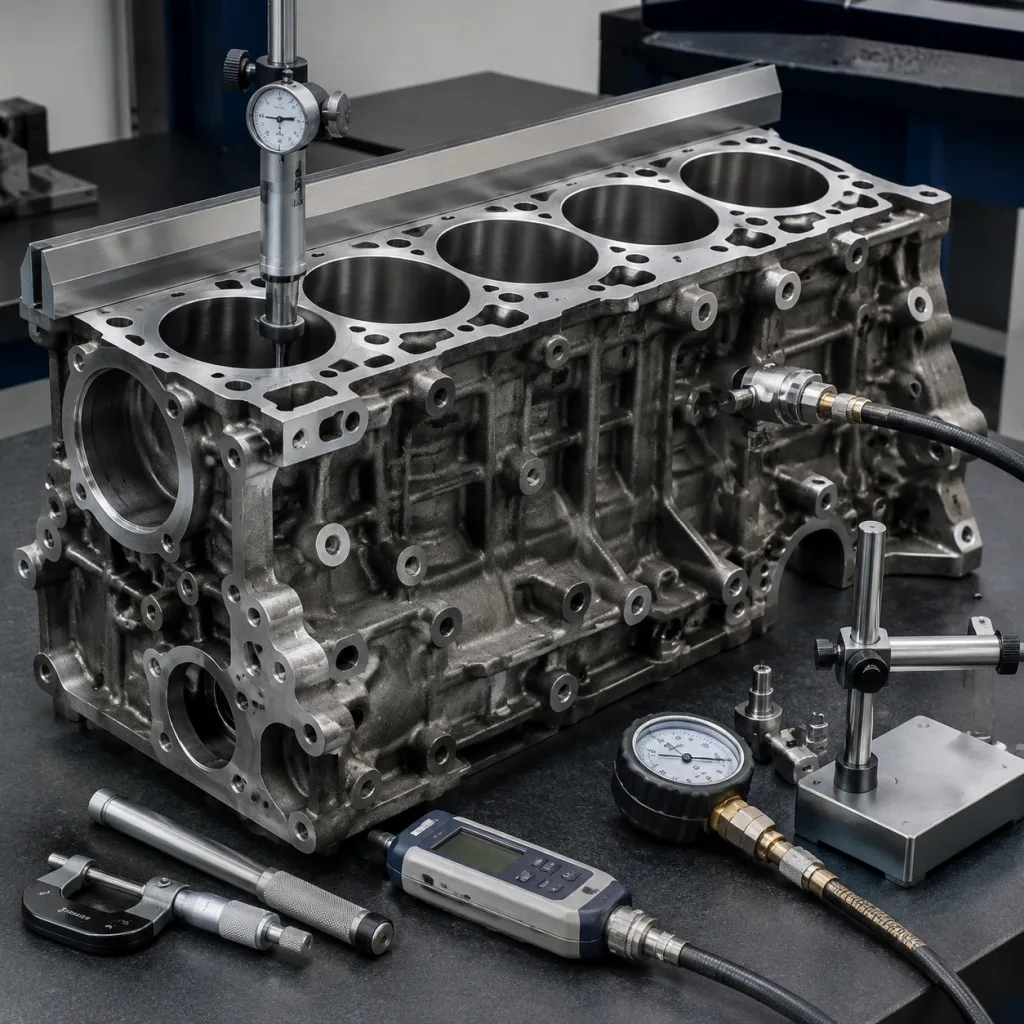
| Measurement | CMM, air gauge or bore gauge, roughness tester, height gauge, calibrated masters | Confirms repeatable dimensional compliance | |
| Heat treatment | Furnace records, hardness mapping where applicable, distortion control | Supports dimensional stability and wear performance | |
| Process control | First-piece approval, in-process checks, final inspection, nonconformance handling | Prevents drift after sample approval | |
| Traceability | Batch number, work order, operator record, inspection record | Supports warranty investigation and distributor claims handling | |
| Export packing | VCI bag or oiling, carton strength, divider design, palletisation | Reduces corrosion, freight damage, and inventory loss |
| Programme type | Typical first step | Commercial focus | Lead-time factor |
|---|---|---|---|
| Catalogue aftermarket | Match application and dimensions | Mixed-SKU MOQ, stock availability | Existing casting and machining route |
| Private-label distributor | Confirm marking, carton, and pallet spec | Branding rules, forecast, reorder cycle | Packaging approval and inventory planning |
| Repair-chain programme | Validate fitment across fleet engines | Stable quality, low claim rate | Batch inspection and regional warehousing |
| OEM service or Tier-1 support | Drawing review and PPAP-style documentation | Change control, traceability, audit readiness | APQP timing, gauges, sample approval |
| Custom repair sleeve | Sample or drawing reverse engineering | Engineering support and tolerance agreement | Tooling, prototype machining, validation |