Cylinder Sleeve Isuzu OEM Supplier Sourcing Guide
Choosing a cylinder sleeve Isuzu OEM supplier is a risk decision, not a catalogue exercise. A sleeve can match the bore and still fail through poor metallurgy, unstable honing, weak flange control, corrosion in transit, or missing batch records. Procurement teams need proof: controlled material, repeatable machining, traceable inspection, realistic lead times, and commercial terms that fit the distribution plan. Driventus manufactures wet and dry cylinder sleeves in Taizhou, Zhejiang for aftermarket distributors, wholesalers, OEM programmes, Tier-1 buyers, and multi-location repair chains. Production is supported by IATF 16949:2016 and ISO 9001:2015 management systems, with export experience to more than 60 countries. This guide breaks supplier evaluation into the decisions buyers actually make: qualification, specification control, programme planning, audit evidence, packaging, quotation comparison, and first-order validation. Driventus is an independent aftermarket manufacturer; brand names are referenced for fitment identification only.
Start With the Risk Screen, Not the Price Sheet
A cylinder sleeve sourcing programme should not open with “please quote your best price.” That invites shortcuts. Start with a controlled technical data exchange so every supplier quotes the same part, the same inspection burden, and the same shipment expectation.
Buyers should provide the engine family, sleeve type, drawing revision, approved sample, annual forecast, first order quantity, packaging requirements, target port, and any OE part-number cross-reference if available. When drawings are unavailable, Driventus can support reverse engineering from approved samples; production release should still be based on confirmed dimensions, defined tolerances, and agreed inspection criteria.
For a new item, the technical pack normally includes bore ID, outside diameter, total length, flange diameter, flange height, wall thickness, chamfer details, coolant-seal groove dimensions for wet sleeves, and required surface finish. Mark critical-to-quality dimensions separately. Those features may need 100% inspection, go/no-go gauges, or tighter machine offsets than general dimensions.
Use this first-pass screen before discussing volume pricing:
- Quality management: Current IATF 16949:2016 and ISO 9001:2015 certificates, with certificate number, scope, expiry date, and issuing body checked.
- Process ownership: Casting control or approved foundry management, CNC rough machining, semi-finish boring, heat or ageing control where specified, finish honing, washing, anti-rust treatment, final inspection, and packing.
- Traceability: Heat number, batch number, operator record, inspection sheet, packing list, and shipment lot linked through internal documentation for at least the agreed claim period.
- Measurement capability: Calibrated bore gauges, outside micrometers, height gauges, roughness testers, hardness testers, and dedicated fixtures for flange or groove locations.
- Export readiness: Commercial invoice, packing list, certificate of origin where required, HS code confirmation, fumigation or IPPC pallet status, and destination-specific documents confirmed before shipment.
- Audit access: Remote document audit or on-site factory audit covering process flow, calibration, nonconforming material control, corrective action handling, warehouse segregation, and batch labelling.
This screen separates a production partner from a trading quotation with limited process visibility. Buyers reviewing wider engine-part coverage can compare related powertrain components in our catalog, and the engine range is also available at /products/engine-components.html.
Spec Deep-Dive: Material, Bore Geometry, and Wet-Sleeve Features
Cylinder sleeves live inside heat, pressure, friction, coolant, and vibration. That is why supplier evaluation should prioritise material consistency, machining stability, and surface finish control over headline price.
Typical programmes use centrifugally cast alloy cast iron or grey cast iron selected for wear resistance, machinability, thermal conductivity, and piston-ring compatibility. Final material selection depends on engine type, wet or dry installation, bore size, liner wall thickness, sealing design, and duty cycle.
Avoid vague RFQ wording such as “standard material.” Ask for an agreed grade or test basis. Commercial sleeves are often controlled by chemical composition, hardness range, microstructure, and absence of casting defects. A typical aftermarket target may include hardness in the HB 190–260 range, pearlitic matrix control where required, and no visible cracks, shrinkage, sand holes, or heavy inclusions on machined surfaces. Exact limits should follow the drawing, approved sample, or validated application requirement.
| Control point | Typical procurement requirement | Failure prevented |
|---|---|---|
| Material verification | Heat-level chemistry or batch material report when specified | Wrong grade or unstable wear resistance |
| Bore machining | CNC boring followed by plateau or cross-hatch honing | Poor ring seating and oil retention |
| Bore tolerance | Drawing limits; critical bores may require ±0.01–0.03 mm depending on size | Blow-by, oil consumption, seizure risk |
| Roundness and cylindricity | Checked at multiple depths and directions | Uneven ring wear and local hot spots |
| Flange height or collar location | 100% checked for critical wet-sleeve designs | Incorrect protrusion or sealing load |
| Seal-groove dimensions | Width, depth, radius, and edge finish checked to drawing | O-ring cutting and coolant leakage |
| Surface roughness | Ra/Rz measured by profilometer where specified | Poor break-in or unstable oil film |
| Hardness | Batch checked at agreed frequency | Premature wear or machining inconsistency |
| Visual defects | No cracks, blowholes, heavy rust, burrs, or handling damage | Assembly rejection and claim exposure |
| Evaluation item | Low-risk quotation should state | Buyer action |
|---|---|---|
| Fitment basis | Drawing, sample, or application reference | Confirm before purchase order |
| Material | Cast iron grade, hardness range, or agreed equivalent | Request test report if critical |
| Tolerance | Drawing-based or sample-based limits with CTQ features marked | Define critical dimensions |
| Surface finish | Honed bore specification, Ra/Rz target, and measurement method where needed | Add roughness requirement |
| MOQ | Item-level, packaging-level, and mixed-order MOQ | Check against forecast |
| Price basis | EXW/FOB/CIF term, currency, tooling, packing, and documentation inclusions | Build landed-cost comparison |
| Lead time | Sample, pilot, and mass production timing | Align with inventory plan |
| Documentation | Inspection report, certificate, export docs, and batch traceability | Include in PO terms |
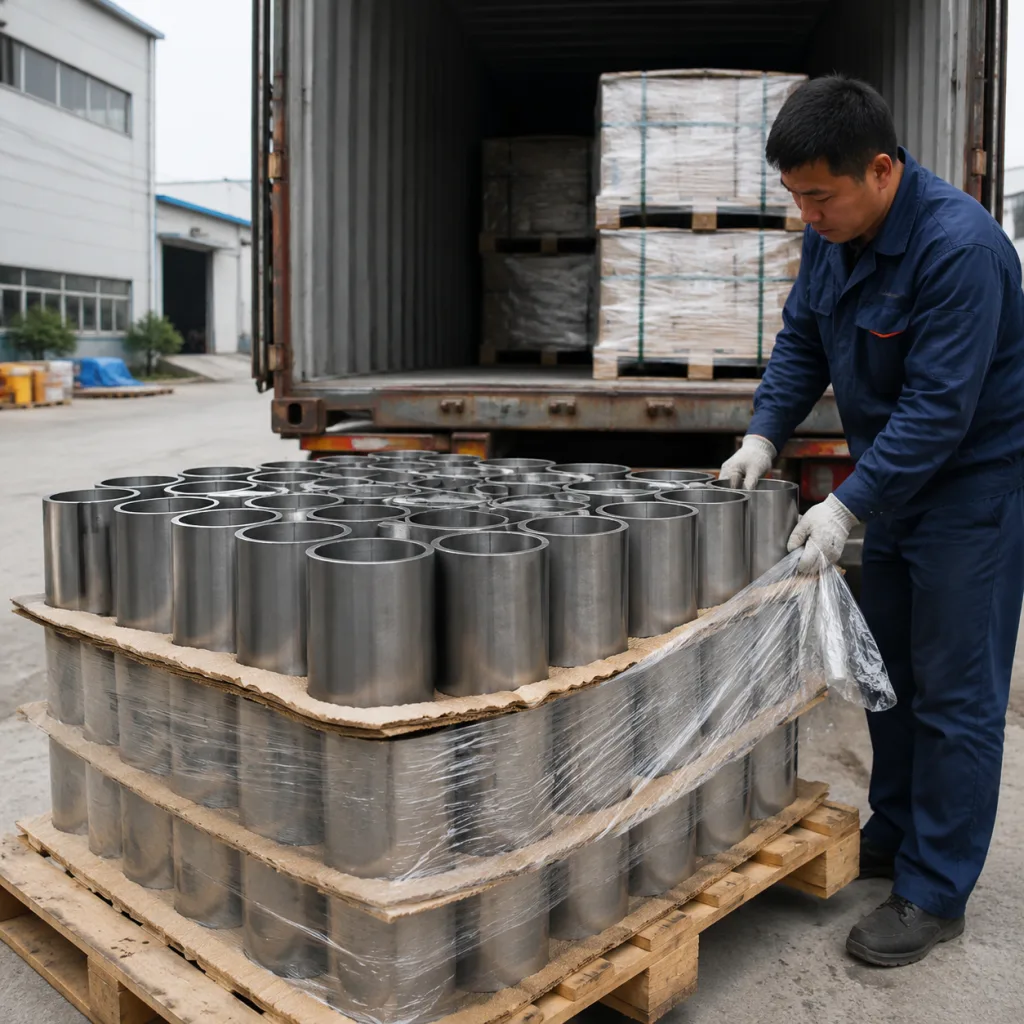
| Packaging | Inner packing, carton, pallet, anti-rust method, and marks | Confirm warehouse acceptance |
| Claims process | Response time, evidence required, and compensation method | Agree before first shipment |