Connecting Rod for Ford Focus OE Equivalent Sourcing
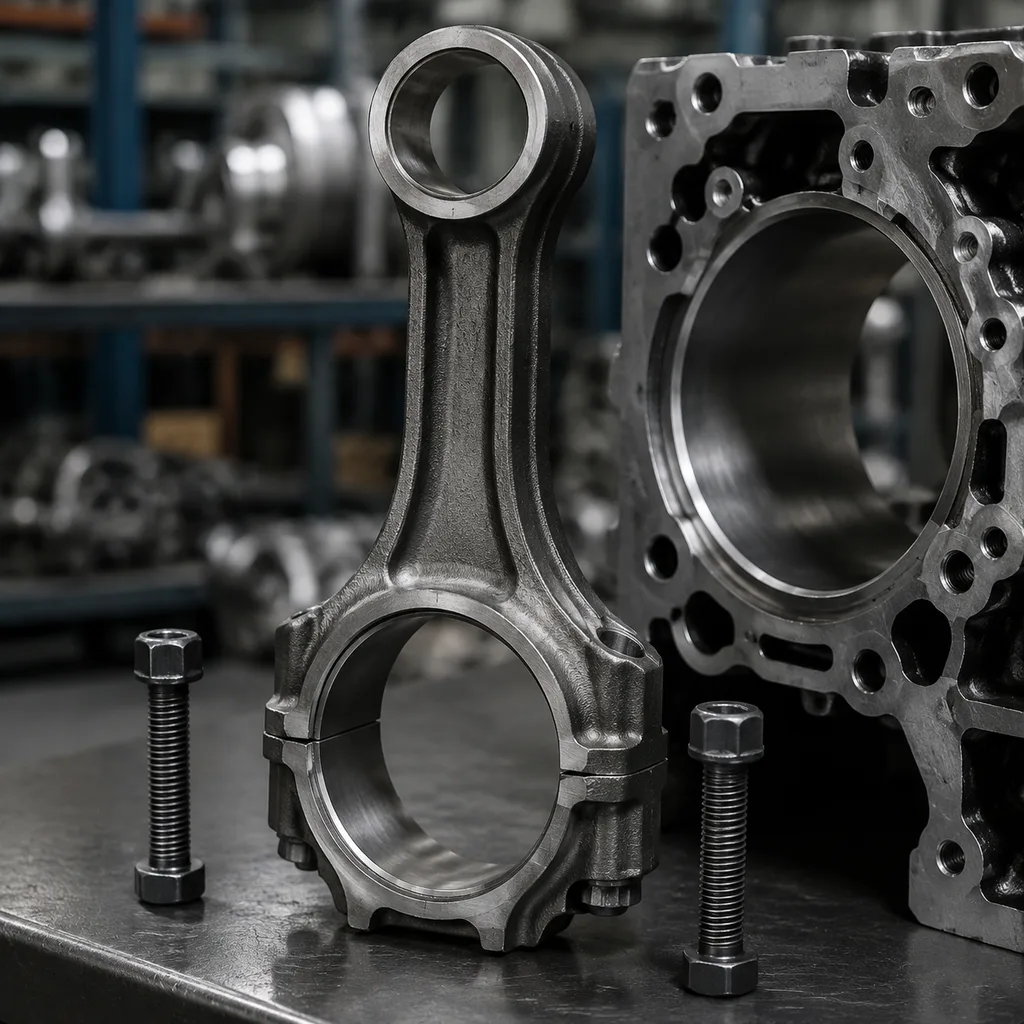
A connecting rod for Ford Focus OE equivalent programme is not won by finding a rod that “looks right.” The buyer has to control the working geometry, bore stability, cap behaviour, mass range, fastener performance, and fatigue margin for the exact engine family being supplied. A small miss in centre-to-centre length, big-end roundness, pin-bush alignment, or bolt clamp load can become an oil-clearance complaint, piston slap, bearing distress, vibration issue, or early warranty return.
For B2B buyers, the sourcing question is practical: can this rod be assembled repeatedly, in different workshops, without creating avoidable risk? Driventus manufactures replacement connecting rods for passenger-car engine applications through controlled forging, machining, heat treatment, assembly, and inspection routes. The sections below reframe qualification as a set of decisions, failure checks, validation gates, and purchasing controls for Ford Focus replacement demand. Driventus is an independent aftermarket manufacturer; vehicle brand names are referenced for fitment identification only.
Decision Framework: When Is a Ford Focus Rod Truly OE-Equivalent?
Treat “OE-equivalent” as a pass/fail engineering claim, not a catalogue adjective. The rod must reproduce the original installation envelope and all functional interfaces for the target engine code: piston, crankshaft journal, bearing shell, bolts, lubrication clearance, and moving clearances inside the block.
Before approving a connecting rod for Ford Focus OE equivalent supply, ask three questions:
1. Does it match the application? Confirm engine code, production year, market, fuel type, aspiration, piston pin diameter, crankpin diameter, bearing shell family, and cap style. 2. Does it match the functional geometry? Check length, bore sizes, width, cap seating, pin alignment, and beam clearance against a drawing or buyer-approved sample. 3. Does it remain stable under assembly load? Verify big-end bore roundness after cap tightening, bolt clamp consistency, fatigue evidence, and batch-to-batch mass control.
The inspection list should normally include:
Centre-to-centre distance between big-end and small-end bores
Big-end bore diameter after cap assembly and specified bolt torque
Big-end bore roundness, cylindricity, and bearing-seat condition
Big-end width and crankshaft side-clearance compatibility
Small-end bore or bush internal diameter
Pin-bush alignment, squareness, and oil-hole position where applicable
Rod beam clearance to block, piston skirt, and crank counterweight
Total mass and end-to-end balance control
Cap design, parting-face geometry, and cap-to-body matching
Bolt grade, thread engagement, torque method, and clamp-load consistency
Surface finish on bearing housing, parting faces, and pin-bush bore
Do not source by model name alone. Ford Focus applications differ across engine generations, displacements, fuel systems, and regions. Where an OE cross-reference is used, it should be buyer-verified and held in an internal interchange file. Generic references such as OE 06A… or OE 11251… style numbers are only useful when tied to a confirmed engine application and measured sample.
RFQ Spec Deep-Dive: The Details That Stop Bad Samples Early
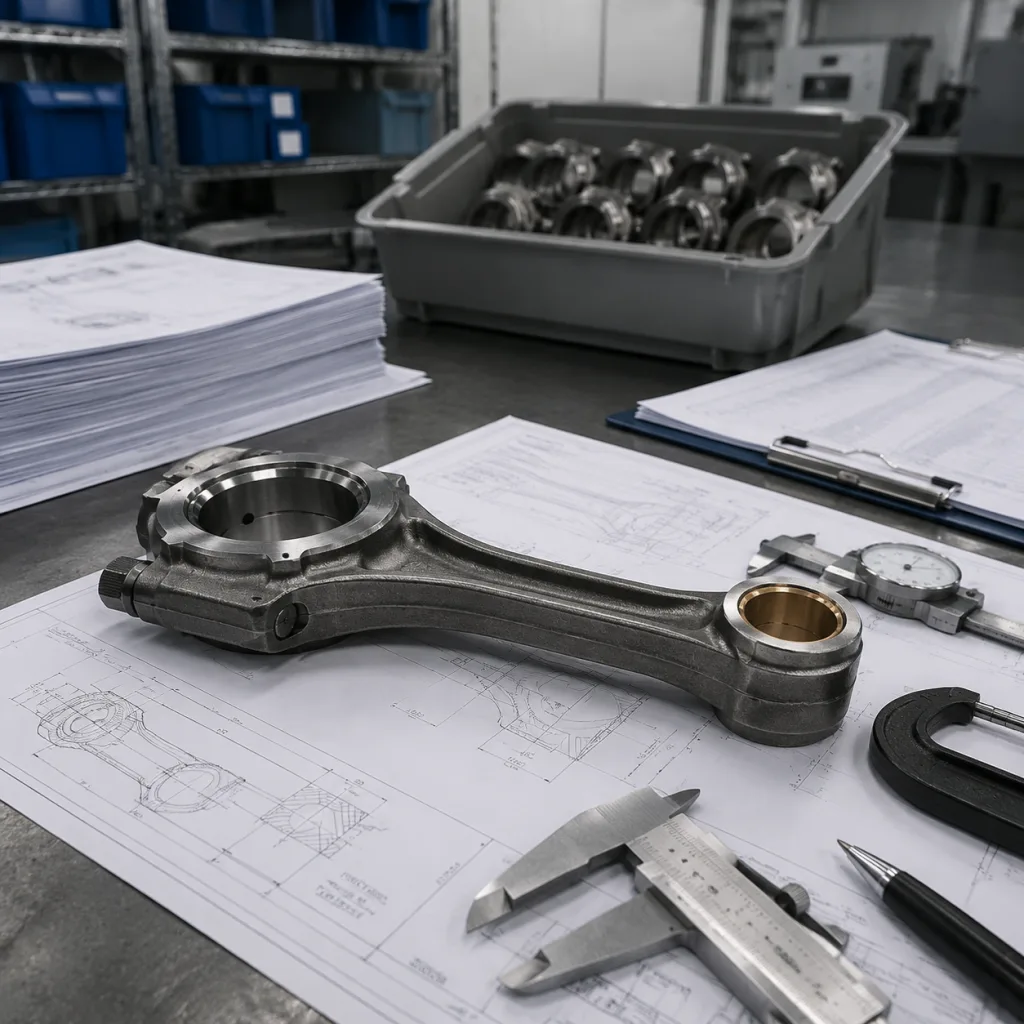
A vague RFQ invites a part that passes a visual comparison but fails during assembly. A controlled RFQ should define the engine code or reference sample, request a dimensioned drawing, and make the supplier show how critical features are produced and checked.
Use the RFQ to lock the features that affect bearing clearance, piston position, balance, and fatigue life:
Check point
Typical requirement for sourcing review
Why it matters
Centre-to-centre length
Drawing tolerance agreed by engine family, often controlled in hundredths of a millimetre
Affects compression height, piston deck position, and cylinder balance
Big-end bore size and roundness
Verified after cap tightening using the specified torque or torque-angle method
Protects oil film, bearing crush, and journal clearance
Small-end bore alignment
Checked against the big-end datum and pin axis
Reduces piston pin side loading, skirt wear, and noise
Big-end width
Matched to crankshaft journal side-clearance requirement
Prevents binding or excessive lateral movement
Weight spread
Batch target agreed with buyer, including total and end-to-end mass where required
Supports balanced engine rebuilds and reduces vibration complaints
Material
Forged steel grade, powder-forged material, or specified alternative by application
Determines tensile strength, machinability, and fatigue margin
Heat treatment
Hardness range and microstructure controlled by specification
Prevents low-cycle fatigue, distortion, or brittle fracture
Surface finish
Bearing bore, thrust faces, and bush bore specified on drawing
Reduces bearing and pin-bush wear during run-in
Fasteners
Bolt property class, coating, thread form, and tightening method defined
Maintains cap clamp load under cyclic engine loading
</tr></thead><tbody> </tbody></table>Also ask how the part is made. Common routes include forged steel blanks, shot blasting, CNC machining, precision cap parting or fracture splitting where required, bolt assembly, finish boring, honing, deburring, cleaning, and critical-dimension inspection. Some engine families require powder-forged or fracture-split designs; others use conventionally machined caps. Do not substitute cap style, material, or tightening method without engineering approval. The bearing housing may no longer behave the same way.
Validation Gate: Prove the Rod, the Bolt, and the Bore as a System
A clean sample is not proof. Connecting rods fail as systems: body, cap, bolts, bush, surface condition, and packaging all interact. The validation gate should therefore test what happens after assembly, tightening, handling, and repeated loading.
A practical validation package can include:
Material certificate with chemical composition and mechanical properties
Hardness report after heat treatment
Metallographic check for grain flow, decarburisation, and abnormal inclusions
Magnetic particle inspection or equivalent crack detection on sample lots
Big-end bore measurement before and after bolt tightening
Bore distortion check after repeated tightening cycles where required
Bolt torque-angle or torque-yield validation when specified by the design
Tensile, proof-load, or clamp-load testing for rod bolts
Rotating bending or axial fatigue testing based on an agreed load profile
Pin-bush retention and small-end wear checks where a bush is fitted
Salt-spray or corrosion-protection assessment for storage and shipment where required
Initial sample inspection report covering all critical-to-function dimensions
Driventus production is managed under IATF 16949:2016 and ISO 9001:2015. These standards do not approve an individual part number and do not create approval from a vehicle manufacturer. They do provide a recognised framework for APQP, PPAP-style documentation, nonconforming material control, corrective action, traceability, calibration, and supplier management. Buyers can review the Driventus quality system before supplier approval.
For regulated markets, procurement files may also need material declarations relevant to REACH (EC) No 1907/2006 and customer-specific restricted-substance rules. Connecting rods are not emissions-control devices, so standards such as ECE R-83 are not part-specific approval routes. Still, poor rod quality can affect durability, noise, oil consumption risk, and customer returns. Validation evidence is commercial protection.
Failure Modes Scenario: How the Wrong Rod Reaches the Workshop
A common sourcing failure starts with a harmless assumption: “same model, same rod.” A distributor lists a Ford Focus application by model year only. A warehouse ships a close-looking part. The rebuilder torques the cap, fits the bearing shells, and only later finds tight rotation, pin noise, deck-height variation, or vibration. By then, the cost is no longer just the rod.
Most rod-related sourcing problems come from incomplete application data. Ford Focus vehicles have used different engine families across production years and regions, and similar external descriptions can hide different crankpin sizes, piston pins, bearing shells, or cap designs. A rod that works in one market may be wrong in another.
Typical failure modes include:
Wrong crankpin diameter: Bearing shells may seat poorly, and oil clearance can fall outside specification.
Incorrect piston pin diameter: The small end may assemble with force, develop excessive clearance, or create pin noise.
Unmatched rod length: Compression height changes, causing deck-height variation, noise, imbalance, or compression differences between cylinders.
Incorrect cap style or cap mismatch: Rod caps are not interchangeable; mixed caps can destroy bore geometry and bearing crush.
Unverified bolt specification: Reusing torque-to-yield bolts or applying the wrong torque method can reduce clamp load and allow cap movement.
Mass variation between cylinders: Excessive spread can increase vibration and uneven bearing loading.
Poor corrosion protection: Rust on machined bores or parting faces can affect assembly accuracy and customer perception.
Incomplete application labelling: Warehouse teams may ship a close-looking but incorrect rod if the part number, engine code, and batch information are unclear.
For repair-chain supply, packaging is part of fitment control. It should prevent cap damage, corrosion, and part mixing. Each rod should be traceable by batch, and each cap should remain secured to its matching rod body. Where rods are sold in sets, they should be weight-matched to the buyer’s agreed range and labelled for the intended engine application.
Driventus is an independent aftermarket manufacturer; vehicle brand names are referenced for fitment only. We do not claim approval, endorsement, or supply status from any vehicle manufacturer.
Documentation Pack: What to Have on File Before the First Bulk Order
A connecting rod is a durability-critical rotating engine part. The purchasing file should be strong enough to support supplier approval, incoming inspection, customer claims review, and repeat-order consistency. This matters even more for private-label distributors managing several factories, batches, or regional applications.
Request these documents before bulk release:
Application list by engine code, displacement, year range, and market where available
OE-equivalent interchange table using buyer-confirmed references, such as OE 06A… or OE 11251… only where applicable
2D drawing with critical dimensions, tolerances, datums, and surface-finish requirements
Material and heat-treatment specification
Control plan and process flow diagram
Sample dimensional report, including bore geometry after cap torque
Material certificate, hardness report, and inspection summary for the sample lot
Bolt specification and tightening procedure, including torque-angle method if relevant
Batch traceability format and label sample
Packaging specification for export cartons, corrosion protection, inner separation, and palletisation
PPAP-style package where required by OEM, Tier-1, fleet, or large programme customers
Warranty, claim-analysis, and corrective-action process
Good documentation reduces silent changes. It makes material, cap process, bolt source, machining datum, heat treatment, and inspection method visible. It also lets the same part family be reordered and audited instead of requalified from zero each time.
Driventus can support standard aftermarket supply and custom manufacturing for customers that need controlled drawings, special packaging, or application-specific validation plans.
Step-by-Step Approval Path for Procurement Teams
The safest sourcing route is to move from application certainty to engineering evidence, then to packaging and traceability. Price comparison comes after the part is technically comparable.
Use this approval path for a connecting rod for Ford Focus OE equivalent programme:
1. Confirm the target engine code, year range, fuel type, and market application. 2. Lock the crankpin diameter, piston pin diameter, rod length, cap style, bearing family, bolt method, and weight range. 3. Compare the supplier drawing with an original sample or buyer-approved reference. 4. Measure centre distance, big-end bore, small-end bore, width, cap fit, and mass distribution. 5. Confirm material, heat treatment, hardness range, and surface finish. 6. Review fatigue, bolt, bore distortion, and crack-detection validation. 7. Check IATF 16949:2016 and ISO 9001:2015 process controls where required. 8. Approve packaging, corrosion protection, cap retention, traceability, and claim-handling method. 9. Freeze the interchange and application notes before releasing the part to sales channels.
This sequence helps wholesalers, engine rebuilders, and repair chains reduce fitment disputes, assembly failures, and repeat claims while maintaining stable inventory for Ford Focus repair demand.
Frequently asked questions
No. Ford Focus applications differ by engine family, displacement, model year, market, piston pin size, crankpin diameter, cap style, and bearing shell family. Buyers should source by engine code and verified dimensions, not by model name alone.
Check centre-to-centre length, big-end bore roundness after bolt torque, small-end bore size, rod width, cap matching, weight range, material certificate, hardness, bolt specification, and surface finish. These points directly affect bearing clearance, balance, noise, and durability.
No. IATF 16949:2016 is a quality management standard for automotive production systems. It does not mean a part is approved or endorsed by any vehicle manufacturer. Driventus is an independent aftermarket manufacturer; brand names are referenced for fitment only.
For drawings, sample validation, packaging options, and programme pricing, contact Driventus to request a quote through /contact.html