Camshaft for Dodge Challenger Replacement Sourcing
A camshaft for Dodge Challenger replacement program usually starts with a concrete pressure point: warranty returns, engine rebuild demand, fleet downtime, or a multi-branch repair chain that needs stock before the season peaks. The sourcing risk is rarely the camshaft price alone. It is the cost of ordering the wrong engine family, bank, intake/exhaust position, sensor target, journal size, lobe profile, thrust feature, oiling route, or surface treatment.
Small errors become expensive fast. A 0.02-0.05 mm deviation on a journal, thrust face, dowel, or sensor target can show up as low oil pressure, cam/crank correlation faults, misfires, abnormal valvetrain noise, accelerated follower or rocker wear, or repeat labour claims. This article is written for aftermarket distributors, importers, and repair networks that need a supplier file strong enough to support repeat orders, not just a catalogue match.
Driventus is an independent aftermarket manufacturer. Dodge Challenger and other vehicle brand names are referenced for fitment identification only.
Start With the Fitment Decision, Not the Quotation
The first decision is not whether the price is acceptable. It is whether the quoted camshaft is truly the right part for the engine and position being repaired.
Dodge Challenger coverage spans multiple model years and engine configurations, so camshaft architecture can change by engine family, bank, intake or exhaust position, and valve train design. A 3.6L DOHC V6-style application may require separate intake and exhaust camshafts by bank. A pushrod V8-style application may use a single central camshaft, but timing, MDS/VVT features, lifter interface, and generation-specific details still matter.
A useful quotation file should answer these fitment questions before price negotiation starts:
Which year range, displacement, engine family, and VIN-position logic are covered where the market uses VIN filtering?
Is the part an intake camshaft, exhaust camshaft, left-bank camshaft, right-bank camshaft, or single central camshaft?
Which OE-style or aftermarket references are interchangeable, and which similar-looking references are excluded?
What sensor trigger, cam phaser, or variable valve timing interface is used, including tooth count and datum reference where applicable?
What timing gear, sprocket, keyway, dowel, bolt thread, or locating feature is controlled?
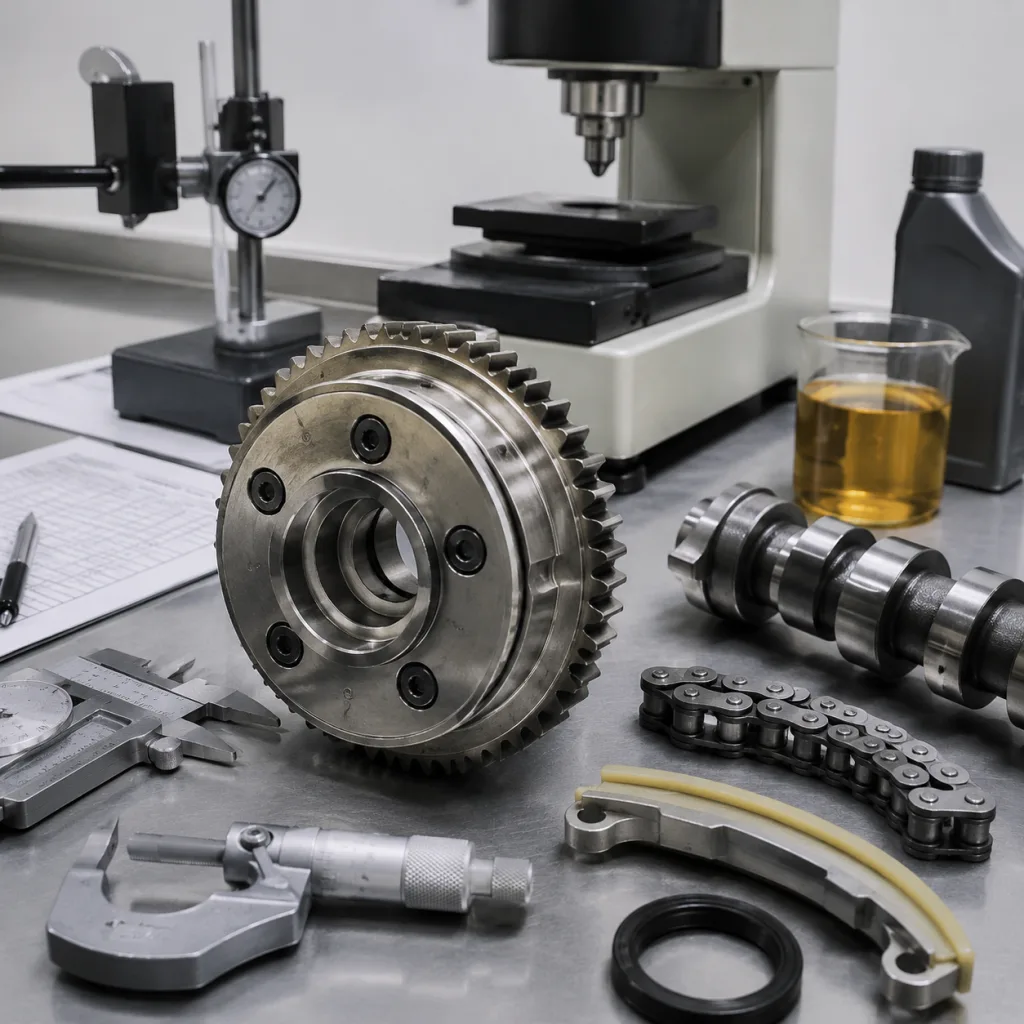
Which related parts should be replaced with the camshaft: followers, lifters, rockers, seals, phasers, cam bolts, timing components, or break-in lubricant?
What unit weight, carton size, pallet layout, maximum stack height, HS code assumption, and country-of-origin marking apply?
For buyers managing broad coverage, reviewing related engine components alongside camshafts can prevent mismatched kit sourcing. The supplier should identify which camshafts can be sold as standalone replacements and which applications are safer as a matched repair set. For a new camshaft for Dodge Challenger replacement program, approve samples first, then run a pilot lot of 20-100 pieces per part number before opening a multi-branch stocking order.
Failure Modes That Usually Trace Back to Geometry
Many camshaft disputes begin with a catalogue listing that looked correct. The part installed. The engine started. Then the fault appeared: noise, timing deviation, low oil pressure at the journal, follower wear, or a cam/crank correlation code.
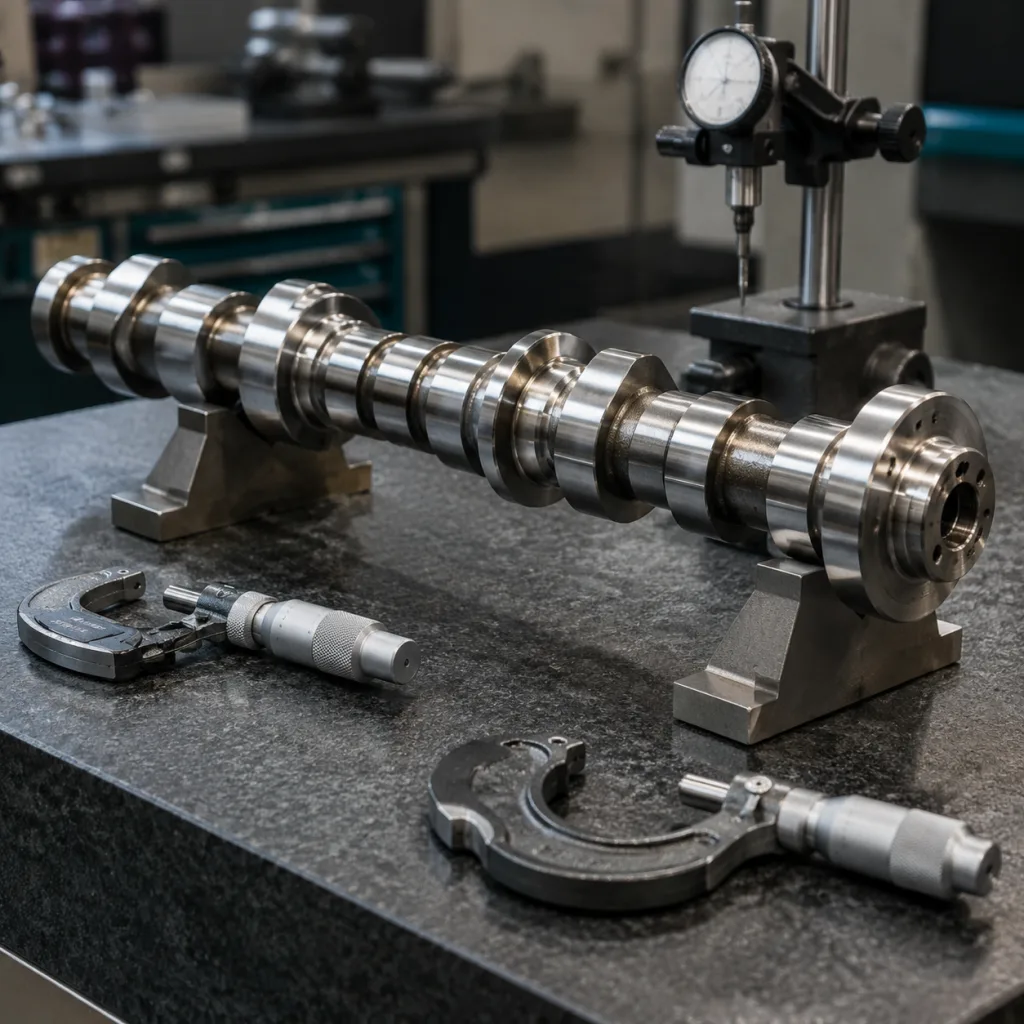
Those failures often trace back to geometry. A sourcing file should therefore include a drawing-controlled inspection plan, not only an interchange number.
Feature to verify
What goes wrong when it drifts
Typical inspection method
Overall length and end face position
Axial location shifts; assembly fit or end play becomes unstable. A common control window is often within +/-0.10 mm unless the drawing requires tighter.
Caliper, height gauge, CMM
Journal diameter and roundness
Oil film, bearing clearance, and oil pressure move out of range. Many programs control diameter in the 0.01-0.03 mm range and roundness below 0.005-0.010 mm.
Micrometer, roundness tester
Thrust face width and finish
End play and axial wear increase. Finish targets are commonly Ra 0.4-0.8 micrometre depending on design.
Micrometer, surface tester, CMM
Lobe lift and base circle
Valve lift, idle quality, and combustion behaviour change. Lift variation is normally controlled within about +/-0.03 mm or agreed drawing tolerance.
Cam profile measuring system
Lobe centre angle and phase
Valve timing shifts; drivability and emissions-related operation may be affected. Phase error should be treated as critical.
Cam profile analysis, CMM fixture
Surface hardness and case depth
Lobe or follower contact surfaces wear early. Typical hardened steel targets may be 50-60 HRC or an agreed equivalent by material route.
Rockwell test, microhardness section
Runout and straightness
Vibration, seal wear, and timing variation increase. Precision programs often specify maximum TIR of 0.03-0.05 mm.
Dial indicator or shaft measuring bench
Oil holes or lubrication passages
Blocked or restricted oiling can cause rapid journal and contact-surface failure.
Visual inspection, pin gauge, air flow check
Sensor target geometry
Edge location or tooth shape errors can trigger cam/crank correlation faults.
CMM, optical inspection
</tr></thead><tbody> </tbody></table>For a camshaft for Dodge Challenger replacement order, ask the supplier to define nominal dimensions, tolerances, control limits, and release rules. “OE equivalent” is not a measurement plan. If exact OE drawings are not available, reverse engineering should use multiple verified references, ideally at least 3-5 new or low-mileage samples from the same application. A single used core with unknown wear history is not enough.
Retain the approved drawing, first article inspection report, gauge list, control plan, golden sample, and batch records for each camshaft family. Those documents make later claims easier to investigate and repeat orders easier to control.
Spec Deep-Dive: Material Route, Heat Treatment, and Finish
Material choice is an engineering decision. It should be matched to follower type, lubrication conditions, contact stress, rotational speed, service environment, and target cost.
Aftermarket camshaft routes may include chilled cast iron, ductile iron, forged steel, billet steel, or assembled shaft construction. None is automatically correct for every engine. The procurement specification should make the route visible and measurable.
Define the following before mass production:
Base material grade or agreed equivalent, with chemical composition limits and mill or foundry certificate
Casting, forging, billet, or assembled construction route, including whether lobes are integral or fitted
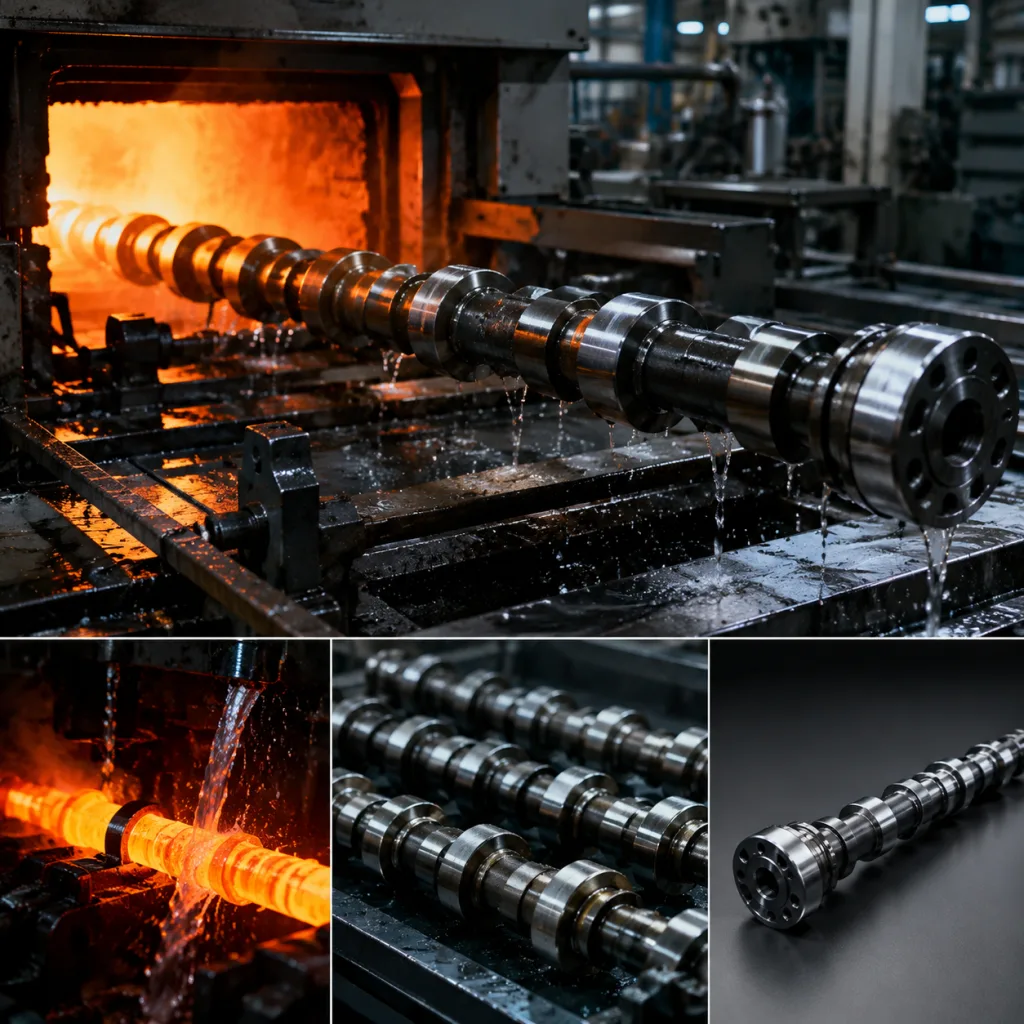
Heat treatment process, such as induction hardening, carburising, nitriding, or chilling where applicable
Lobe hardness range and case depth; for hardened steel routes, request effective case depth at a specified hardness threshold, not surface hardness only
Journal hardness and surface roughness requirements, commonly Ra 0.2-0.8 micrometre depending on the bearing system and drawing
Straightness and runout limits after heat treatment and final grinding, not only before heat treatment
Grinding burn prevention and inspection method, such as nital etch or process-controlled wheel dressing records where relevant
Cleaning standard for abrasive residue, chips, magnetised particles, and debris in oil passages
Anti-corrosion oil, VCI packaging, sealed bag, or export coating requirement with an agreed protection period, often 6-12 months for sea freight plus storage
Hardness alone does not prove durability. A lobe can pass a surface hardness check and still fail if case depth is shallow, microstructure is wrong, grinding burn is present, oil holes contain residue, or surface roughness sits outside the lubrication window. Journal finish matters too; poor roughness control can accelerate bearing wear or disturb oil film stability.
For approval, request metallographic checks on new part development and periodic batch testing during production. A practical plan may include hardness testing on every heat-treatment batch, case-depth testing on first article and scheduled batches, 100% runout checks before packing, and surface roughness sampling of 3-5 pieces per lot unless the application risk requires more.
Driventus manufactures engine and powertrain components under IATF 16949:2016 and ISO 9001:2015 quality management systems. Buyers can review our quality system for details on incoming material control, in-process inspection, calibration, nonconforming product handling, and traceability.
Validation Ladder: Sample, Pilot Lot, Stocking Order
Validation should scale with the business risk. A sample order does not need the same evidence package as a national distributor launch, but a stocking program should not rely on a sample-only check.
Use a staged validation ladder:
1. Sample approval: confirm dimensions, material route, cam profile, timing interface, sensor target, and packaging concept. 2. Pilot lot: run 20-100 pieces per part number through receiving inspection, controlled installation, warehouse handling, and early field feedback. 3. Stocking order: release repeat quantities only after batch traceability, inspection records, packaging performance, and claim procedures are agreed.
Typical validation evidence includes:
First article inspection report with actual measured values, not pass/fail only
Material certificate linked to lot number and heat number where available
Lobe and journal hardness results, plus case depth where applicable, with test method and location stated
Runout and straightness report before packaging, including maximum TIR and datum setup
Surface roughness report for journal, lobe, and thrust areas in Ra micrometres
Cam profile data for lift, base circle, opening and closing events, and phase relative to timing datum
Trial assembly confirmation with timing components, cam phaser interface, sensor features, and end-play check
Oil-hole and lubrication-passage verification by air flow, pin gauge, borescope, or equivalent evidence
Cleanliness check for machined passages and oil-contact surfaces after grinding and deburring
Corrosion or packaging check for long sea freight routes, such as 48-96 hours neutral salt spray on protected samples when agreed
Batch traceability code on the component, label, carton, or pallet, readable after normal handling
IATF 16949:2016 and ISO 9001:2015 support disciplined process control, but they do not replace part validation. Define revalidation triggers in writing: material change, tooling repair, heat-treatment recipe change, grinding wheel change, subcontractor change, or relocation of any critical process.
For high-volume programs, agree either AQL sampling or 100% checks for critical characteristics such as runout, oil-hole openness, sensor target damage, visible cracks, and heavy burrs. For markets with chemical substance rules, request supplier declarations aligned with REACH (EC) No 1907/2006 where required. Vehicle-level emissions regulations such as ECE R-83 should not be treated as standalone approval for an aftermarket camshaft.
Scenario: The Import Order That Looks Cheap Until It Lands
A low unit price can become expensive when the operational details are undefined. The common scenario is familiar: the quote is accepted, the purchase order is placed, and only later do the parties argue about labels, cartons, rust prevention, catalogue data, MOQ, or claim handling.
Avoid that sequence. Importers and wholesalers should settle commercial and packaging controls before releasing the purchase order.
Key checks include:
MOQ by part number and mixed-container quantity; existing tooled items may be feasible from 50-200 pieces per part number, while new development may require 300-1,000 pieces or tooling contribution
Sample, pilot, and repeat-order lead times; common planning ranges are 20-45 days for samples, 45-75 days for first production after approval, and 30-60 days for repeat lots depending on material and heat-treatment capacity
Incoterms, payment terms, tooling responsibility, and ownership of gauges, fixtures, and packaging artwork
Neutral packaging, customer brand packaging, or private-label artwork approval before mass packing
Barcode format, carton label data, batch traceability format, and country-of-origin marking
Rust-prevention period for sea freight and warehouse storage, linked to VCI, oil, bag sealing, and carton design
Spare parts catalogue data format for TecDoc-style or internal systems, including position wording and application notes
Product photos, drawings, and installation notes for sales teams, especially where intake/exhaust or left/right parts look similar
Claim handling process, including photo evidence, mileage and labour data, sample return rules, root cause analysis, and credit policy
Service-part continuity plan for repeat demand and discontinued applications, including last-buy notice if tooling is retired
Ask suppliers to quote at 50, 100, 300, and 1,000 pieces when demand is uncertain. Separate tooling, first article inspection, private-label packaging, and sea-worthy palletisation into visible line items. This prevents false comparisons between a simple trial order and a validated stocking program.
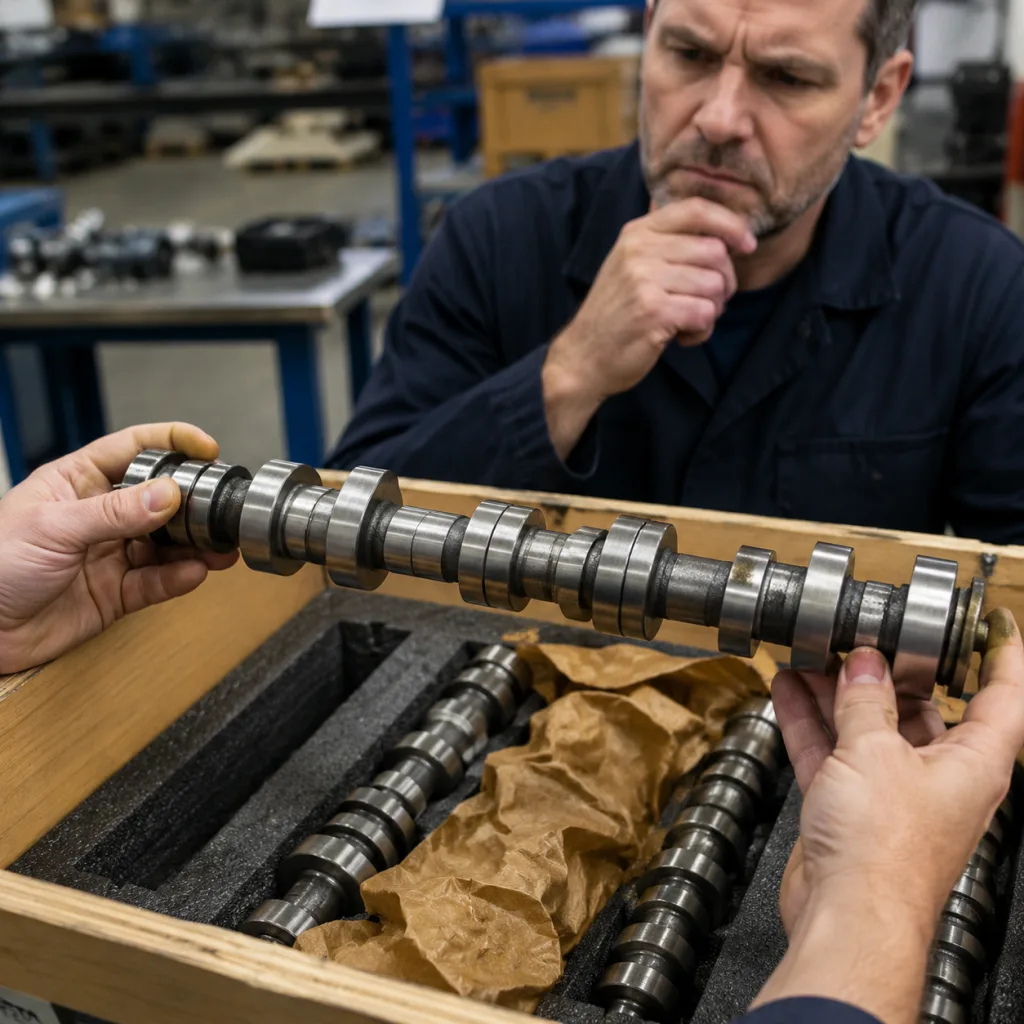
Packaging deserves special attention because camshafts are long precision parts. They must be protected from bending, edge impact, corrosion, and contamination. Individual sleeves, end caps, VCI paper, sealed bags, and strong inner cartons are preferred for export. Avoid heavy mixed cartons unless separators and weight limits are defined; many buyers cap inner cartons around 15-20 kg gross weight to reduce drop damage and warehouse claims.
A distributor shipping through multiple warehouses should request drop-test evidence or a written packaging specification with carton strength, gross weight limits, pallet layout, moisture protection, and photos of the packed unit, inner carton, master carton, and pallet.
You can review related engine items in our catalog or discuss custom manufacturing if the required camshaft is not already tooled.
Purchase-Order Q&A for Supplier Approval
Before approving a supplier, turn the supplier conversation into an audit-ready Q&A. The aim is to separate a controlled camshaft for Dodge Challenger replacement offer from a catalogue-only offer.
Ask these questions and keep the answers in the project file:
1. Which engine families, year ranges, and camshaft positions are covered by this part number, and which similar-looking applications are excluded? 2. What drawing, OE-style reference, or verified sample basis was used for development, and how many reference samples were measured? 3. What controlled dimensions and tolerances apply to journals, lobes, thrust faces, oil holes, dowels, keyways, threads, and sensor features? 4. What material and heat-treatment route is used, and what hardness, case depth, microstructure, and roughness targets apply? 5. Can you provide first article inspection, cam profile, hardness, case depth, surface roughness, runout, cleanliness, and oil-passage reports? 6. Which characteristics are checked 100%, which are sampled, and what AQL or control-limit rules are used for release? 7. How are production changes, tooling repairs, heat-treatment changes, grinding process changes, and subcontracted operations controlled? 8. How is batch traceability marked on the component, label, carton, pallet, and internal records, and how long are records retained? 9. What packaging method protects the camshaft during sea freight and warehouse storage, and what rust-prevention period is claimed? 10. What is the process for technical claims, photo evidence, mileage records, sample return, root cause analysis, corrective action, and credit? 11. Are chemical compliance declarations available for REACH (EC) No 1907/2006 where required? 12. Can pilot samples be supplied and approved before a stocking order, and what sample cost, MOQ, and lead time apply? 13. What repeat-order lead time and monthly capacity are available during seasonal demand peaks? 14. What are the price breaks at 50, 100, 300, and 1,000 pieces, and which inspection or packaging items are included in each quote?
A qualified supplier should answer with documents, photos, inspection records, and process descriptions. Catalogue screenshots are not enough. The best purchasing decision is based on total risk: dimensional conformity, validation evidence, repeatability, packaging reliability, lead time, communication quality, and field-response speed.
If a supplier cannot provide tolerances, material route, batch traceability, or packaging details before the purchase order, treat the offer as high risk even when the unit price is attractive.
Frequently asked questions
Confirm by engine family, model year, camshaft position, bank where applicable, valve train design, sensor target geometry, and timing interface. Do not rely only on model name. Request drawings, sample comparison data, and fitment tables before placing a stocking order.
At minimum, request first article inspection, material certificate, lobe and journal hardness results, case depth where applicable, runout measurement, surface roughness data, cam profile confirmation, and batch traceability. Larger programs should include trial assembly, durability, or packaging validation evidence.
No. Driventus is an independent aftermarket manufacturer; brand names are referenced for fitment only. We supply OE-equivalent replacement components based on dimensional matching, controlled manufacturing, and agreed validation requirements.
For camshaft drawings, sample validation, MOQ, and export packaging details, procurement teams can [request a quote](/contact.html). We will review the application data and respond with feasible sourcing options.